1937–1945: The Sino-Japanese War
The Battle of Xuzhou
- Dates:
- 23 December 1937 – 19 May 1938
- Front:
- Far East
- Location:
- The area around the Xuzhou railway junction where the provinces of Jiangsu, Shandong, Anhui and Henan meet, from Jinan and Linyi in the north to the Huai River in the south, along the Tianjin–Pukou and Longhai railwaysOn the battle map →
- Sides:
- Japan (North China Area Army and Central China Expeditionary Army)Hisaichi Terauchi, Shunroku HataChina (5th War Area of the National Revolutionary Army)Li Zongren, Bai Chongxi, Tang Enbo
- Result:
- Japanese victory. The Japanese took Xuzhou and linked their fronts in North and Central China, but failed to destroy the Chinese forces, which broke out westwards and later defended Wuhan. Along the way the Chinese won the Battle of Taierzhuang.
- Author:
- Łukasz
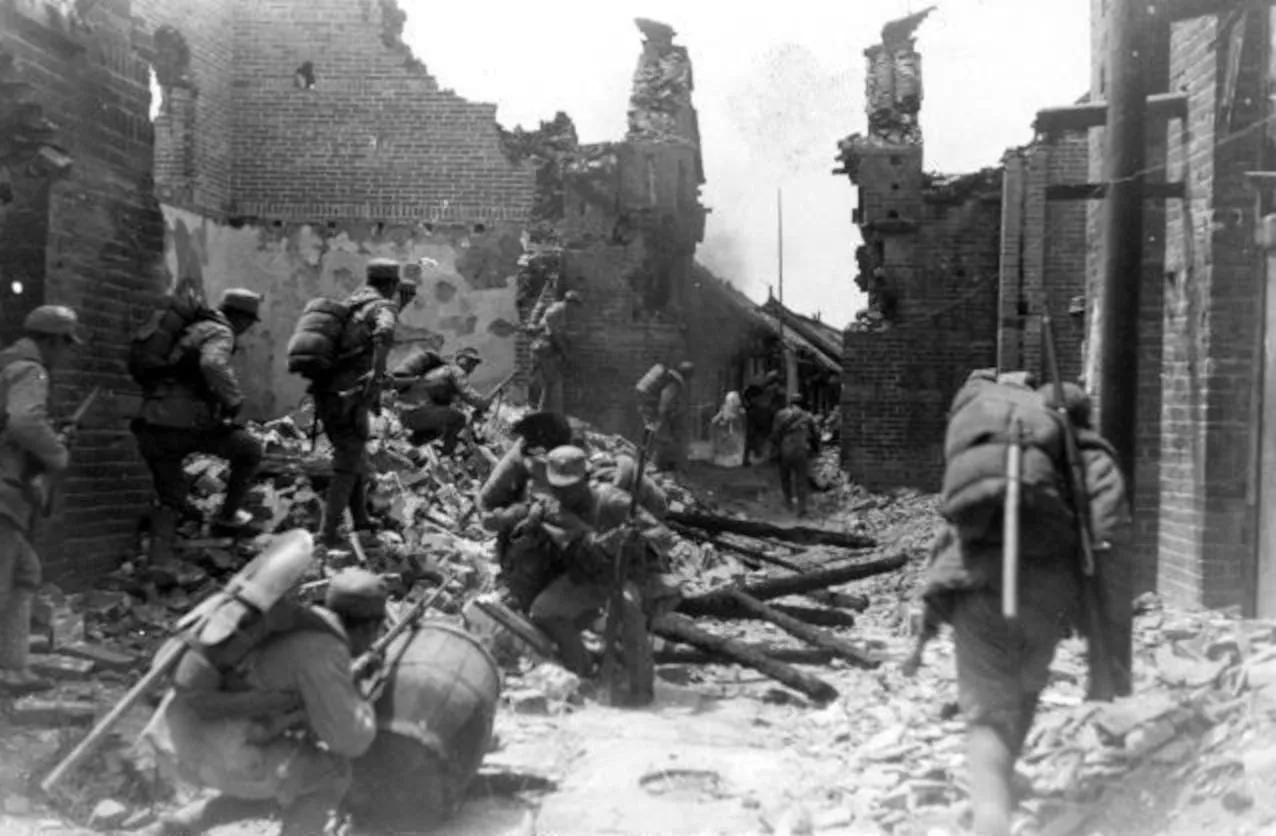
The Battle of Xuzhou was the largest campaign of the Sino-Japanese War in the first half of 1938. It was fought for almost five months across a vast, flat stretch of the North China Plain where the provinces of Jiangsu, Shandong, Anhui and Henan meet. The prize was Xuzhou, the city where the two most important railways of eastern China crossed: the north–south Tianjin–Pukou line and the east–west Longhai line. After the fall of Shanghai and Nanjing, the Japanese armies wanted to join up their conquests in the north and on the lower Yangtze here, and then advance on Wuhan, where the Chinese government had taken refuge. Under General Li Zongren, the Chinese concentrated several hundred thousand troops from almost every province of the country around Xuzhou. For three months they held the Japanese on the Huai River and at Linyi and Tengxian, and at the turn of March and April they inflicted on them at Taierzhuang their first serious defeat of the war. In May the Japanese, reinforced by further divisions, closed a great pincer around Xuzhou, but when they entered the city on 19 May they found it deserted: the main Chinese forces had broken out to the west.
Name and dates
In China the campaign is called the Battle of Xuzhou (literally the great battle, huizhan, of Xuzhou); in Japan, the Xuzhou Operation or Battle of Xuzhou (Jo-shū sakusen, Jo-shū kaisen). The two sides, however, understand the name differently. Chinese historiography dates the battle from the second half of December 1937, when, after the capture of Nanjing, Japanese forces moved simultaneously from the north, through Shandong, and from the south, from the Yangtze, along the Tianjin–Pukou railway, until 19 May 1938, when Xuzhou fell. For the Japanese, the Xuzhou Operation began only on 7 April 1938, when Imperial General Headquarters ordered the destruction of the Chinese forces around the city. Everything that happened before that they regarded as separate, local actions – conducted, moreover, against Tokyo’s wishes. Japanese studies end the operation only in June, counting the pursuit westwards and the fighting around Lanfeng as part of it. Some Western authors adopt yet another starting point: January or February 1938, when Japanese divisions from the Nanjing area set off towards the Huai River.
The battle is taken to have begun on 23 December 1937, the day the Japanese 10th Division crossed the Yellow River between Qingcheng and Jiyang in Shandong. That crossing opened the offensive along the northern section of the Tianjin–Pukou railway, which ran through Jinan and Tengxian straight to Xuzhou, and it is in practice from this point that Chinese studies count the battle. It is taken to have ended on 19 May 1938, the day the Japanese entered Xuzhou. Some war chronologies give 1 May as the date of Xuzhou’s fall. This is a mistake: at the beginning of May the decisive Japanese offensive was only just starting, and all Japanese, Chinese and Western sources agree on 19 May. The Chinese withdrawal was completed around 21 May.
Background
The war after Nanjing. The war that began with the Marco Polo Bridge incident in July 1937 brought Japan a string of victories by the end of the year. In the north its troops occupied Beijing, Tianjin and most of the provinces of Hebei, Chahar and Shanxi. In the south, after three months of bloody fighting in the Battle of Shanghai, the Japanese broke the Chinese front, and in December, in the Battle of Nanjing, they captured the capital of the Republic of China. Once in the city, the soldiers of General Iwane Matsui perpetrated the Nanjing massacre. Chiang Kai-shek’s government moved inland, and Wuhan on the middle Yangtze became its de facto seat. Many in Tokyo believed that China would now sue for peace. Mediation by the German ambassador Oskar Trautmann came to nothing, however, because the Japanese terms of December 1937 amounted to a Chinese capitulation, and on 16 January 1938 Prime Minister Fumimaro Konoe announced that his government would “not deal with” Chiang Kai-shek’s National Government. The road to negotiations was closed. In February both states recalled their ambassadors.
The importance of Xuzhou. Japan’s conquests formed two separate areas: a northern one, around Beijing and Tianjin, and a southern one, around Shanghai and Nanjing. Between them lay several hundred kilometres of territory still in Chinese hands, crossed by the Tianjin–Pukou railway, which linked Tianjin with Pukou on the bank of the Yangtze opposite Nanjing. Its midpoint was Xuzhou, where it was crossed by the Longhai railway, running from the port of Lianyungang on the coast through Kaifeng and Zhengzhou into the interior. At Zhengzhou it met the railway from Beijing to Hankou, that is, to Wuhan. Whoever held Xuzhou could move troops from north to south and from east to west. For China, in turn, the city was the gateway to Central China and to Wuhan, and holding it bought time to evacuate factories, universities and government offices to the west.
Japanese hesitation. At the beginning of 1938 the General Staff in Tokyo did not want any new large-scale operations. The army had sent more than a dozen divisions to China, which weakened it against the USSR, and its commanders feared that the war would spread across the whole country. In mid-February 1938, at a conference held in the presence of Emperor Hirohito, it was decided that there would be no new offensives until the summer and that the army would concentrate on holding the territory it had occupied. The commanders in China, above all the commander of the North China Area Army, General Hisaichi Terauchi, thought otherwise. Terauchi told an envoy of the General Staff that “Xuzhou must be taken”. The head of the General Staff’s operations section, Colonel Torashirō Kawabe, who had toured the headquarters in China to persuade them to halt operations, was removed from his post on 1 March, after his return. His successor, Masazumi Inada, approved ever more far-reaching “local” operations. The same mechanism – the army in the field running ahead of Tokyo’s decisions, and Tokyo then approving the fait accompli – had already been seen during the invasion of Manchuria.
The Chinese side. The area between the Yellow River and the Yangtze came under the 5th War Area, whose command Chiang Kai-shek had given in the autumn of 1937 to Li Zongren, leader of the Guangxi clique. Only a few years earlier Li had been fighting Chiang, but the war with Japan united the former adversaries. In January 1938 Chiang sent him, as his assistant, his old Guangxi comrade, the Deputy Chief of the General Staff Bai Chongxi, one of China’s ablest strategists. At a conference in Wuchang at the end of January, the defence of Xuzhou was declared the most important task of the war. Provincial armies from almost the whole of China were gathered under Li’s command: troops from Guangxi, former units of Feng Yuxiang’s Northwestern Army, detachments of the Northeastern Army – the army of Zhang Xueliang, driven out of Manchuria years before – poorly armed Sichuanese and, later, troops from Yunnan as well. By March Chiang had added some of his best divisions, trained by German advisers, above all General Tang Enbo’s 20th Corps. The Chinese forces, numbering a few tens of thousands at first, grew to 64 divisions – between 400,000 and 600,000 men, according to various estimates. They outnumbered the Japanese several times over, but they had little artillery and almost no tanks or aircraft, and their commanders, accustomed to fighting one another, did not always trust each other. Over the various phases of the campaign the Japanese committed around eight divisions and several brigades – some 240,000 men in all, according to Chinese and German studies – with strong artillery, tanks and air power.
Course of the battle
Shandong without a fight (December 1937 – January 1938)
In the north the Japanese had stood since the autumn of 1937 on the Yellow River, which then divided Shandong province in two. The province was ruled by General Han Fuju, a former subordinate of Feng Yuxiang who for years had cared mainly about preserving his own army and power, and who was at the same time deputy commander of the 5th War Area. On 18 December 1937, as the Nanjing operation was drawing to a close, Imperial General Headquarters allowed Terauchi to cross the river. On 23 December General Rensuke Isogai’s 10th Division, part of General Toshizō Nishio’s 2nd Army, crossed the Yellow River and advanced on the provincial capital, Jinan. Han Fuju, against the orders of Li Zongren and Chiang Kai-shek, put up no resistance. On 27 December the Japanese entered Jinan without a fight, at the end of the month they took Tai’an, and over the following weeks they pushed south along the railway towards Jining. Han withdrew into the interior of the province, and when ordered to defend Tai’an he is said to have replied: “If Nanjing was not held, why hold Tai’an?” On 10 January 1938 the Japanese navy took Qingdao, Shandong’s largest port, without a fight.
Chiang Kai-shek decided to make an example. On 11 January Han Fuju was arrested at a commanders’ conference in Henan, taken to Hankou and, on 24 January, shot in Wuchang after a court martial sentenced him for unauthorised retreat. It was the most notorious case in the war of so senior a commander being executed for fleeing the enemy. His execution shook other provincial commanders, and in the months that followed many of them fought with a determination they had previously lacked.
On the Huai River (January – March 1938)
In the south, General Rippei Ogisu’s Japanese 13th Division, which had crossed to the northern bank of the Yangtze after the capture of Nanjing, advanced in December and January along the Tianjin–Pukou railway towards the Huai River. On 26 January it attacked Fengyang and Bengbu, which fell at the beginning of February. On 9 and 10 February the Japanese forced the Huai. On the northern bank they were stopped by General Yu Xuezhong’s 51st Army, made up of soldiers of the former Northeastern Army. The fighting for the bridgeheads lasted more than a week; positions changed hands repeatedly, and there was bayonet fighting too. General Zhang Zizhong’s 59th Army came to the rescue, and from the south troops from Guangxi struck the Japanese flank at Dingyuan. Ogisu had to send part of his forces back to the southern bank, and by the beginning of March the Chinese had regained their positions north of the river. The front on the Huai froze for two months. The southern arm of the Japanese pincer had been stopped before it could get anywhere near Xuzhou.
Linyi and Tengxian (February – March 1938)
In February and March the weight of the fighting shifted north, to southern Shandong. The 2nd Army, overstepping the limits set for it by the General Staff, sent two divisions there. In the east, from the direction of Qingdao, a group from the 5th Division of General Seishirō Itagaki – the same man who in 1931 had engineered the Mukden incident – was advancing. Its objective was Linyi, an important town on the north-eastern approach to Xuzhou. It was defended by General Pang Bingxun with a weak, under-strength corps. At the beginning of March the Japanese reached the town walls. Zhang Zizhong’s 59th Army, brought up from the Huai, was sent to relieve it. Zhang and Pang had been enemies in the days of the civil wars, yet on 14–18 March their joint attack threw the Japanese back from Linyi. Despite reinforcements, Itagaki was unable to take the town for more than another month and could not support the neighbouring division – which was to prove decisive for the fighting at Taierzhuang.
In the west, along the railway, Isogai’s 10th Division made faster progress. At Tengxian, about 75 kilometres north of Xuzhou, its way was barred by units of the 22nd Army Group from Sichuan: poorly armed soldiers whom other commanders had refused to accept and to whom Li Zongren had assigned a sector of the front. From 14 March the Japanese attacked the town with heavy artillery and aircraft. On 17 March the commander of the 122nd Division, General Wang Mingzhang, was killed defending Tengxian, and the next day the town fell. The Sichuanese had nevertheless held up the Japanese for several days, which Li Zongren used to organise a defence along the Grand Canal. The advanced group of the 10th Division under Major General Hajime Seya took Zaozhuang and Lincheng and moved on Taierzhuang, intending to cross the Grand Canal and open the way to Xuzhou.
Taierzhuang (23 March – 7 April 1938)
Taierzhuang, a walled market town on the Grand Canal about 30 kilometres north-east of Xuzhou, became the scene of the campaign’s most famous battle. Li Zongren decided to halt the Japanese there and close in on them from the rear. The town was defended by General Sun Lianzhong’s 2nd Army Group, made up of former soldiers of Feng Yuxiang, with General Chi Fengcheng’s 31st Division in Taierzhuang itself. Tang Enbo’s 20th Corps, with artillery that included German 150 mm howitzers, was to let the Japanese pass southwards and then strike their flank and rear. The first clashes outside the town broke out on 23 March, and on 24 March the Japanese launched their first assault. Over the following days they breached the wall, and the fighting moved into the streets and houses, where the Japanese superiority in artillery and aircraft ceased to count. The fighting went on at night, with grenades and bayonets, for every house and every wall. Western observers compared it with what was to happen in the cities of Europe a few years later. At the end of March Chiang Kai-shek himself came to Xuzhou, and Bai Chongxi committed heavy artillery to speed up preparations for the counter-attack.
By the beginning of April the Japanese held most of the town, but the Chinese still held the south gate, through which ammunition and reinforcements reached them at night. Meanwhile Tang Enbo’s 20th Corps – which under Li’s orders should have struck earlier and, according to his memoirs, moved only under the threat of sharing Han Fuju’s fate – entered the battle from the north and east. The group under General Jun Sakamoto, which Itagaki had sent from Linyi to help Seya, was itself caught in a pincer. On 5 April Sakamoto received an order from Itagaki to return to Linyi – issued, according to some sources, in the belief that Taierzhuang had already fallen, and according to others as a result of confused communications. When Seya learned that his neighbour was withdrawing, he decided on his own initiative, against his divisional commander’s orders, to pull out of Taierzhuang. On the evening of 6 April the Japanese began to retreat, and on 7 April the Chinese took the whole town and its surroundings. The Japanese abandoned some of their equipment, and Seya was later transferred to the reserve.
Chinese propaganda presented the battle as the destruction of two of Japan’s best divisions and spoke of more than 20,000 enemy dead. These figures were inflated, as even the government’s propaganda chief at the time, the writer Guo Moruo, admitted years later. According to Japanese returns, the 5th and 10th Divisions lost about 2,400 killed and 9,600 wounded in the fighting in southern Shandong, including Linyi and Taierzhuang. Chinese losses were at least comparable, and Chi Fengcheng’s 31st Division lost most of its men. Even so, it was the first victory of the war after which the Japanese army had been forced to quit the field. The news set off an outburst of joy in Wuhan and throughout China, and Taierzhuang was written about in the press all over the world. Chiang Kai-shek’s German adviser, General Alexander von Falkenhausen, on the other hand, was furious that Li Zongren had not thrown Tang Enbo’s almost untouched units into a pursuit and had let the Japanese get away.
The great pincer (April – May 1938)
The defeat at Taierzhuang settled the argument in Tokyo. It had become clear that the main Chinese forces were concentrated around Xuzhou, and in the General Staff those who wanted to encircle and destroy them in a single blow won the day. On 7 April, the day the Japanese withdrew from Taierzhuang, Imperial General Headquarters ordered Terauchi’s North China Area Army and the Central China Expeditionary Army of General Shunroku Hata – formed in February in place of Matsui’s army – to destroy the enemy in the Xuzhou area. The policy of not widening the war, adopted in February, had lasted less than two months. The head of the General Staff’s operations bureau, General Gun Hashimoto, came to Jinan to coordinate the operations of the two armies. Reinforcements were brought in from Japan and Manchuria, including the 14th, 16th and 114th Divisions and brigades of the Kwantung Army.
The Chinese, intoxicated by victory, brought ever more armies up to Xuzhou and tried to go over to the offensive, but without heavy weapons they could not dislodge the Japanese from their fortified positions. From 18 April the 5th and 10th Divisions attacked again to the east and north-east of Xuzhou. Around 20 April the Japanese finally took Linyi. At Pizhou and on Mount Yuwang the fighting went on until mid-May; the 60th Army from Yunnan held its positions for almost a month and lost more than half its men. On this axis the Japanese tied down Chinese forces while the main blow was to fall from other directions.
The plan was for the 16th Division to advance from the north-west, from the Jining area west of Lake Weishan, and for the 9th and 13th Divisions, followed by the 3rd Division, to advance from the south, from the Huai, with the pincers closing on the Longhai railway west of Xuzhou and cutting the Chinese line of retreat into the interior. Further west still, General Kenji Doihara’s 14th Division was to cross the Yellow River and cut the Longhai railway at Lanfeng. On 5 May Hata gave the order to attack in the south, and on 7 May the commander of the 2nd Army, Prince Naruhiko Higashikuni, a member of the imperial family, did the same in the north. Hata’s divisions advanced faster than planned. On 9 May they took Mengcheng, and on 14 May other units captured Hefei. A motorised detachment under Colonel Iwanaka, with a tank battalion, was formed from the 13th Division; it took Yongcheng on 12 May and on 14 May blew up a bridge on the Longhai railway west of Xuzhou. The next day an armoured detachment of the 16th Division did the same. At the same time, on 12–14 May, Doihara’s 14th Division crossed the Yellow River and advanced on Heze and Lanfeng.
The breakout (15–21 May 1938)
Li Zongren realised that the Japanese pincers were about to close and that most of his troops would be trapped. Chiang Kai-shek, who as late as April had hoped for a decisive battle, agreed to a withdrawal. On 15 May the Chinese command decided to abandon Xuzhou, and on 16 May Li issued his orders. He divided the armies of the 5th War Area into five groups, assigned each a direction and an assembly area, and left Zhang Zizhong’s 59th Army to cover the city. The main forces did not head straight west, where the Japanese were waiting for them, but first south and south-east, and then, broken up into smaller groups, slipped between the Japanese columns to the south-west, towards the Dabie Mountains on the borders of Henan, Anhui and Hubei. The soldiers marched by night and hid by day in fields of ripening wheat. On 18 May a sandstorm and fog hampered Japanese aerial observation. Bai Chongxi and Tang Enbo led some of the troops, and Li Zongren’s headquarters left Xuzhou at the last moment. The rearguards fought hard battles: at Xiaoxian the Chinese 139th Division was almost wiped out.
The 13th Division, which pushed ahead faster than the others, took Bawangshan hill west of the city on 17 May, and on 19 May soldiers of its 65th Infantry Regiment and tanks of the Iwanaka detachment entered the deserted, bomb-shattered city of Xuzhou. The same day Imperial General Headquarters in Tokyo announced its capture. On 20 May the Japanese navy took Lianyungang at the eastern end of the Longhai railway, and on 25 May Terauchi and Hata made a ceremonial entry into Xuzhou. The ring, however, had turned out to be empty. According to various estimates, between 200,000 and 300,000 Chinese soldiers from some forty divisions escaped the encirclement. Western historians regard this withdrawal as one of the most skilful manoeuvres of the Chinese army in the entire war. The Japanese blamed the failure on the 13th Division, whose overly rapid advance was said to have upset the encirclement plan, but more important was the fact that forces several times smaller could not seal off a vast, flat area criss-crossed by canals and lakes.
Losses
Losses for the campaign as a whole are hard to establish, because the two sides counted them over different periods and defined the battle itself differently. Official Japanese returns state that from February to May 1938, 2,130 soldiers were killed and 8,586 wounded in the operations around Xuzhou. Other Japanese documents suggest that these figures are too low: the 2nd Army alone lost 5,082 killed and 16,877 wounded between the crossing of the Yellow River in December 1937 and July 1938; at the end of June 7,452 dead of that army were commemorated in Xuzhou; and the North China Area Army lost around 35,000 killed and wounded from February to May. On top of that came the losses of Hata’s divisions in the south. In all, then, the Japanese lost several tens of thousands killed and wounded in the campaign. Chinese losses were much heavier, but reliable figures are lacking. The Japanese estimated that they had destroyed about a tenth of the Chinese forces, that is, several tens of thousands of soldiers, and some studies speak of around 100,000 killed and wounded.
The civilian population suffered heavily. Xuzhou had been bombed since August 1937, and a single air raid on 14 May 1938 reportedly killed around 700 people. Canadian Jesuits who stayed in the city wrote that more than a third of the houses lay in ruins and that most of the inhabitants had fled. Missionaries reported killings of civilians by Japanese soldiers in the villages around the city. Taierzhuang and Tengxian were almost completely destroyed, and hundreds of thousands of refugees passed through the region.
Significance
The Japanese achieved their territorial objective. They linked their conquests in North China and on the lower Yangtze, took over the whole of the Tianjin–Pukou railway and the eastern section of the Longhai line, and from Xuzhou the road west lay open to them, towards Zhengzhou and on to Wuhan. They did not, however, achieve the aim for which they had launched the great operation in April: the Chinese army had not been destroyed. According to some studies, the troops that escaped the encirclement made up, a few months later, around half of the forces defending Wuhan. Instead of a decisive victory, Japan gained another city, a longer front line and still larger areas to occupy.
For China the campaign had a twofold significance. The victory at Taierzhuang, though exaggerated, was the first proof that an army made up of troops from many provinces – until recently at odds with one another and with Chiang Kai-shek – could defeat the Japanese. It strengthened the spirit of resistance and faith in a strategy of protracted war, in which China was to “trade space for time”. At the same time, euphoria over the success led the Chinese command to bring too many troops to Xuzhou, and they very nearly found themselves trapped.
The direct consequence of the fall of Xuzhou was one of the most tragic decisions of the war. When at the end of May the Japanese moved west along the Longhai railway, a Chinese attempt to destroy Doihara’s division at Lanfeng failed, and at the beginning of June Kaifeng fell. To stop the enemy before Zhengzhou, Chiang Kai-shek agreed to breach the dykes of the Yellow River. On 9 June Chinese soldiers cut through the dyke at Huayuankou. The flood inundated huge areas of Henan, Anhui and Jiangsu and halted the Japanese on that axis, but according to various estimates it killed between some 400,000 and nearly 900,000 people, and several million lost their homes. The Japanese had to take the longer route to Wuhan, along the Yangtze. The Battle of Wuhan lasted until October 1938 and ended with the capture of the city, but the Chinese government moved to Chongqing, beyond the reach of the Japanese armies.
The Xuzhou campaign revealed the mechanism that was to decide the further course of the war in Asia. Japan won battles and took cities, but could neither destroy the Chinese army nor force China to capitulate. The war that Tokyo had hoped to end with a single great encirclement turned into a stalemate lasting many years, in which more than a million Japanese soldiers were tied down in China. In search of raw materials and a way of cutting China off from outside help, Japan turned towards Indochina and the European colonies in South-East Asia – a course that in December 1941 led it into war with the United States and Britain and merged the war in China with the Second World War.