1945: From the Vistula to the Oder
East Prussian offensive
- Dates:
- 13 January – 25 April 1945
- Front:
- Eastern Front
- Location:
- East Prussia (Gumbinnen, Insterburg, Tilsit, Olsztyn, Elbląg, Königsberg, the shore of the Vistula Lagoon, the Samland Peninsula with Pillau) and northern Masovia between the Narew and the Prussian borderOn the battle map →
- Sides:
- Soviet UnionIvan Chernyakhovsky, Aleksandr Vasilevsky, Konstantin Rokossovsky, Ivan BagramyanNazi GermanyGeorg-Hans Reinhardt, Lothar Rendulic, Friedrich Hossbach, Otto Lasch
- Result:
- A Soviet victory. The Red Army cut East Prussia off from the Reich, destroyed the encircled German groupings on the Vistula Lagoon, in Königsberg and on the Samland Peninsula, and took Pillau; the remnants of the German forces held out on the Vistula Spit until the surrender of 9 May 1945. According to Russian figures, Red Army losses amounted to some 126,500 killed and missing and more than 458,000 wounded and sick.
- Author:
- Natalia
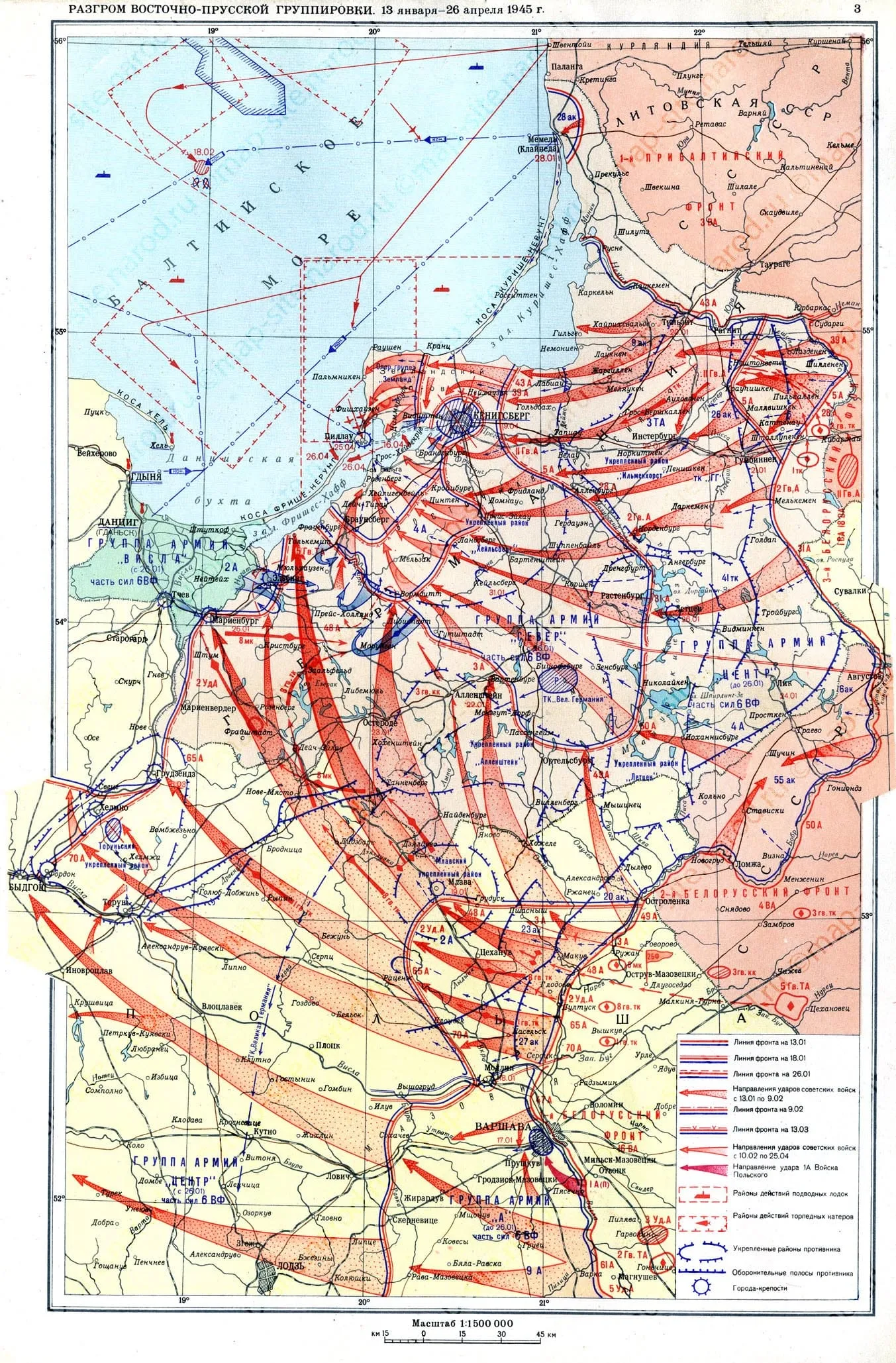
The East Prussian offensive was the winter and spring offensive of the Red Army against the German forces defending East Prussia – the easternmost province of the Reich, the cradle of the Prussian state and the land that German national memory associated with Tannenberg in 1914. It began on 13 January 1945 with an attack by the 3rd Belorussian Front under General of the Army Ivan Chernyakhovsky towards Gumbinnen and Insterburg; a day later Marshal Konstantin Rokossovsky’s 2nd Belorussian Front moved out of its bridgeheads on the Narew. Within two weeks East Prussia had been cut off from the rest of Germany, and over the following months the Red Army destroyed, one after another, the groupings trapped there – on the Vistula Lagoon, in Königsberg and on the Samland Peninsula. The operation ended on 25 April with the capture of the port of Pillau.
It was one of the bloodiest operations of the last year of the war – for both armies and for the civilian population. Hundreds of thousands of the province’s inhabitants, whom the Party authorities forbade to evacuate until the very last moment, fled in bitter cold across the frozen lagoon and by sea; thousands died on the way, and those overtaken by the front fell victim to violence by Soviet soldiers. After the war East Prussia ceased to exist: its northern part with Königsberg was incorporated into the USSR, its southern part into Poland.
Name and dates
In Soviet and Russian historiography the operation is called the East Prussian Strategic Offensive Operation and dated 13 January – 25 April 1945; within these limits fall a number of front operations: the Insterburg–Königsberg operation, the Mława–Elbing operation, the destruction of the grouping on the Vistula Lagoon (known, after the town of Heiligenbeil, today Mamonovo, as the Heiligenbeil pocket, and in Polish literature also as the Braniewo pocket), the storming of Königsberg and the Samland operation. In some Polish studies the name “East Prussian operation” (or “Masovian–Masurian operation”) covers only the fighting of January and February, which ended when the offensive was halted at the end of February, and the later battles are treated separately. German historians speak of the second East Prussian offensive – the first being the failed Gumbinnen–Goldap operation of October 1944.
The operation can be dated by the Russian convention: from the first day of the 3rd Belorussian Front’s attack to the fall of Pillau. The fighting on the Vistula Spit, where the remnants of the German forces held out until the general German surrender of 8–9 May 1945, was merely its epilogue.
Background
In the summer of 1944 Operation Bagration smashed Army Group Centre and brought the Red Army to the Vistula, the Narew and the border of East Prussia. In mid-August the first Soviet divisions reached the Šešupė, on the frontier of the Reich. In the autumn, during the Baltic offensive, the 1st Baltic Front cut off Army Group North in Courland and laid siege to Klaipėda (Memel), and on 16 October the 3rd Belorussian Front struck the province itself for the first time. The attack on Gumbinnen and Goldap stalled after two weeks on the fortifications and under German counter-attacks, at a cost of nearly 80,000 Soviet soldiers (killed, wounded and missing). Joseph Goebbels’s propaganda turned the events at Nemmersdorf into a symbol of the fate awaiting the Germans if they were defeated; in the same days Heinrich Himmler announced at Bartoszyce (Bartenstein) the creation of the Volkssturm.
From November the front in East Prussia stood still. Adolf Hitler, who for more than three years had directed the war from his headquarters near Kętrzyn (Rastenburg), left the Wolf’s Lair on 20 November and never returned. Meanwhile the province was being prepared for defence: tens of thousands of civilians, forced labourers and Volkssturm men dug anti-tank ditches and firing positions; the pre-war fortifications by the Great Masurian Lakes, with the fortress of Giżycko (Lötzen), and the Heilsberg fortified area (Heilsberger Dreieck) were expanded; and Königsberg, Pillau, Giżycko, Toruń, Grudziądz and Modlin were declared fortresses (Festungen), which were to hold out even when surrounded. The Gauleiter and Oberpräsident of East Prussia, Erich Koch, treated preparations to evacuate the population as defeatism; evacuation plans existed, but permission to carry them out was refused almost until the last moment.
Strategically, East Prussia threatened the right flank of the main Soviet thrust on Berlin. The Stavka of the Supreme High Command therefore decided, as part of the January offensive, to cut off and destroy the German forces in the province at the same time – the day after the 1st Ukrainian Front opened the Vistula–Oder offensive from the Baranów–Sandomierz bridgehead.
Forces and plans
On the Soviet side the operation involved Chernyakhovsky’s 3rd Belorussian Front, Rokossovsky’s 2nd Belorussian Front and, on the northern flank, the 43rd Army of the 1st Baltic Front under General of the Army Ivan Bagramyan, supported by the Baltic Fleet. According to Russian tabulations they totalled some 1.67 million soldiers, more than 25,000 guns and mortars, about 3,900 tanks and self-propelled guns and nearly 3,100 combat aircraft. Polish studies point out that many infantry divisions, bled white in earlier fighting, were at only about 60 per cent of their establishment strength.
The plan provided for the 3rd Belorussian Front to strike from the area east and north-east of Gumbinnen along the line Gumbinnen–Insterburg–Königsberg, destroy the Tilsit–Insterburg grouping and reach the provincial capital. The 2nd Belorussian Front was to break through the defences from its bridgeheads on the Narew near Różan and Serock, advance on Mława and Lidzbark Welski and then to the lower Vistula towards Malbork (Marienburg), cutting East Prussia off from Pomerania. Supporting attacks were to be made along the Niemen towards Tilsit and from the Serock bridgehead towards Płońsk and Sierpc.
The defence was conducted by Army Group Centre under Colonel General Georg-Hans Reinhardt: General Erhard Raus’s 3rd Panzer Army in the north, on the Niemen and near Gumbinnen; General of Infantry Friedrich Hossbach’s Fourth Army in an arc running from the Goldap area along the Augustów Canal and the Biebrza; and General Walter Weiss’s Second Army on the Narew. According to Polish studies the German forces in East Prussia numbered about 600,000 soldiers, 750 tanks and assault guns, more than 8,000 guns and mortars and about 400 aircraft, plus numerous Volkssturm battalions. The reserve was the Panzer Corps Großdeutschland, which, however, Hitler ordered to be transferred south in the first days of the offensive, against the fronts advancing from the Vistula. Reinhardt and the Chief of the Army General Staff, Heinz Guderian, asked Hitler in vain to shorten the front by withdrawing the troops from the exposed salient along the Narew and the Masurian Lakes.
Course of the battle: the breakthrough (13–19 January)
On 13 January 1945, after an artillery preparation lasting several hours, the armies of the 3rd Belorussian Front went into the attack on the sector between Pillkallen and Stallupönen, north-east of Gumbinnen, in the direction of Insterburg. Fog and low cloud prevented the air forces from operating and reduced the effectiveness of the artillery, and according to German commanders some of the infantry had been pulled back from the front line ahead of the bombardment, so that much of the fire fell on empty trenches. On the first day the attack advanced a mere 2–3 kilometres; only in the sector of the 28th Army, directly east of Gumbinnen, was the first position broken to a depth of about 7 kilometres. From 14 January the 3rd Panzer Army counter-attacked, and the Soviet infantry suffered heavy losses in fighting for every village and every strongpoint.
On 14 January the 2nd Belorussian Front moved out of its bridgeheads near Różan and Serock. Here too the first day yielded a few kilometres at most. The turning point came with the improvement in the weather on 16 January, when the air forces could join the battle and Soviet troops took Pułtusk, Nasielsk and Maków Mazowiecki. On 17 January Rokossovsky committed General Vasily Volsky’s 5th Guards Tank Army to the breach; by the evening of 18 January the gap was, according to Russian figures, some 110 kilometres wide and 60 kilometres deep, and on 19 January Mława fell. The German Second Army was shattered and its remnants were pushed back north-west towards the Vistula.
In the north, Chernyakhovsky, seeing that his armies had stalled on the Gumbinnen–Insterburg axis, shifted the weight of the attack into the gap won north of Gumbinnen by the 39th Army and committed the 11th Guards Army to it from his second echelon. By 18–19 January the 3rd Belorussian Front had broken through the German defences to a depth of more than 40 kilometres and forced the Inster river. In a week of fighting Raus’s 3rd Panzer Army was largely destroyed, and its remnants began to fall back towards Königsberg.
Course of the battle: East Prussia cut off (20–31 January)
On 20 January the Stavka changed the direction of the 2nd Belorussian Front’s attack: instead of advancing on Malbork and the lower Vistula, Rokossovsky’s main forces were to wheel north towards Elbląg (Elbing) and the Vistula Lagoon, in order to cut the German Fourth Army’s line of retreat as quickly as possible. The turn took the German command by surprise. On 21 January Nidzica (Neidenburg) fell; on 22 January the 3rd Guards Cavalry Corps took Olsztyn (Allenstein), Iława (Deutsch Eylau) was captured the same day, and Ostróda (Osterode) on 23 January. According to Polish and German historians, Soviet soldiers in occupied Olsztyn killed civilians and prisoners, and in the following days set fire to much of the town centre – one of the first of many such cases in Warmia and Masuria. On 23 January a leading armoured detachment drove into Elbląg, where the trams were still running, but did not take the town; its garrison held out until 10 February. On 26 January tanks of the 5th Guards Tank Army reached the shore of the Vistula Lagoon near Tolkmicko (Tolkemit). East Prussia’s land link with the Reich had been severed.
In the north the 3rd Belorussian Front took Tilsit on 20 January, Gumbinnen on 21 January and Insterburg during the night of 21–22 January, and then broke through successive defensive lines on its way to Königsberg. On 22 January Hossbach’s Fourth Army – with Reinhardt’s consent but against Hitler’s wishes – began to withdraw from the Masurian Lakes, the Augustów Canal and the Biebrza. The fortress of Giżycko was abandoned almost without a fight, which provoked fury at Führer Headquarters. On 27–28 January units of the 1st Baltic Front took Klaipėda, whose defenders were evacuated to the Curonian Spit and Samland.
During the night of 26–27 January Hossbach, in agreement with Reinhardt, attacked from the area west of Lidzbark Warmiński (Heilsberg) towards Elbląg, in order to break through to the Second Army and lead the troops and crowds of refugees out of the encirclement. The Germans recaptured Orneta (Wormditt) and got close to Pasłęk (Preußisch Holland) and Młynary, but Soviet reinforcements halted the attack. Hitler dismissed both commanders: Reinhardt lost his post on 26 January and Hossbach on 29 January; the Fourth Army was taken over by General of Infantry Friedrich-Wilhelm Müller. Army Group Centre was renamed Army Group North (the former group of that name in Courland became Army Group Courland), and on 27 January Colonel General Lothar Rendulic became its commander. At the end of January troops of the 3rd Belorussian Front reached the Vistula Lagoon south-west of Königsberg and trapped the main forces of the Fourth Army – some 20 divisions, according to Polish studies – in a pocket between Braniewo (Braunsberg), Orneta, Dobre Miasto, Bartoszyce and Friedland. Königsberg, whose commandant from 28 January was General of Infantry Otto Lasch, was almost surrounded on the landward side.
The flight of the population and Operation Hannibal
At the beginning of 1945 East Prussia had – according to the West German Schieder Commission – some 2.4–2.6 million inhabitants, including evacuees from the bombed cities of western Germany. Some of the inhabitants of the border strip had already been moved out in the autumn of 1944, but Koch and the Party apparatus forbade flight from the remaining districts and punished preparations for it as defeatism. Evacuation was usually ordered only when the front was a few kilometres or a dozen or so kilometres away; in many places it was never ordered at all. When people finally set off – mostly women, children and the elderly, since the men had been drafted into the Wehrmacht and the Volkssturm – the roads filled with columns of horse-drawn carts, trudging on in frosts of fifteen degrees or so below zero, and at night of more than twenty. The columns became mixed up with retreating troops, were fired on and run over by tanks; many were overtaken by Soviet armoured units.
Once the land link with the Reich had been cut near Tolkmicko, the only way west led across the frozen Vistula Lagoon to the Vistula Spit, and from there to Gdańsk and Gdynia, or through the ports of Pillau and Königsberg. Hundreds of thousands of people crossed the ice of the lagoon in February 1945; the ice gave way under the weight of the carts and at holes left by bombs, and Soviet aircraft attacked the columns in the open. From the second half of January Grand Admiral Karl Dönitz, Commander-in-Chief of the Kriegsmarine, sent every available vessel – liners, merchant ships, warships and small craft – into the bay as part of Operation Hannibal. By May 1945, according to the most frequently cited estimates, they had carried some 800,000–900,000 civilians and around 350,000 soldiers from the ports of East Prussia, Gdańsk Pomerania and Courland.
The sea was not safe either. On 30 January 1945 the Soviet submarine S-13 under Captain 3rd Rank Alexander Marinesko torpedoed the Wilhelm Gustloff off the Pomeranian coast, level with Łeba; the ship had sailed from Gdynia carrying refugees, wounded and sailors of a submarine training division. Depending on the source, the death toll is estimated at between about 5,300 and more than 9,000 people – the greatest known loss of a single ship in maritime history. On 10 February the same submarine sank the General von Steuben, outbound from Pillau with several thousand wounded and refugees, and on 16 April another Soviet submarine sank the Goya off Hel, with an estimated 6,000–7,000 dead. Under the law of war, ships sailing in Kriegsmarine convoys and carrying soldiers as well were military targets; for the Germans their sinkings became one of the symbols of the tragedy of the flight from the east.
Those overtaken by the front experienced mass violence. Red Army soldiers, entering the territory of the Reich for the first time after years of German crimes in the USSR and spurred on by revenge propaganda (including the writings of Ilya Ehrenburg), committed – as German, Russian, Polish and Western historians agree – mass rape, killings of civilians, looting and arson. Soviet soldiers themselves left testimony: the officer Lev Kopelev was arrested and sentenced, among other things for opposing violence against the population in East Prussia, and Aleksandr Solzhenitsyn, then an artillery captain, described it in his poem Prussian Nights. Tens of thousands of civilians – Germans, but also indigenous Masurians and Warmians – were deported to forced labour in the USSR. On the other hand, forced labourers and prisoners of war from all over occupied Europe were liberated, many Poles among them, though their fate in the front zone was also often uncertain.
In the same weeks the Germans too committed crimes. SS men drove columns of prisoners, mainly Jewish women, from the evacuated subcamps of Stutthof concentration camp in East Prussia through Königsberg to the coast of Samland; during the night of 31 January – 1 February 1945, near Palmnicken (today Yantarny), they shot about 3,000 of them on the seashore. According to historians’ findings, only a dozen or so people survived the massacre.
Course of the battle: the pockets on the Vistula Lagoon (February – March)
From February the task of destroying the German forces in East Prussia fell almost entirely to the 3rd Belorussian Front: Rokossovsky’s main forces turned west for the fighting in Pomerania, and four of his armies were handed over to Chernyakhovsky. The Germans, supported by the guns of ships on the lagoon and at sea, held out in three groupings: in the pocket on the Vistula Lagoon south-west of Königsberg (the remnants of the Fourth Army, fifteen to twenty weakened divisions), in Königsberg itself, and on the Samland Peninsula, where General Hans Gollnick’s corps covered the port of Pillau. At the beginning of February Soviet troops took Sępopol, Bisztynek, Bartoszyce and Górowo Iławeckie, on 9 February Frombork, and on 10 February Preußisch Eylau; on the same day units of the 2nd Belorussian Front captured Elbląg after more than ten days of street fighting.
On 9 February a Soviet attack cut Königsberg off from Samland. On 19 February the Germans struck simultaneously from the city and from the west, from the peninsula, and after two days of fighting reopened a corridor to Pillau, through which tens of thousands of civilians were evacuated from the city. After the recapture of Metgethen, near Königsberg, the German authorities found there the bodies of murdered inhabitants and refugees; propaganda publicised the case as it had Nemmersdorf earlier, and the numbers of victims later given in the literature are uncertain.
On 18 February, near Mehlsack (today Pieniężno), Chernyakhovsky was mortally wounded by an artillery shell splinter; he died the same day. He was not yet forty and was one of the youngest front commanders in the Red Army. Command of the 3rd Belorussian Front was taken over by Marshal Aleksandr Vasilevsky, until then Chief of the General Staff, who as the Stavka’s representative had previously coordinated the operations of the fronts on the Baltic. On 24 February the 1st Baltic Front was disbanded; its troops formed the Samland Group (Zemland), commanded by Bagramyan, who from then on was also Vasilevsky’s deputy. On 26 February the exhausted Soviet troops halted their attack.
The offensive was resumed on 13 March. The day before, Rendulic had been transferred to Courland and Army Group North was taken over by General Walter Weiss. In the pocket on the lagoon, squeezed into a strip several dozen and then only a dozen or so kilometres wide around Braniewo and Heiligenbeil (today Mamonovo; Polish Święta Siekierka), some of the hardest fighting of the whole campaign took place. Braniewo fell on 20 March, Heiligenbeil on 25 March, and the last point of resistance – the Balga peninsula – on 29 March. Some of the soldiers and civilians managed to cross the lagoon to the Vistula Spit and to Pillau. According to Soviet figures the Germans lost about 93,000 killed and about 46,000 prisoners in the pocket; these numbers cannot be verified from German sources. The Warmian towns on the lagoon – Braniewo, Frombork, Heiligenbeil – were reduced to ruins.
Course of the battle: the storming of Königsberg and the fall of Pillau (April)
Königsberg, the provincial capital and the city where the first King in Prussia had been crowned, was in April 1945 a fortress with a ring of nineteenth-century forts, anti-tank obstacles and fortified tenement blocks. Its old town had already been destroyed by British bombers in August 1944. According to Soviet estimates, General Lasch’s garrison numbered about 130,000 men – remnants of shattered divisions, Volkssturm, police and sailors – but it had very few tanks, limited stocks of ammunition and practically no air support. According to various estimates, some 100,000 civilians remained in the city. On 2 April Army Group North was disbanded, and on 7 April the German forces on the Gulf of Danzig and in East Prussia were placed under a new command, Army East Prussia, formed from the headquarters of the 2nd Army under General Dietrich von Saucken.
After several days of artillery bombardment and air raids, in which long-range bombers also took part, four armies of the 3rd Belorussian Front launched the assault from the north and south on 6 April. Assault detachments took the forts and blocks of buildings one after another, while the Soviet air force, facing almost no German opposition in the air, bombed the city without pause. On 8 April the two pincers met west of the city, cutting it off from Samland; an attempt by the garrison to break out to the west and a relief attack from the peninsula both failed. On the evening of 9 April Lasch, judging further resistance pointless, signed the surrender. According to Soviet figures some 42,000 German soldiers were killed in the fighting for the city and more than 90,000 were taken prisoner. Many thousands of civilians died during the assault and in the following weeks, amid violence, hunger and epidemics. Hitler sentenced Lasch to death in absentia and had his family arrested; the general spent ten years in Soviet captivity.
On 13 April the troops of the 3rd Belorussian Front began the final phase – the Samland operation. Within a few days they pushed the remnants of the German forces back to the south-western tip of the Samland Peninsula; on 17 April they took Fischhausen, while the evacuation by sea of the people crowded into the port continued to the last. On 25 April, after heavy fighting, Pillau (today Baltiysk) fell. Around this time, at the end of April, Vasilevsky handed over command of the front to Bagramyan, while he himself prepared to take command in the coming war with Japan. The next day Soviet troops landed on the northern tip of the Vistula Spit, but the remnants of Army East Prussia held out on the spit and on the Hel peninsula until the general German surrender of 8–9 May 1945.
Losses
According to the Russian tabulation of losses edited by Grigori Krivosheev, the Red Army and the Baltic Fleet lost some 126,500 killed and missing and more than 458,000 wounded and sick in the operation between 13 January and 25 April 1945 – over 580,000 men in all, more than in the Vistula–Oder offensive. The heaviest losses were suffered by the 3rd Belorussian Front. German losses are not known precisely; Soviet figures speak of 25 divisions destroyed, another fifteen or so having lost 50–70 per cent of their strength, and more than 220,000 prisoners, but these numbers also include Volkssturm members and men of other formations and cannot be verified.
Civilian losses are the hardest to estimate. In the 1950s the Schieder Commission gave a figure of about 30,000 civilians killed directly in the fighting in East Prussia, while in 1958 the West German Federal Statistical Office put the civilian dead of the province at about 299,000, including the flight, the deportations and the later expulsions. Historians treat these tabulations with caution, since they rest largely on unresolved cases of missing persons. The victims of the war in East Prussia also include camp prisoners and forced labourers who died on death marches and in the front zone.
Significance
The East Prussian offensive destroyed the last great Wehrmacht grouping on the northern flank of the Eastern Front and secured the right flank of the advance on Berlin. It cost the Red Army more, however, than any other operation of the winter of 1945, and for many weeks tied down the forces of two fronts, and later of one. For the German command the stubborn defence of the fortresses and pockets had a further purpose: it covered the evacuation which, through the ports of Pillau, Gdańsk and Gdynia and across the ice of the Vistula Lagoon, saved hundreds of thousands of people from the front.
For East Prussia itself it was the final catastrophe. Of more than two million inhabitants, an estimated few hundred thousand remained in the province at the end of May 1945, and towns such as Königsberg, Braniewo and Heiligenbeil, as well as much of Olsztyn and Elbląg, lay in ruins. The Potsdam Conference in the summer of 1945 assigned the northern part of the province with Königsberg to the USSR (pending a future peace conference) and the southern part, with Warmia and Masuria, to Poland; the border between them was drawn by the Polish–Soviet agreement of 16 August 1945. The Klaipėda Region returned to the Lithuanian SSR. In 1946 Königsberg was renamed Kaliningrad, and by 1948 the Germans remaining there had been deported to Germany. In the Polish part, alongside the Poles who were settled there – including people resettled from the lost eastern territories – the Masurians and Warmians remained, many of whom left for Germany in the following decades. Erich Koch, who had fled East Prussia in the last weeks of the war, was handed over to Poland and in 1959 sentenced to death by a court in Warsaw; the sentence was never carried out, and he died in 1986, still a prisoner, in the prison at Barczewo. The memory of 1945 in East Prussia – of the flight, the Gustloff, Nemmersdorf and the violence against civilians – remains one of the most painful and contested subjects in German, Polish and Russian memory of the war.
Places·Masovia