United Kingdom
Richard O’Connor
Commander of the Western Desert Force and XIII Corps (1940–1941), commander of VIII Corps (1944), Adjutant-General to the Forces (1946–1947), general
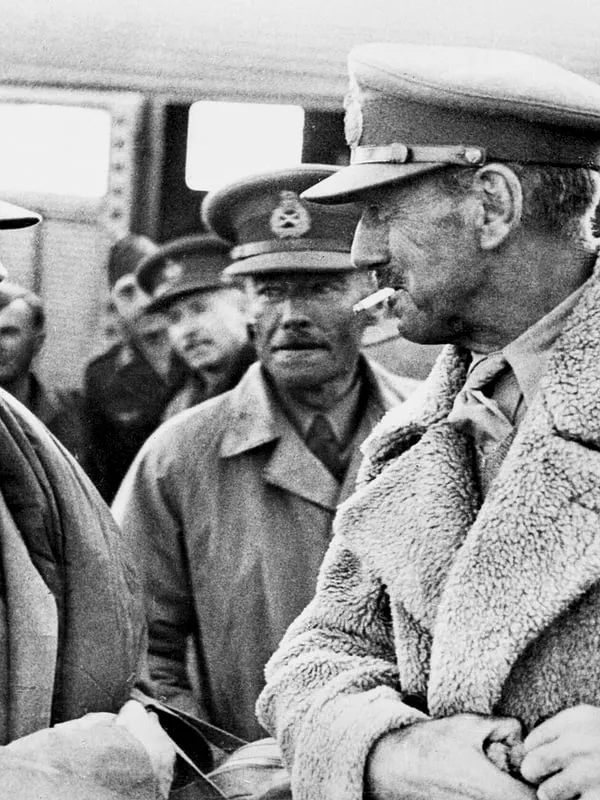
- Born:
- 21 August 1889, Srinagar (British India)
- Died:
- 17 June 1981, London
- Author:
- Łukasz
- Photo:
- Imperial War Museums, domena publiczna, Wikimedia Commons

Richard O’Connor commanded Britain’s first great land victory of the Second World War. In the winter of 1940–1941 his Western Desert Force, which began with some 31,000 men, advanced in two months from Egypt across the whole of Cyrenaica, destroyed the Italian Tenth Army and took around 130,000 prisoners. The defeat forced Hitler to send German troops to North Africa under Erwin Rommel. A few weeks after they arrived O’Connor was taken prisoner and vanished from the war for more than two and a half years. After a daring escape he went on to command a corps in Normandy, but he never regained the standing he had enjoyed in December 1940. A biographer called him “the forgotten victor”. He was a modest man who shunned publicity, and his subordinates remembered him as a calm, firm commander, always ready to listen to others.
Early life and the First World War
Richard Nugent O’Connor was born on 21 August 1889 in Srinagar, Kashmir, into the family of a British Army officer. His father, Major Maurice O’Connor, served in the Royal Irish Fusiliers, and his mother, Lilian, was the daughter of the governor of one of the Indian provinces. His father was killed in an accident when Richard was thirteen. The boy was educated at Wellington College and in 1908 entered the Royal Military College at Sandhurst. He did not distinguish himself at either school or college. In September 1909 he was commissioned as a second lieutenant into a Scottish regiment, the Cameronians (Scottish Rifles), with which he remained associated for the rest of his life. He served with its battalion in England and on Malta, where he was signals officer.
Throughout the First World War he fought with the 7th Infantry Division. At first he commanded its signals, for which he received the Military Cross in February 1915; then he was a brigade major and fought at Arras and Bullecourt. In June 1917, aged 27, he took command as a lieutenant colonel of the 2nd Battalion, Honourable Artillery Company, and was awarded the Distinguished Service Order. At the end of 1917 the division was transferred to Italy, to the front on the Piave. In the last days of October 1918, during the Battle of Vittorio Veneto, his battalion captured the island of Grave di Papadopoli in the Piave. For this O’Connor received a bar to his DSO and the Italian Silver Medal of Military Valour. He was mentioned in dispatches nine times.
Between the wars
After the war he passed through the Staff College at Camberley, and from 1921 to 1924 he was brigade major of the Experimental Brigade, in which, under the eye of Colonel J.F.C. Fuller, one of the fathers of the theory of armoured warfare, co-operation between tanks, aircraft, infantry and artillery was practised. He then taught at Sandhurst and Camberley, served with his battalion in Egypt and India, worked at the War Office and attended the Imperial Defence College. In 1936 he took command of a brigade at Peshawar on India’s North-West Frontier. He said later that it was there that he learned the mobility he would put to use in the Libyan desert.
In September 1938, promoted to major general, he became commander of the 7th Infantry Division in Palestine and at the same time military governor of Jerusalem. The Arab revolt was then under way, and O’Connor introduced curfews, patrols and roadblocks, working with the commander of the neighbouring 8th Division, General Bernard Montgomery, with whom he shared a long friendship. In August 1939, just before the outbreak of war, his division was moved to the fortress of Mersa Matruh in Egypt to defend the country against the Italian Tenth Army in Libya.
The Western Desert Force
When Italy entered the war on 10 June 1940, the headquarters of O’Connor’s division was renamed the Western Desert Force. From the first days his light motorised columns of the 7th Armoured Division harried the Italians on the Libyan frontier. In September, in accordance with a plan prepared together with Archibald Wavell, he pulled his covering forces back before the Italian offensive, and Marshal Rodolfo Graziani’s Tenth Army halted at Sidi Barrani and built a chain of fortified camps.
Wavell ordered a raid of a few days against them, and O’Connor drew up the plan. Instead of attacking the camps on the flanks, he decided to pass by night through a gap in the centre of the Italian line and take the camps one after another from the rear, led by heavy Matilda infantry tanks. Operation Compass began on 9 December 1940 and in three days yielded more than 38,000 prisoners. O’Connor, appointed acting lieutenant general in November, had no intention of stopping at a raid. Although he lost the 4th Indian Infantry Division, which Wavell sent to the Sudan, he set off in pursuit. In mid-December he entered Libya; at the beginning of January 1941 the 6th Australian Division took Bardia, and on 22 January Tobruk. The Western Desert Force was then renamed XIII Corps.
When the Italians began to abandon Cyrenaica, O’Connor took the greatest risk of the campaign. While the infantry followed them along the coast, he sent the 7th Armoured Division on a short cut across unknown desert, via Msus, into the rear of the retreating army. On 5 February its leading units cut the road at Beda Fomm, south of Benghazi, and on 7 February the remnants of the Tenth Army surrendered. Among those captured was General Annibale Bergonzoli. The signal to Wavell announcing the victory, sent by O’Connor and Wavell’s staff officer Eric Dorman-Smith, began with the words “Fox killed in the open”. In ten weeks his troops had advanced some 800 kilometres and taken about 130,000 prisoners, hundreds of tanks and more than a thousand guns, at a cost of about 500 killed and 1,400 wounded. In March 1941 he was knighted (KCB, Order of the Bath).
O’Connor wanted to press on to Tripoli and believed he could drive the Italians out of North Africa altogether. The government in London, however, decided to halt the advance at El Agheila and send the best forces to Greece. O’Connor himself took command of British troops in Egypt. The decision to stop in February 1941 remains one of the most debated choices of British strategy in the war.
Captivity and escape
In February Rommel’s German troops began to arrive in Tripoli. On 31 March 1941 Rommel struck at the weak, inexperienced units left in Cyrenaica. Wavell sent O’Connor to the front to advise the commander in Cyrenaica, General Philip Neame. On the night of 6–7 April the car carrying the two generals and Colonel John Combe ran into a German patrol near Martuba. All three were taken prisoner.
O’Connor spent more than two and a half years in an Italian camp for senior officers at the Castello di Vincigliata near Fiesole, outside Florence, together with General Adrian Carton de Wiart and several other high-ranking officers. The prisoners formed an escape club. For his first attempt, over the castle wall, O’Connor served a month in solitary confinement. In March 1943, after several months of digging a tunnel, he slipped out with Carton de Wiart, but after more than a week on the move both were caught in the Po valley near Bologna. Success came only after the Italian surrender in September 1943. With the help of the Italian resistance, O’Connor, Neame and Air Vice-Marshal Owen Boyd escaped while being moved from Vincigliata, hid for several months and, after failed attempts to meet a submarine, reached Termoli, behind the Allied front line, by boat. On 21 December 1943 they were in Bari as guests of General Harold Alexander.
Normandy and India
Montgomery proposed him as his successor in command of the Eighth Army in Italy, but on 21 January 1944 O’Connor was given VIII Corps, which was preparing for the invasion of France. The corps landed in Normandy in mid-June and on 26 June launched Operation Epsom, an attack across the Odon valley intended to envelop Caen from the west. The British crossed the river but failed to break the German defences. In July O’Connor commanded Operation Goodwood, an attack by three armoured divisions east of Caen which, after enormous losses in tanks, stalled on the Bourguébus ridge, and then Operation Bluecoat. In the autumn his corps supported Operation Market Garden and fought in the southern Netherlands. In the view of some historians his years in captivity had cost him some of his former boldness, and his methods did not suit the massive, artillery-based battles of 1944.
On 27 November 1944 he was removed from command of the corps and sent to India as General Officer Commanding-in-Chief, Eastern Command. According to some historians this was Montgomery’s doing, as he was dissatisfied with O’Connor’s overly lenient attitude towards his American subordinates; according to others it was the initiative of the Chief of the Imperial General Staff, General Alan Brooke. Montgomery, at any rate, made no attempt to keep him. In April 1945 O’Connor was promoted to general, and in the autumn he took command of the North Western Army in India, soon renamed Northern Command.
Last years and legacy
In 1946 he became Adjutant-General, responsible for personnel matters throughout the British Army, and aide-de-camp general to King George VI. As early as 1947 he resigned in a dispute over the suspension of demobilisation for soldiers in the Far East. Montgomery, then Chief of the Imperial General Staff, later claimed to have sacked him. He retired in 1948 at the age of 58. He settled in Scotland, where he commanded cadets, was colonel of his Cameronians and from 1955 to 1964 was Lord Lieutenant of Ross and Cromarty. In 1964 he was Lord High Commissioner to the General Assembly of the Church of Scotland, and in 1971 he received Scotland’s highest honour, the Order of the Thistle. His first wife, Jean, died in 1959, and in 1963 he married Dorothy Russell. He died in London on 17 June 1981, aged nearly 92.
O’Connor belonged to the generation of officers who had studied mobile warfare in the 1920s and 1930s, and he was one of the first to show in practice what motorised troops could achieve in the desert. The campaign of the winter of 1940–1941 restored British faith in their own army after Dunkirk and dented the prestige of Fascist Italy. Paradoxically, it also had a consequence no one wanted: it brought Rommel and the Afrika Korps to Africa, and the desert war went on for more than two more years. Many historians believe that had O’Connor been allowed to advance on Tripoli in February 1941, or had he not been captured in April, the course of the war in North Africa might have been different. His friend Field Marshal John Harding said after his death that O’Connor had been his model of a commander in battle: approachable and ready to listen, yet firm, fair and exceptionally modest.
Sources
Commanded in battles
(03)Often appears with
People who appear in the same events.