1942–1943: The counter-offensive at Stalingrad
Operation Uranus
- Dates:
- 19–23 November 1942
- Front:
- Eastern Front
- Location:
- The steppe between the Don and the Volga: the Don bridgeheads at Serafimovich and Kletskaya, the lakes south of Stalingrad, Kalach-on-Don and SovetskyOn the battle map →
- Sides:
- Soviet UnionAleksandr Vasilevsky, Nikolai Vatutin, Konstantin Rokossovsky, Andrei YeremenkoNazi Germany and RomaniaFriedrich Paulus, Hermann Hoth, Maximilian von Weichs, Petre Dumitrescu
- Result:
- Decisive Soviet victory. The Red Army smashed the Romanian 3rd and 4th Armies and within five days closed the ring near Kalach around the 6th Army, part of the 4th Panzer Army and Romanian units – between about 250,000 and 330,000 men, according to various estimates.
- Author:
- Natalia
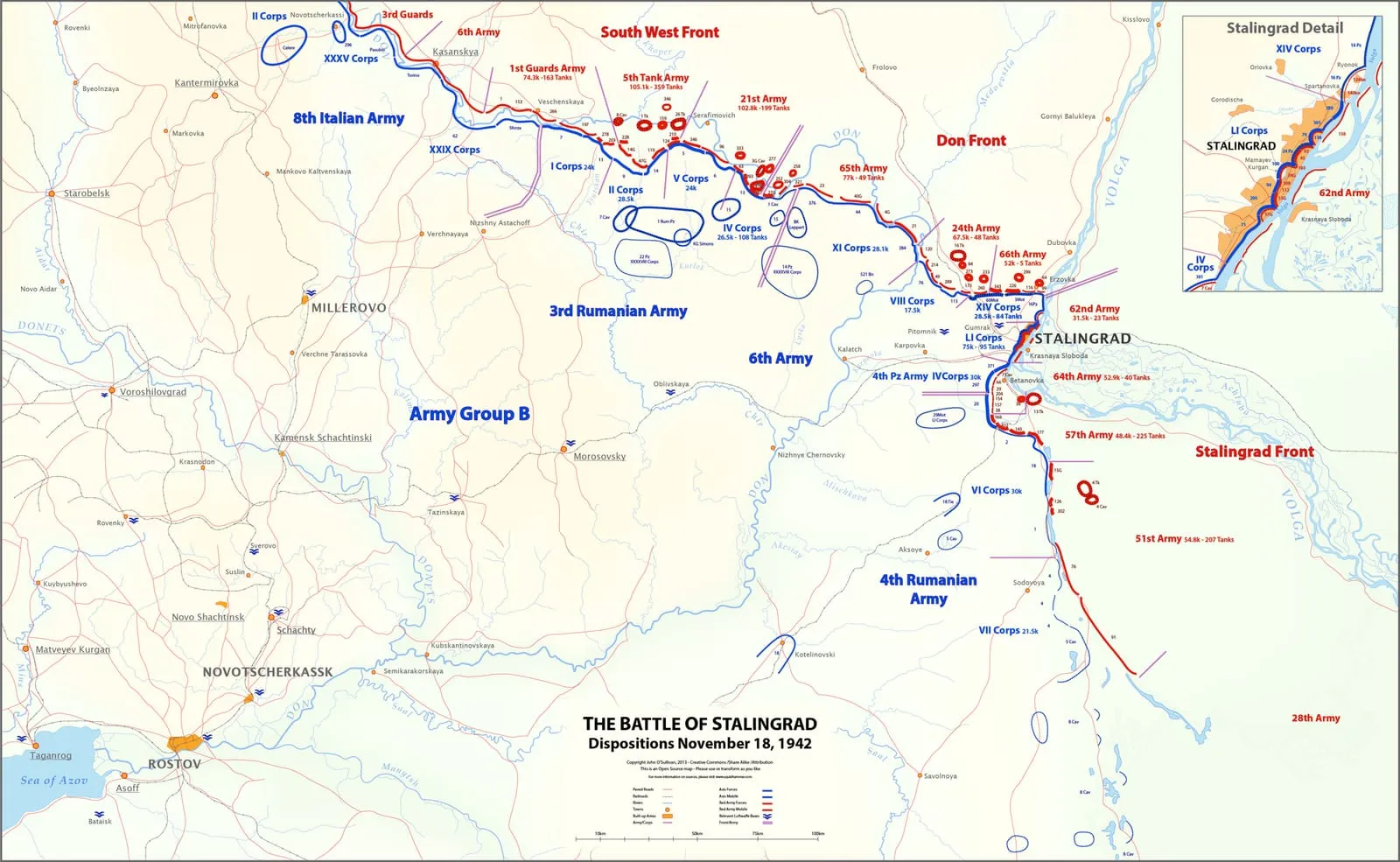
Operation Uranus was the Soviet counter-offensive that reversed the course of the Battle of Stalingrad in five days. Throughout the autumn of 1942 General Friedrich Paulus’s German 6th Army had been bleeding itself white in the ruins of the city on the Volga, while its long flanks along the Don and out into the Kalmyk steppe were covered by poorly armed Romanian armies. It was against these that the Red Army struck. At dawn on 19 November the troops of the South-Western Front and the Don Front attacked from their bridgeheads on the Don, and on 20 November the armies of the Stalingrad Front followed from the lakes south of the city. The front of the Romanian 3rd and 4th Armies gave way in both sectors on the very first day of the attack; Soviet tank and mechanised corps broke through into the German rear and on 23 November met at Sovetsky, near Kalach-on-Don. The whole of the 6th Army, together with part of General Hermann Hoth’s 4th Panzer Army, was caught in the ring – the largest Wehrmacht force encircled up to that time. The operation was prepared in the Stavka by Georgy Zhukov and the Chief of the General Staff, Aleksandr Vasilevsky, who coordinated the three fronts in the field.
Name and dates
“Uranus” was the code name the Stavka gave to the plan. It belonged to a series of “planetary” operations prepared in the autumn of 1942: in parallel, Operation Mars was being planned against the German Army Group Centre near Rzhev, and Uranus was to be followed by “Saturn” – a blow against the Italian army on the middle Don and towards Rostov. Soviet and Russian historians usually call the operation the Stalingrad offensive operation (the counter-offensive at Stalingrad), and its first stage the encirclement of the enemy forces between the Don and the Volga.
The operation is taken to have begun on 19 November 1942, when the artillery preparation north of Stalingrad opened at 7.30 a.m. Moscow time, after the signal “Siren” at 7.20. The Stalingrad Front attacked a day later, on 20 November. The end is placed on 23 November, when at around 4 p.m. the spearheads of the two fronts met near the khutor (hamlet) of Sovetsky and closed the ring. Some authors give 22 November as the date of the encirclement, because on that day Soviet tanks captured the bridge at Kalach and Paulus reported that his army was surrounded; the link-up, however, came a day later. In memory of the barrage that opened the offensive, 19 November was celebrated in the USSR from 1944 as Artillery Day (later the Day of the Missile Forces and Artillery). Fighting with cut-off Romanian and German units went on into 24 November, and the destruction of the pocket itself dragged on until February 1943.
Background
The German summer offensive in the southern sector of the Eastern Front, launched at the end of June as Case Blue, won the Wehrmacht vast tracts of territory but did not destroy the Red Army. Adolf Hitler divided his forces: Army Group A advanced into the Caucasus towards the oil of Grozny and Baku, while Army Group B was to reach the Volga and take Stalingrad. After the fighting in the great bend of the Don the 6th Army crossed the river and on 23 August reached the Volga north of the city. From September it fought a war of attrition in the streets of Stalingrad, and in October and the first half of November it captured one industrial plant after another in the northern part of the city – the Tractor Factory, the Barrikady works and part of the Red October steelworks. Even so, General Vasily Chuikov’s 62nd Army held on to its footholds along the river. As late as 11 November Paulus threw fresh pioneer battalions into a last great assault, which reached the Volga on a narrow front but failed to take the whole city.
The fighting in Stalingrad sucked in more and more German divisions. The flanks of the 6th Army, stretching for hundreds of kilometres along the Don and deep into the Kalmyk steppe, were held by allied armies: from the west the Hungarian 2nd Army and the Italian 8th Army, then the Romanian 3rd Army under General Petre Dumitrescu, and south of the city the Romanian 4th Army under General Constantin Constantinescu-Claps, which was subordinated to the 4th Panzer Army. The Romanians were defending sectors far too wide for their strength; the 3rd Army held a front some 140 kilometres long. Above all they lacked anti-tank weapons: they relied on obsolete 37 mm guns that were powerless against the T-34, and the Germans had given them only a handful of newer 75 mm guns per division. The German commander of Army Group B, General Maximilian von Weichs, and Paulus himself were aware of the danger, and for weeks the Romanian command had been reporting Soviet bridgeheads on the right bank of the Don at Serafimovich and Kletskaya. The Chief of the Army General Staff, Franz Halder, who had warned against overstretching the front, had been dismissed in September. His successor, Kurt Zeitzler, also drew Hitler’s attention to the danger, but the only reserves behind the Romanian front were the weak XLVIII Panzer Corps and, south of the city, the 29th Panzergrenadier Division.
Plan and preparations
According to the memoirs of Zhukov and Vasilevsky, the idea of a counter-offensive was born in mid-September 1942 when the two men, discussing in the Kremlin how to save the city, proposed to Joseph Stalin “another solution” than endlessly feeding forces into one counter-attack after another. Historians treat this scene with caution, since the memoirs were written years later and the plan took shape gradually throughout September and October. Its essence, however, was the same from the start: Stalingrad was to be defended only enough to pin down the 6th Army, while the Stavka’s reserves were to be massed on the flanks and thrown against the weakest links in the German line – the Romanian armies. Two pincers were to break through far from the city, in the north-west and in the south, and meet on the Don around Kalach, behind Paulus’s back. Smaller forces were to strike closer to Stalingrad in order to cut off the German divisions standing on the Don from the rest of the 6th Army.
Georgy Zhukov, Deputy Supreme Commander since August, and Vasilevsky toured the sectors of the front, and Stalin approved the final plan on 13 November. Its execution was entrusted to three fronts. The newly re-formed South-Western Front under General Nikolai Vatutin, with the 5th Tank Army, the 21st Army and the 1st Guards Army, was to attack from the bridgeheads at Serafimovich and Kletskaya. General Konstantin Rokossovsky’s Don Front, with the 65th, 24th and 66th Armies, attacked alongside it, along the Don and in the land between the rivers. General Andrei Yeremenko’s Stalingrad Front, with the 51st, 57th and 64th Armies, was to break the Romanian front between Lakes Sarpa, Tsatsa and Barmantsak south of the city. Because Zhukov left in mid-November to prepare Operation Mars on the Western Front, Vasilevsky took over the coordination of Uranus on the spot.
The preparations were an enormous logistical undertaking. The troops of the Stalingrad Front were ferried across the Volga by night, under shellfire and air attack – according to Soviet figures, some 111,000 soldiers, 420 tanks and 556 guns in three weeks. In the north, regiments moved into the Don bridgeheads over bridges built under cover of darkness, with dummy bridges put up alongside them. Maskirovka (military deception) was employed on a grand scale: radio traffic was restricted, orders were carried by messengers, the troops on the flanks built fortifications as if preparing to defend, and in the central sector of the front preparations for an offensive against Army Group Centre were simulated. German military intelligence in the east (Fremde Heere Ost, Foreign Armies East) expected a blow against Army Group Centre rather than in the south, and as late as November judged that the Red Army lacked the reserves for two major offensives at once.
The start date was postponed several times, because the rail transports could not keep up and the air force was not ready – from the first days of November to the 17th, and then to 19 November. As late as 17 November the commander of the 4th Mechanised Corps, General Vasily Volsky, wrote to Stalin that the operation was badly prepared and could end in disaster. After speaking to Vasilevsky and to Volsky himself, Stalin kept to the date, and Volsky gave his assurance that he would carry out his orders.
Forces
Figures for the strength of the two sides vary with the source and with whether one counts all the troops of the three fronts or only the strike groups. Soviet historiography stated that the South-Western, Don and Stalingrad Fronts together numbered just over a million soldiers, some 15,000 guns and mortars, nearly 1,500 tanks and self-propelled guns and about 1,350 aircraft; Western scholars, including David Glantz, accept a similar number of men but a lower tank count – from about 900 to 1,000 in the assault formations. The core of the attack consisted of the tank and mechanised corps: the 1st and 26th Tank Corps in General Prokofy Romanenko’s 5th Tank Army, the 4th Tank Corps and 3rd Guards Cavalry Corps in General Ivan Chistyakov’s 21st Army, and in the south the 13th and 4th Mechanised Corps and the 4th Cavalry Corps of the Stalingrad Front. In the breakthrough sectors the Soviets massed an artillery superiority of several times over, and on the Don they also brought up regiments of rocket launchers.
By Soviet reckoning, the enemy had on the whole Stalingrad axis about a million men, 10,000 guns, 675 tanks and more than 1,200 aircraft, but this figure included the whole of Army Group B with the Italian and Hungarian armies. In reality, directly in the path of the Soviet attacks stood the Romanian 3rd Army, with several infantry and cavalry divisions in the front line, and the Romanian 4th Army, with General Ferdinand Heim’s XLVIII Panzer Corps in reserve. On paper the corps consisted of the German 22nd Panzer Division and the Romanian 1st Armoured Division, but the German division had little more than 30 serviceable tanks – in their winter quarters mice had gnawed through the insulation of the vehicles’ electrical wiring – while the Romanian one was equipped with R-2 light tanks armed with 37 mm guns. In the south, behind the Romanian 4th Army, stood only the 29th Panzergrenadier Division. The best German panzer divisions, the 14th, 16th and 24th, were stuck, bled white, in Stalingrad or just behind the city.
The German air force, General Wolfram von Richthofen’s Luftflotte 4, had dominated the skies over the city all autumn, but by November it had been weakened by the transfer of some units to the Mediterranean after the Allied landings in North Africa. In any case, during the first days of the offensive fog and snowstorms grounded the aircraft of both sides.
Course of the battle
19 November: the breakthrough on the Don
The night of 18–19 November was freezing and foggy. Shortly after 5 a.m. a German liaison officer with the Romanian IV Corps near Kletskaya telephoned 6th Army headquarters at Golubinsky to warn that the attack was imminent; there had been so many false alarms, however, that the duty officer did not wake the army’s chief of staff, General Arthur Schmidt. At 7.20 a.m. Moscow time the gunners received the signal “Siren”, and at 7.30 the artillery preparation began, lasting about 80 minutes. Some 3,500 guns and mortars fired on the narrow breakthrough sectors; the fog made it impossible to correct their fire, but the targets had been reconnoitred in advance, and the bombardment destroyed the Romanians’ communications, ammunition dumps and observation posts.
At 8.50 a.m. the 21st Army and the 5th Tank Army of the South-Western Front and the 65th Army of the Don Front went over to the attack. The Romanians beat off the first infantry assaults – many soldiers of the 3rd Army fought stubbornly as long as they had anything to fire. Once the tanks entered the battle, however, the lack of anti-tank weapons decided the matter. Around midday the 4th Tank Corps and the 3rd Guards Cavalry Corps broke through the front near Kletskaya, while the 5th Tank Army smashed the Romanian II Corps near Serafimovich and pushed the 1st and 26th Tank Corps and the 8th Cavalry Corps into the gap. Soviet tanks advanced through the fog by compass, crushing artillery positions beneath their tracks. By evening three Romanian divisions had disintegrated and the rest had been outflanked on both sides.
The German command was slow to react. Weichs and Paulus did not immediately decide to pull the panzer divisions out of the city, and the task of stopping the breakthrough fell to Heim’s XLVIII Panzer Corps, which was ordered to change the direction of its counter-attack by successive orders – first from Army Group B, then from Hitler’s headquarters. The 22nd Panzer Division went into action scattered and short of fuel, and the Romanian 1st Armoured Division lost contact with it and clashed alone with the Soviet 26th Tank Corps. Hitler was at the time at the Berghof near Berchtesgaden, while the Chief of the General Staff, Zeitzler, who was in East Prussia, communicated with him by telephone. On the evening of 19 November, on Weichs’s orders, Paulus finally halted the attack in Stalingrad itself and began withdrawing some of his armoured units from the city in order to send them west.
20 November: the blow from the south
On the morning of 20 November thick fog also lay over the lakes south of Stalingrad. Yeremenko, pressed by the Stavka over the telephone, agreed to begin only once it had lifted; the 51st Army opened fire at the appointed time, but the rest of the front’s troops were ordered to put back the attack to 10 a.m. The blow of the 51st, 57th and 64th Armies fell on the Romanian VI and VII Corps of the 4th Army. Here too the defence quickly collapsed: the Romanians, their divisions stretched across dozens of kilometres of steppe, surrendered by whole battalions or fled west. The 13th and 4th Mechanised Corps and the 4th Cavalry Corps were committed into the gap, although their entry into battle went badly and cost precious hours.
The only German reserve in this direction, the 29th Panzergrenadier Division, counter-attacked in the afternoon and, according to various accounts, destroyed several dozen Soviet tanks of the 13th Mechanised Corps. The collapse of the Romanians along the whole sector, however, forced it to turn back to cover the southern flank of the 6th Army, so the road to Kalach from the south remained practically open. The same day, in the north, the 26th Tank Corps took Perelazovsky, about 130 kilometres north-west of Stalingrad, while the 4th Tank Corps pushed south, bypassing the German XI Army Corps in the bend of the Don.
21–22 November: the pocket closes
By 21 November Soviet armoured columns from north and south were already driving through the German rear. In the south General Volsky’s 4th Mechanised Corps, after a short halt, set off north-west towards the Don. In the north the main body of the Romanian 3rd Army – the remnants of IV and V Corps, with several divisions – was cut off around the stanitsa (Cossack village) of Raspopinskaya, between the 5th Tank Army and the 21st Army. Command of this group was taken by General Mihail Lascăr, who rejected a call to surrender and tried to break out to the west. The XLVIII Panzer Corps came to its aid, but the 22nd Panzer Division, reduced to a dozen or so tanks, could not reach the encircled troops and itself had to withdraw to the south-west.
That day Soviet tanks came within a dozen or so kilometres of 6th Army headquarters at Golubinsky on the Don. Paulus and Schmidt moved to the stanitsa of Nizhnechirskaya on the River Chir, from where on 22 November they flew to Gumrak inside the forming pocket. Hitler, still at the Berghof, ordered the 6th Army to stand fast despite the threat of temporary encirclement, to hold the Volga line and the northern front, and to await further orders.
22 November saw the most famous episode of the operation. The forward detachment of the 26th Tank Corps under Lieutenant Colonel Georgy Filippov, led by two captured German tanks and an armoured car, drove up with its headlights on to the bridge over the Don near Kalach in the early hours. The German sentries took it for one of their own units, and by the time they realised their mistake it was too late: the Russians seized the bridge before the sappers could blow it. Units of the 26th and 4th Tank Corps crossed the river, and the town itself, defended mainly by rear-area and workshop units, was taken in fighting that lasted until the following morning. In the evening Paulus reported to Army Group B and to Hitler’s headquarters that the army was surrounded, that it had fuel and ammunition for only a few days, and asked for freedom of action, including permission to break out to the south-west. The same day, according to Romanian sources, Lascăr was taken prisoner; the remnants of his group fought on for two more days.
23 November: the meeting at Sovetsky
On 23 November the 4th Tank Corps of the South-Western Front, having crossed the Don, turned south-east, while from the opposite direction came the 4th Mechanised Corps of the Stalingrad Front, which had taken Sovetsky the day before and cut the railway to Stalingrad. At around 4 p.m. the head of the 36th Mechanised Brigade sighted tanks of the 45th Tank Brigade near Sovetsky. Because the agreed green flares had not been fired, each side briefly took the other for Germans and there was a short exchange of fire; once the misunderstanding was cleared up, the tank crews fell into each other’s arms. The scene of the meeting was later re-staged for the newsreel cameras, and the footage went round the world. The ring around the 6th Army had been closed.
The same day most of the Romanian group at Raspopinskaya surrendered: according to various sources, between about 27,000 and 30,000 soldiers were taken prisoner there on 23–24 November. Only a few units, such as Major Gheorghe Răscănescu’s battalion, broke out to the west. South of Stalingrad, by contrast, the Soviet corps, cooperating poorly with the infantry, allowed a considerable part of the Romanian 4th Army to withdraw to the west and south-west.
Inside the ring, the German divisions standing west of the Don fell back over the last bridges to the east bank, abandoning equipment and blowing up the crossings behind them. On the evening of 23 November Paulus once again asked Hitler for permission to break out to the south-west, with the backing of all his corps commanders and of Weichs. The commander of the LI Army Corps, General Walther von Seydlitz-Kurzbach, on his own initiative withdrew some of his divisions from their fortified positions in the north of the pocket, which ended with the 94th Infantry Division being cut to pieces on the open steppe. Hitler, who on the evening of 22 November had left the Berghof by train for the Wolf’s Lair near Rastenburg (Kętrzyn), refused during the night of 23–24 November: the 6th Army was to hold “Fortress Stalingrad” and wait for supplies by air and for relief. His decision was influenced by the assurance of Hermann Göring that the Luftwaffe could keep the encircled troops supplied, although Göring’s own officers warned that this was impossible.
General Heim fell victim to the defeat. Hitler blamed his corps for the failed counter-attack, relieved him of command and ordered his dismissal from the army; the general spent several months under arrest in Berlin’s Moabit prison, and in 1943 his expulsion from the army was commuted to ordinary retirement. Historians generally consider that with two weak divisions he had no chance of stopping several Soviet tank corps.
Losses
The losses of Operation Uranus alone are hard to separate from those of the Battle of Stalingrad as a whole and are not known precisely. The Romanian armies suffered most: according to Romanian figures, between 19 November 1942 and the beginning of January 1943 the 3rd and 4th Armies lost a total of some 150,000–160,000 men killed, wounded, missing and captured, a large part of them in the first days of the offensive. Soviet reports spoke of several tens of thousands of Romanian prisoners taken by 24 November. The Red Army lost many tanks in the attack, especially in the fighting with the 29th Panzergrenadier Division and the XLVIII Panzer Corps, but there are no exact figures for these five days; for the whole counter-offensive at Stalingrad, from 19 November to 2 February, the Russian statistical study edited by Grigori Krivosheev gives about 155,000 Soviet soldiers killed and missing.
The most important result, however, was not the losses suffered in combat but the encirclement. Trapped in the ring were 20 German divisions (including three panzer and three motorised divisions), two Romanian divisions, a Croatian infantry regiment, numerous special, engineer and artillery units and Luftwaffe ground personnel, as well as thousands of Soviet auxiliaries (Hilfswillige) and prisoners of war. Depending on the source and the method of counting, the number of encircled men is estimated at between about 250,000 and 330,000. The Stavka initially assumed that there were no more than 85,000–90,000 soldiers in the pocket, which weighed on its plans to liquidate it quickly.
Significance
Operation Uranus was the first encirclement of a German field army on such a scale in the war and the turning point on the Eastern Front. In five days the Red Army, which had been retreating all summer, seized the strategic initiative in the south and trapped the Wehrmacht’s strongest army in a pocket. The operation showed that the Soviet command had learned to conduct deep offensives with tank and mechanised corps, to combine them with cavalry and air power, and to conceal its preparations from the enemy. It also laid bare the weakness of German strategy in 1942: a front stretched beyond the army’s strength, reliance on less well-armed allies, and disregard for warnings.
Instead of allowing the 6th Army to break out westwards while it still had fuel and ammunition, Hitler ordered it to defend itself in the pocket and wait for relief. He gave command of the newly created Army Group Don to Field Marshal Erich von Manstein. The airlift proved inadequate: the encircled troops usually received only a fraction of the supplies they needed. Hoth’s relief attempt in December (Operation Wintergewitter, “Winter Storm”) came to a halt a few dozen kilometres from the pocket, and the Soviet Operation Little Saturn, carried out in place of the original Saturn, shattered the Italian 8th Army on the middle Don in December. In January 1943 Rokossovsky’s Don Front began to liquidate the pocket in Operation Ring, and on 31 January and 2 February 1943 the remnants of the 6th Army surrendered. About 91,000 soldiers were taken prisoner together with Field Marshal Paulus, of whom only a few thousand returned home after the war.
The defeat also engulfed Germany’s allies. The destruction of two Romanian armies, followed in the next few weeks by the Italian and Hungarian ones, undermined the confidence of Bucharest, Rome and Budapest in Hitler and strengthened those in all three capitals who wanted to leave the war. The parallel Operation Mars near Rzhev, commanded by Zhukov, ended by contrast in a costly defeat for the Red Army and was passed over in silence by Soviet historiography for decades. It was Uranus, not Mars, that went down in history as the beginning of the end of the Third Reich in the east.