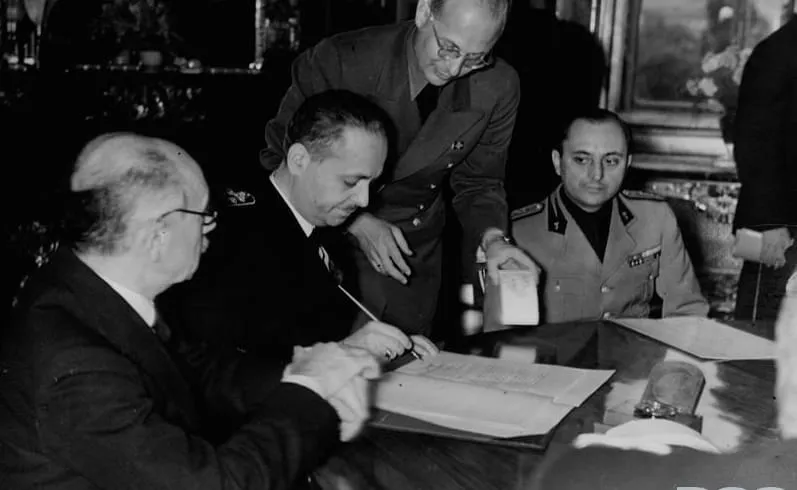
On 30 August 1940, in the Belvedere, Prince Eugene of Savoy’s baroque palace in Vienna, the foreign ministers of Germany and Italy, Joachim von Ribbentrop and Galeazzo Ciano, announced their settlement of the Hungarian–Romanian dispute over Transylvania. Romania had to cede to Hungary the northern part of the region, together with Romanian Maramureș and the northern part of Crișana – some 43,000 square kilometres in all, with roughly two and a half million inhabitants. When the Romanian foreign minister saw the map with the new frontier, he fainted at the table. The term “arbitration” was a euphemism: both sides had agreed in advance, under threat, to accept the verdict, and the line had been drawn by Adolf Hitler in person. It is often said that the award was “dictated” by Hitler and Benito Mussolini. In substance that is what happened, although formally the verdict was issued and signed by their ministers, and the decisive word lay with Berlin. Romanians still call it the Vienna Diktat.
The wound of Trianon
For centuries Transylvania had been part of the Kingdom of Hungary or an autonomous principality under its influence, and for Hungarians it was the cradle of many noble families, schools and national memories. The majority of its inhabitants, however, were Romanians, alongside whom lived Hungarians, the Hungarian-speaking Székelys in the east, Transylvanian Saxons and a large Jewish population. In the autumn of 1918, as Austria-Hungary fell apart, the Romanian army entered Transylvania; on 1 December an assembly of Romanians at Alba Iulia proclaimed union with Romania, and the Treaty of Trianon of 1920 awarded Bucharest Transylvania, Crișana, Maramureș and the eastern Banat. According to the Hungarian census of 1910, some 1.6 million Hungarians lived in the lands assigned to Romania.
Throughout the interwar years revision of the treaty was the foundation of Hungarian policy, and the loss of Transylvania hurt most of all. Romania defended its borders through an alliance with France and through the Little Entente with Czechoslovakia and Yugoslavia. Miklós Horthy’s Hungary looked for support to Italy and, from the mid-1930s, to Germany as well. The first fruits came after the Munich Agreement: on 2 November 1938, in the same Belvedere, Ribbentrop and Ciano announced the First Vienna Award, which gave Hungary a southern strip of Slovakia and Carpathian Ruthenia, nearly 12,000 square kilometres. In March 1939 Hungarian troops occupied the rest of Ruthenia. Transylvania, however, remained in the hands of Romania, which was allied with the Western powers and from April 1939 covered by their guarantee.
Summer 1940: queuing for Romanian land
The fall of France deprived Romania of its protector. On 26 June 1940 the Soviet Union demanded Bessarabia and northern Bukovina, and King Carol II, advised by Berlin to give way, surrendered both provinces without a fight. In Budapest this was taken as proof that under pressure Romania would give up other lands too. The Hungarian army was mobilised and moved up to the Romanian frontier; according to Hungarian studies, some 550,000 troops stood there by mid-July. On the other side the Romanians manned the fortifications built in previous years along their western frontier, the so-called Carol II Line. Bulgaria, too, demanded its lost territory, southern Dobruja.
Hitler did not want a war in the Balkans. Romania was the Reich’s main supplier of oil, and a Hungarian–Romanian conflict might prompt the Soviet Union to march further west. Romanian policy, meanwhile, had changed completely: on 1 July Carol II renounced the Anglo-French guarantee, the next day he offered to have Hitler send a German military mission, and on 4 July he appointed the pro-German government of Ion Gigurtu. On 10 July Hitler received the Hungarian Prime Minister, Pál Teleki, and Foreign Minister István Csáky in Munich and agreed to a revision of the frontiers, on condition that it was achieved by negotiation. In a letter to Carol II of 15 July he made German goodwill conditional on Romania reaching agreement with Hungary and Bulgaria. On 26 July Gigurtu and the new Foreign Minister, Mihail Manoilescu, heard the same from Hitler at the Berghof, and they brought back the King’s consent to talks.
Hungarian–Romanian negotiations opened on 16 August at Turnu Severin on the Danube. The Hungarian delegation began by demanding some 69,000 square kilometres, roughly two-thirds of Transylvania, with 3.8 million inhabitants, nearly two-thirds of them Romanians. The Romanians proposed in reply an exchange of populations and, at most, minor frontier adjustments. The positions could not be reconciled, and on 24 August (according to some sources the day before) the talks were broken off. Incidents multiplied on the frontier, Hungarian aircraft flew over Transylvania, and the Hungarian General Staff issued directives for an offensive that was to begin at dawn on 28 August.
The decision at the Berghof
On 26 August Hitler decided to settle the dispute himself. Ribbentrop summoned the foreign ministers of Italy, Hungary and Romania to Vienna, and the Wehrmacht was ordered to prepare divisions to intervene in the region if necessary, above all to secure the Ploiești oilfields. According to German research in the files of the Auswärtiges Amt, two variants were considered at Ribbentrop’s residence at Fuschl: the Reich’s minister in Bucharest, Wilhelm Fabricius, proposed giving Hungary only the border areas with a Hungarian majority, while a director in the Foreign Office, Carl Clodius, argued that Hungary must receive the Székely Land, lying in the very centre of Romania, linked to Hungary by a corridor of northern Transylvania. At the Berghof Hitler combined the two proposals and with a blue pencil drew a line on the map that gave Hungary considerably more than either variant envisaged. The thickness of that pencil line corresponded on the ground to several kilometres, which later caused the commission demarcating the frontier a great deal of trouble.
On 28 August Ciano arrived in Salzburg. The Italians felt that the Germans were going too far, but they managed to obtain only one amendment: the town of Turda remained in Romania. That evening the two ministers left for Vienna, where on 29 August they received the two delegations in turn. The Romanians, led by Manoilescu, had brought experts and maps, hoping to persuade the arbiters to settle for a small concession. They were told that everything had been decided and that Romania must accept the verdict in advance; otherwise Germany would not restrain Hungary or the Soviet Union. The minutes of the Romanian Crown Council called this “a communication in the nature of an ultimatum”. The Council met in Bucharest in the night, between three and four in the morning of 30 August, and according to Romanian publications accepted the arbitration by 19 votes to 10, with one abstention. Among those opposed was the leader of the National Peasants and a Transylvanian Romanian, Iuliu Maniu. Carol II concluded that a German–Italian guarantee for the rest of the country was the only way to save Romania from complete disintegration. The Hungarians agreed without hesitation.
The verdict
On 30 August, at the Belvedere, Ribbentrop and Ciano handed the award to Manoilescu and Csáky, who signed it in Teleki’s presence. Ciano noted in his diary that at the sight of the map Manoilescu fainted and had to be revived; he nevertheless had to attend the joint luncheon afterwards. The text was short. The frontier was to follow the attached map, and the details of its course on the ground were to be settled by a mixed commission. Within fifteen days Romania was to evacuate its troops and administration from the ceded territory and hand it over “in good order”. The inhabitants of these lands became Hungarian citizens, but within six months they could opt for Romanian citizenship and within a further year move to Romania with their movable property. Hungarians remaining in Romania were given the same right of option. Both governments undertook “solemnly” to treat their minorities on an equal footing with their other citizens, and disputes were to be settled by Germany and Italy. At the same time the two Axis powers guaranteed the inviolability of Romania’s new frontiers, and Germany concluded a separate agreement with Hungary granting extensive rights to the German minority in Hungary; Romania had to accept similar obligations towards its own Germans.
Hungary regained 43,104 square kilometres (Romanian sources give 43,492), with the cities of Cluj, Oradea, Satu Mare, Baia Mare and Târgu Mureș, and the whole of the Székely Land up to the arc of the Carpathians. The Maramureș awarded to Hungary was the Romanian part of the region, south of the Tisza; its northern part had already belonged to Hungary since the occupation of Carpathian Ruthenia in 1939. Romania kept southern Transylvania with Brașov and Sibiu, as well as Arad and Timișoara. The population of the ceded lands depends on the source: the Romanian census of 1930 counted about 2.39 million inhabitants in the area, the Hungarian census of 1941 about 2.58 million; in 1940 both governments used estimates of 2.6 to 2.7 million. The ethnic composition was even more disputed: according to the Romanian census, Romanians made up about half the inhabitants and Hungarians about 38 per cent; according to the Hungarian one, Hungarians made up over 53 per cent. The American historian Keith Hitchins estimated that between 1.15 and 1.3 million Romanians were left north of the new frontier, and about half a million Hungarians south of it (up to 800,000 by Hungarian estimates, 363,000 by Romanian ones). The award thus did not separate the nations; it merely swapped the majority and the minority.
The Hungarians march in
In Budapest the news was greeted with enthusiasm, and Hungarians in northern Transylvania welcomed their army with flowers. Teleki was one of the few who did not celebrate: according to German and Hungarian studies, he was troubled by the fate of the Hungarians left in Romania and by the dependence on Germany into which the country was slipping. On 5 September Hungarian units crossed the Trianon frontier, and the Regent, Miklós Horthy, accompanied the advancing troops; on 15 September he made a ceremonial entry into Cluj. By 13 September the army had reached the new frontier. The Romanians withdrew in a tense atmosphere, and the Hungarian entry was not without crimes. On 9 September, in the village of Treznea, Hungarian soldiers killed 87 Romanians and 6 Jews according to official Hungarian figures, considerably more according to Romanian sources; on 13 and 14 September some 150–160 people were killed at Ip. The Hungarian authorities explained these killings as a response to fire from local people, which witness accounts do not confirm. Until the autumn of 1940 the area was under military administration, and Romanian clergy, teachers and officials were forced to leave. By the beginning of 1941 more than a hundred thousand people had left or fled from each side of the new frontier.
Crisis in Bucharest
In Romania the verdict came as a shock. Within two months the country had lost Bessarabia, northern Bukovina and northern Transylvania, and on 7 September, under the Treaty of Craiova, it ceded southern Dobruja to Bulgaria. In all, roughly a third of the territory and population of Greater Romania had been lost. A second Crown Council, on the night of 30/31 August, confirmed the acceptance of the award, but the street would not accept it. There were demonstrations in Bucharest, Cluj and other cities, which the government, at the German minister’s request, ordered to be suppressed; the anger then turned against the King, and on the night of 3/4 September the fascist Iron Guard tried to stir up a revolt against him. On 4 September Gigurtu resigned, and Carol II entrusted the premiership to General Ion Antonescu, to whom he handed full powers the next day. Antonescu immediately demanded his abdication. On 6 September Carol II surrendered the throne to his eighteen-year-old son Michael and left the country, and the general, together with Horia Sima’s Iron Guard, took over the government.
Moscow received the award coolly. On 1 September Vyacheslav Molotov told the German ambassador, Friedrich-Werner von der Schulenburg, that by failing to consult the Soviet Union on a matter affecting the interests of both states, Germany had violated Article 3 of the Molotov–Ribbentrop Pact. The guarantee given to Romania was directed above all against Moscow: it closed the way to further Soviet demands, for instance on southern Bukovina. Britain did not recognise the frontier changes.
Place in the war
The Second Vienna Award was the largest frontier change that Germany and Italy carried out in Europe without a war. Hitler secured peace in the Balkans and access to Romanian oil, and at the same time bound both of the feuding states to himself: Hungary because it owed him its gains and could lose them, Romania because only Germany guaranteed what remained of its territory, and Berlin’s goodwill was its only hope of recovering northern Transylvania. In October 1940 a German military mission arrived in Romania, and in November both countries joined the Tripartite Pact: Hungary on 20 November, Romania on 23 November. The rivalry over Transylvania continued, this time as a race for Hitler’s favour, and in 1941 both states sent their armies against the Soviet Union in the hope that their loyalty would be rewarded in the matter of the region.
Hungarian rule in northern Transylvania lasted four years. In the spring of 1944, after the German occupation of Hungary, the Hungarian gendarmerie, in concert with the Germans, confined the Jews of the region in ghettos and deported them, the vast majority to Auschwitz-Birkenau; according to figures cited by historians, more than 127,000 people were deported from northern Transylvania alone, excluding the Székely Land, of whom fewer than 20,000 returned. After Romania went over to the Allies on 23 August 1944, the armistice agreement of 12 September declared the Vienna Award null and void, and in the autumn of 1944 Soviet and Romanian troops occupied northern Transylvania. The peace treaties signed in Paris on 10 February 1947 restored the Hungarian–Romanian frontier of 1 January 1938, that is, the Trianon line. The dispute over Transylvania, which in August 1940 the Germans tried to settle with a pencil line on a map, remains to this day one of the most sensitive subjects in relations between the two nations.
Sources
Meanwhile
(02)Elsewhere, within a week.
- 31 August 1940 · Western FrontDisaster off TexelOn the night of 31 August/1 September 1940 a British flotilla ran into a German minefield off Texel. The destroyers Esk and Ivanhoe sank; some 300 men died.
- 25 August 1940 · Western FrontThe first RAF raid on BerlinAfter bombs hit the City of London on the night of 24/25 August 1940, Churchill ordered a strike on Berlin. The raid of 25/26 August did little damage.
Related events
(04)The same battle, people or subject.
- 20 November 1940 · DiplomacyHungary, Romania and Slovakia join the Tripartite PactBetween 20 and 24 November 1940 Hungary, Romania and Slovakia joined the Tripartite Pact. Hitler bound to the Axis the states he needed for war in the east.
- 6 September 1940 · PoliticsThe abdication of Carol IIOn 6 September 1940 Carol II handed the throne to 18-year-old Michael and fled. General Ion Antonescu took power in Romania in alliance with the Iron Guard.
- 7 October 1940 · MilitaryThe German military mission in RomaniaIn October 1940 a German military mission arrived in Romania. Officially it was to train the army; in fact it guarded Ploiești oil and prepared war on the USSR.
- 4 October 1940 · DiplomacyThe Brenner Pass meeting (October 1940)On 4 October 1940 Hitler and Mussolini met again at the Brenner. They discussed Spain, France and a bloc against Britain, but not troops for Romania.