1944: The fighting for Hungary
The Vienna offensive
- Dates:
- 16 March – 15 April 1945
- Front:
- Eastern Front
- Location:
- Western Hungary between Lake Balaton and the Danube (the Vértes and Bakony Hills, Székesfehérvár, Veszprém, Pápa, Győr, Sopron, Szombathely, Nagykanizsa), eastern Austria – Burgenland and Lower Austria with Wiener Neustadt, Baden and the Vienna Woods – and Vienna itself with its suburbs on both banks of the DanubeOn the battle map →
- Sides:
- Soviet Union and BulgariaFyodor Tolbukhin, Rodion MalinovskyNazi Germany and HungaryOtto Wöhler, Lothar Rendulic, Sepp Dietrich
- Result:
- Soviet victory. The troops of the 3rd and 2nd Ukrainian Fronts drove the Germans out of western Hungary, crossed the Austrian border on 29 March, took Bratislava on 4 April and, on 13 April, after a week of street fighting, captured Vienna. According to Soviet statistics the Red Army lost 167,940 men in the operation, including 38,661 killed and missing, and the Bulgarian army 9,805, including 2,698 killed and missing; German and Hungarian losses cannot be determined precisely.
- Author:
- Łukasz
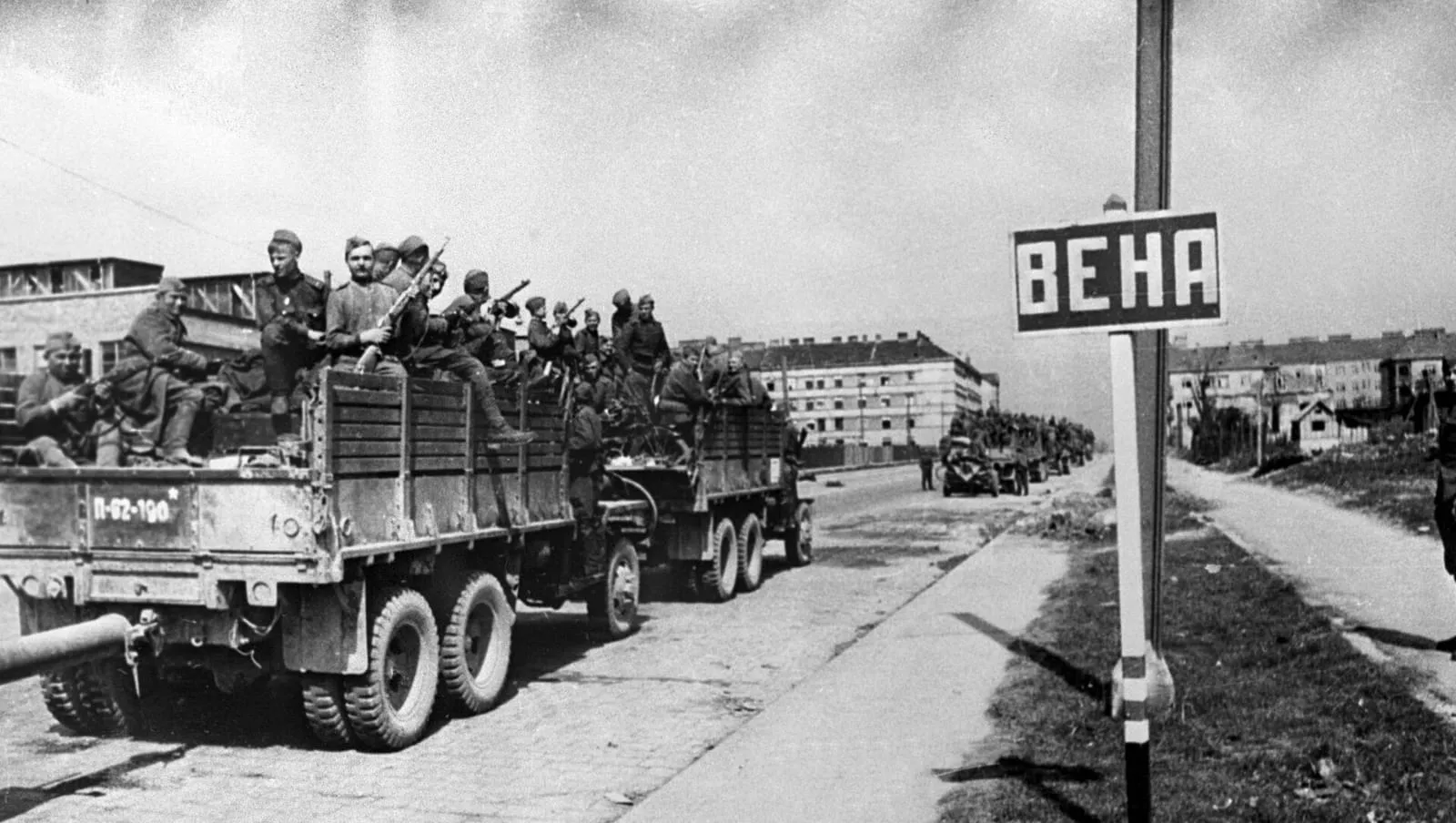
Name and dates
The Vienna offensive (Russian: Venskaya nastupatelnaya operatsiya) is the name given in Soviet and Russian historiography to the offensive of Marshal Fyodor Tolbukhin’s 3rd Ukrainian Front and the left wing of Marshal Rodion Malinovsky’s 2nd Ukrainian Front, conducted from 16 March to 15 April 1945 across western Hungary and eastern Austria as far as Vienna and beyond. German and Austrian writing usually describes the same events as the Battle of Vienna (Schlacht um Wien) or, more broadly, as the “war in Austria in 1945”, while the actual fighting within the city limits lasted from 6 to 13 April.
The starting date is marked by the attack of two Guards armies north of Székesfehérvár, launched at 3.35 p.m. on 16 March after an hour-long artillery preparation – at a moment when the German offensive at Lake Balaton, Operation Frühlingserwachen, had already come to a standstill and its troops had not yet had time to withdraw. Soviet statistical surveys take 15 April as the end of the operation: two days after the fall of Vienna, units of the 3rd Ukrainian Front reached the line assigned to them by the Stavka and went over to the defensive, while the fighting in the Vienna Woods, near St. Pölten and in Styria turned into a slow shifting of the front that was halted only by Germany’s surrender. Some accounts end the operation on 13 April, the day the city was taken.
The Vienna offensive was the Red Army’s last major operation in Hungary and its first on Austrian soil. It brought to a close the Hungarian campaign, which had begun in the autumn of 1944 with the fighting at Debrecen and the siege of Budapest, and it settled that Soviet troops, not the Western Allies, would occupy the Austrian capital. It also had a political dimension reaching beyond the battlefield: while the fighting in Vienna was still going on, Moscow decided who would head the reborn Austrian state.
Background
Austria had not existed as a state since March 1938, when after the Anschluss it was incorporated into the Third Reich as the so-called Ostmark and later divided into the “Alpine and Danubian Reichsgaue”. From 1940 Vienna was ruled, as Reich Governor and Gauleiter, by Baldur von Schirach, who was responsible among other things for the deportation of the Viennese Jews. At the Moscow Conference in October 1943 the foreign ministers of the USSR, Britain and the United States declared the Anschluss null and void and announced the restoration of a free Austria, calling it “the first free country to fall a victim to Hitlerite aggression”, while at the same time reminding it of its responsibility for taking part in the war on Germany’s side. Before the spring of 1945 nothing had been decided about who would occupy the country and how: not even at the Yalta Conference were occupation zones for Austria agreed. Whoever entered Vienna first stood to gain the upper hand in the talks on the country’s future.
From the spring of 1944 Austria ceased to be the “air-raid shelter of the Reich”: Allied bombers from bases in Italy attacked Vienna, Wiener Neustadt and the refineries, and by March 1945 the city had been through several dozen raids. At the same time, from the autumn of 1944, the fortifications of the so-called South-East Wall (Südostwall) were being built along the former Hungarian–Austrian border; working on them in inhuman conditions, and dying and being murdered there, were Hungarian Jews handed over to the Germans by the regime of Ferenc Szálasi.
After the fall of Budapest on 13 February 1945, the Stavka, in Directive No. 11027 of 17 February, ordered Malinovsky and Tolbukhin to prepare an offensive on Bratislava, Brno and Vienna. The main weight was to fall on the right wing of the 3rd Ukrainian Front, reinforced by General Vasily Glagolev’s 9th Guards Army, transferred from the Stavka reserve – a fresh army made up largely of former airborne divisions. The attack was set for the middle of March.
The plan was upset by Adolf Hitler, who – against the advice of some of his generals – sent Josef “Sepp” Dietrich’s Sixth SS Panzer Army, withdrawn from the Ardennes, to Hungary instead of throwing it into the battle on the Oder. His aims were to hold on to the last oil deposits available to the Reich – around Nagykanizsa in Hungary and Zistersdorf in Austria – and to shield Vienna. Operation Frühlingserwachen, launched on 6 March, advanced through the mud between Lake Balaton and Lake Velence only a few dozen kilometres, to the Sió Canal, and stalled on 15 March. Tolbukhin repelled it with his defending forces without drawing on the 9th Guards Army – the Stavka had forbidden its use in the defence and kept it for the counter-offensive. So when the Soviet offensive opened on 16 March, the German armoured force was stuck deep in an exposed salient south of Székesfehérvár, its northern flank covered by the weak divisions of the Hungarian Third Army.
Forces and plans
On the main axis the 3rd Ukrainian Front deployed General Nikanor Zakhvatayev’s 4th Guards Army and the 9th Guards Army, which were to strike south-westwards from the area north of Székesfehérvár through the Vértes Hills, cut off the German troops crowded between Lake Balaton and Lake Velence and destroy the Sixth SS Panzer Army. On the evening of 16 March the Stavka transferred to Tolbukhin from the neighbouring front General Andrei Kravchenko’s 6th Guards Tank Army, which was to become the spearhead of the pursuit. Further south stood the 26th, 27th and 57th Armies and the 1st Bulgarian Army (PL) – Bulgaria had been fighting on the Allied side since September 1944. Air support for the front came from the 17th Air Army.
The left wing of the 2nd Ukrainian Front – General Aleksandr Petrushevsky’s 46th Army with the 2nd Guards Mechanised Corps – was to advance along the right bank of the Danube through Komárom and Győr towards Vienna, supported by Rear Admiral Georgy Kholostyakov’s Danube Military Flotilla. The rest of Malinovsky’s front – Mikhail Shumilov’s 7th Guards Army, the 53rd Army, Issa Pliyev’s cavalry-mechanised group and the Romanian troops fighting alongside it – opened a separate operation north of the Danube, the Bratislava–Brno offensive, on 25 March. According to the Soviet statistical survey (G. Krivosheev), 644,700 Red Army soldiers and 100,900 Bulgarians took part in the Vienna offensive.
On the German side, the front from the Drava to the Danube was held by General of Infantry Otto Wöhler’s Army Group South. On its northern flank, at the foot of the Vértes Hills, stood General Hermann Balck’s Sixth Army with units of the Hungarian Third Army under its command; in the salient at Lake Balaton, the Sixth SS Panzer Army with four SS panzer divisions (the 1st Leibstandarte, 2nd Das Reich, 9th Hohenstaufen and 12th Hitlerjugend); south of the lake, General Maximilian de Angelis’s Second Panzer Army; and beyond the Danube, the Eighth Army. Soviet estimates speak of some 410,000 men, 700 tanks and assault guns and 700 aircraft, but after ten days of Frühlingserwachen the German panzer divisions had in fact been bled white: many had only a dozen or a few dozen serviceable vehicles, and the shortage of fuel paralysed their movements. The Hungarian units, demoralised by defeat and the fall of Budapest, were for the most part no longer willing to fight.
The Germans had no reserves. Hitler forbade any retreat, and the commanders in the field knew that behind them lay only the unfinished fortifications on the border of the Reich. The defence of Vienna was later entrusted to General of Infantry Rudolf von Bünau as the city’s battle commandant, with Wilhelm Bittrich’s II SS Panzer Corps as the main force.
The breakthrough in western Hungary (16–28 March)
The first day brought no decision. Caught by surprise by the artillery fire, the defenders on some sectors at first offered no resistance, but they quickly manned intermediate positions in the wooded Vértes Hills, and by nightfall the Guards armies had penetrated only 3–7 kilometres into their defences. Regrouping the 6th Guards Tank Army took several days, and the Germans made use of the time: Dietrich, contrary to his original orders, began pulling his divisions out of the Balaton salient, while the Sixth Army defended Székesfehérvár as the hinge around which the retreat could take place.
After several days of heavy fighting the separated Hungarian and German units on the northern flank began to fall back, and the Soviet armoured columns turned south-west towards Várpalota and Veszprém. The Sixth SS Panzer Army escaped encirclement by squeezing through a narrow corridor between Lake Balaton and the Bakony Hills, but abandoned much of its heavy equipment there. Székesfehérvár fell on 22 March and Veszprém a day later. On that same day, 23 March, the Stavka approved the next stage of the plan: the main forces of the 3rd Ukrainian Front (the 4th and 9th Guards Armies and the 6th Guards Tank Army) were to advance north-west through Pápa on Sopron, the 26th Army on Szombathely, the 27th Army on Zalaegerszeg, and the 57th Army with the Bulgarians on the oil-bearing area around Nagykanizsa.
The defeat at Lake Balaton sent Hitler into a fury. According to widely cited accounts, the dictator, convinced that the Waffen-SS had let him down, ordered at the end of March that the SS divisions, including his own Leibstandarte, be stripped of the cuff titles bearing their units’ names that they wore on their sleeves. Dietrich is said to have refused to pass this order on to his subordinates; the affair, which belongs to the story of Operation Frühlingserwachen, was a symptom of the breakdown of trust between Hitler and his army in the last weeks of the war.
The Germans tried to halt the pursuit on the Rába, where defensive positions had been prepared on the western bank, but the Soviet divisions forced the river on the march. The 46th Army, attacking along the Danube from 17 March, encircled and destroyed a German-Hungarian force in the Tata and Esztergom area and on 28 March took Komárom and Győr; by 30 March the last German bridgehead on the right bank of the Danube, opposite Komárno, had been eliminated. The front of Army Group South ceased to exist as a continuous line: the Sixth SS Panzer Army was falling back towards Sopron and Eisenstadt, and the Sixth Army, with the remnants of the Hungarian Third Army, through Szentgotthárd towards Styria. At the end of March Szálasi and the remnants of his government left Hungary and took refuge in Austria.
Entry into Austria and the end of the fighting in Hungary (29 March – 4 April)
At 11.05 a.m. on 29 March, according to Austrian research, tanks of the 6th Guards Tank Army crossed the then border of the Reich near Klostermarienberg in the Oberpullendorf district of Burgenland. On the same day Kőszeg and Szombathely fell, and on the left wing of the front the 57th Army and the Bulgarians moved off to attack Nagykanizsa. The fortifications of the South-East Wall, built by the efforts of forced labourers, including thousands of Hungarian Jews, were broken through within a few days, because there was no one to man them. Behind the retreating Germans also went columns of evacuated forced labourers: some of them were driven on death marches towards Mauthausen, and their guards – SS men, members of the Volkssturm and the Hitler Youth – murdered those who grew weak or could no longer march. Among the worst crimes committed in Burgenland and Styria in those weeks were the massacres at Deutsch Schützen and Rechnitz in Burgenland and on the Präbichl Pass near Eisenerz in Styria.
The corps of the 6th Guards Tank Army turned north towards Wiener Neustadt and Mattersburg, covered on the right by the 4th Guards Army, advancing through Eisenstadt on Schwechat, and on the left by the 9th Guards Army, which was heading through the Bucklige Welt towards Gloggnitz. Sopron was taken on 1 April. That day a new Stavka directive ordered Tolbukhin’s main forces to capture the Austrian capital and to reach the line Tulln – St. Pölten – Neulengbach by 12–15 April at the latest, and the armies of the left wing to take Gloggnitz, Bruck, Graz and Maribor. On 2 April, after breaking through the front of the 1st SS Panzer Division between Walpersbach and Frohsdorf, Soviet troops entered Wiener Neustadt, which had already been reduced to ruins by Allied air raids; the same day Vienna radio denied rumours that Vienna had been declared an open city. South of Lake Balaton the cavalry of the 5th Guards Cavalry Corps got behind the German defences and made it possible to take Nagykanizsa and its oilfields before the Germans could destroy them.
On 4 April a Soviet communiqué announced that Hungary had been completely cleared of Germans; the last place to be taken was considered to be the border village of Nemesmedves. In communist Hungary 4 April was celebrated as Liberation Day. Hungarian historians point out that this was a conventional date – minor fighting in the western corners of the country went on for several more days – and that for many Hungarians the very word “liberation” meant the beginning of a new occupation, of looting and of deportation to forced labour in the USSR. Also on 4 April troops of the 2nd Ukrainian Front, advancing in the Bratislava–Brno offensive, took Bratislava, the capital of Father Jozef Tiso’s Slovak state, whose government had already fled westwards.
Austrians between the fronts: O5, Operation Radetzky and Renner
The approach of the front revived the Austrian resistance. Under the banner of “O5” (from “Oe” – O and the fifth letter of the alphabet – that is, Österreich) operated a loose network of conservative, social democratic and communist groups, and in the headquarters of Military District XVII in Vienna there was a conspiracy of officers grouped around Major Carl Szokoll. Szokoll, who was responsible for deploying the replacement units, drew up a plan named Radetzky: at the moment of the Soviet attack, units under the conspirators’ control were to seize key points in the city, prevent the bridges and plants from being blown up and make it easier for the Red Army to enter Vienna from the west, so as to spare the city street fighting.
At the beginning of April two emissaries of the conspiracy, Staff Sergeant Ferdinand Käs and Corporal Johann Reif, crossed the front line and, at Tolbukhin’s headquarters in Hochwolkersdorf, agreed the lines of attack and signals with the Soviet command. The plan, however, was betrayed. On 6 April the Gestapo and the military police arrested several of the conspirators; after a summary trial, Major Karl Biedermann, Captain Alfred Huth and Lieutenant Rudolf Raschke were hanged on 8 April from lamp posts at the Floridsdorfer Spitz, with placards branding them as traitors. Szokoll managed to go into hiding. The role of the resistance in the capture of Vienna is disputed by historians: some authors, especially Austrian historians of the resistance, believe that the conspirators helped to direct the Soviet attack from the west and to save part of the city, while others – such as the military historian Manfried Rauchensteiner – stress that the Red Army was planning to outflank Vienna in any case and that the betrayal paralysed the action before it had begun.
A political drama was unfolding at the same time. In Gloggnitz, where the Nazis had sent him after the Anschluss, lived the 74-year-old Karl Renner, the first Chancellor of the Republic in 1918–1920. When Soviet troops entered the little town at the beginning of April, Renner went of his own accord to the local command to intervene over the looting, and offered his readiness to help rebuild the Austrian state. He was taken to the headquarters of the 9th Guards Army and of the 3rd Ukrainian Front. Joseph Stalin, who – according to the memoirs of Soviet participants – had himself asked what had become of Renner, accepted him as head of government, counting on the elderly social democrat to be an obedient figurehead. In a letter to Stalin of 15 April Renner did not stint on flattery, assuring him that the country’s future belonged to socialism.
The Battle of Vienna (2–13 April)
Vienna, which then had about 1.5 million inhabitants, was declared a “defence area”. Hitler forbade its surrender, and Schirach thwarted several attempts by officers to have it declared an open city. The battle commandant, General von Bünau, and the commander of the Sixth SS Panzer Army, Dietrich, agreed that the defence was hopeless but argued over how to conduct it. According to Austrian estimates, no more than 20,000 German soldiers fought in the city and some 8,000 in the Vienna Woods, supported by the Volkssturm, the Hitler Youth and the guns of the concrete flak towers (Flaktürme), which were turned against ground targets. On the southern edge of the city the 2nd SS Panzer Division Das Reich and the 3rd SS Panzer Division Totenkopf held the line, in the Prater and to the east the 6th Panzer Division, and from 6 April the Panzergrenadier Division Führer. In this area the Sixth SS Panzer Army had only a few dozen serviceable tanks and assault guns.
Tolbukhin decided to encircle the city. On 3 April the 6th Guards Tank Army drove the 12th SS Panzer Division out of Bad Vöslau and reached Baden, from where the next day it turned north up the Helenental valley, through the Vienna Woods towards the Danube, while the 4th and 9th Guards Armies advanced on the city from the south and east, between Inzersdorf and Schwechat. On 6 April four Soviet spearheads reached the city limits, and in the west the 5th Guards Tank Corps, meeting no resistance, reached the Danube near Tulln and entered Klosterneuburg. On the same day Malinovsky’s 46th Army began crossing the Danube near Hainburg; within five days the Danube flotilla ferried more than 70,000 soldiers to the left bank.
The fighting in Vienna itself began on 6 April in the southern suburbs – Mödling, Hetzendorf and Simmering. From 7 to 9 April the heaviest fighting raged for the Arsenal, defended by units of Totenkopf, where the Red Army suffered heavy losses; on 8 April Soviet troops broke into the inner districts from the west and pushed towards the Westbahnhof. That day the Führer division was moved to the north bank of the Danube to hold up the 46th Army, and on 9 April the Germans blew up the Nordbahnbrücke railway bridge and the Nordwestbahnbrücke. During the night of 11–12 April the roof and belfry of St Stephen’s Cathedral burned; the great bell, the Pummerin, crashed down and shattered. For decades the blame was laid on Soviet or German shellfire; today, on the basis of eyewitness accounts, it is accepted that the fire spread to the cathedral from nearby houses set alight by looters, and that the fighting made it impossible to put out.
The bridges became the last centre of resistance. The Reichsbrücke, prepared for demolition, was the Germans’ only line of retreat. On 11 April the Soviet command decided to use the flotilla: armoured boats landed a party at the southern approach to the bridge, which beat off counter-attacks for two days and then – supported by an attack by the 80th Guards Rifle Division and the 7th Guards Airborne Division – seized the crossing on 13 April and cut the leads to the demolition charges. That day the last defenders of Vienna on the right bank laid down their arms or fled; in the evening the remnants of the II SS Panzer Corps withdrew north-westwards through Floridsdorf. Bünau and Bittrich left the city before it fell. On 13 April Moscow celebrated the capture of Vienna with an artillery salute, and on 9 June 1945 the Presidium of the Supreme Soviet of the USSR instituted the Medal “For the Capture of Vienna”.
The civilian population
For the inhabitants of Vienna and eastern Austria the end of the fighting did not mean the end of fear. In the last days of German rule, drumhead courts martial operated in the city, sentencing to death deserters and people who hung out white flags, and SS men murdered Jews in hiding – on 12 April, in a block of flats in Förstergasse in Leopoldstadt, they shot nine Jews who had survived the war there.
After the Red Army entered, the city was left for several weeks without water, electricity, gas or police. Looting was carried out by soldiers and local people alike, as well as by liberated forced labourers. The deepest trauma was caused by the mass rapes committed by Soviet soldiers – according to many accounts chiefly by second-echelon units, which were less disciplined than the assault troops. Their scale cannot be determined precisely: Austrian historians of the Soviet occupation cite estimates of the order of 70,000–100,000 victims for Vienna alone, stressing that these figures are highly uncertain, because most women never reported what had been done to them. In 1945 the Austrian health authorities temporarily permitted the termination of pregnancies resulting from rape. The Soviet command punished some of the perpetrators, but the phenomenon died away only slowly and weighed heavily for a long time on Austrians’ attitude to the occupier. Memories of those weeks also helped to shape in post-war Austria the image of the country solely as a victim – an image that for decades obscured the part many Austrians had played in the crimes of the Third Reich.
At the same time the Soviet military authorities quickly set about restoring the administration. In April the retired general and social democrat Theodor Körner became Mayor of Vienna; on 14 April the Social Democratic Party of Austria was re-established in the City Hall; on 17 April the Christian democratic Austrian People’s Party was founded, with Leopold Figl among its founders; and the Communist Party of Austria, whose leaders had arrived from Moscow, returned to legal activity.
The end of the operation and the Renner government
Even before Vienna fell, part of the 3rd Ukrainian Front had bypassed the city and moved west and south-west. After 13 April the 4th Guards Army, supported by the 18th Tank Corps, took St. Pölten, and the 26th, 27th and 57th Armies and the Bulgarians reached the approaches to Graz and Maribor. North of the Danube the 46th Army and the 7th Guards Army took the Marchfeld, with the oilfields near Zistersdorf. On 15 April the front stabilised along the line of the Vienna Woods, the Lower Austrian Alps and eastern Styria, where Army Group South – commanded from 7 April by Colonel General Lothar Rendulic, who had replaced Wöhler after Hitler dismissed him – held out until the capitulation. There, between the Semmering and Alland, fighting continued into May.
On 27 April 1945 Karl Renner’s provisional government, made up of Social Democrats, People’s Party members and Communists, met in Vienna and issued a declaration of independence – restoring the democratic Republic of Austria and declaring the Anschluss null and void. The Communists took, among other posts, the ministries of the interior and of education. The Western Allies, distrustful of a government set up under Soviet tutelage, recognised it only on 20 October 1945, after its base had been broadened to include representatives of the federal states in the western zones.
Losses
According to the Soviet statistical study edited by Grigori Krivosheev, the Red Army lost 167,940 men in the Vienna offensive, including 38,661 killed, died of wounds and missing and 129,279 wounded and sick, together with some 600 tanks and self-propelled guns, 760 guns and mortars and 614 combat aircraft. The losses of the 1st Bulgarian Army amounted to 9,805 men, including 2,698 killed and missing. Russian publications state that some 18,000 Soviet soldiers were killed in the fighting for Vienna alone; this figure probably also includes the fighting on the approaches to the city.
German and Hungarian losses cannot be established. Soviet communiqués spoke of more than 130,000 prisoners taken in 30 days, but this figure also included the captures of the 2nd Ukrainian Front in the Bratislava–Brno offensive and – like many Soviet figures of the time – is difficult to verify. Austrian estimates for the Battle of Vienna itself speak of some 20,000 killed in the city and some 5,000 in the Vienna Woods, of whom roughly a fifth are said to have been civilians; other sources give a total of about 37,000 Wehrmacht and Waffen-SS soldiers killed in the Vienna area, while in August 1945 the city council counted only about 5,000 soldiers’ graves. Even so, Vienna suffered far less than Budapest or Warsaw: the damage included part of the buildings of the city centre and suburbs, the State Opera (hit earlier, in the air raid of 12 March), the cathedral, and most of the bridges over the Danube and the Danube Canal.
Significance
The Vienna offensive ended the war in Hungary and opened the way for the Red Army into Austria and southern Bohemia and Moravia. The last great German counter-offensive, Frühlingserwachen, not only failed to save the oil and Vienna but bled the Sixth SS Panzer Army so badly that it could no longer stop the Soviet pursuit – and with it Hitler lost the last substantial armoured reserve formation, which was missing on the Oder before the Battle of Berlin. The loss of the oilfields at Nagykanizsa and Zistersdorf deprived the Reich of the last oil deposits still available to it.
Politically, the capture of Vienna gave Stalin the upper hand in the contest for Austria. The Renner government was formed with Soviet consent before the Western Allies had entered the country, and the Red Army occupied eastern Austria together with Vienna. The division of Austria and its capital into four occupation zones, agreed in July 1945, lasted ten years. Stalin did not turn Austria into a satellite state – the Communists were roundly defeated in the elections of November 1945 – but the Soviet presence lasted until the State Treaty of 15 May 1955, which restored the country’s full sovereignty in return for permanent neutrality. In the centre of Vienna, on the Schwarzenbergplatz, a monument to the Soviet soldiers killed in the fighting for the city was unveiled as early as August 1945 – to some a symbol of liberation from Nazism, to others a reminder of the occupation and the violence of the spring of 1945.
In Austrian memory the Vienna offensive became both liberation and defeat, the end of Nazi terror and the beginning of occupation. This duality, combined with the Moscow Declaration, allowed post-war Austria to build a narrative of itself as Hitler’s “first victim” – a narrative that was challenged only in the 1980s.