Germany
Baldur von Schirach
Reich Youth Leader of the NSDAP and Youth Leader of the German Reich (1931–1940), Gauleiter and Reich Governor in Vienna (1940–1945)
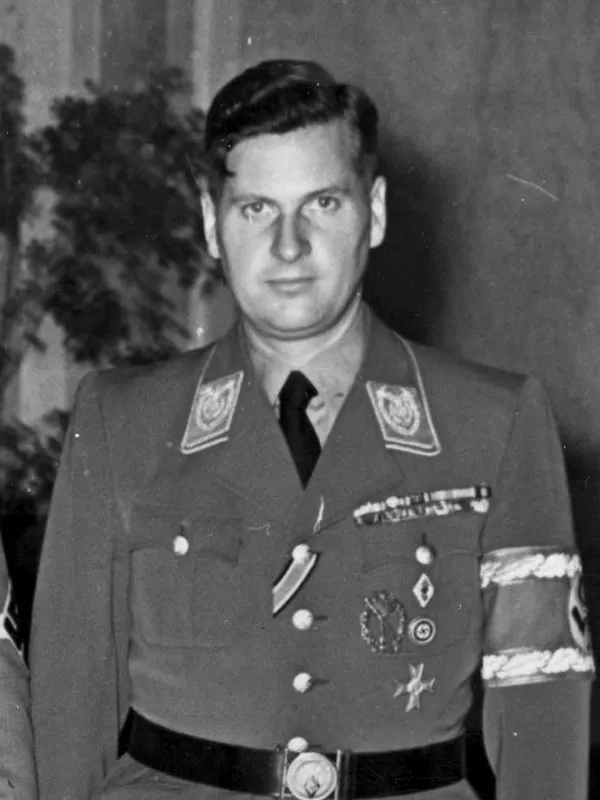
- Born:
- 9 May 1907, Berlin (German Empire)
- Died:
- 8 August 1974, Kröv (West Germany)
- Author:
- Natalia
- Photo:
- autor nieznany, domena publiczna, Wikimedia Commons

Baldur von Schirach was the man who raised a whole generation for Hitler. As leader of the Hitler Youth from 1931 to 1940 he turned a small party youth wing into a state organisation that took in almost all German children and teenagers, instilling in them the cult of the Führer, obedience and a readiness to die for the “national community”. It was from these age groups that the army which marched into Poland in 1939 was recruited. From 1940, as Gauleiter and Reich Governor in Vienna, he brought about the deportation of tens of thousands of Jews from the city, almost none of whom survived. At Nuremberg he was one of the few defendants to condemn Hitler and the Holocaust publicly, but to the end of his life he denied knowing where the trains from Vienna were going.
Childhood in Weimar
Baldur Benedikt von Schirach was born in Berlin on 9 May 1907, the youngest of the four children of Carl von Schirach, a former officer in the Guards cavalry, and an American, Emma Middleton Lynah Tillou. His father’s noble family also had American roots – three of the boy’s four grandparents came from the United States – and through his mother Baldur was descended from one of the signatories of the Declaration of Independence. English was spoken at home, and the boy learned German only when he was several years old.
In 1909 his father became intendant of the court theatre in Weimar, and the family moved to the city of Goethe and Schiller. After the revolution of 1918 Carl von Schirach lost his post, and Baldur’s elder brother Karl took his own life in 1919, reportedly in despair at the Kaiser’s abdication and the Treaty of Versailles. Baldur was educated at a boarding school in Bad Berka and then at the Weimar grammar school. The atmosphere at home combined a cult of the arts with nationalism and hostility to the republic. As a teenager he joined a paramilitary youth group, and his antisemitism, as he later admitted, came from reading The International Jew by the American industrialist Henry Ford and the writings of Houston Stewart Chamberlain.
Student and NSDAP activist
In 1925 the seventeen-year-old Schirach heard Adolf Hitler speak in Weimar and became his fervent disciple; Hitler later visited his parents’ home. That same year he joined the NSDAP (membership number 17,251) and the SA. He went to Munich to study German and art history, never completing his studies, and quickly entered the party leader’s entourage. He wrote fawning poems about Hitler, and in 1928 became head of the National Socialist German Students’ League (NSDStB). He won over for the party the sons of the middle classes, who went over to the Nazis in large numbers during the Great Depression; in 1929–1931 the league won student union elections at one university after another, before the NSDAP gained mass support among voters.
On 30 October 1931 Hitler appointed him Reich Youth Leader of the NSDAP, that is, leader of all the party’s youth organisations, foremost among them the Hitler Youth. In March 1932 Schirach married Henriette Hoffmann, the daughter of Hitler’s personal photographer Heinrich Hoffmann; the witnesses were Hitler and Ernst Röhm. The marriage brought him into the Führer’s innermost circle and to his Alpine residence, the Berghof. In July 1932 he was elected to the Reichstag. In October he organised the “Reich Youth Day” in Potsdam, attended by several tens of thousands of Hitler Youth members, and he turned the death of fifteen-year-old Herbert Norkus, killed by communists, into the myth of a martyr of the movement.
Youth Leader of the Reich
After Hitler came to power, Schirach swiftly eliminated the competition. On 5 April 1933 a Hitler Youth squad occupied the offices of the Reich Committee of German Youth Associations, and on 17 June Hitler appointed Schirach Youth Leader of the German Reich, responsible for all young people in the state. Scouting, trade union, political and denominational organisations were dissolved or absorbed into the Hitler Youth; the Catholic associations held out longest. Schirach proclaimed the slogan “youth leads youth”, but in practice the Hitler Youth was an ideological machine: weekly sessions on “race” and “blood”, marches, camps, shooting practice, field “war games” and the cult of Hitler, to whom Schirach dedicated his poems and songs. “The true great educational work of a nation consists in instilling in its youth blind obedience, unshakeable loyalty, unconditional comradeship and absolute reliability,” he said in May 1938.
The law of 1 December 1936 made the Hitler Youth the state organisation for all German youth, and Schirach, as head of a “supreme Reich authority”, answered directly to Hitler. According to the organisation’s own figures, it had some six million members in 1936, and after compulsory service was introduced in March 1939 it embraced almost all children and teenagers aged 10 to 18. Together with Robert Ley, Schirach founded the elite Adolf Hitler Schools to train the party’s future cadres. He cultivated contacts with the fascist youth of Italy and other countries. In 1937 he clashed with Erwin Rommel, the army’s liaison officer to the Hitler Youth, who wanted to place the military training of young people under the Wehrmacht; the dispute ended with Rommel being removed from youth affairs.
During Kristallnacht in November 1938, Hitler Youth members in some places took part in destroying synagogues and Jewish shops. After the war defence witnesses claimed that Schirach had forbidden the Hitler Youth to take part in the pogrom, but there is no evidence of this, and any such ban would in any case have been issued only after the riots.
At the front and in Vienna
The war deprived the Hitler Youth of most of its older leaders, who were called up. In December 1939 Schirach, too, volunteered for the army. He served in the Großdeutschland infantry regiment, with which he went through the French campaign in May 1940, including the fighting at Sedan; he rose to the rank of Leutnant and was awarded the Iron Cross 2nd Class. Meanwhile in Berlin Artur Axmann became his deputy and, from August, his successor at the head of the youth organisation. Schirach kept the title of Reichsleiter for Youth Education and from the autumn of 1940 directed the expanded programme of evacuating children from cities threatened by air raids to the countryside (Kinderlandverschickung), which in time took in millions of children and also served to indoctrinate them ideologically in Hitler Youth camps.
On 7 August 1940 Hitler appointed him Gauleiter and Reich Governor in Vienna in place of Josef Bürckel, and at the same time Reich Defence Commissioner for Military District XVII. For an ambitious 33-year-old this was in reality only an apparent political promotion: it removed him from Berlin and the centre of power. Unlike Bürckel, who had brought men from the Reich to Vienna, Schirach surrounded himself with Austrian Nazis, flattered the Viennese and invested in theatre, opera, exhibitions and music, hoping to make Vienna the cultural capital of the “new Europe”. He and his wife lived in luxury, furnishing their residence with works of art and furniture looted from Jews.
The deportation of the Viennese Jews
Schirach was an avowed antisemite, and in Vienna he made his own the local party’s demand that the Jews be removed from the city and their flats taken over. Almost all the Jews from other parts of Austria had previously been concentrated in Vienna, and in the autumn of 1940 some 60,000 still lived in the city, most of them elderly and poor. On 2 October 1940, at a meeting with Hitler attended by Hans Frank, Schirach declared that the Governor-General would have to take over more than 50,000 Viennese Jews. On 3 December 1940 the head of the Reich Chancellery, Hans Lammers, informed him that the Führer had approved their removal to the General Government. Between 15 February and 12 March 1941 five trains carried some 5,000 Viennese to Opole Lubelskie, Kielce, Modliborzyce, Łagów and Opatów, where most of them died of hunger and disease or were murdered in 1942 in the death camps of Operation Reinhard. The transports were halted because of the preparations for the attack on the USSR.
From October 1941 the deportations resumed on a much larger scale. Trains from the Aspang station went to the Łódź Ghetto, Kaunas, Riga, Minsk, Izbica, Sobibór and Theresienstadt. They were organised by the Central Office for Jewish Emigration headed by Alois Brunner, which was subordinate to Adolf Eichmann’s office in Berlin, but the Gauleiter fully supported them and publicly boasted of them. On 6 June 1942 he told a rally that when he came to Vienna he had declared to Hitler that he regarded making the city “free of Jews” as his chief task, and he announced that the task would be completed that autumn, after which it would be the turn of Vienna’s Czechs. In September 1942, at a congress of the European Youth Association in Vienna, he said: “If anyone were to reproach me for having deported tens of thousands of Jews from this city, once the metropolis of Jewry, to the ghetto in the east, I must reply: I see in this an active contribution to European culture.” According to various calculations, between about 48,000 and 65,000 Jews were deported from Vienna under his rule; only a few per cent survived.
Schirach later claimed that he had not known that the deportees were being murdered. Yet reports from the Einsatzgruppen on mass executions in the east reached his office. In May 1942 he listened to a speech by the Reich Governor of the Wartheland, Arthur Greiser, who, to the applause of the audience, made it clear what had happened to the Jews of the Łódź Ghetto, including the Viennese who had been sent there; and in October 1943 he was in the audience for Heinrich Himmler’s Posen speech about the “extermination” of the Jews, women and children included.
Disfavour and the fall of Vienna
Schirach’s cultural ambitions irritated Hitler and Joseph Goebbels. Hitler did not want Vienna, which he had loathed since his youth, to rival Berlin; Linz was to be its cultural counterweight. After an exhibition of young art that Schirach brought to Vienna in 1943, and which Nazi critics condemned as “degenerate”, Hitler ordered it closed and reproached the Gauleiter. In 1943, during the Schirachs’ stay at the Berghof, there occurred a scene that was later described many times: Henriette von Schirach told Hitler of a brutal deportation of Jewish women she had witnessed in Amsterdam, and he flew into a rage and accused her of sentimentality. Baldur von Schirach also spoke there of the need for a milder policy towards the peoples of Eastern Europe and of the need to end the war. The Schirachs were never again invited to the Berghof, but the Gauleiter kept his office. In Vienna his conflict with Hitler was later sometimes presented as a kind of resistance, although Schirach remained a loyal National Socialist.
In the last year of the war Schirach commanded the Volkssturm in his Gau. On 24 February 1945, at a meeting of Gauleiters in Berlin, Hitler ordered him to defend Vienna at all costs. When the Red Army approached the city at the beginning of April, Schirach issued an order to fight “to the last man”, while he himself left the city on 9 April for the area north of the Danube, where for several weeks he served as a liaison officer with retreating SS headquarters. After Hitler’s death he fled west to the Tyrol, where, under the name “Richard Falk”, he posed as a writer of crime novels. On 4 June 1945 he gave himself up to the Americans.
Nuremberg and Spandau
Before the International Military Tribunal at Nuremberg (PL), Schirach, the youngest of the defendants, was tried for participation in the conspiracy against peace and for crimes against humanity. He adopted a strategy similar to Albert Speer’s: he accepted moral responsibility but denied knowing of specific crimes. He called the Holocaust “the greatest and most satanic mass murder in history”, for which Hitler and Himmler were responsible. “My guilt is that I educated German youth for a man who murdered millions,” he said, while arguing at the same time that the young generation itself was innocent. The prosecutor Thomas J. Dodd presented documents that had passed through his office concerning the deportation of Viennese Jews to Riga and mass executions of Jews in the east; Schirach claimed he had not seen them.
On 1 October 1946 the tribunal acquitted him of crimes against peace, finding that, despite the military character of the Hitler Youth, he had not taken part in planning wars of aggression. It convicted him, however, of crimes against humanity: it found that Schirach had not initiated the removal of the Jews from Vienna but had taken part in it as Gauleiter, knowing that the best the deportees could expect was a miserable existence in the ghettos of the east, and that reports of their murder were in his office. The sentence was 20 years’ imprisonment.
He served the full term in Spandau prison in Berlin, together with Rudolf Hess, Speer and other convicts. While he was in prison his wife obtained a divorce (in 1950, according to most sources); he also lost the sight of one eye. He was released together with Speer at midnight on 30 September – 1 October 1966.
Last years
After his release Schirach gave interviews to the weekly Stern, on which his memoirs Ich glaubte an Hitler (“I Believed in Hitler”, 1967) were based. He also appeared on television, including in a conversation with the British journalist David Frost. By now he called the Nuremberg trial a show trial and denied both his own antisemitism and any knowledge of the Holocaust. He lived in Munich, then on the estate of a former Nazi industrialist near Trossingen, and from 1971, almost blind, in a guesthouse in Kröv on the Moselle run by two former leaders of the League of German Girls. He died there on 8 August 1974. His gravestone bears the words “I was one of you” (Ich war einer von euch).
Significance
Schirach belonged to the youngest generation of the Third Reich’s leaders; he was neither a soldier of the Great War nor an ideologue, but a skilful organiser and propagandist. His achievement was to bind German youth to Hitler: millions of boys who marched in the ranks of the Hitler Youth in the 1930s fought in the Wehrmacht and the Waffen-SS during the war, and in 1945 the youngest of them were sent to defend Berlin. As Gauleiter of Vienna he contributed to the murder of the Viennese Jews, starting the deportations in February 1941, before they extended to the whole Reich, and publicly praising them as a “contribution to European culture”. His confession of guilt at Nuremberg, one of the few made at that trial, was remembered, but his later statements showed that it had been above all a defence rather than a reckoning with the past.
Sources
Mentioned in battles
(01)Often appears with
People who appear in the same events.