United States
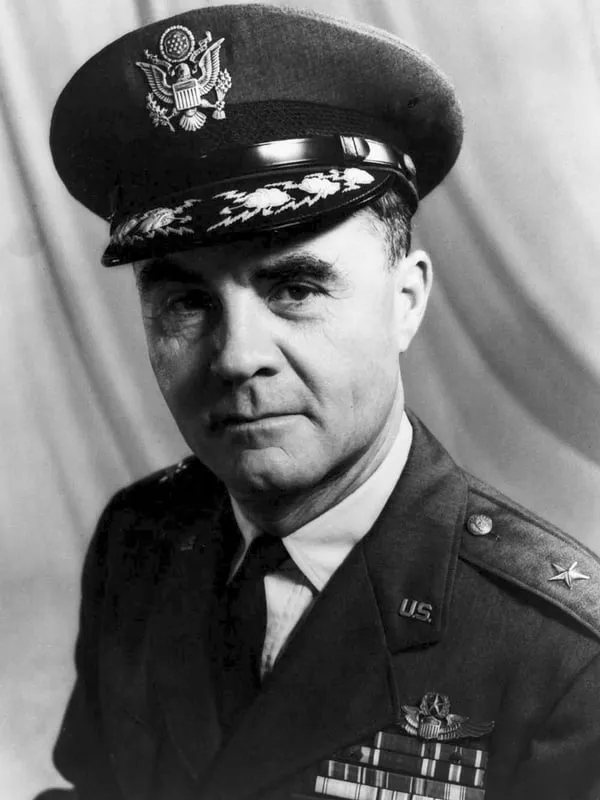
Paul Tibbets
B-17 pilot with the 97th Bomb Group (1942–1943), B-29 test pilot (1943–1944), commander of the 509th Composite Group (1944–1946), USAF Brigadier General (1959)
- Born:
- 23 February 1915, Quincy (Illinois, United States)
- Died:
- 1 November 2007, Columbus (Ohio, United States)
- Author:
- Łukasz
- Photo:
- United States Air Force, domena publiczna, Wikimedia Commons

Paul Warfield Tibbets Jr was an American military pilot who, on 6 August 1945, as aircraft commander of the B-29 bomber Enola Gay, led the raid in which the atomic bomb Little Boy was dropped on Hiroshima – the first nuclear weapon ever used in war. Earlier he had been among the first American bomber pilots to fight over occupied Europe and North Africa, and from 1943 he was one of the principal test pilots of the B-29. From December 1944 he commanded the 509th Composite Group, a self-contained unit created for the sole purpose of delivering atomic bombs to their targets. After the war he served in strategic aviation and rose to the rank of brigadier general, and for the rest of his long life he remained a symbolic figure in the dispute over the purpose and the morality of the bombing of Hiroshima and Nagasaki.
Childhood and the road to flying (1915–1937)
He was born on 23 February 1915 in Quincy, Illinois, the son of Paul Warfield Tibbets Sr, a veteran of the First World War, and Enola Gay Tibbets, née Haggard. He spent his childhood in Iowa, and when he was eight the family settled in Hialeah, near Miami, Florida. It was there, in 1927, that the twelve-year-old boy first went up in an aeroplane: his father had hired a barnstorming pilot, Doug Davis, to drop chocolate bars on miniature parachutes over the Hialeah Park racetrack as an advertising stunt for his company, and Paul flew with him as his helper.
In the late 1920s financial difficulties forced the family to return to Illinois. Paul graduated from the Western Military Academy in Alton in 1933 and then studied at the University of Florida in Gainesville, taking private flying lessons at Opa-locka airfield in Miami at the same time. He intended to become a surgeon and moved to the University of Cincinnati for pre-medical studies, but gave up after a year and a half. His father was against the decision, but his mother – as he recalled – told him that if he wanted to fly, he would certainly be all right. He later gave her name to his most famous aircraft.
Pre-war service (1937–1941)
On 25 February 1937 he enlisted as a flying cadet in the United States Army Air Corps. He did his primary training at Randolph Field, and in 1938 at Kelly Field in San Antonio, Texas, he received his pilot’s wings and a commission as a second lieutenant. He was posted to the 16th Observation Squadron at Lawson Field, Georgia, which worked with the Infantry School at Fort Benning. There, in June 1938, he married Lucy Wingate; they had two sons. In 1940–1941 he was, among other things, the personal pilot of General George Patton, then commanding an armoured brigade at Fort Benning. In June 1941 he moved to the 3rd Bomb Group at Savannah, where he flew A-20 light bombers and was promoted to captain.
He heard about the attack on Pearl Harbor on the radio on 7 December 1941, during a routine flight. In early 1942 he led anti-submarine patrols over the Atlantic coast, flown from Pope Field in North Carolina in obsolete B-18 bombers, and in February 1942 he took command of the 340th Bomb Squadron of the 97th Bomb Group, equipped with B-17 heavy bombers.
Over Europe and North Africa (1942–1943)
In July 1942 the 97th Bomb Group became the first heavy bomber unit of the Eighth Air Force to move to England, to Polebrook in Northamptonshire. The group’s new commander, Colonel Frank Armstrong, made Tibbets his deputy. On 17 August 1942 Tibbets flew as co-pilot in the lead aircraft, Butcher Shop, piloted by Armstrong, on the first daylight raid by American B-17s, against the marshalling yards at Rouen. His usual aircraft was Red Gremlin; his crew included the bombardier Thomas Ferebee and the navigator Theodore Van Kirk, who would fly with him to Hiroshima. On 9 October 1942 he led the first American raid with more than a hundred bombers – against industrial plants and the railway junction at Lille. Many of the bombs fell wide of their targets and killed numerous French civilians. Tibbets later recalled that as early as those first raids, seeing the effects of the bombing, he had decided that as a bomber pilot he could not concern himself with the moral side of his missions – a conviction he repeated all his life.
In the autumn of 1942, during the preparations for Operation Torch, the commander of the Eighth Air Force, General Carl Spaatz, is said to have been asked to name his two best pilots for a secret assignment. According to Tibbets’s biographers and the historian Stephen Ambrose, it was Tibbets who flew General Mark Clark to Gibraltar before his secret mission to Algeria, and a few weeks later, in early November, the Allied Commander-in-Chief himself, General Dwight Eisenhower. Ambrose wrote that Tibbets was then regarded as “the best flier in the Army Air Forces”.
After the Allied landings in North Africa the 97th Group was transferred to General James Doolittle’s newly formed Twelfth Air Force and operated from airfields in Algeria. Tibbets flew in all – according to different tallies – somewhere between a dozen or so and 25 combat missions, and in January 1943 he joined the staff of the Twelfth Air Force as an officer for bombing operations.
B-29 test pilot (1943–1944)
When the commander of the Army Air Forces, General Henry Arnold, was looking for an experienced bomber pilot to test the new B-29 Superfortress strategic bomber, Doolittle recommended Tibbets. In February 1943 Tibbets returned to the United States. The programme was then struggling with serious technical problems, and in February 1943 Boeing’s chief test pilot was killed in the crash of a prototype. Tibbets flew the B-29 at Boeing’s plant in Wichita, Kansas, and soon had more hours on the type than anyone else.
In March 1944 he became director of operations of a B-29 crew training unit at Grand Island, Nebraska.
The 509th Composite Group (1944–1945)
On 1 September 1944 Tibbets reported to the headquarters of the Second Air Force in Colorado Springs. Its commander, General Uzal Ent, and representatives of the Manhattan Project – Captain William Parsons of the US Navy, Lieutenant Colonel John Lansdale and the physicist Norman Ramsey – let him into the secret of the atomic bomb. General Leslie Groves, who headed the project, agreed with the air force that the bomb would be carried by a B-29 and accepted Tibbets as commander of the unit that was to drop it. Tibbets – younger than the other candidates, yet a combat veteran of the skies over Europe and the pilot who knew the B-29 best – was given broad authority and top priority for supplies.
As his base he chose the remote airfield at Wendover, Utah. The core of the unit was the 393rd Bomb Squadron, and in December 1944 the 509th Composite Group was formed – a self-contained formation which by 1945 numbered more than 1,700 men, with its own transport squadron, technical services and, from March 1945, a special ordnance squadron to assemble the bombs. Tibbets picked the crews himself, bringing in Ferebee and Van Kirk among others. The bombers, modified under the Silverplate programme, were stripped of most of their defensive armament. The crews practised dropping single heavy bombs from high altitude, followed immediately by a steep turn of about 155 degrees that was meant to carry the aircraft away from the shock wave; navigation flights over the sea were practised in Cuba. According to Tibbets’s recollections, Robert Oppenheimer warned him that the aircraft might not survive the shock wave of the explosion. In January 1945 Tibbets was promoted to colonel.
In May and June 1945 the 509th Group moved to Tinian in the Marianas, where it occupied a separate section of North Field, fenced off from the other units of the Twentieth Air Force. In July its crews flew training missions with conventional “pumpkin” bombs, which had the shape and weight of the plutonium bomb. After the Trinity test on 16 July and the delivery to the island of components of the uranium bomb by the cruiser Indianapolis, Tibbets was waiting only for the order and for the weather. Under an order issued on 25 July, the day before the Potsdam Declaration was announced, the first bomb could be dropped after 3 August on one of four cities: Hiroshima, Kokura, Niigata or Nagasaki. According to Tibbets, the choice of aircraft was left to him; he picked B-29 serial number 44-86292, which one of the production managers had pointed out to him while it was still on the assembly line at the Martin plant in Nebraska.
Hiroshima (6 August 1945)
On 5 August 1945, when the forecasts promised better weather over Japan, Tibbets had his mother’s name – Enola Gay – painted on the fuselage of the chosen aircraft. To the irritation of the aircraft’s regular commander, Captain Robert Lewis, who flew as co-pilot, he took the controls himself. On 6 August at 2.45 a.m. local time the overloaded B-29 carrying the Little Boy bomb took off from North Field; during the flight Captain Parsons and Second Lieutenant Morris Jeppson armed the bomb. Three weather reconnaissance aircraft had set off an hour ahead of them, and the Enola Gay was accompanied by two B-29s: The Great Artiste, flown by Major Charles Sweeney and carrying measuring instruments, and a third aircraft that took photographs. When the reconnaissance aircraft over Hiroshima reported good visibility, Tibbets set course for the city. At 8.15 a.m. local time Ferebee released the bomb, aiming at the Aioi Bridge; some 43 seconds later it exploded at a height of about 600 metres with a yield usually estimated at 15 kilotons. Tibbets made the rehearsed turn and pulled away from the target; the aircraft was hit by two shock waves.
After twelve hours in the air the Enola Gay landed on Tinian, where General Spaatz at once decorated Tibbets with the Distinguished Service Cross. The effects of the atomic attack on Hiroshima were catastrophic: according to the most frequently cited estimates, between about 70,000 and 140,000 people had died by the end of 1945, the overwhelming majority of them civilians. Three days later the 509th Group carried out the second attack. Tibbets set its date and chose its commander, Major Sweeney, but did not fly himself; after failed runs over Kokura, where the target was obscured by smoke and cloud, the Fat Man bomb fell on Nagasaki. On 15 August Hirohito announced the acceptance of the surrender terms in a radio broadcast.
In the United States Tibbets became a national hero overnight, and the newspapers printed photographs of his wife and sons. By his own account, a few years later President Harry Truman received him at the White House and told him never to lose any sleep over the mission, because it was he, the president, who had given the order.
Post-war service (1945–1966)
In November 1945 the 509th Group returned to the United States and was stationed at Roswell, New Mexico; in January 1946 Tibbets handed over command to Colonel William Blanchard. At the nuclear tests at Bikini Atoll in the summer of 1946 he was only a technical adviser – neither he nor the crew of the Enola Gay was entrusted with the drop. In 1950–1952 he was the supervising officer at Boeing’s Wichita plant for the B-47 Stratojet jet bomber programme, and then directed its trials at Eglin Air Force Base in Florida. In 1955, after divorcing his first wife, he went to the headquarters of NATO’s Allied air forces at Fontainebleau in France, where he met Andrea Quattrehomme; they married in 1956 and had a son, James.
After returning home he commanded the 308th Bombardment Wing in Georgia and, from 1958, the 6th Air Division at MacDill Air Force Base in Florida – both of them Strategic Air Command nuclear bomber units. In 1959 he was promoted to brigadier general. In 1964–1966 he was military attaché in India, where part of the press called him “the world’s greatest killer”. He retired from the service on 31 August 1966.
Later years and the battles over memory
After leaving the military Tibbets joined Executive Jet Aviation, an air taxi company based in Columbus, Ohio (today NetJets), and was its president from 1976 to 1986. He remained a defender of the decision to use the bomb. He repeatedly said that it had hastened the end of the war and saved the lives of hundreds of thousands of soldiers on both sides who would have died in an invasion of the Japanese Home Islands, and that he would do the same again. In a 1975 interview he said that he was proud of having carried out the mission and that he “sleeps clearly every night”.
In October 1976, at an air show in Harlingen, Texas, Tibbets flew a restored B-29 in a re-enactment of the bombing that ended with a pyrotechnic “mushroom cloud”. The display caused outrage in Japan, and – according to press reports – the American government officially apologised to the Japanese for it; Tibbets insisted that he had not meant to offend anyone. An even fiercer dispute broke out in 1994–1995 over the exhibition being prepared by the National Air and Space Museum of the Smithsonian Institution for the 50th anniversary of the raid. The script, which alongside the fuselage of the Enola Gay showed the destruction and the victims in Hiroshima and the historians’ debate over Truman’s decision, came under attack from veterans’ organisations and members of Congress. Tibbets called it “a damn big insult”, accusing its authors of foregrounding the Japanese victims while passing over the brutality of Japan’s war. In January 1995 the museum abandoned that version and displayed only the aircraft with a short caption, and its director resigned.
He died on 1 November 2007 at his home in Columbus, Ohio, at the age of 92, after years of heart trouble. In accordance with his wishes there was no funeral and no headstone – he feared that a grave would become a site of protest for opponents of the bombing. His ashes were scattered over the English Channel, which he had crossed so many times during the war.
Significance
Tibbets did not make the decision to use the atomic bomb, nor did he choose its target – he was the man who carried it out, entrusted with preparing the unit and flying the most difficult mission. That is precisely why he became a mirror of the dispute over Hiroshima: to some he was a soldier who had faithfully obeyed his orders and helped to end the war without a bloody invasion, to others a symbol of a new age in which a single aircraft could destroy an entire city. The flight of the Enola Gay opened the nuclear age and, together with the Soviet declaration of war on Japan and the attack on Nagasaki, sealed Japan’s surrender and the end of the Second World War.
Sources
Often appears with
People who appear in the same events.