Equipment
The Vickers Wellington
A twin-engined bomber built on Barnes Wallis's lattice frame: the mainstay of Bomber Command until 1942, then a U-boat hunter and night bomber in the south.
- Role:
- medium bomber
- State:
- United Kingdom
- Maker:
- Vickers-Armstrongs
- First flight:
- 15 June 1936
- Built:
- 11,461 (11,462 according to some sources)
- Author:
- Natalia
- Updated:
- 1 November 2026
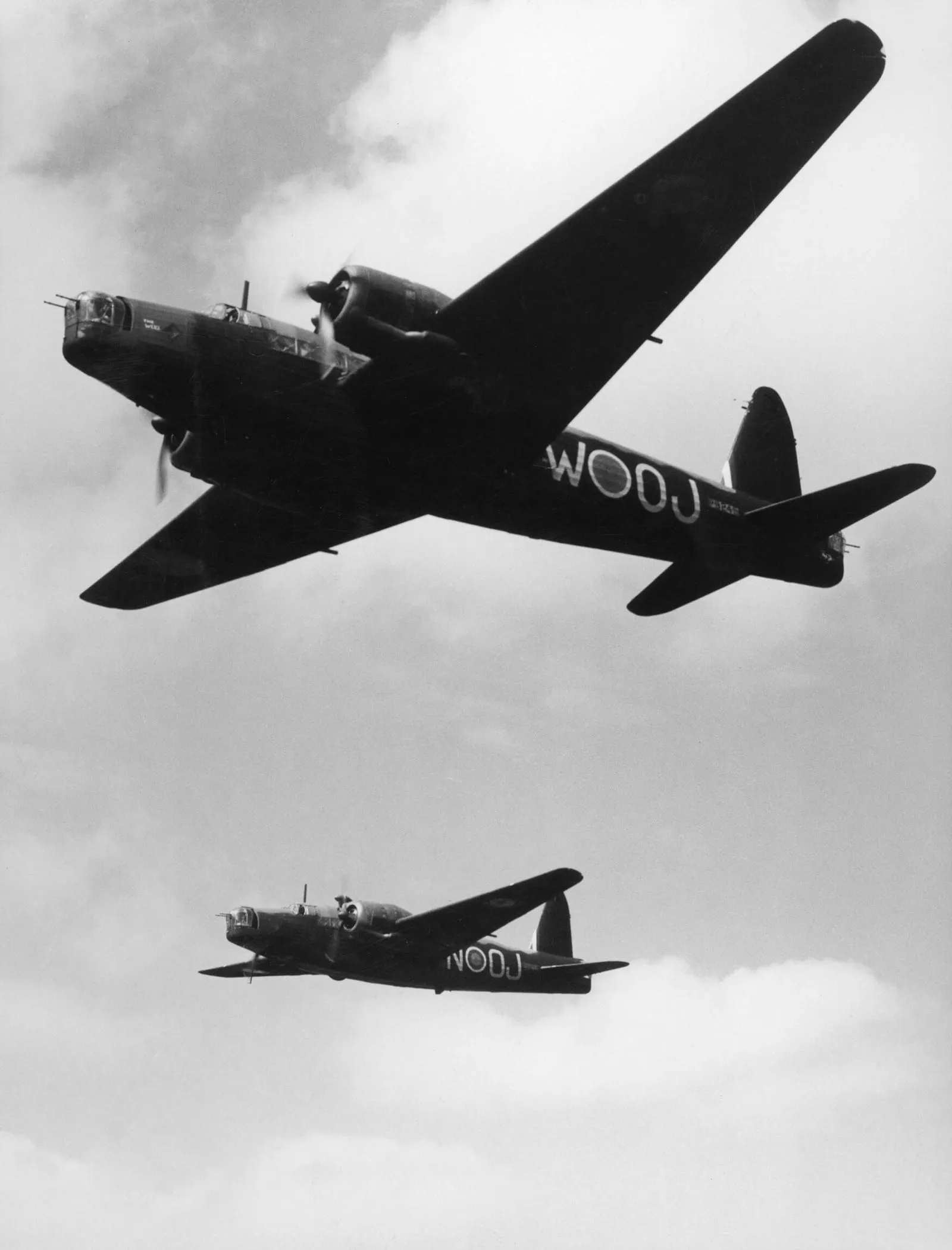
The Vickers Wellington, known to its crews as the “Wimpy” after a character in the Popeye comic strip, was the most numerous British bomber of the war and, until 1942, the backbone of the night offensive against Germany. What set it apart was its structure: the fuselage and wings were an open mesh of light metal strips covered in fabric, which usually held together after being hit. When the heavy four-engined bombers began flying over Germany, the Wellington did not disappear but changed jobs: it hunted submarines over the Atlantic and bombed the ports of the Mediterranean, the Balkans and Burma by night. Poles, New Zealanders, Canadians and Australians flew it as well.
Wallis’s lattice
The aircraft was built to an Air Ministry requirement of 1932 for a twin-engined day bomber. The Vickers team under Rex Pierson used an idea of Barnes Wallis, who had earlier designed airships: a lattice of more than fifteen hundred duralumin members woven together like a basket. It was light and surprisingly strong, but laborious to build and hard to modify. The prototype took off from Brooklands on 15 June 1936, the first production Wellington on 23 December 1937, and in October 1938 No. 9 Squadron RAF received its aircraft. By the outbreak of war six squadrons of No. 3 Group in East Anglia had them, and in August 1939 New Zealand handed the British thirty Wellingtons it had ordered for itself, together with their airmen.
The lesson over the Heligoland Bight
In 1939 the Air Staff believed that well-armed bombers in close formation could defend themselves by day without fighters, and the Wellington, with turrets in the nose and tail, was to prove it. The first RAF raids on 4 September against warships at Brunsbüttel cost two aircraft, and on 3 December twenty-four Wellingtons came back from Heligoland without loss, which No. 3 Group took as confirmation of the theory. Two weeks later, on 18 December, over the Heligoland Bight, German fighters attacked from the beam and from above, where the turrets could not reach, and wings hit without self-sealing tanks caught fire. Of the 22 aircraft that reached the target the RAF lost 15, counting those wrecked on return. From then on the Wellingtons flew over Germany by night.
Before that, a few aircraft were given a quite unusual task. A ring about 15 metres across was fitted under the fuselage, carrying current from a generator on board. Flying low over the water, they set off German magnetic mines; the first was detonated in this way on 8 January 1940.
The night war over Germany
Together with Hampdens and Whitleys, the Wellingtons carried the weight of the Bomber Command offensive for the first two years of the war. On the night of 15–16 May 1940 they flew over the Ruhr by night for the first time, and in August they took part in the first raid on Berlin. In the autumn of 1940 the Polish Nos. 300 and 301 Squadrons converted to Wellingtons from Fairey Battles, followed by Nos. 304 and 305; the Polish Air Force had four squadrons of the type in Bomber Command. The first Polish crews flew it on the night of 22–23 December 1940 against oil tanks at Antwerp. Night bombing was hardly accurate at the time, and losses were growing, as the night of 7–8 November 1941 showed.
When Arthur Harris took over the command in February 1942, Wellingtons fitted with the Gee radio-navigation aid led the first great raids. In the thousand-bomber raid on Cologne on the night of 30–31 May 1942 they made up the majority: according to British returns 602 of 1,047 aircraft, many of them from training units and some with Polish crews. After that their share fell quickly. Squadrons converted to Lancasters and Halifaxes, and No. 305 Squadron flew its last Bomber Command sortie in August 1943. According to Polish accounts, the last Wellington bombing raid on Germany, against Hanover on the night of 8–9 October 1943, was flown by No. 300 Squadron and one Canadian squadron. Until March 1944 Polish airmen still laid mines in them, and in the operational training units Wellingtons served until the end of the war.
The Mediterranean, the Middle East and the Far East
In the south the Wellington was for a long time the heaviest bomber the RAF had. From Luqa on besieged Malta, No. 148 Squadron bombed Naples, Tripoli and the Sicilian airfields from the autumn of 1940, for which the Luftwaffe destroyed its aircraft on the ground. In May 1941 Wellingtons of Nos. 70 and 37 Squadrons from Shaibah struck the Iraqis besieging Habbaniya in the Anglo-Iraqi War. Over the desert they flew by night: at Alam Halfa in August 1942 naval aircraft dropped flares over Rommel’s jammed columns and the Wellingtons bombed the lit-up targets.
Later No. 205 Group RAF took them to Apulia. In the spring of 1944 its Wellingtons, flying low over the water at night, dropped mines into the Danube, along which Romanian oil travelled to Germany. In India Nos. 99 and 215 Squadrons were the RAF’s only long-range bombers until the summer of 1944; in November 1943 they bombed Rangoon by night while the Americans attacked by day.
Over the Atlantic and the end of service
Coastal Command received Wellingtons with radar and, from 1942, with a powerful searchlight under the fuselage, the Leigh Light, which lit up a surfaced submarine in the last seconds of a night approach. In July 1942, in the Bay of Biscay, a Wellington so equipped sank the first U-boat to be destroyed this way. The Polish No. 304 Squadron (PL) also moved to coastal defence in May 1942, after heavy losses over Germany. Until the end of the Battle of the Atlantic it patrolled the Bay of Biscay and the waters around the British Isles in Wellingtons, and on 2 April 1945 it sank U-321.
In 1942 the factories at Weybridge, Broughton near Chester and Blackpool each built several dozen aircraft a month; in October 1943 workers at Broughton assembled a Wellington in less than a day to set a record. The last one left the shop on 13 October 1945, and as a trainer it served with the RAF until 1953. Today visitors can see an example raised in 1985 from the bottom of Loch Ness, displayed at Brooklands, and a restored Wellington at the RAF Museum at Cosford.
Sources
Battles
(03)- 2–31 May 1941Anglo-Iraqi WarFrom 2 to 31 May 1941 the British defeated Rashid Ali's army: they held RAF Habbaniya, took Fallujah and reached the outskirts of Baghdad.
- 15–17 June 1941Operation BattleaxeOn 15–17 June 1941 the British tried to defeat Rommel on the Egyptian frontier and relieve Tobruk. They lost more than 90 tanks and fell back.
- 30 August – 5 September 1942Battle of Alam el HalfaOn 30 August – 5 September 1942 Rommel struck in Egypt for the last time. Short of fuel and under RAF bombs, he was repulsed at Alam el Halfa and fell back.
In the chronicle
(45)1939
1940
- 15 May 1940The RAF begins bombing the Ruhr
- 12 July 1940Air raids on Wales and Scotland
- 25 August 1940The first RAF raid on Berlin
- 24 September 1940A major RAF raid on Berlin
- 25 October 1940RAF raids on Berlin and Hamburg
- 16 November 1940British aid to Greece
- 9 December 1940Operation Compass begins
- 16 December 1940The raid on Mannheim
1941
- 3 January 1941RAF raids on Bremen and the Kiel Canal
- 5 January 1941The capture of Bardia
- 21 January 1941The capture of Tobruk
- 10 February 1941Malta under the bombs
- 30 April 1941The Iraqi siege of Habbaniya
- 2 May 1941The Anglo-Iraqi War begins
- 12 May 1941RAF raids on Hamburg and Berlin
- 6 June 1941Operation Rocket
- 17 July 1941Operation Substance
- 7 September 1941The RAF raid on Berlin of 7 September
- 7 November 1941The RAF raid of 7–8 November
1942
- 13 March 1942Gee raids on the Ruhr
- 28 March 1942The bombing of Lübeck
- 28 March 1942The St Nazaire raid
- 5 April 1942RAF raids on Cologne and Hamburg
- 30 May 1942The thousand-bomber raid on Cologne
- 2 June 1942The thousand-bomber raid on Essen
- 25 June 1942The thousand-bomber raid on Bremen
- 27 July 1942The RAF raid on Hamburg of 26/27 July
- 30 August 1942The Battle of Alam el Halfa begins
- 10 September 1942The raid on Düsseldorf
- 22 October 1942The raid on Genoa
- 23 October 1942The Second Battle of El Alamein begins
- 25 October 1942Rommel returns to Africa