- Category:
- Military operations
- Front:
- Mediterranean
- Date:
- 23 October 1942
- Author:
- Łukasz
- Battle:
- Second Battle of El Alamein
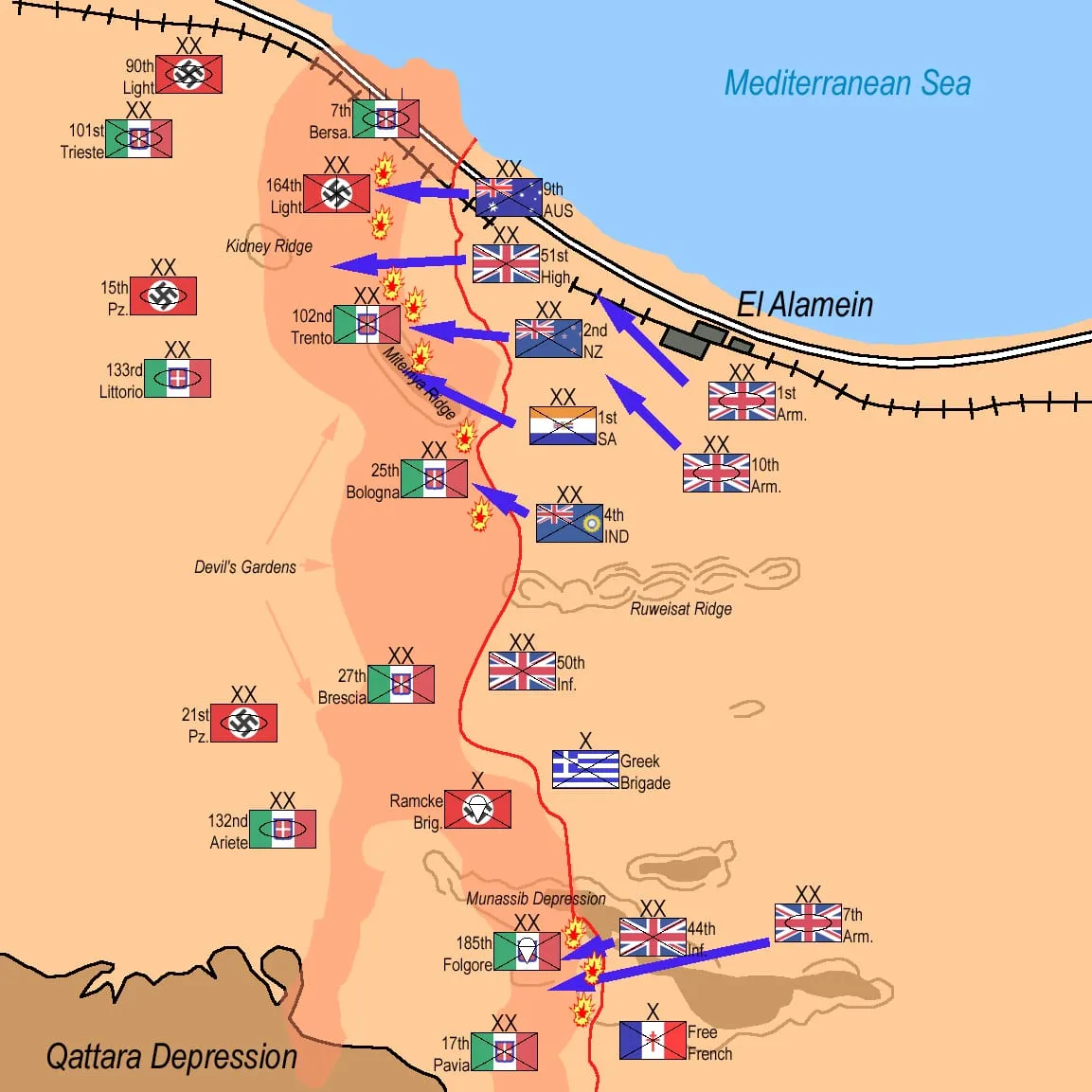
On the evening of 23 October 1942, at 9.40 p.m. local time, the artillery of the British Eighth Army opened fire along the whole front at El Alamein, from the Mediterranean coast to the edge of the Qattara Depression. Twenty minutes later the infantry of four divisions – Australian, Scottish, New Zealand and South African – moved forward, followed by sappers who began clearing lanes through the German and Italian minefields by the light of a full moon. So began Operation Lightfoot, the first phase of the Second Battle of El Alamein, which General Bernard Montgomery had been preparing ever since he took command of the Eighth Army in August. On the other side of the front Field Marshal Erwin Rommel was absent; he had been on sick leave in Europe for a month.
The air war before the battle
The battle on the ground was preceded by a battle in the air. British air forces in the Middle East under Air Chief Marshal Arthur Tedder, and on the Egyptian front the Desert Air Force under Air Vice-Marshal Arthur Coningham, had for weeks been attacking Axis supply routes, the ports in Libya and enemy airfields. Coningham’s headquarters stood next to Montgomery’s at Burg el Arab, west of Alexandria – such close co-operation between air and land forces was something new in 1942. The Desert Air Force then numbered 29 squadrons, including nine South African and three American; according to most accounts, at the start of the battle the Allies had about 530 serviceable combat aircraft in front-line units in Egypt, against about 350 German and Italian.
War chronologies describe 21 October with the phrase “increased RAF activity over El Alamein”, which captures the essence of those days, although it does not refer to a single event. As early as 9 October, when torrential rain flooded the Axis forward airfields around El Daba, British bombers and fighter-bombers attacked the aircraft stranded on them. From about 19–20 October the intensity of operations rose further: above all, the air forces had to keep German reconnaissance away from the Eighth Army’s rear areas, where tanks and guns were being moved into their start positions at night, while at the same time bombing Axis airfields, columns and positions. According to British accounts, in the last days before the attack German and Italian aircraft seldom appeared over the front, and German air reconnaissance failed to spot the concentration. From Malta, which in October was beating off Field Marshal Albert Kesselring’s last great air offensive, aircraft and submarines went on sinking ships carrying fuel and ammunition for Panzer Army Africa, with signals intelligence supplying information on their routes.
The Lightfoot plan
Since the end of the Battle of Alam el Halfa in early September the two armies had faced each other in almost the same positions. The front at El Alamein was about 60 kilometres long and could not be outflanked: in the north it ended at the sea, in the south in the trackless wastes of the Qattara Depression. Any attack therefore had to be a frontal assault on a fortified zone. Even before his departure for Europe Rommel had ordered the construction of “devil’s gardens” – two main belts of minefields, linked by transverse belts into boxes, containing almost half a million mines, mostly anti-tank. Behind the second belt lay the main line of defence.
Montgomery decided to strike his main blow in the north. During the night the infantry of General Oliver Leese’s XXX Corps was to break through the first minefield belt on a front some fifteen kilometres wide and seize positions on the western edge of the second, marked on the maps as the Oxalic line. Behind it the sappers were to open two corridors: a northern one, in the Australian and Scottish sector, and a southern one through the New Zealand sector towards Miteirya Ridge. Through these corridors the two armoured divisions of General Herbert Lumsden’s X Corps – the 1st and 10th – were to pass and, before dawn, take up position further west on the Pierson line, ready to repel German counter-attacks. In the south, General Brian Horrocks’s XIII Corps was to attack so as to pin down the German 21st Panzer Division and the Italian Ariete Division there, but without suffering heavy tank losses.
Montgomery envisaged a battle lasting about twelve days, in three stages: the break-in, a long and bloody “dog fight” that he called “crumbling” – the methodical destruction of the enemy infantry piece by piece – and finally the decisive break-out. He departed from earlier British plans in which the tanks were first to destroy the enemy’s tanks. Now it was the infantry and artillery that were to wear down the defence, with the tanks shielding them from counter-attacks. The plan rested on the assumption that in a battle of attrition the side with more men, equipment and ammunition would win. The date of the attack, set for the October full moon, was approved by the Commander-in-Chief Middle East, General Harold Alexander. Both generals resisted pressure from Winston Churchill, who wanted an attack as early as September – Montgomery replied that he needed time to train the new divisions and build up supplies, and that haste risked a repetition of the summer’s failures.
And of these the Eighth Army had a great many more. According to the British official history it numbered about 195,000 men against some 104,000 on the Axis side (other estimates give up to 116,000), roughly half of them Italian. It had 1,029 serviceable tanks, including about 250 new American Shermans, against 547 German and Italian tanks, more than half of them obsolete Italian vehicles. The superiority in artillery and aircraft was similar. What Panzer Army Africa lacked most acutely, however, was fuel – its stocks would last only a few days of fighting.
Deceiving the enemy
There was no hiding the preparations for an attack on so narrow a front. It was possible, however, to mislead the enemy about the place and timing of the blow. That was the purpose of Operation Bertram, worked out by the Eighth Army staff with the help of Colonel Dudley Clarke’s secret deception unit, “A” Force, and the camouflage team of Major Geoffrey Barkas, a film director before the war. In the north, where the blow was to fall, stacks of empty crates and tins were laid out under camouflage nets as early as September. German airmen photographed them, but when nothing changed for weeks they stopped paying attention – and then, night by night, the dummies were replaced with real ammunition, fuel and food. Tanks moving to their start positions were covered with light frames disguised as lorries, and dummies were left in the places they had vacated. Guns and their limbers were hidden under canopies shaped like vehicles.
In the south, by contrast, the impression of a great concentration was created: dummy tanks and guns made of woven palm fronds and canvas, fake dumps and a sham water pipeline, built at a pace suggesting that it would not be finished before the beginning of November. Fake radio traffic (Operation Canwell) completed the picture. The Germans were to believe that the attack would come in the south and several days later than planned. This part of the task largely succeeded: Stumme was expecting an attack, but not on that night, and the division of the armoured reserves into a northern and a southern group meant that the 21st Panzer Division and the Ariete stood far from the main scene of the fighting for the first few days.
The navy also took part in the deception. Some chronologies mention British warships supporting the right wing of the attack – in fact their role was one of deception rather than fire support. On the night of 23–24 October the Royal Navy staged a mock landing on the coast behind the Axis lines, between El Daba and Sidi Abd el Rahman: motor torpedo boats shelled the shore, played recordings of unloading through loudspeakers and manoeuvred so as to give the impression of an approaching flotilla, while aircraft laid smoke screens still further west. How far this ruse influenced the decisions of the Axis command is hard to judge; British writers credit it above all with deepening the enemy’s uncertainty about the direction of the main attack in the first hours of the battle.
The evening of 23 October
Montgomery issued a message to his troops, read out in the units on the eve of the attack. He reminded them that under the orders he had received the Eighth Army was to destroy Rommel and his army, that it was ready and had the advantage, and that the battle would be one of the decisive battles of history. He ended with a call to pray that “the Lord mighty in battle” would give them the victory. Throughout 23 October the front-line infantry lay hidden in narrow slit trenches in no man’s land, unable to move for fear of betraying the concentration.
The evening was cloudless and the moon was full – the date had been chosen precisely because the sappers needed light to work in the minefields. At 9.40 p.m. some 880 field and medium guns positioned along the whole front opened fire, so synchronised that the first shells of every battery landed at the same moment. For the first quarter-hours the artillery pounded previously located Axis battery positions; it then shifted its fire to the positions in front of the advancing infantry and kept it up for more than five hours. The bombardment is most often described as the fire of “a thousand guns”; behind that round number lie just under 900 barrels of field and medium artillery, not counting anti-tank and anti-aircraft guns. Each gun fired several hundred rounds that night – by British calculations more than half a million in all. At the same time Vickers Wellington bombers attacked artillery positions and reserves behind the front, and, according to British sources, specially equipped aircraft jammed the radio communications of German armoured units.
The barrage took the defenders by surprise. The first salvoes destroyed much of the telephone network, and many command posts had no idea for hours what was happening in front of them. The German artillery, husbanding its ammunition, replied only weakly.
A night in the “devil’s gardens”
At 10 p.m. the infantry of XXX Corps left their trenches. They advanced in four divisions side by side. On the right, coastal flank attacked General Leslie Morshead’s 9th Australian Division, veterans of the defence of Tobruk in 1941. To its left went the Scottish 51st (Highland) Division, fighting its first battle in Africa – its battalions were led by pipers, and their objectives bore the names of Scottish towns. Next came General Bernard Freyberg’s 2nd New Zealand Division and, on the left flank, General Dan Pienaar’s 1st South African Division. On Ruweisat Ridge the 4th Indian Division carried out raids designed to pin down the enemy in the centre.
The statement found in some chronologies that the attack was carried out “mainly by Australians” therefore needs qualifying. The 9th Australian Division was one of the four divisions that broke into the defences that night, and it attacked on the most exposed, northern sector. It was the Australians who in the following days would play a particularly important role and suffer the heaviest losses, but on the first night the main burden of the break-in was shared more or less equally between Australians, Scots, New Zealanders and South Africans, supported by British tanks and artillery. Even before the barrage one of the Australian brigades staged a feint attack on the coast itself, drawing the enemy’s fire and attention.
The sappers followed the infantry. Their task was to clear several lanes about seven metres wide in each corridor – enough for tanks to drive through one behind another – and to mark them with tape and lamps. Anti-tank mines did not explode under the feet of infantrymen, but they were deadly to tanks and lorries. The sappers found them on their knees, probing the sand with bayonets, and also with new electromagnetic detectors. Some of these were a version of the mine detector designed in Scotland by a Polish engineer, Lieutenant Józef Kosacki; according to Polish writers several hundred of these devices reached Egypt before the battle. Scorpion flail tanks were also used in battle for the first time; they detonated mines in their path with chains attached to a rotating drum, but they were still unreliable and quickly broke down.
The attack advanced more slowly than planned. The minefields proved deeper, and the defensive positions denser, than British intelligence had believed. The Italian and German defenders, though stunned by the bombardment, put up stubborn resistance in many places. The Australians in the north reached most of their objectives. The Scots took some of theirs but were held up in certain sectors in front of strongly defended strongpoints. The New Zealanders reached Miteirya Ridge at dawn, and the South Africans took its southern end at about eight in the morning, at the cost of heavy losses. Roughly half the infantry reached the Oxalic line; the rest halted short of it.
At about two in the morning the tanks of X Corps began to enter the lanes. The corridors soon turned into traffic jams: hundreds of vehicles raised so much dust that visibility fell almost to zero, the lanes were not yet finished, and vehicles that strayed off the narrow tracks were blown up on mines. By dawn on 24 October not one armoured division had got through the second minefield belt. The 1st Armoured Division was stuck in the northern corridor, and the 10th Armoured Division on and behind Miteirya Ridge, exposed to the fire of German anti-tank guns.
In the south
In the southern sector XIII Corps sent the 7th Armoured Division and brigades of the 44th Infantry Division into the attack. They broke through the first minefield belt but stalled in front of the second under fire from well-concealed positions. On the extreme left flank a Free French brigade tried to seize the Himeimat heights, which overlooked the whole southern part of the battlefield, but a German tank counter-attack forced it to withdraw. The Italian 185th Parachute Division “Folgore”, which had already repulsed a British attack in this area at the end of September, fought with particular tenacity. The attack in the south gained no ground, but it served its purpose: it convinced the Axis command that a serious blow might come here too and kept the 21st Panzer Division in place.
The morning of 24 October
The first night gave the Eighth Army a foothold deep in the Axis defences, but not a breakthrough. The infantry had driven several kilometres into the “devil’s gardens” and taken some of the key heights, but the tanks had not reached open ground, which the plan had expected to happen before dawn. Montgomery, who by his own account had gone to bed before the barrage began, ordered in the morning that the clearing of the corridors be completed and the armoured divisions pushed forward. From that moment the battle ceased to follow the timetable, and the phase he himself called the “dog fight” began.
On the Axis side the effects of the first night were more serious than they had at first seemed. The Italian Trento Division and the German 164th Light Division, holding the northern sector, had lost much of their infantry and artillery, and army headquarters had no clear picture of the situation for many hours. In the morning General Georg Stumme drove to the front to see everything for himself – and never came back from that journey. That same day Adolf Hitler telephoned Rommel at his sanatorium in Semmering.
Place in the war
The Second Battle of El Alamein is often described as the last great battle that Britain and the Commonwealth won on their own, without Americans fighting on land. After more than ten days of gruelling fighting, on the night of 1–2 November, Montgomery launched a new attack, Operation Supercharge, and on 4 November Rommel – against Hitler’s order to fight to victory or death – began to withdraw the remnants of his army westwards. Within a week the Axis forces had left Egypt. On 8 November the Allies landed in Morocco and Algeria, an operation whose preparations – from General Clark’s secret mission to the first convoys – went on in the very days when the guns were thundering at El Alamein. The Axis forces in Africa were caught in a pincer that closed in Tunisia in May 1943.
In Britain the victory was greeted as a release from a series of defeats stretching from Dunkirk to the fall of Tobruk. On 10 November, at the Mansion House, Churchill said that this was not the end, nor even the beginning of the end, but perhaps the end of the beginning, and a few days later church bells rang out across the country for the first time since 1940. Churchill later wrote that before Alamein there had been no victories and after it there were no defeats – an exaggeration, but one that captures the mood of that autumn well.
The battle that began on 23 October coincided with decisive struggles on two other fronts. That same day the Japanese launched their great attack on Henderson Field on Guadalcanal, while in Stalingrad the heaviest fighting for the factories in the northern part of the city was under way. None of these three battles decided the outcome of the war on its own, but together they marked the moment when the strategic initiative began to pass to the Allies: in Africa, in the Pacific and on the Eastern Front, the autumn of 1942 was the last period of Axis offensives.
Sources
Meanwhile
(04)Elsewhere, within a week.
- 22 October 1942 · SocietyBritain lowers the call-up ageOn 22 October 1942 Ernest Bevin told the Commons that 18-year-olds would be called up. Until then, in practice, men were called only from 18 and a half.
- 24 October 1942 · MilitaryThe Operation Torch convoys sailOn 24 October 1942 Admiral Hewitt's fleet with Patton's troops left Hampton Roads for Morocco. Convoys from the Clyde were already bound for Algeria.
- 26 October 1942 · PacificThe Battle of the Santa Cruz IslandsOn 26 October 1942 the Japanese sank the carrier Hornet and damaged Enterprise but lost nearly 150 airmen. Tactically, Japan won the battle.
- 18 October 1942 · PacificHalsey takes command in the South PacificOn 18 October 1942 Nimitz relieved the exhausted Ghormley and gave the South Pacific to Vice Admiral Halsey. The news lifted morale on Guadalcanal.
Related events
(04)The same battle, people or subject.
- 24 October 1942 · MediterraneanThe crisis at El AlameinOn 24 and 25 October 1942 British tanks stuck in the minefield corridors at El Alamein. Montgomery ordered them to keep attacking despite the losses.
- 3 November 1942 · MediterraneanRommel's retreat from El AlameinOn 3 November 1942 Hitler forbade Rommel to retreat from El Alamein. A day later the front broke and the Axis army fled west, abandoning the Italian infantry.
- 1 November 1942 · MediterraneanOperation SuperchargeOn the night of 1/2 November 1942 the Eighth Army struck at Tel el Aqqaqir. The charge of the 9th Armoured Brigade and a tank battle broke the Afrika Korps.
- 31 October 1942 · MediterraneanThe fighting for Thompson's Post at El AlameinOn the night of 30/31 October 1942 the Australians reached the coast road at El Alamein. Beating off counter-attacks, they drew Rommel's reserves north.