- Category:
- Military operations
- Front:
- Mediterranean
- Date:
- 9 December 1940
- Author:
- Natalia
- Battle:
- Operation Compass
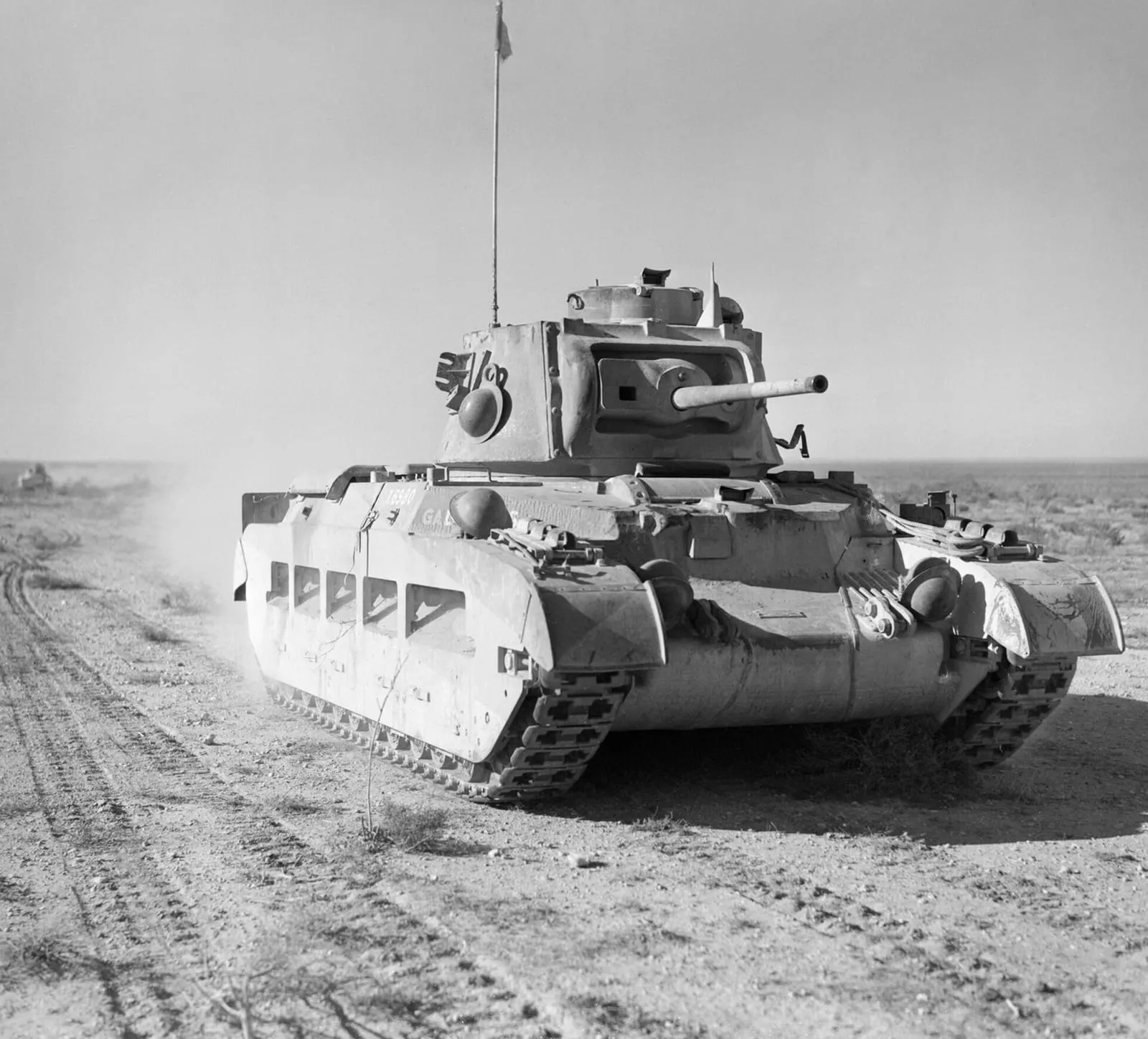
At dawn on 9 December 1940, after two nights of marching across the desert, Matilda infantry tanks of the British 7th Royal Tank Regiment drove into the rear of the Italian fortified camp at Nibeiwa, about 20 kilometres south of Sidi Barrani. In less than four hours the camp had fallen and its commander, General Pietro Maletti, was dead. So began Operation Compass, the first great British offensive in North Africa. Conceived by General Archibald Wavell as a raid of a few days on the camps in which the Italian Tenth Army had been sitting since September, it shattered the core of the Italian forces in Egypt within three days. By the evening of 11 December General Richard O’Connor’s Western Desert Force had taken more than 38,000 Italian and Libyan soldiers prisoner, and by 12 December the only Italian units still holding on in Egypt were those on the approaches to Sollum and at Sidi Omar.
War chronologies describe these days under two dates: on 6–9 December the Western Desert Force attacks five camps around and south of Sidi Barrani, defended by seven Italian infantry divisions and the Maletti Group, and on 12 December the Italians lose more than 39,000 men killed and captured in Egypt. This account agrees with the sources in its main outlines. Three points need to be made more precise: the approach march began on 6 December and the attack went in on 9 December; there were somewhat more Italian divisions east of the border; and the figure of 39,000 is a rounding of British figures for prisoners, not a full tally of losses.
Three months at a standstill
Since 16 September 1940, when it halted at Sidi Barrani after a four-day march from the Libyan border, the Italian Tenth Army had not moved. Marshal Rodolfo Graziani, Commander-in-Chief in Libya since July, refused to advance further on the British base at Mersa Matruh, some 130 kilometres away, until his engineers had rebuilt the coast road and brought up a water pipeline. After the attack on Greece on 28 October, Rome’s attention and resources turned to the Balkans, and the advance on Mersa Matruh was announced for mid-December.
The divisions of the Tenth Army were spread out in a chain of fortified camps along an arc some 80 kilometres long, from the coast to the escarpment of the plateau. According to the British official history, the 1st and 2nd Libyan Divisions and the 4th Blackshirt Division “3 Gennaio” of General Sebastiano Gallina’s Libyan Corps were stationed at Maktila on the coast, in the camps at Tummar and at Sidi Barrani. The camp at Nibeiwa held General Pietro Maletti’s group: battalions of motorised Libyan infantry, a battalion of M11/39 medium tanks and artillery. The 63rd Infantry Division Cirene stood at Rabia and Sofafi, the 62nd Division Marmarica on the escarpment towards the Halfaya Pass, and the 64th Division Catanzaro east of Buq Buq. At Sollum and Sidi Omar stood two more Blackshirt divisions of General Annibale Bergonzoli’s XXIII Corps. By various calculations the Tenth Army had between 50,000 and 80,000 men in Egypt, some 250 guns and more than a hundred tanks, most of them light tankettes. The army commander, General Mario Berti, was on sick leave in Italy, and his place was taken by General Italo Gariboldi at army headquarters in Bardia, more than a hundred kilometres behind the front.
The camps were surrounded by stone walls, anti-tank ditches and minefields, but they were separated by gaps several kilometres wide, and the Italian infantry had no vehicles with which to patrol them. The widest gap, about 25 kilometres, yawned between Nibeiwa and Rabia. Throughout the autumn British armoured cars and columns of the 7th Armoured Division’s Support Group roamed around the camps and made sure the Italians did not close it.
A five-day raid
Wavell, the British Commander-in-Chief in the Middle East, had ordered studies of a future offensive into Cyrenaica as early as 11 September. At first he intended to receive the Italian attack at Mersa Matruh, but when the Italians failed to move he decided to forestall them. He instructed the commander of British troops in Egypt, Lieutenant General Henry Maitland Wilson, to prepare a short, swift blow against one or more of the camps, after which most of the force was to withdraw to the railhead. There were not enough lorries both to carry the troops across the desert and to keep them supplied, so the operation was planned to last four or five days.
The plan of attack was drawn up by O’Connor, commander of the Western Desert Force. Instead of dispersing his forces against the coastal camps and the strong Sofafi area, he proposed to strike at the centre: Major General Noel Beresford-Peirse’s 4th Indian Infantry Division with the 7th Royal Tank Regiment was to pass through the gap between Nibeiwa and Rabia, turn north and take the camps one after another, each from the west – the direction from which the Italians did not expect an attack. Major General Michael O’Moore Creagh’s 7th Armoured Division was to screen the Indian division from the west, cut the road from Sidi Barrani to Buq Buq and prevent relief from Sofafi. On the coast, Brigadier A. R. Selby’s force, some 1,800 men from the Mersa Matruh garrison, was to pin down the camp at Maktila. On 2 November Wavell approved the plan, giving the operation the code name Compass.
In a cipher message of 28 November Wavell wrote to Wilson that he did not entertain “extravagant hopes” of the operation, but wanted to be certain that, if a big opportunity occurred, they would be prepared “morally, mentally and administratively” to use it to the full. Preparations were conducted in secrecy. Two camouflaged dumps holding five days’ supplies were set up in the desert. On 25 and 26 November infantry and tanks rehearsed an assault on mock-ups of the camps at Nibeiwa and Tummar, but only a handful of officers knew what these mock-ups really represented. In Cairo and Alexandria rumours were spread that the forces in the desert were being weakened for the sake of aid to Greece.
O’Connor had at his disposal some 31,000 men, about 275 tanks, including nearly fifty heavy Matilda IIs, and some 120 guns. The Matildas, which had reached Egypt in the autumn, were slow, but their armour, up to 78 millimetres thick, was impervious to the Italian 47 mm anti-tank guns and field guns. The Italians did not know the British had them in the desert. The Matildas were to break into a camp, and the infantry, brought up by lorry to the very foot of the wall, were to clear it.
Air force and fleet
Despite sending several squadrons to Greece, the RAF assembled 48 fighters and 116 bombers for Compass under Air Commodore Raymond Collishaw. According to the British official history, the Italian 5th Air Fleet (5a Squadra Aerea) had 140 bombers and 191 fighters and ground-attack aircraft, but scattered from Tripoli to Tobruk. On 7 December eleven Wellington bombers from Malta destroyed or damaged 29 aircraft at Castel Benito airfield near Tripoli, and the following night bombers struck the airfields around Benghazi. During the first days of the battle the Italian air force hardly interfered with the British columns.
Admiral Andrew Cunningham’s Mediterranean Fleet sent the monitor HMS Terror, armed with two 15-inch (381 mm) guns, and two river gunboats, Aphis and Ladybird, to the coast. On the night of 8–9 December they shelled Maktila and Sidi Barrani.
The approach march
On 6 December General O’Connor issued his orders, and the 4th Indian Infantry Division set off from Maaten Baggush to Bir Kenayis, some 65 kilometres west of Mersa Matruh. On 7 December the soldiers learned that this time it was not an exercise. On 8 December the division covered more than a hundred kilometres in a single day’s bound to its assembly area, about 24 kilometres from Nibeiwa. Only one Italian aircraft was seen. Its crew reported some four hundred vehicles south-east of Nibeiwa, but the Italian staffs, which for weeks had been explaining British movements to themselves as reliefs of units, drew no conclusions from this, and the Maletti Group, according to some studies, was not warned.
At dusk on 8 December Brigadier Reginald Savory’s 11th Indian Infantry Brigade and the tanks of the 7th Royal Tank Regiment moved up in darkness to the final start line, about ten kilometres from the camp. The night was bitterly cold. Just before five in the morning an artillery detachment shelled Nibeiwa from the east to divert the defenders’ attention from the side from which the attack was to come.
Nibeiwa
The camp at Nibeiwa was a rectangle measuring roughly one and a half by two and a half kilometres, surrounded by a stone wall and an anti-tank ditch. On the night of 7–8 December a British patrol had found that the north-western corner, through which Italian supply lorries entered, was not mined. It was decided to strike there. At 7.15 a.m. on 9 December the 72 guns of the 4th Indian Division opened fire, and two squadrons of Matildas advanced on the corner. In front of the wall stood some twenty Italian M11/39 tanks, whose crews, according to Italian authors, were only just warming up their engines. The Matildas destroyed or captured them within minutes and drove into the camp. Behind them, carried by lorry to within a kilometre, came the infantry of the 2nd Battalion Cameron Highlanders and the 1st Battalion 6th Rajputana Rifles.
The Italians and Libyans fought bravely but helplessly. Gunners fired at the Matildas at close range, and some tried to stop them with grenades, but the shells glanced off their armour. General Maletti was killed in the fighting. According to Italian accounts, he ran out of his dugout and fired at the tanks with a machine gun. His son, who was serving in the group, was wounded and taken prisoner. Around 8.30 a.m. organised resistance ceased, and by 10.40 a.m. the camp had been cleared. Some two thousand men were taken prisoner, and intact stocks of food and water were captured in the camp. According to their own figures, the British lost eight officers and 48 other ranks killed and wounded. Italian losses in killed and wounded are given variously, most often as about 800 killed and 1,300 wounded.
Maletti, a 60-year-old veteran of the colonial wars, was posthumously awarded the Gold Medal of Military Valour. He had, however, a dark past: in May 1937, on Graziani’s orders, he had directed the massacre of monks, deacons and pilgrims at the monastery of Debre Libanos in Ethiopia, in which, according to historians’ research, as many as about two thousand people were killed.
The Tummar camps
While Nibeiwa was still burning, Brigadier Wilfrid Lloyd’s 5th Indian Infantry Brigade moved on to the next objective, the camp of Tummar West, held by the 2nd Libyan Division. The 7th Royal Tank Regiment lost six Matildas in a minefield on the way, but joined the brigade at 11 a.m. A sandstorm blew up. At around 1 p.m., after an hour’s artillery bombardment, the tanks again attacked from the north-west and broke through the perimeter without difficulty. Twenty minutes later New Zealand drivers brought the infantry through the fire to within 150 metres of the wall. Here the defence was tougher than at Nibeiwa. By 4 p.m. resistance had ceased everywhere except in the north-eastern corner of the camp.
Before dark a few Matildas also broke into the neighbouring camp of Tummar East, which was cleared the following day. Only the fifth camp, known to the British as Point 90 and to the Italians as Ras el Dai, remained untouched. The 2nd Libyan Division ceased to exist as a fighting formation. Meanwhile the 4th Armoured Brigade cut the road from Sidi Barrani to Buq Buq. The Maktila garrison, the 1st Libyan Division, slipped away from Selby’s force during the night and fell back to Sidi Barrani.
Sidi Barrani, 10–11 December
On the evening of 9 December O’Connor and Beresford-Peirse decided not to wait but to strike at Sidi Barrani itself. 10 December was a day of chaos. A sandstorm reduced visibility to a few dozen metres. Brigadier Cyril Lomax’s 16th British Infantry Brigade set off for Sidi Barrani before six in the morning without waiting for the artillery and came under fire from Italian guns. Only with the support of three artillery regiments did it break the resistance, and at around 1.30 p.m. it cut the roads leading south and west from Sidi Barrani. Beresford-Peirse decided to attack before dark. After 4 p.m., supported by the whole divisional artillery, the last serviceable Matildas and the tanks of the 2nd Royal Tank Regiment, the brigade broke into Sidi Barrani. Resistance collapsed within half an hour, and by evening only a patch of ground east of the harbour was still holding out. The 16th Brigade lost 277 men that day.
The remnants of the 1st and 2nd Libyan Divisions and the 4th Blackshirt Division were caught in a pocket between the 16th Brigade and Selby’s force, pinned against the sea. On the morning of 11 December Selby’s force and the 6th Royal Tank Regiment attacked the 1st Libyan Division, which surrendered before 1 p.m. By evening the 4th Blackshirt Division had also surrendered, and in the afternoon the last camp, Point 90, where two thousand Libyans held out longest, laid down its arms. According to Italian studies, the commander of the Libyan Corps, General Gallina, was captured together with his staff. Sidi Barrani, whose capture in September Rome had celebrated as the taking of “the key to Egypt”, was back in British hands.
Flight from the border
On the escarpment the Cirene Division did not wait for its turn. On the night of 10–11 December it withdrew from Rabia and Sofafi along the edge of the plateau towards the Halfaya Pass. The order to cut off its retreat reached the 4th Armoured Brigade too late. The Catanzaro Division, falling back along the coast, was less fortunate: on 11 December the 7th Armoured Brigade caught it at Buq Buq, taking thousands of prisoners and many guns. According to Italian studies, only a third of its soldiers reached their own lines.
The fleeing columns crowded onto the coast road near Sollum, where on 11 December, all day and for much of the night, they were shelled by Terror and the two gunboats. By the evening of 12 December the only Italian forces still holding out in Egypt were the units defending the immediate approaches to Sollum and a fairly strong group at Sidi Omar. The pursuit by the armoured brigades was slowed by shortages of fuel and water and by a flood of prisoners twenty times larger than expected, who had to be given water, fed and sent to the rear.
The balance of three days
According to the British official history, between 9 and 11 December the Western Desert Force took 38,300 Italian and Libyan soldiers prisoner and captured 237 guns, 73 tanks and more than a thousand vehicles. According to figures cited by historians, the Italians also had some 2,200 killed and 2,300 wounded. The report usually given under 12 December of more than 39,000 Italians lost in Egypt agrees with these numbers: it is a rounding of the figures for prisoners, and the Tenth Army’s total losses in these days probably exceeded 40,000 men. The Maletti Group, the 1st and 2nd Libyan Divisions and the 4th Blackshirt Division were destroyed, and so, to a large extent, was the Catanzaro Division. British losses amounted to 624 killed, wounded and missing.
The British official history identifies three reasons for the victory: surprise, achieved through secrecy and night marches; the Matilda tanks, to which the Italians had no answer; and the dispersal of the Italian forces in camps that could not support one another. The Italian armoured divisions, Centauro and Ariete, were in Albania and in Italy. The same history judges harshly the Italian command, which ignored the airman’s report of 8 December, and the morale of some of the soldiers, but does justice to the Italian gunners who at Nibeiwa, at Tummar and at Sidi Barrani fired to the last.
In London, Cairo and Rome
Winston Churchill received the news with enthusiasm. In a cable to Wavell he wrote that “the Army of the Nile has rendered glorious service to the Empire and to our cause”, adding that the Italians looked like “corn ripe for the sickle”. Wavell gave the credit to his subordinates but warned that fortified Bardia might be beyond his present strength. As early as 11 December, in accordance with earlier plans, he decided to send the 4th Indian Infantry Division to the Sudan, against Italian East Africa, and to replace it with the 6th Australian Infantry Division – an unpleasant surprise for O’Connor, who had not been forewarned.
In Rome the news from Egypt coincided with defeats in Albania, where the Greeks were just taking Gjirokastër. The Chief of the General Staff, Marshal Pietro Badoglio, blamed for the setbacks in Greece, had resigned on 26 November, and Mussolini had accepted his resignation on 4 December. In his reports to Rome Graziani painted the situation in the darkest colours and began asking for the German tanks that Mussolini had turned down in the autumn. The defeat was all the more painful for Fascist propaganda because a month earlier British aircraft had put three Italian battleships out of action at Taranto.
Place in the war
Operation Compass, planned as a five-day raid, did not end at Sidi Barrani. The raid grew into a two-month campaign. In mid-December the British took Sollum and the Halfaya Pass and advanced into Libya. At the beginning of January 1941 the 6th Australian Infantry Division captured Bardia, Tobruk fell on 22 January, and on 5–7 February at Beda Fomm, south of Benghazi, the 7th Armoured Division cut off the remnants of the Tenth Army and forced them to surrender. In all, some 130,000 Italian and Libyan soldiers were taken prisoner, among them General Bergonzoli. It was Britain’s first great land victory of the war, won half a year after Dunkirk.
The victory had a bitter sequel. In February 1941 the advance was halted at El Agheila, and the best units and aircraft were sent to Greece, which was threatened by a German attack. Hitler, who could not allow Mussolini to lose Libya, sent air units to Sicily to help the Italians, and a panzer corps under General Erwin Rommel to Africa. At the end of March 1941 Rommel went over to the offensive and within two weeks drove the weakened British forces back to the Egyptian border, and O’Connor was taken prisoner. For more than two years the Libyan–Egyptian front became one of the main theatres of the war. It was decided there only in the autumn of 1942, at El Alamein.
Sources
Meanwhile
(02)Elsewhere, within a week.
- 8 December 1940 · DiplomacyFranco refuses to enter the warOn 7 December 1940 Franco told Canaris that Spain could not enter the war on 10 January. Hitler called off Operation Felix, the attack on Gibraltar.
- 3 December 1940 · PolandFirst Government Delegate for PolandOn 3 December 1940 Gen. Sikorski appointed Cyryl Ratajski Government Delegate. A secret civil state administration began to take shape in occupied Poland.
Related events
(04)The same battle, people or subject.
- 16 December 1940 · MediterraneanThe British enter LibyaOn 16 December 1940 the Italians gave up Sollum, Fort Capuzzo and Sidi Omar and shut themselves in Bardia. The British entered Libya and began to encircle it.
- 21 January 1941 · MediterraneanThe capture of TobrukOn 21 January 1941 the 6th Australian Division attacked Tobruk. Next day the fortress capitulated and some 25,000 Italians were taken prisoner.
- 7 February 1941 · MediterraneanThe Battle of Beda FommOn 5–7 February 1941 the British 7th Armoured Division cut off the 10th Army fleeing Cyrenaica at Beda Fomm. On 7 February its remnants gave up; Tellera died.
- 5 January 1941 · MediterraneanThe capture of BardiaOn 5 January 1941 General Mackay’s Australians broke the last resistance at Bardia. Some 36,000–40,000 Italians were captured, but Bergonzoli escaped to Tobruk.