- Category:
- Politics
- Date:
- 18 October 1941
- Author:
- Natalia
- Tags:
- Japan, United States, Hideki Tōjō, Fumimaro Konoe
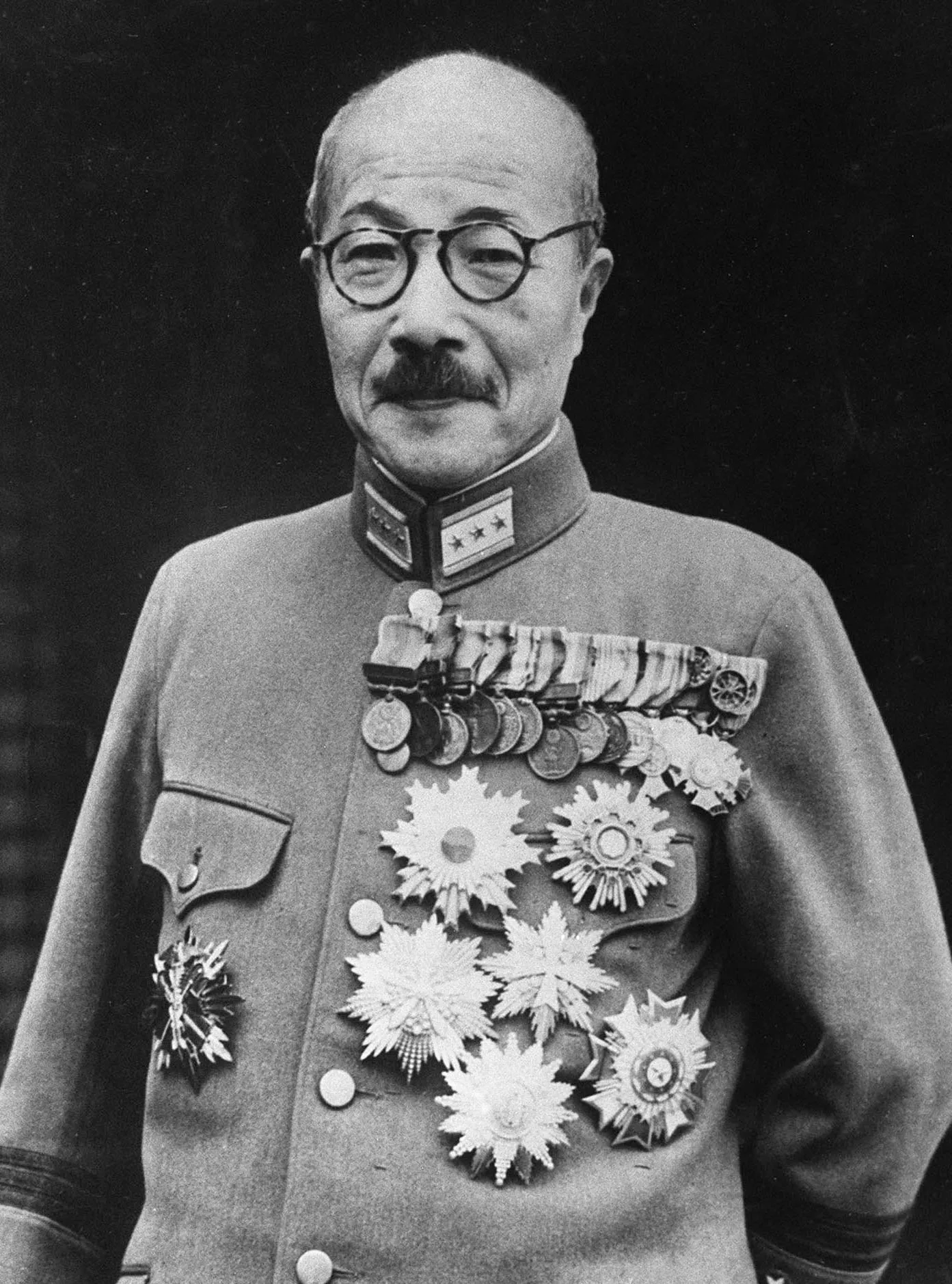
On Saturday 18 October 1941 a new government was sworn in in Tokyo. At its head was General Hideki Tōjō, War Minister since July 1940, who on that same day was promoted to full general (taishō). He kept the War Ministry, also took over the Home Ministry – and with it the police – and remained an officer on active service. He was the fortieth prime minister in Japan’s history, and his cabinet was to last almost three years. Two days earlier Prince Fumimaro Konoe had resigned; since the summer he had been trying to reach an understanding with the United States, and in the last weeks his efforts had foundered precisely on Tōjō’s opposition. In the eyes of the world, a man of the army had taken power in Tokyo, and that is how Washington read it. Few knew that the general had been instructed by the Emperor to reconsider from scratch the decision on preparations for war.
Chronologies often state that the Konoe government fell on 17 October and that on 21 October the negotiations in Washington seemed to be heading for failure. The first date is inaccurate: Konoe tendered the resignation of the entire cabinet on 16 October; on 17 October a body of former prime ministers was already meeting to choose his successor, and that same day the Emperor entrusted Tōjō with forming a government. The second item is an assessment rather than an event. On 21 October the new Foreign Minister instructed the ambassador in Washington to continue the talks, and the next day the ambassador asked to be recalled, as he did not believe they could succeed.
The note of 2 October
The Imperial Conference of 6 September had set Japanese diplomacy a deadline. If by early October the negotiations offered no prospect of Japan’s demands being met, Japan was to decide at once on war with the United States, Britain and the Netherlands. War preparations were to be completed by the end of October. Everything depended on whether agreement could be reached with the Americans, who since the summer, after the Japanese move into southern Indochina, had frozen Japanese assets and cut off oil supplies.
The reply came on 2 October. Secretary of State Cordell Hull handed the ambassador, Admiral Kichisaburō Nomura, a memorandum restating the four principles on which the United States was prepared to base an agreement: respect for the territorial integrity and sovereignty of all nations, non-interference in their internal affairs, equality of commercial opportunity, and no change in the status quo in the Pacific except by peaceful means. A meeting between President Franklin Delano Roosevelt and Konoe, which the Prime Minister had been seeking since August, was out of the question until the two sides had agreed on the basic terms. Hull asked directly what the Japanese meant by keeping their troops in certain regions of China “for an indefinite period”, and asked for clarification of Tokyo’s attitude to the Tripartite Pact. What was needed in the Pacific, he wrote, was a clear-cut agreement, not a temporary patching-up of the dispute.
The Americans, who thanks to breaking the Japanese diplomatic cipher were reading the cables between Tokyo and the embassy, knew that the Japanese were playing for time and had no intention of giving way over China. In Tokyo the note of 2 October meant that the situation foreseen in the resolution of 6 September had arisen: the negotiations offered no “prospect” of success. On 5 October the War Ministry and the Army General Staff concluded that diplomacy had no chance and resolved to demand an Imperial Conference to decide on war.
The leap from Kiyomizu
The key issue was the troops in China. The army, which had been waging war there since 1937 and had suffered enormous losses in it, had no intention of giving up what it regarded as its fruits. Tōjō and the Chief of the Army General Staff, General Hajime Sugiyama, agreed that they would not accept Hull’s four principles and would not alter the terms on keeping troops in China, not even in their wording. Konoe met the War Minister on 5 and 7 October and proposed accepting the principle of withdrawal while, in its practical application, retaining a military presence where it mattered most. Tōjō replied that this was impossible. In those weeks he is also said to have told the Prime Minister that in life one must sometimes close one’s eyes and leap from the terrace of the Kiyomizu temple – a Japanese expression for taking a risky decision without regard for the consequences. Konoe replied that an individual might act that way, but not a state with two thousand years of history.
The navy, on which it depended whether a war with America was possible at all, would not say what the Prime Minister expected of it. In the leadership of the Navy Ministry the prevailing view was that a war with America over the troops in China would be the height of folly, but the Chief of the Navy General Staff, Admiral Osami Nagano, opposed this, and the Navy Minister, Admiral Koshirō Oikawa, was unwilling to stand up openly against the army. Even the head of the War Ministry’s Military Affairs Bureau, Akira Mutō, let it be known through the cabinet secretary that if the navy declared clearly that it could not fight, the army would find it easier to restrain its own advocates of war. Oikawa did not do so.
On 12 October, his fiftieth birthday, Konoe invited the War, Navy and Foreign Ministers and the head of the Planning Board, General Teiichi Suzuki, to his villa Tekigaisō in Ogikubo, on the outskirts of Tokyo. According to notes of the meeting, the Foreign Minister, Admiral Teijirō Toyoda, believed that agreement was possible if Japan softened its wording on the troops in China somewhat, and admitted that the decision of 6 September had been reckless. Oikawa stated that Japan stood at a crossroads between diplomacy and war and that the Prime Minister must decide. Konoe said that if he had to choose now he would choose diplomacy, because he did not believe in war; let someone who believed in it wage it. Tōjō replied that the army, on the strength of a resolution adopted in the Emperor’s presence, was already moving troops, so a “let’s try” kind of diplomacy did not satisfy him. Withdrawing the troops from China was unacceptable to him, and their presence there, he said, was to be in principle indefinite. The meeting settled nothing. Suzuki suggested to the Prime Minister that he ask the Emperor to treat the resolution of 6 September as null and void.
On 14 October, before a cabinet meeting, Konoe asked the War Minister one last time for a concession over China. Tōjō refused, and at the meeting delivered an impassioned speech to the ministers. According to surviving accounts he said that the question of the troops in China was the “heart” of the whole problem: if Japan yielded to the Americans’ demands, it would throw away the fruits of the war in China and endanger the existence of Manchukuo and Japanese rule in Korea. Concession after concession was not diplomacy but surrender. None of the ministers answered him. After the meeting Tōjō declared that he would not meet the Prime Minister again because the talks had become too emotional, and explained to General Staff officers that the army had just passed sentence on the Konoe government.
Konoe resigns
On the evening of 14 October Tōjō conveyed his position to the Prime Minister through Suzuki. Since the navy, as it turned out, did not want war, the resolution of 6 September had lost its basis, and all those who had prepared and adopted it, from the Prime Minister to the chiefs of staff, had failed in their duty to the throne. They should therefore all step down, and the matter had to be reconsidered afresh. There was, however, no one among the Emperor’s subjects with enough authority to impose this on the army and the navy, so the new prime minister should be a member of the imperial family. Tōjō pointed to Prince Higashikuni, the Emperor’s uncle, a general on active service known for his opposition to war with America. Konoe accepted the idea.
On 15 October matters became more complicated. The police arrested the journalist Hotsumi Ozaki, a long-standing adviser to Konoe and a member of the Soviet intelligence ring run by Richard Sorge. The investigation could reach the Prime Minister himself. That same day the Lord Keeper of the Privy Seal, Kōichi Kido, the closest political adviser to Emperor Hirohito, came out against a government headed by the prince. He held that a member of the imperial family must not be entrusted with solving a problem that the politicians had failed to solve. If a government under the prince led Japan into war and the war ended in defeat, the nation’s anger would turn against the dynasty. The Emperor shared this fear.
On the afternoon of 16 October Konoe collected the ministers’ letters of resignation and placed them in the monarch’s hands. In his letter to the Emperor he wrote that a war with America, whose outcome was uncertain, was not the right course while there was still hope of agreement, and that he had been unable to persuade the War Minister. The third Konoe cabinet had lasted about three months.
Kido’s choice
On 17 October the jūshin – former prime ministers who since the late 1930s had advised the Emperor on the choice of head of government – met at the Imperial Palace under Kido’s chairmanship. They included Keisuke Okada, Reijirō Wakatsuki, Kōki Hirota, Senjūrō Hayashi, Nobuyuki Abe and Mitsumasa Yonai, as well as the President of the Privy Council, Yoshimichi Hara. Hayashi proposed Prince Higashikuni. Kido rejected the idea and proposed Tōjō, who was to become prime minister without leaving the War Ministry. Wakatsuki warned that the general would make a bad impression abroad and called Kido’s idea a decision taken in desperation. Okada and Yonai pointed out that there was no point in proposing an admiral, because the army would not support him, and Abe added that the same would apply to the retired general Kazushige Ugaki. No one put forward any other candidate; Abe, Hirota and Hara backed Kido, and that same afternoon the Lord Keeper of the Privy Seal submitted Tōjō’s name to the Emperor.
The choice seemed paradoxical and is still a matter of dispute. Kido later explained it as follows: since the army was demanding war and a prince of the blood could not be prime minister, the only man who could restrain it was its leader himself, a general on active service who knew every detail of the negotiations and was boundlessly loyal to the Emperor. If the monarch demanded peace of him, Tōjō would obey and force the army to obey too. According to Kido’s diary, the Emperor responded to the proposal with a proverb: if you do not enter the tiger’s den, you cannot catch the tiger’s cub.
Tōjō, summoned to the palace, expected, as he himself recounted, a reprimand for the army’s intransigence. Instead he was told to form a government. Hirohito urged him to cooperate closely with the navy, and immediately afterwards said the same to the Navy Minister, Oikawa. In the waiting room Kido conveyed the Emperor’s wishes to both men: in setting the principles of state policy they were not to feel bound by the resolution of the conference of 6 September, but were to examine the country’s situation more broadly and deeply and consider the matter carefully. In Japan this became known as the “command to return to a clean slate” (白紙還元の御諚, hakushi kangen no gojō). The deadline that had hung over Japanese policy for a month ceased, for the time being, to apply.
The general’s government
Tōjō obeyed. Many historians stress that for him the Emperor’s word was an order and that in his first weeks as prime minister he genuinely tried to carry out the instruction – something that in the army was even called his “apostasy”. As Foreign Minister he invited the career diplomat Shigenori Tōgō, a former ambassador in Berlin and Moscow, known for his dislike of the alliance with Germany. Tōgō accepted office on condition that the army seriously consider concessions over China, and it was agreed that he would step down if the negotiations failed. The Finance Minister was Okinori Kaya, whom Tōjō assured that he would strive for agreement with America and a peaceful solution. The Ministry of Commerce and Industry went to Nobusuke Kishi, and Suzuki remained in charge of the Planning Board. The new Navy Minister was Admiral Shigetarō Shimada, a political novice who, in the talks about taking office, demanded both an expansion of the fleet and the continuation of diplomacy.
The Prime Minister’s taking over of the Home Ministry was explained in different ways. According to one interpretation, Tōjō wanted the police in his hands in case an agreement with America, bought with concessions in China, provoked nationalist riots, as the peace with Russia had done in 1905. According to another, he was simply concentrating power, which was to become a hallmark of his rule. The fact that the War Minister had become prime minister without ceasing to be an active general also worried some Japanese politicians. The army and navy general staffs, however, which were independent of the government and answerable directly to the Emperor, remained in the hands of the same men, Sugiyama and Nagano, who in September had forced through the deadline for the negotiations.
Washington waits
In the United States Konoe’s resignation was received with concern. The prince was regarded as the Japanese politician one could talk to. On 16 October the Chief of Naval Operations, Admiral Harold Stark, warned the commanders of the Pacific and Asiatic Fleets, including Admiral Husband Kimmel at Pearl Harbor, that the resignation of the Japanese government had created a “grave situation” and that the new cabinet would probably be strongly nationalistic and anti-American. The possibility that Japan might attack the United States and Britain could not be ruled out, so appropriate redeployments were to be ordered in such a way as not to disclose intentions or provoke Japan. The State Department, as one of the admirals later testified, assessed the change of government more calmly than the navy did. The talks were not broken off, and after the new cabinet’s first days the prevailing view was that Tokyo would continue them.
On 21 October Tōgō instructed Nomura to tell the Americans that the new government desired a settlement of relations with the United States no less than its predecessor, and to ask for an American response to the Japanese proposals made so far. The Americans read this cable, like the others. The ambassador was in no position to promise anything. On 22 October, in a cable that was also read by American intelligence, he asked to be recalled. He wrote that he ought to have resigned together with the Konoe government, that he did not wish to go on leading this “hypocritical existence”, deceiving himself and others, and that he saw no point in remaining at his post like the bones of a dead horse. On 23 October Tokyo replied that a great deal depended on the outcome of the negotiations and asked the admiral to sacrifice his personal wishes and remain in Washington. Those days have gone down in accounts as the moment when the talks seemed to be heading for failure. In line with the Emperor’s command, however, a review was under way in Tokyo on which it depended whether they would continue at all.
Place in the war
The “return to a clean slate” changed nothing. From 23 October the government and the general staffs met almost daily at liaison conferences. The material for the review was prepared by the same officers who had drafted the resolution of 6 September, and the general staffs kept repeating that oil stocks were dwindling and that time was working against Japan. On 30 October the Navy Minister, Shimada, who had joined the government as a supporter of diplomacy, told his associates that he could not turn the tide, and agreed to war. On 1 November, after deliberations lasting well over ten hours, the government and the general staffs decided that Japan would prepare for war, with hostilities to begin in early December, and that negotiations would continue until midnight on 1 December. Tōgō was given two proposals: Plan A, under which Japan agreed to keep troops in part of China for 25 years and to withdraw them from the rest once peace was concluded, and Plan B, an interim agreement under which it would withdraw from southern Indochina in exchange for the restoration of oil supplies and an end to American aid to China. On 5 November the resolution was approved by an Imperial Conference. This time the Emperor remained silent. The former ambassador in Berlin, Saburō Kurusu, flew to Washington to support Nomura.
From the decrypted cables the Americans knew the Japanese deadline. On 26 November Hull presented the Japanese with a note demanding the withdrawal of all troops from China and Indochina. In Tokyo it was regarded as an ultimatum; on 1 December an Imperial Conference decided to go to war, and on 7 December 1941, Hawaiian time, Japanese carrier aircraft attacked Pearl Harbor. The war in the Pacific was begun by the Tōjō government, and to the Allies Tōjō himself became the Asian counterpart of Adolf Hitler and Benito Mussolini.
Historians differ in their assessment of October 1941. Some see the choice of Tōjō as the court’s last, failed attempt to restrain the army through the hands of its strongest man. Others stress that Kido and the Emperor, by turning to a general who a few days earlier had brought down a government over the troops in China, in effect accepted war should the negotiations fail, and that the review could not succeed when no one was willing to give way on the one issue on which everything depended. What is certain is that in October Japan lost its last prime minister who did not believe in war with America, and that the decision for that war was taken within seven weeks of Tōjō’s coming to power.
Sources
Meanwhile
(04)Elsewhere, within a week.
- 17 October 1941 · AtlanticThe torpedoing of USS KearnyOn 17 October 1941 U-568 torpedoed the US destroyer Kearny while she was defending convoy SC 48. Eleven sailors were killed; the ship limped to Iceland.
- 21 October 1941 · MediterraneanBefore Operation CrusaderIn autumn 1941 the British readied the Eighth Army in Egypt to relieve Tobruk. New Zealanders trained in the desert; Fort Capuzzo was still held by the Axis.
- 13 October 1941 · Eastern FrontFighting on the Mozhaisk LineIn mid-October 1941 the Germans attacked the Mozhaisk Line, taking Kaluga, Kalinin, Mozhaisk and Volokolamsk, but by late October they stalled before Moscow.
- 24 October 1941 · Eastern FrontThe Germans take KharkivOn 24 October 1941 the German Sixth Army took Kharkiv. Its tank and aircraft plants had gone to the Urals; famine, terror and the murder of Jews followed.
Related events
(04)The same battle, people or subject.
- 26 November 1941 · Far EastThe Kidō Butai sails for HawaiiOn 26 November 1941 Vice-Admiral Chūichi Nagumo’s six carriers left Hitokappu Bay in the Kurils, sailing under radio silence to strike Pearl Harbor.
- 8 December 1941 · DiplomacyThe “Day of Infamy” speechOn 8 December 1941 Roosevelt called Pearl Harbor a day of infamy and Congress declared war on Japan. Within days a dozen or more other states had done the same.
- 4 November 1941 · PoliticsThe Imperial Conference of 5 NovemberIn early November 1941 Japan resolved on war with the US, Britain and the Netherlands if negotiations brought no result by 1 December.
- 26 November 1941 · DiplomacyThe Hull noteOn 26 November 1941 Cordell Hull handed the Japanese a note demanding withdrawal from China and Indochina. It set no deadline, but Tokyo saw it as an ultimatum.