Japan
Saburō Kurusu
Japanese Ambassador to Belgium (1936–1939) and Germany (1939–1941), special envoy to the United States (1941)
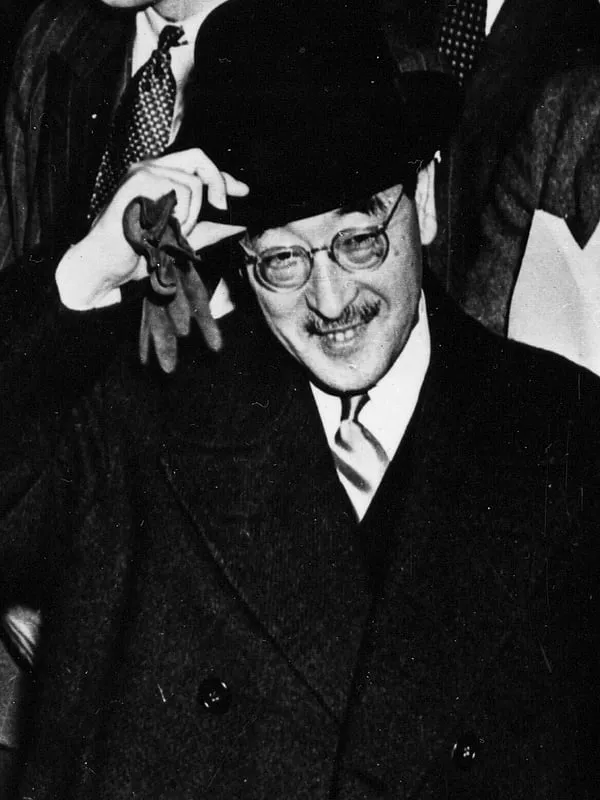
- Born:
- 6 March 1886, Yokohama (Japan)
- Died:
- 7 April 1954
- Author:
- Łukasz
- Photo:
- Office of War Information, domena publiczna, Wikimedia Commons

Saburō Kurusu was a career diplomat who twice found himself where the course of the war was being decided. On 27 September 1940, as ambassador in Berlin, he signed the Tripartite Pact on Japan’s behalf, binding his country in alliance with Germany and Italy. A year later, as a special envoy, he conducted the last negotiations with the Americans in Washington, and on 7 December 1941 he handed the Secretary of State the note breaking off the talks at a moment when Japanese aircraft were already bombing Pearl Harbor. In the United States he was for years seen as the embodiment of Japanese treachery. Most historians now accept that he knew nothing of the plans for the attack, and that the alliance with Hitler that he signed had been prepared by others.
A diplomat from Yokohama
He was born on 6 March 1886 in Yokohama. His father, Sōbei Kurusu, was a businessman, president of the Yokohama Dock shipyard and vice-president of the local chamber of commerce. In 1909 he graduated from the consular department of the Tokyo Higher Commercial School (today Hitotsubashi University), passed the diplomatic examination and in 1910 joined the Foreign Ministry.
He spent his first years in the consular service: in Hankou in China, in Honolulu and in New York. From 1913 he was consul in Chicago. There he met Alice Jay Little, an American born in New York to English parents, and married her in 1914. She took Japanese citizenship and remained at his side to the end. They had three children: a daughter, Jaye (1915); a son, Ryō (1919), born in Chicago; and a daughter, Teru, known as Pia (1926), born in Italy.
In the 1920s Kurusu was consul general in Manila, secretary of the legations in Chile and Greece, first secretary of the embassy in Rome and consul general in Hamburg. Around 1930 he was minister to Peru (sources give different dates). The Japanese community there suffered from hostility and violence, so he encouraged emigrants to settle in the countryside in the mountains rather than in Lima. In 1932 he returned to Tokyo as director of the ministry’s Commercial Affairs Bureau. Japan, which was emerging from the Depression on the strength of cheap textiles, was then engaged in trade disputes with Britain, India and other markets, and Kurusu’s bureau was responsible for negotiating trade agreements. He was regarded as an economic specialist who knew the West well and spoke excellent English.
Brussels and Berlin
In 1936 he became ambassador to Belgium (some sources give 1937). After war broke out in Europe he was recalled from Brussels, and in December 1939 he was appointed ambassador to Germany. He replaced General Hiroshi Ōshima, an advocate of alliance with Hitler, who had to go when Germany unexpectedly concluded its pact with the USSR. The appointment of a career diplomat with no ties to the army suited the more cautious policy of the governments of Nobuyuki Abe and Mitsumasa Yonai, which kept Japan out of the war in Europe.
The Wehrmacht’s victories in the spring of 1940 changed his tasks. On 19 June, the day after Tokyo had decided to put pressure on French Indochina, Kurusu assured an official of the German Foreign Office that even those in Japan who had hitherto been opponents understood that the country’s future depended on Germany, not on the Western powers. According to documents presented after the war to the Tokyo tribunal, he said that Japan’s future lay in the south and that the enemy in the north had to be made a friend, and he foresaw the division of the world into four spheres of influence. On 8 July, together with the government envoy Naotake Satō, he set out Japan’s position to Joachim von Ribbentrop, and on 7 August, following the line of the new foreign minister Yōsuke Matsuoka in the second Konoe cabinet, he explained to Ribbentrop and State Secretary Ernst von Weizsäcker that Japan expected recognition of its leadership in Greater East Asia and the South Seas.
The actual negotiations, however, went on without him. They were conducted in Tokyo by Matsuoka, the German ambassador Eugen Ott and Ribbentrop’s special envoy Heinrich Georg Stahmer. Kurusu was handed the finished text, and on 27 September 1940, in the New Reich Chancellery and in the presence of Adolf Hitler, he signed the pact together with Ribbentrop and Galeazzo Ciano. In photographs of the ceremony he stands out as the only man in a diplomatic frock coat among the uniforms. The day before, he had reported to Tokyo that the German press was to stress that the pact was not directed against Russia, but that Germany was concentrating troops in the east. In November 1940 he signed on Japan’s behalf the protocols of accession to the pact of Hungary, Romania and Slovakia.
In January 1941 he was still explaining to Weizsäcker that any strike against Singapore would require passing through Indochina and Thailand. Early in 1941 he stood down, and Ōshima returned to Berlin. In his memoirs Kurusu claimed that he had left out of distaste for the pact. Historians believe that the fact that he had been bypassed in its preparation mattered more. He travelled home by way of the United States, where he met his friend Admiral Kichisaburō Nomura, the new ambassador in Washington.
The last negotiations
Nomura’s talks with Secretary of State Cordell Hull, under way since the spring of 1941, had stalled. In July the Japanese entered southern Indochina, and the United States froze Japanese assets and halted oil deliveries. In October General Hideki Tōjō became Prime Minister. Nomura, who had long been asking to be recalled or given help, had requested in August that “someone like Kurusu” be sent. At the beginning of November the foreign minister, Shigenori Tōgō, sent Kurusu himself to Washington. The Imperial Conference of 5 November decided both to continue the negotiations and to prepare for war should they produce no result by the end of November. Kurusu carried no new instructions, and, according to the German ambassador, Tōgō gave assurances that the envoy was aware of the government’s firmness and had a strictly fixed deadline. According to one account, Tōjō told him before his departure that the one condition that could not be given up was keeping troops in China, and put the chances of an agreement at thirty per cent.
Kurusu flew into Washington on 15 November 1941. On 17 November Hull took him and Nomura to see President Franklin Delano Roosevelt. The Americans treated him with suspicion: he was, after all, the man who had signed the alliance with Hitler, and having broken the Japanese diplomatic cipher they knew that Tokyo had set a final deadline for the negotiations. On 20 November the two ambassadors presented “Proposal B”, an interim agreement: Japan would advance no further in South-East Asia, and the United States would restore oil supplies and stop aiding China. On 26 November Hull replied with a note, later called the Hull note, demanding the withdrawal of Japanese troops from China and Indochina and the non-recognition in China of any government other than that of Chiang Kai-shek. According to the American record, Kurusu said that if this was the American government’s position, he saw no possibility of agreement, and Tokyo would “throw up its hands”.
Over the following days Kurusu tried to go round the government in Tokyo. Through the Methodist missionary Eli Stanley Jones and the financier Bernard Baruch, both of whom had access to the president, he urged Roosevelt to appeal directly to Emperor Hirohito. Roosevelt sent such a telegram on 6 December, but the war machine was already in motion. On 7 December the ambassadors were to hand Hull the final Japanese note at 1 p.m. Washington time. Because of difficulties in decoding and typing up the long text, they did not reach the State Department until after 2 p.m. and were received about an hour after the attack on Pearl Harbor had begun. Hull, who already knew the contents of the note from intercepted telegrams and knew of the attack, called it a document full of “infamous falsehoods and distortions” and showed them the door. Reporters outside the building, asking whether this had been the last meeting, got no answer from them.
Internment and return
After war broke out Kurusu, his family and other Japanese diplomats were interned, first at the Homestead hotel in Hot Springs, Virginia, and then at the Greenbrier hotel in West Virginia. In June 1942 the internees were taken aboard the Swedish ship Gripsholm to Lourenço Marques in Portuguese East Africa (today Maputo), where they were exchanged for Americans interned in Japan, among them Ambassador Joseph Grew. He returned to Japan in the summer of 1942 aboard the Asama Maru. In 1942–1943 he gave lectures on the course of the negotiations, also published in English, in which he defended the Japanese version of events.
The war brought him personal tragedy. His son Ryō, an engineer and army test pilot who looked more like his mother than his father and for that reason often met with prejudice, was killed on 17 February 1945 at Fussa airfield near Tokyo. Running to a Ki-84 fighter to take off against aircraft from American carriers, he was struck by the propeller of a plane that was taking off. That same month Kurusu left the service. The family’s house in Tokyo burned down in an air raid, so he and his wife moved to their summer house in Karuizawa.
After the war
Kurusu’s role in the negotiations was examined in the preparations for the trial before the International Military Tribunal for the Far East, but he was not charged. In its judgment, however, the tribunal quoted General Akira Mutō, who on the day after the outbreak of war had called Kurusu’s mission “a kind of camouflage”. For a short time Kurusu lectured at Tokyo University. In 1947 the occupation authorities included him, like more than two hundred thousand officials, officers and activists, in the purge barring them from public office. His appeals were unsuccessful. The ban was lifted in the early 1950s, but after a heart attack he did not return to diplomacy. He wrote his memoirs, published in 1948 as Thirty-Five Years Like Foam on the Water (泡沫の三十五年), and a second book in 1952. He died on 7 April 1954. Both his daughters married American officers and settled in the United States. Alice Kurusu died in Tokyo in 1973.
Memory
For Americans Kurusu became the personification of the “treacherous Japanese” who talked of peace while the fleet was already sailing for Hawaii. Eleanor Roosevelt spoke of him with contempt, and Under Secretary of State Sumner Welles wrote in 1944 that he had been sent to Washington like a goat tethered to a stake to lure the tiger into a trap. Hull judged him very harshly in his memoirs. In the first post-war years the American and British press called him the “Judas of diplomacy”.
To the end of his life Kurusu maintained that he had known nothing of the plan of attack. He was defended by Joseph Grew, who wrote to him in 1946 that he had never doubted the sincerity of his and Nomura’s efforts to preserve peace. Most historians now accept that Kurusu did not know the details of the operation, although he knew that the negotiations had a deadline after which the government was ready for war. In 2016 his memoir of the weeks before Pearl Harbor, which he had translated himself during his lifetime, was published in English. It showed that he had tried to the very end to find a way to agreement, but it could not change the fact that his name is linked with two documents that led Japan into the world war: the Tripartite Pact, which he signed, and the note of 7 December 1941, which he and Nomura handed to Hull.
Sources
Mentioned in battles
(01)Often appears with
People who appear in the same events.
On the timeline
(09)1940
1941
October
November
- 26
- Key eventThe Kidō Butai sails for HawaiiOn 26 November 1941 Vice-Admiral Chūichi Nagumo’s six carriers left Hitokappu Bay in the Kurils, sailing under radio silence to strike Pearl Harbor.
- The Hull noteOn 26 November 1941 Cordell Hull handed the Japanese a note demanding withdrawal from China and Indochina. It set no deadline, but Tokyo saw it as an ultimatum.