United Kingdom
Trafford Leigh-Mallory
Air Officer Commanding No. 12 Group RAF (1937–1940) and No. 11 Group (1940–1942), Commander-in-Chief of RAF Fighter Command (1942–1943) and of the Allied Expeditionary Air Force (1943–1944)
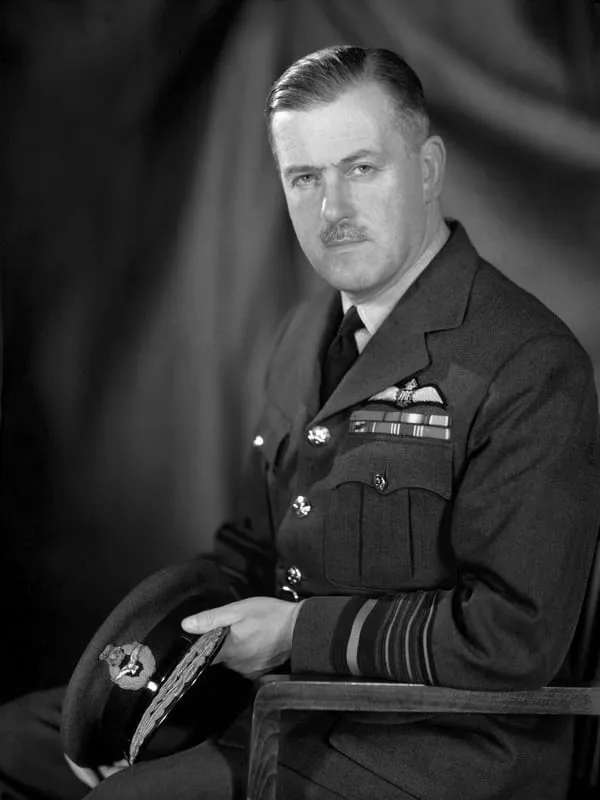
- Born:
- 11 July 1892, Mobberley (England)
- Died:
- 14 November 1944, The Alps, near Le Rivier-d'Allemont (France)
- Author:
- Łukasz
- Photo:
- British official photographer, domena publiczna, Wikimedia Commons

Trafford Leigh-Mallory was one of the most important and most controversial British air commanders of the Second World War. In the Battle of Britain he commanded No. 12 Group, covering the Midlands and eastern England, and together with Douglas Bader he pushed the tactics of the “Big Wing”, made up of several squadrons. Many historians regard his quarrel with Keith Park and Hugh Dowding, both of whom were removed after the battle, as one of the least creditable episodes in the history of the RAF. Leigh-Mallory went on to a brilliant career: he directed air operations over Dieppe in 1942, headed Fighter Command, and in 1944 commanded the Allied tactical air forces during the invasion of Normandy. He was killed in an air crash in the Alps on his way to a new command in Asia.
The mountaineer’s brother
Trafford Leigh Mallory was born on 11 July 1892 in Mobberley, Cheshire, the son of the local Anglican rector, Herbert Leigh Mallory, who in 1914 formally changed the family name to Leigh-Mallory. His elder brother was George Mallory, the mountaineer who disappeared in 1924 during an attempt on Mount Everest. Trafford was educated at Haileybury and then read law at Magdalene College, Cambridge, where he met Arthur Tedder, later Marshal of the RAF and Deputy Supreme Allied Commander in Europe. After graduating he intended to become a barrister, but in the summer of 1914 war broke out.
The First World War
Leigh-Mallory enlisted as a private in a Territorial battalion of the King’s (Liverpool Regiment), and in October 1914 he was commissioned as a second lieutenant in the Lancashire Fusiliers. In the spring of 1915 he went to the front with the South Lancashire Regiment and, according to his biographers, was wounded during the Second Battle of Ypres. After recovering, at the beginning of 1916, he transferred to the Royal Flying Corps. He was not a fighter pilot. He flew with army co-operation squadrons, which carried out reconnaissance, photographed enemy positions and directed artillery fire, among other places during the Battle of the Somme.
At the end of 1917 he took command of No. 8 Squadron, which after the Battle of Cambrai specialised in co-operation with tanks and artillery. This experience shaped his entire later career. For his wartime service he was awarded the Distinguished Service Order (DSO). In 1915 he married Doris Sawyer; they had two children.
Army co-operation specialist
After the war Leigh-Mallory gave up the idea of a legal career and stayed in the newly created Royal Air Force. In the years that followed he was regarded as one of the RAF’s leading experts on co-operation between aircraft and ground forces. He graduated from the RAF Staff College, in 1927 became commandant of the School of Army Co-operation, and later taught at the Army Staff College at Camberley. In the early 1930s he worked at the Air Ministry and was a member of the British delegation to the League of Nations disarmament conference in Geneva, where he made many useful contacts. He then completed the Imperial Defence College course, commanded the flying training school and airfield at Digby, and in 1936, by now an air commodore, served on the staff of the British air command in Iraq.
In December 1937 Leigh-Mallory took command of No. 12 Group, with its headquarters at Watnall near Nottingham. This was new territory for him, as he had never before had anything to do with fighters. He proved an energetic organiser, popular with his staff, although his relations with his station commanders were sometimes strained. On 1 November 1938 he was promoted to air vice-marshal, one of the youngest officers of that rank.
The Battle of Britain and the Big Wing
When the Battle of Britain began in the summer of 1940, the brunt of the fighting fell on Keith Park’s No. 11 Group, which defended London and south-east England. Leigh-Mallory had long disliked Park, and the fact that in April 1940 it was Park, not he, who received the most important command deepened his resentment. Under Dowding’s plan the squadrons of No. 12 Group were to defend the Midlands and the industrial north and, while No. 11 Group was fighting over Kent, to cover its airfields north of the Thames. From August No. 12 Group also included the Polish No. 302 (City of Poznań) Squadron and the Czechoslovak No. 310 Squadron.
Leigh-Mallory considered this role too passive. Douglas Bader, commanding No. 242 Squadron at Duxford, persuaded him that instead of sending squadrons up one at a time they should be assembled into a single “Big Wing” of three to five squadrons, which would fall on the German formations in superior numbers and break them up. From September 1940 the “Duxford Wing” under Bader regularly flew south. The trouble was that assembling several dozen fighters and climbing them to altitude took so long that No. 11 Group’s airfields, which the wing was supposed to protect, had often already been bombed, and the wing would meet the bombers on their way home from the target. Park complained that No. 12 Group failed him just when it was most needed. Leigh-Mallory replied that it did not matter when a bomber was shot down, as long as as many as possible were destroyed. He also argued that Park was needlessly endangering his pilots by sending single squadrons into action against superior forces.
On 15 September, the day of the great raids on London, Bader’s wing went into action twice and claimed about a third of the 185 aircraft announced as destroyed. In reality the Luftwaffe lost around 60 aircraft that day, and the Big Wing’s claims were even more inflated than those of other units. They nevertheless impressed the Air Ministry, where Dowding and Park had many critics. On 17 October, at a meeting at the Ministry chaired by the Deputy Chief of the Air Staff, Air Vice-Marshal Sholto Douglas, Leigh-Mallory presented his tactics as superior; he brought Bader with him, junior in rank to most of those present, which Park and Dowding took as an affront. Dowding and Park found themselves cast as the accused.
Park’s successor
In November 1940 Dowding had to hand over Fighter Command to Sholto Douglas, and on 18 December Leigh-Mallory took over No. 11 Group from Park. Many of those involved, and some historians after them, believed that Leigh-Mallory had schemed to have both commanders removed and that he was helped by the exaggerated reports of the Duxford Wing’s successes. Others point out that the changes were also decided by criticism of the helplessness in the face of night raids and by the views of the new Chief of the Air Staff, Charles Portal. The dispute continues to this day.
As commander of No. 11 Group, Leigh-Mallory went on to the offensive. In 1941 his fighter wings carried out so-called Rodeos over northern France – sweeps by fighters alone – and Circus operations, in which small bomber forces were meant to draw German fighters into combat. The Polish squadrons from Northolt also took part. The results were disappointing: in 1941 the RAF lost more than 500 fighter pilots and far more aircraft than the Luftwaffe, which, after most of its strength had left for the east for Operation Barbarossa, could fight over its own territory with radar support, just as the RAF had done over England a year earlier.
On 19 August 1942 Leigh-Mallory directed the air cover for the Dieppe Raid from the operations room at Uxbridge. Over the French port one of the largest single-day air battles of the war was fought. The RAF lost 106 aircraft, the Luftwaffe, according to post-war findings, 48. Polish squadrons were among the several dozen engaged, and according to Polish records No. 303 Squadron claimed more aircraft shot down that day than any other. Leigh-Mallory judged the operation an air success because it had forced the Luftwaffe to fight, and he proposed repeating similar landings as bait, which the army firmly opposed.
Normandy
At the end of November 1942 Leigh-Mallory succeeded Sholto Douglas as Commander-in-Chief of Fighter Command, and in January 1943 he was knighted (Order of the Bath). After a visit to North Africa he pressed for a single unified air command for the invasion of France. In August 1943 he was designated Air Commander-in-Chief of the Allied Expeditionary Air Force, which comprised the British Second Tactical Air Force and the American Ninth Air Force; he formally took up the post in November 1943 and was promoted to air chief marshal.
His position, however, was weaker than his title suggested. The commanders of the strategic air forces, Arthur Harris and Carl Spaatz, refused to serve under him, and General Dwight Eisenhower placed them directly under himself, through his deputy Tedder. The Americans, and some of the British too, considered Leigh-Mallory rigid and difficult to work with. Together with Tedder he defended the plan to bomb French and Belgian railway junctions before the invasion. Politicians, led by Winston Churchill, feared heavy losses among French civilians, but Leigh-Mallory considered them the necessary price of paralysing German troop movements. At the end of May 1944 he warned Eisenhower that the American parachute and glider landings on the Cotentin Peninsula might end in slaughter, with losses running to several tens of per cent. Eisenhower held to the plan, and losses proved far lower; according to Eisenhower’s memoirs, Leigh-Mallory was the first to admit after the Normandy landings that he had been wrong.
During the fighting in Normandy the tactical air forces under his command destroyed bridges, railway lines and German columns behind the front, seriously hampering the movement of German reserves. General Bernard Montgomery, with whom he worked more closely than other air commanders did, valued him as an airman who genuinely wanted to win the land battle.
Death in the Alps
In August 1944, as the Battle of Normandy was drawing to a close, Leigh-Mallory was appointed Allied Air Commander-in-Chief in South East Asia Command. His existing command was disbanded in the autumn. On 14 November 1944 he took off from England in an Avro York transport aircraft together with his wife. In bad weather the aircraft crashed in the Alps east of Grenoble. Everyone on board was killed. The wreck was not found until June 1945. The court of inquiry concluded that Leigh-Mallory’s insistence on flying despite the crew’s warnings about the weather had contributed to the accident. Leigh-Mallory and his wife were buried with the airmen at Le Rivier-d’Allemont, near the crash site. He was the most senior RAF officer to be killed during the war. His post in Asia went to his rival of 1940, Keith Park.
Significance
Leigh-Mallory was able, ambitious and energetic, but his reputation remained marked by the dispute of 1940. His critics charge that during the hardest weeks of the Battle of Britain he did not support No. 11 Group as Dowding expected, and that afterwards he helped to remove the two commanders who had won the battle. His defenders point out that the idea of concentrating fighters into larger formations made sense where there was time for it, and that Bader and his wing raised the RAF’s morale and undermined the Luftwaffe’s. His fighter offensive of 1941 brought heavy losses and few gains, but the experience of air–ground co-operation he had gained as far back as the First World War paid off in Normandy. In the 1969 film Battle of Britain he was played by Patrick Wymark, in a scene of a quarrel with Park that Park himself considered milder than the reality.
Sources
Commanded in battles
(01)Mentioned in battles
(01)Often appears with
People who appear in the same events.