Germany
Werner von Blomberg
Head of the Truppenamt (1927–1929), Reichswehr minister (1933–1935), war minister and commander-in-chief of the Wehrmacht (1935–1938), Field Marshal (1936)
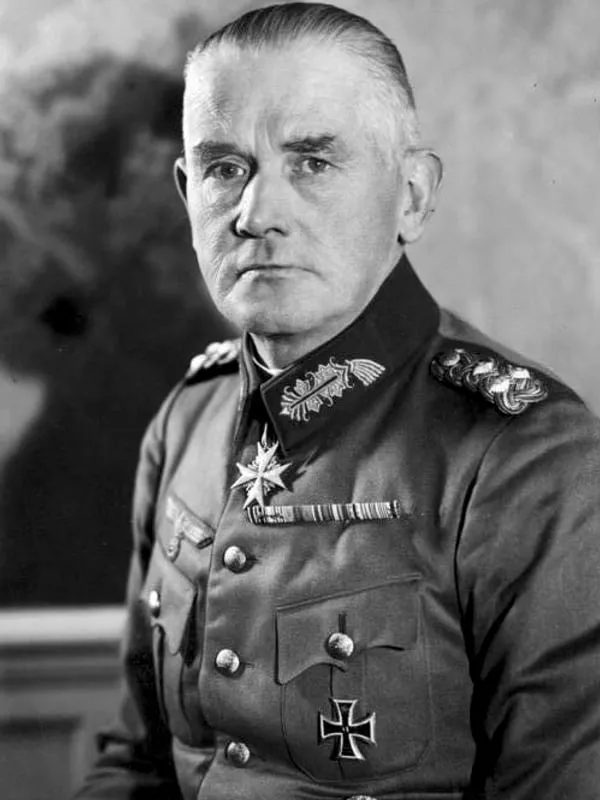
- Born:
- 2 September 1878, Stargard (Pomerania, Kingdom of Prussia)
- Died:
- 14 March 1946, Nuremberg
- Author:
- Łukasz
- Photo:
- Heinrich Hoffmann, CC BY 3.0, Wikimedia Commons

Werner von Blomberg was Hitler’s first war minister and the first field marshal of the Third Reich. He was meant to be one of the conservatives who in January 1933 would “fence in” the new chancellor and keep him in check. He became the very opposite: the general who opened the barracks doors to the Nazis. He introduced the Aryan paragraph and the swastika into the army, stood idly by when two generals were murdered during the Night of the Long Knives, and on the day President Hindenburg died had the soldiers swear unconditional obedience to Hitler in person. In 1933–1938 he directed the rebuilding of German military power from which the Wehrmacht emerged. When in the autumn of 1937 he warned against going to war too soon, he became dispensable, and in January 1938 a sex scandal, exploited by Göring and Himmler, ended his career. He sat out the war on the sidelines and died in American custody in Nuremberg.
A Prussian staff officer
He was born on 2 September 1878 in Stargard in Pomerania, the son of Lieutenant Colonel Emil von Blomberg and Emma, née Tschepe. The Blomberg family was descended from the Baltic German nobility. The boy followed the path typical of officers’ sons: the cadet corps, including the main cadet school at Groß-Lichterfelde near Berlin, and in 1897 a commission as a second lieutenant in the 73rd (Hanoverian) Fusilier Regiment. In 1904 he married Charlotte Hellmich, a major’s daughter, with whom he had five children. In 1907–1910 he studied at the War Academy in Berlin (some sources give slightly different years), and then joined the Great General Staff. In 1911 he was promoted to captain.
He spent almost the whole of the First World War on staffs on the Western Front. As first staff officer of the 19th Reserve Division he fought on the Marne in 1914 and planned its operations at Verdun in 1916. He then became first staff officer of the 7th Army, whose chief of staff was Walther Reinhardt, later the republic’s first chief of the Army Command, who had a great influence on him. On 3 June 1918 Blomberg was awarded the Pour le Mérite. Like many staff officers, he came out of the war convinced that the next one would be a total war, requiring the mobilisation of the whole of society and the economy.
In the Reichswehr
After the war he joined the 100,000-strong Reichswehr being built up by General Hans von Seeckt. In 1919–1921 he worked in the Reichswehr ministry, in 1921–1924 he was chief of staff of the military district in Stuttgart, and in 1925 Seeckt put him in charge of army training. In 1927 Blomberg became head of the Truppenamt (Troop Office), the camouflaged general staff whose existence was prohibited by the Treaty of Versailles.
He was an ardent supporter of secret military cooperation with the USSR, which allowed the Reichswehr to train pilots at Lipetsk and tank crews at Kazan, and to test chemical weapons far from the eyes of the Allies. In 1928 he spent several weeks in the Soviet Union. He returned fascinated by the Red Army and by the position it held in the state. According to many historians, it was then that he became convinced that only a totalitarian state, subordinating everything to preparations for war, could give Germany military power.
In 1929 he came into conflict with General Kurt von Schleicher, the ministry’s political strategist, who personally disliked him. The dispute concerned, among other things, the secret border defence, which Blomberg wanted to extend to the west of the country as well – something Schleicher wanted to avoid at all costs until the French had withdrawn from the Rhineland. Minister Wilhelm Groener summoned him to Berlin to explain himself, and as a result Blomberg lost his post at the Truppenamt and was given command of the 1st Division and Military District I in East Prussia. His successor in Berlin was Kurt von Hammerstein-Equord. In Königsberg Blomberg’s chief of staff was Colonel Walter von Reichenau, an avowed Nazi sympathiser who drew his commander closer to Hitler’s movement. Blomberg met Hitler himself in 1931.
In 1932 he headed Germany’s military delegation to the Disarmament Conference in Geneva. That same year his wife died. In Geneva Blomberg favoured breaking with the policy of Groener, who wanted to win equality of rights for Germany within the international system, and argued for unilateral rearmament.
Hitler’s minister
At the end of January 1933 President Paul von Hindenburg summoned Blomberg from Geneva to Berlin. On the morning of 30 January, a few hours before Hitler was sworn in as chancellor, he swore Blomberg in as Reichswehr minister and promoted him to General der Infanterie. This was contrary to the constitution, under which ministers were appointed on the chancellor’s proposal. Hindenburg wanted a man he trusted in the post, and the conservatives, above all Franz von Papen, counted on Blomberg to keep the army out of the Nazis’ reach. As early as 3 February 1933 Hitler met the Reichswehr commanders at a dinner in Hammerstein’s flat and, in Blomberg’s presence, spoke of rearmament, the struggle against Marxism and the conquest of “living space in the East”.
Blomberg quickly became one of the men in the government most devoted to Hitler. In the army he was nicknamed the “rubber lion”. He removed officers linked with Schleicher from the ministry and made Reichenau head of the new Ministerial Office. In August 1933 he was promoted to Colonel General. He agreed that military aviation should pass under the control of Hermann Göring and of the air ministry created for him. He supported Germany’s withdrawal from the League of Nations and the Disarmament Conference in October 1933.
In February 1934, on his own initiative, he introduced the Aryan paragraph into the Reichswehr. Some seventy soldiers and officers of Jewish descent were discharged, even though the civilian civil-service law still spared front-line veterans at that time. Several officers, among them Erich von Manstein, protested, but Blomberg did not give way. That same month he ordered the eagle and swastika to be worn on uniforms. Historians such as Klaus-Jürgen Müller explain these steps by the rivalry with the SA: Blomberg wanted to convince Hitler that the army was at least as ideologically reliable as the party militia of Ernst Röhm, which sought to absorb it.
The Night of the Long Knives and the oath
Blomberg was one of Röhm’s most important opponents. In February 1934 he put it to Hitler that the army would never agree to be subordinated to the SA, and on 28 February Hitler announced in his presence that the Reichswehr would remain the sole bearer of arms in the state. In June the army knew what was coming: on 25 June it was placed on alert, on 28 June Röhm was expelled from the officers’ association, and on 29 June the Völkischer Beobachter published an article by Blomberg assuring readers that the armed forces stood behind Hitler. During the Night of the Long Knives the SS murdered not only Röhm and the SA leaders but also two generals: Schleicher and his associate Ferdinand von Bredow. Blomberg said nothing, and at a cabinet meeting he thanked Hitler on behalf of the army.
On 2 August 1934 Hindenburg died and Hitler took over his office as “Führer and Reich Chancellor”. That same day, at the initiative of Blomberg and Reichenau, the soldiers of the Reichswehr swore an oath of unconditional obedience to Hitler in person. The two generals intended in this way to bind the new leader to the army and to secure it a privileged position vis-à-vis the party. Years later Blomberg admitted that he had not thought through all the consequences at the time. The oath proved to be one of the most enduring bonds tying German officers to Hitler right up to 1945.
Builder of the Wehrmacht
On 16 March 1935 Hitler announced the reintroduction of universal military service, and the Defence Law of 21 May 1935 renamed the Reichswehr the Wehrmacht. The Reichswehr ministry became the Reich War Ministry, and Blomberg was given the title of commander-in-chief of the armed forces, which no one had held before him. Supreme command remained with Hitler as head of state. Under Blomberg’s direction the army grew within a few years from 100,000 men to several hundred thousand and dozens of divisions, and the Luftwaffe and the Kriegsmarine came out into the open.
Blomberg, however, was no gambler. When German battalions marched into the demilitarised Rhineland on 7 March 1936, he was more nervous than anyone and, according to many accounts, advised withdrawing the troops if France responded with force. Hitler never forgot it. Even so, on 20 April 1936, Hitler’s birthday, Blomberg became the first soldier of the Third Reich to receive a field marshal’s baton. In December 1936 he opposed sending several German divisions to Spain, believing that it would risk a major war before Germany had rearmed. In the end German support for General Franco’s forces was limited to the Condor Legion. On 30 January 1937 Hitler presented him with the Golden Party Badge and admitted him to the NSDAP. On 24 June 1937 Blomberg issued a directive on the unified preparation of the armed forces for war, which listed among the possible contingencies a strike against Czechoslovakia and an intervention in Austria.
On 5 November 1937 he took part in the secret conference at the Reich Chancellery at which Hitler set out to the heads of the armed forces and the foreign minister, Konstantin von Neurath, his plan to win “living space” by force, beginning with Austria and Czechoslovakia, possibly as early as 1938. Blomberg and the commander-in-chief of the army, Werner von Fritsch, warned that France and Britain would not stand by and that the Wehrmacht was not ready for war with them. They had no moral objections; they argued only about the pace. Hitler, however, concluded that generals who hesitated would have to go.
Scandal and downfall
In 1937 the widowed field marshal met Margarethe (Erna) Gruhn, a typist much younger than himself. He confided his intentions to Göring, who encouraged him and helped to get a rival for her hand out of the way. On 12 January 1938 a modest wedding took place, with Hitler and Göring as witnesses. A few days later the Berlin police discovered in their files that the bride had been registered as a prostitute and had posed for pornographic photographs. The Berlin police chief passed the files to Göring, who passed them to Hitler. Hitler, who felt he had been made a laughing stock, demanded that the marriage be annulled. Blomberg refused and on 27 January 1938 resigned, officially on grounds of ill health. On taking his leave he is said to have suggested to Hitler that he take command of the Wehrmacht himself.
A few days later Göring and Himmler, using a fabricated charge of homosexuality, brought about the removal of Fritsch, whom a military court acquitted in March 1938. Historians call the whole affair the Blomberg–Fritsch affair. On 4 February 1938 Hitler abolished the War Ministry and assumed supreme command himself, handing his staff, the new Oberkommando der Wehrmacht, to the compliant General Wilhelm Keitel, whose son was engaged to Blomberg’s daughter. Command of the army went to Walther von Brauchitsch. That same day Hitler also dismissed Neurath and made Joachim von Ribbentrop foreign minister. Blomberg’s removal was therefore not merely a sex scandal but the final step towards the complete subordination of the army and the diplomatic service to the will of the Führer. A month later the Wehrmacht marched into Austria.
War and death
Blomberg and his wife went to Capri for almost a year. According to some accounts, Grand Admiral Erich Raeder believed that the field marshal ought to wipe out his disgrace by suicide and sent an officer after him, who tried in vain to persuade him to do so. On his return Blomberg settled in the Bavarian spa town of Bad Wiessee. During the Second World War he received no posting. Two of his sons were killed: Axel, a Luftwaffe major, in Iraq in May 1941, shot by Germany’s own allies, and Hans-Henning in 1942.
In 1945 the Americans arrested Blomberg. At Nuremberg he was questioned as a witness before the International Military Tribunal. Gravely ill with bowel cancer and shunned by his former comrades, he died on 14 March 1946 in the American prison hospital in Nuremberg (some sources give 13 March). He was buried without ceremony; his remains were later laid to rest in Bad Wiessee.
Significance
Blomberg was one of the men without whom Hitler would have found it far harder to win over the army. In 1933 the conservatives made him minister to keep watch over the new chancellor. Instead, Blomberg brought Nazi ideology into the barracks, sacrificed Jewish soldiers, accepted in silence the murder of two generals and, on his own initiative, swore the armed forces to the Führer. The 1934 oath, devised by him and Reichenau to bind Hitler to the army, bound the army to Hitler.
As the builder of the Wehrmacht he prepared the instrument with which Hitler unleashed war in 1939. His caution over the Rhineland and in November 1937 sprang not from opposition to aggression but from fear that it would come too soon. When he began to waver, Hitler got rid of him without difficulty, and his fall opened the way to Austria, Munich and war. German historiography, in particular Kirstin A. Schäfer’s 2006 biography, portrays him as a typical representative of the military elites who, out of ambition and in the belief that they could use Hitler for their own ends, themselves became his instrument.
Sources
Often appears with
People who appear in the same events.
On the timeline
(15)1933
1934
June
August
- 02
- Hitler becomes FührerPresident Hindenburg died on 2 August 1934. Under a law of 1 August Hitler took over his powers and became head of state as “Führer and Reich Chancellor”.
- The Wehrmacht's oath of loyalty to HitlerOn 2 August 1934, the day Hindenburg died, Reichswehr soldiers swore unconditional obedience not to the constitution but to Adolf Hitler in person.