United Kingdom
Austen Chamberlain
Chancellor of the Exchequer (1903–1905, 1919–1921), Foreign Secretary of the United Kingdom (1924–1929), First Lord of the Admiralty (1931)
- Born:
- 16 October 1863, Birmingham
- Died:
- 16 March 1937, London
- Author:
- Natalia
- Photo:
- Bassano Ltd, domena publiczna, Wikimedia Commons

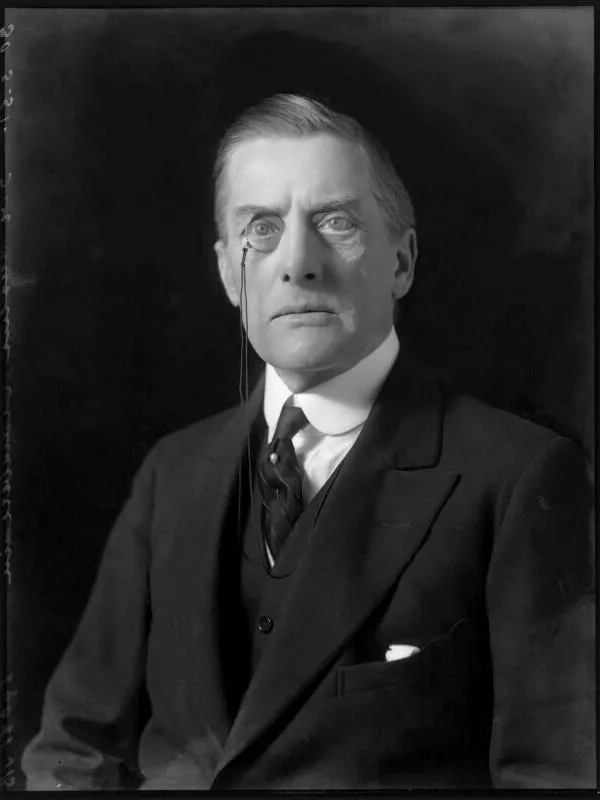
Sir Austen Chamberlain, son of the great Victorian politician Joseph Chamberlain and elder half-brother of the future Prime Minister Neville, sat in the House of Commons for forty-five years. He was twice Chancellor of the Exchequer and briefly leader of the Conservatives, but he went down in history as Foreign Secretary from 1924 to 1929. It was he who, on Britain’s behalf, guaranteed Germany’s western border at Locarno, for which he received the Nobel Peace Prize. The same settlement marked the limits of British commitment in Europe: Britain would defend the Rhine, but not the Vistula. In the last years of his life Chamberlain was one of the first to warn against Hitler’s Germany and, together with Winston Churchill, demanded rearmament. He died in March 1937, ten weeks before his brother became Prime Minister and embarked on the policy of concessions to Hitler.
Son of Joseph Chamberlain
Joseph Austen Chamberlain was born on 16 October 1863 in Birmingham. His mother died giving birth to him. His father, Joseph Chamberlain – a screw manufacturer, radical mayor of Birmingham and later one of the most important politicians of the Empire – destined his son for politics from the start. Austen was educated at Rugby School and Trinity College, Cambridge, and then spent several months in Paris, where he studied at the School of Political Sciences and met, among others, Georges Clemenceau. He brought back from France a love of its culture that never left him. He later said that he loved France as one loves a woman.
He then lived in Berlin for a year. He dined with Otto von Bismarck, which he counted among the most important experiences of his youth, but the lectures of the historian Heinrich von Treitschke revealed to him, as he wrote, a new side of the German character: a narrow, proud and intolerant Prussian chauvinism. He returned to this impression during both great crises, in 1914 and in the 1930s.
A Unionist politician
In 1892 he was elected to Parliament for his father’s Liberal Unionist Party, which opposed Irish Home Rule and worked with the Conservatives. His maiden speech, delivered in 1893 against the Irish Home Rule Bill, was praised by the Prime Minister, William Gladstone, himself. In Conservative and Unionist governments he was successively a Civil Lord of the Admiralty, Financial Secretary to the Treasury and Postmaster General, and in 1903, at the age of 40, he became Chancellor of the Exchequer. His father, who had left the government at that time to campaign for imperial tariffs, was incapacitated by a stroke in 1906, and Austen took over the leadership of the movement from him. In 1906 he married Ivy Dundas. They had two sons and a daughter.
In 1911 he had the chance to become leader of the Conservatives, but he withdrew along with his rival so as not to split the party, and Andrew Bonar Law became leader. Churchill later remarked that Austen always played the game and always lost it. Stiff, with his ever-present monocle and an orchid in his buttonhole, he struck many people as a latecomer from the Victorian age.
War and its aftermath
In May 1915 he joined the coalition government of Herbert Asquith as Secretary of State for India. He was formally responsible for the Mesopotamian campaign conducted by the Indian Army, which in April 1916 ended with the surrender of the British garrison at Kut. When a parliamentary commission sharply criticised the preparation of the expedition, Chamberlain resigned in July 1917, although he bore no personal blame for the command’s mistakes. The gesture won him widespread respect. In April 1918 he returned to the War Cabinet of David Lloyd George, and in January 1919 he became Chancellor of the Exchequer for the second time. He had to put in order the finances of a country indebted by the war, including to the United States.
In 1921 he became leader of the Conservatives in the House of Commons and, as one of the British negotiators, signed the treaty with the Irish representatives in December of that year. His loyalty to Lloyd George, however, cost him the leadership. On 19 October 1922 Conservative MPs meeting at the Carlton Club decided to leave the coalition, and Chamberlain stepped down. For two years he was out of government.
Foreign Secretary
In November 1924 Stanley Baldwin entrusted him with the Foreign Office. Chamberlain found a Europe that had just been through the occupation of the Ruhr and the adoption of the Dawes Plan, with France seeking security guarantees and Germany seeking a way out of isolation. He believed that the key to peace was France’s security, and with it calm on the Rhine. In March 1925 he announced at the League of Nations Council that Britain rejected the Geneva Protocol, which would have obliged it to apply sanctions anywhere in the world. When the German minister Gustav Stresemann proposed a pact guaranteeing the Rhine frontier, Chamberlain saw his opportunity. He consistently refused to guarantee the borders in the east. In 1925 he wrote that for the Polish Corridor no British government ever would or ever could risk the bones of a British grenadier. He hoped that once France and Germany were reconciled, the disputes in the east could in time be settled peacefully, even at the expense of Poland and Czechoslovakia.
In October 1925 at Locarno he was, alongside Stresemann and Aristide Briand, one of the three principal architects of the agreement. The texts were initialled on 16 October, his 62nd birthday, and on 1 December Chamberlain hosted the signing ceremony of the Locarno Treaties at the Foreign Office. Britain then undertook to come to the aid of France or Germany if either attacked the other. For Locarno the King made Chamberlain a Knight of the Garter, and the Nobel Committee awarded him the Nobel Peace Prize for 1925, jointly with the American Charles Dawes. Chamberlain also helped bring Germany into the League of Nations in 1926 and accepted German assurances that the Treaty of Berlin with the USSR did not contradict Locarno.
Other matters went less well for him. He was distrustful of the Soviet Union. In May 1927, after a police raid on the London offices of the Soviet trading company Arcos, Baldwin’s government broke off diplomatic relations with Moscow. In the same year Britain sent troops to Shanghai to protect its citizens during the Chinese civil war. Chamberlain met Benito Mussolini several times, valued him as a politician capable of imposing order, and maintained friendly relations with him. In 1928 he acceded to the Kellogg–Briand Pact, while reserving freedom of action in regions Britain regarded as vital to its Empire. After the Conservatives’ defeat in the May 1929 election he ceased to be Foreign Secretary.
Warnings against Hitler
In August 1931, during the financial crisis, he joined Ramsay MacDonald’s National Government as First Lord of the Admiralty. In September pay cuts provoked a mutiny among sailors of the fleet at Invergordon, and Chamberlain, criticised for the way the Admiralty had introduced the reductions, did not join the new government after the October election.
As a respected backbencher he quickly understood what National Socialist Germany was. In April 1933, a few weeks after Adolf Hitler came to power, he told the House of Commons that the new German nationalism was the worst form of Prussian imperialism with an added brutality and racial pride that denied equal rights to anyone not of “pure Nordic birth”, and he asked whether it was possible to discuss treaty revision with such a government at all. From 1934, alongside Winston Churchill, he was one of the most respected advocates of rearmament. In December 1935 his stance helped Baldwin’s government survive the crisis that followed the disclosure of the Hoare–Laval Pact, which handed Mussolini a large part of Abyssinia. In 1936 he led deputations of Conservative MPs pressing Baldwin to speed up rearmament.
He died suddenly on 16 March 1937 at his home in London, aged 73. He was buried in East Finchley Cemetery. Two and a half months later his half-brother Neville Chamberlain became Prime Minister, and in September 1938 at Munich he agreed to hand the Sudetenland to Germany.
Assessment
Austen Chamberlain was a man of honour and a conscientious minister, but he lacked the ruthlessness that leads to the top. He was the only Conservative leader of the 20th century before the 1990s who never became Prime Minister. His greatest achievement, Locarno, calmed Western Europe for several years and restored Germany’s place among the great powers. At the same time it entrenched the principle that Britain guaranteed the borders on the Rhine and left those of Poland and Czechoslovakia to their fate. When Hitler tore up the Rhineland Pact on 7 March 1936, Britain did not honour even the guarantee it had given in the west. Chamberlain, by then only a backbencher, witnessed the end of his work. The British government abandoned the principle he had formulated in 1925 only on 31 March 1939, when Neville Chamberlain announced the guarantee to Poland.
Sources
Often appears with
People who appear in the same events.