Germany
Gustav Bauer
Deputy Chairman of the General Commission of Trade Unions (1908–1918), Minister of Labour (1919), Reich Minister-President and Reich Chancellor (1919–1920), Vice-Chancellor (1921–1922)
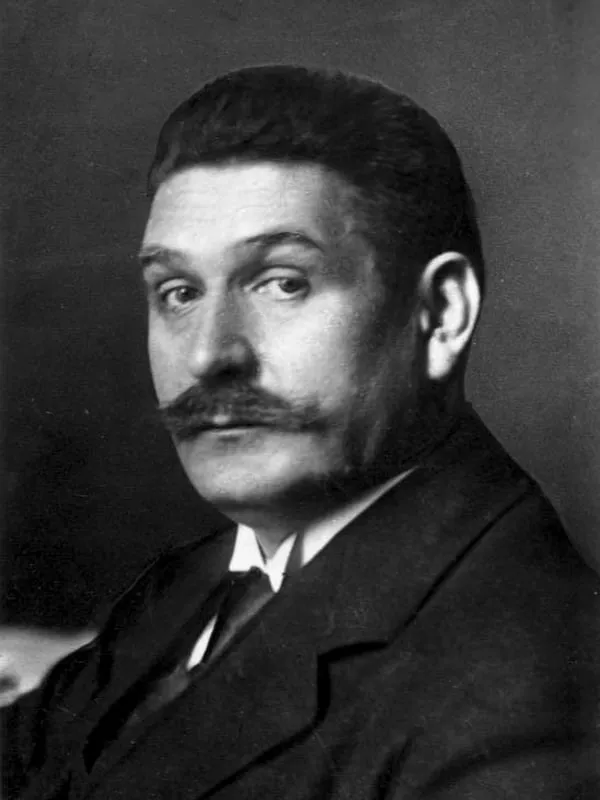
- Born:
- 6 January 1870, Darkehmen (East Prussia)
- Died:
- 16 September 1944, Berlin
- Author:
- Łukasz
- Photo:
- autor nieznany, CC BY-SA 3.0 DE, Wikimedia Commons

Gustav Bauer, a law clerk from East Prussia who rose to become one of the leaders of the German trade union movement, took charge of the Reich government at the worst possible moment. On 21 June 1919, when the government of Philipp Scheidemann resigned rather than sign the peace, Bauer took over with a single task: to accept the victors’ terms before the ultimatum expired. Under his government Germany signed the Treaty of Versailles and adopted the Weimar constitution. His cabinet fell in March 1920 after the Kapp Putsch, and a few years later a corruption scandal ended his career. To the right he remained for ever the “Chancellor of Versailles”.
From the lawyer’s office to the trade unions
He was born on 6 January 1870 in Darkehmen in East Prussia, today Ozyorsk in Kaliningrad Oblast, the son of a court bailiff. The family was said to descend from Protestant refugees from Salzburg who had settled in Prussia in the eighteenth century. He attended elementary school in Königsberg until 1884 and then worked as a clerk in a lawyer’s office. From 1893 to 1895 he ran the office of the well-known Berlin defence counsel Fritz Friedmann.
In 1895 Bauer co-founded the union of office workers of Germany and became its leader. He also edited its journal. In 1902 he lost his job because of his union activity. A year later he took charge of the central workers’ secretariat of the free trade unions in Berlin, which gave workers legal advice. From 1908 to 1918 he was second chairman of the General Commission of the Trade Unions of Germany – the head office of the Social Democratic unions – ranking directly after its chairman, Carl Legien. In 1912 he entered the Reichstag for a Breslau constituency and became the first chairman of Volksfürsorge, a newly founded workers’ insurance cooperative.
War and revolution
Bauer belonged to the right wing of the Social Democratic Party of Germany. During the war he supported the policy of the Burgfrieden (“castle peace”), under which the Social Democrats and the trade unions backed the war effort in return for recognition of their role in the state. In those years the unions gained an influence over social policy such as they had never had before.
In October 1918 Chancellor Max von Baden appointed him State Secretary of the new Reich Labour Office. Together with Scheidemann he was one of the first two Social Democrats ever to sit in a Reich government. He kept his post after the outbreak of the revolution and under the Council of People’s Deputies led by Friedrich Ebert. In January 1919 he was elected to the National Assembly, and on 13 February he joined Scheidemann’s government as Minister of Labour.
The Chancellor of Versailles
On 7 May 1919 the Allies presented Germany with the peace terms, and on 16 June they issued an ultimatum: either Germany would sign, or the armistice would lapse and the victorious armies would advance beyond the Rhine. Scheidemann’s government fell apart. Like most Social Democrats, Bauer also regarded the treaty as unjust, but when Scheidemann stepped down on 20 June he agreed to form a new government. On 21 June he became head of a cabinet of Social Democrats and the Centre Party. The liberals of the German Democratic Party refused to take part in the signing and did not return to the government until the autumn. Until 14 August 1919, when the new constitution came into force, Bauer bore the title of Reich Minister-President; thereafter he was Chancellor.
On 22 June he put before the National Assembly a motion approving the signing of the treaty. He said that the government stood before it out of a sense of responsibility and in the knowledge that it was its accursed duty to save what could be saved. The Assembly agreed by 237 votes to 138, but with the reservation that Germany did not accept sole guilt for the war and would not hand its citizens over to foreign courts. That same day the Allies rejected all reservations. On 23 June, after the army command had admitted that resistance was hopeless, Bauer called on the Assembly to approve signing without conditions. A few hours before the deadline expired the government informed Paris that Germany would sign. Bauer stressed that Germany was yielding to force but not renouncing its honour. On 28 June, in the Hall of Mirrors at Versailles, the treaty was signed on behalf of his government by the Foreign Minister, Hermann Müller, and by the minister Johannes Bell.
Bauer’s government had other achievements too. On 11 August 1919 Ebert signed the new Weimar constitution. The Vice-Chancellor and Finance Minister, Matthias Erzberger, carried out a sweeping financial reform which for the first time gave the main taxes to the Reich rather than to the states. The takeover of the state railways by the Reich was prepared, and the Works Councils Act gave employees representation within their companies. On 13 January 1920, during the debate on that act, police opened fire on a left-wing demonstration outside the Reichstag building, killing several dozen people. The government responded with a state of emergency.
The Kapp Putsch
The Treaty of Versailles required the army to be cut to 100,000 men and the volunteer Freikorps (PL) to be disbanded. When the Defence Minister, Gustav Noske, ordered the dissolution of Captain Hermann Ehrhardt’s naval brigade, the brigade marched into Berlin on 13 March 1920, and the nationalist Wolfgang Kapp and General Walther von Lüttwitz proclaimed that they had taken power. The Reichswehr command refused to defend the government. Ebert and his ministers left for Dresden and then for Stuttgart. The trade unions called a general strike which, together with the civil service’s refusal to cooperate, brought down the Kapp–Lüttwitz Putsch within a few days.
The government returned to Berlin, but the trade unions, to which it owed its survival, demanded changes, above all Noske’s dismissal. Bauer, who was accused of weakness towards the army and of negotiating with the putschists, lost the confidence of his own supporters. On 26 March 1920 the government resigned, and the next day Müller formed a new cabinet.
Downfall
Bauer did not vanish from politics. In Müller’s government he was briefly Treasury Minister and Transport Minister, and in 1921–1922, in the governments of Chancellor Joseph Wirth, he was Vice-Chancellor and Treasury Minister. This was the period in which Germany, forced by the London Ultimatum of May 1921 to accept a schedule of reparations payments, pursued a policy of carrying out the treaty in order to show that its demands could not be met. The nationalists called it the “policy of fulfilment” and answered it with terror: in August 1921 they murdered Erzberger, and in June 1922 the Foreign Minister, Walther Rathenau.
Bauer’s career was ended by the Barmat affair. The Barmat brothers, businessmen who had done deals during the inflation on credit from state institutions, kept close contacts with SPD politicians. When the scandal broke at the end of 1924, it emerged that Bauer had enjoyed their favours. He denied having taken bribes, but at the beginning of 1925 he had to give up his seat and the party expelled him. The right used the affair to portray the whole republic as corrupt. In May 1926 a party tribunal overturned the expulsion and Bauer returned to the Reichstag, where he sat until 1928. He then withdrew from politics and devoted himself to a housing cooperative in Berlin.
Last years
After Adolf Hitler came to power, the Nazis did not forget the Chancellor of Versailles. In 1933 Bauer was arrested on charges of embezzling public money. He was released after a short time, and in 1935 the proceedings were dropped for lack of evidence. In Berlin he lived to see the outbreak of a war whose pretext was the revision of the borders drawn at Versailles. He died on 16 September 1944 in Hermsdorf, on the northern outskirts of Berlin.
Significance
Bauer was a typical representative of the generation of trade unionists who unexpectedly found themselves in power in 1918. Pragmatic, a good organiser and without great ideological ambitions, he accepted an office that nobody wanted and took upon himself a decision that politicians and generals preferred to avoid. The army, which in June 1919 had judged resistance impossible, signed nothing; the signature under the treaty was given by a government of Social Democrats and the Centre. This allowed the right, and later the Nazis, to present the republic as the work of men who had accepted the “Diktat” and the “disgrace”. The Barmat affair added the image of the corrupt Social Democrat, which propaganda readily projected onto the whole republic. In this way the chancellor who ended the state of war unwittingly supplied arguments to those who, twenty years later, unleashed the next one.
Sources
Often appears with
People who appear in the same events.