Germany
Walther von Lüttwitz
Commander of III Army Corps (1916–1918), commander of the troops in Berlin and the Mark (1918–1919) and of Reichswehr Group Command No. 1 (1919–1920), leader of the putsch (1920)
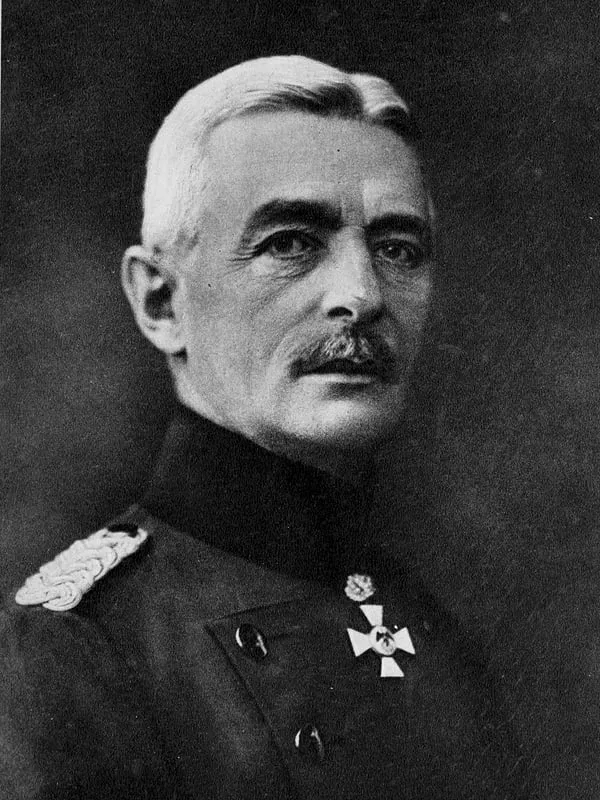
- Born:
- 2 February 1859, Bodland, now Bogacica near Kluczbork (Kingdom of Prussia)
- Died:
- 20 September 1942, Wrocław (Breslau), Germany
- Author:
- Łukasz
- Photo:
- Fotostudio Hermann Noack, domena publiczna, Wikimedia Commons

Walther Freiherr von Lüttwitz was a Silesian aristocrat and professional Prussian officer who in the First World War commanded an army corps and served as an army chief of staff at Verdun. After the defeat and the revolution the Social Democratic government gave him command of the troops in Berlin, and, relying on the volunteer Freikorps, he crushed the left-wing risings of 1919. His soldiers called him the “father of the Freikorps”. When the Treaty of Versailles required the volunteers to be disbanded and the army reduced, Lüttwitz rebelled against the government he had defended. In March 1920, on his orders, the Ehrhardt Naval Brigade occupied Berlin, and the putsch that bears his name alongside that of Wolfgang Kapp showed how little the Weimar Republic could expect of its army.
A Silesian officer
He was born on 2 February 1859 at the hunting lodge of Bodland in the Kreuzburg (Kluczbork) district of Upper Silesia, now Bogacica in the Opole Voivodeship. He came from an old Silesian family of barons von Lüttwitz. His father, Ernst, was a senior forester, a retired captain and head of a dyke association; his mother, Cecile, née Countess Strachwitz, was a Catholic. His elder brother Hinko also became a general, and in the next generation the family gave Germany several more generals.
After the cadet corps he was commissioned as a second lieutenant in the Silesian 38th Fusilier Regiment on 15 April 1878. At the end of the 1880s he graduated from the War Academy in Berlin, and from then on his career alternated, as was customary, between the General Staff and regimental service. In 1884 he married Countess Louise von Wengersky, with whom he had a son and three daughters. In 1911, as a Generalmajor, he commanded infantry brigades, including the 2nd Guards Infantry Brigade in Potsdam; in 1912 he became one of the Oberquartiermeister on the Great General Staff, and on 1 January 1914, as a Generalleutnant, he took over the 25th Division in Darmstadt.
The Great War
In August 1914 he became chief of staff of the Fourth Army of Duke Albrecht of Württemberg, which advanced through the Ardennes. At the end of September he took command of the 33rd Division, in 1915 of the 2nd Guards Division, and in the autumn of that year of X Army Corps, with which he held the line in Champagne. In August 1916, after the German offensive at Verdun had broken down, he became chief of staff of the Fifth Army, commanded by Crown Prince Wilhelm. His biographer in the Neue Deutsche Biographie considers one of his greatest services to have been limiting the consequences of that battle of attrition. The Crown Prince, however, judged him to be “more a commander of troops than an army chief of staff, more a Blücher than a Gneisenau”.
From 25 November 1916 until the end of the war he commanded III Army Corps. In March 1918 his corps took part in the Spring Offensive in the area of Saint-Quentin and La Fère. For this operation he received the oak leaves to the Pour le Mérite, which he had been awarded in August 1916. In August 1918 he was promoted to General der Infanterie. After the armistice he was one of the oldest and most experienced generals of an army returning to a country in the grip of revolution.
“Father of the Freikorps”
After the Christmas fighting in Berlin, when on 24 December 1918 regular army units failed to deal with the revolutionary People’s Naval Division, the revolutionary government, the Council of People’s Deputies, on 28 December appointed Lüttwitz commander of the troops in and around Berlin and commander-in-chief in the Mark of Brandenburg. The old regiments were falling apart, so Lüttwitz relied on the volunteer Freikorps (PL), raised by officers from men who hated the revolution. Together with the minister Gustav Noske, in January 1919 he directed the suppression of the Spartacist uprising. Under his command was the Guards Cavalry Rifle Division, whose officers, on the orders of Captain Waldemar Pabst, murdered Karl Liebknecht and Rosa Luxemburg. In March 1919 his troops bloodily put down further fighting in Berlin, in which more than a thousand people were killed. At that time several tens of thousands of soldiers were under his command, which made him one of the most powerful commanders in Germany. In May 1919 the government designated him commander-in-chief of all the Reich’s forces in the event of war or emergency.
He soon began to make demands that went beyond a soldier’s role, among them a ban on strikes and the abolition of unemployment benefit. In the summer of 1919, during the dispute over accepting the peace treaty, there was talk of a coup in the general’s circle, and according to some historians he was at that time privy to conspiratorial plans. Yet when in July Pabst wanted to lead troops on Berlin on his own initiative, Lüttwitz, together with General Georg Maercker, stopped him. On 1 October 1919 he became commander of Group No. 1 of the Provisional Reichswehr, which controlled the troops in East Prussia, Pomerania, Brandenburg, Silesia and Saxony. After the retirement of Hindenburg he was then the army’s most senior serving general.
Revolt against Versailles
Lüttwitz regarded the Treaty of Versailles as a catastrophe that would break the army. He most strongly opposed the reduction of the army to 100,000 men, the disbandment of the Freikorps and the handing over to the Allies of some 900 Germans accused of war crimes. When the treaty came into force on 10 January 1920 and on 29 February Noske ordered the Ehrhardt Naval Brigade to be dissolved, the general declared publicly that he would not allow so fine a formation to be broken up. On the evening of 10 March he presented President Friedrich Ebert with an ultimatum: he demanded the dissolution of the National Assembly, new elections, the election of the president by the people, a cabinet of expert ministers, the dismissal of the head of the army command and supreme command for himself. Ebert refused, and on 11 March Noske suspended him from duty.
Lüttwitz had long been in contact with the nationalist civil servant Wolfgang Kapp and his National Association, but, as his biographer writes, he never really agreed with him. Once suspended, he made the decision himself and only then informed the conspirators. On the night of 12–13 March the Ehrhardt Brigade marched on Berlin, and in the morning it occupied the government quarter, from which Ebert and the ministers had fled. Kapp proclaimed himself chancellor, and Lüttwitz became Reichswehr minister and commander-in-chief.
The two men wanted different things. Kapp wanted to overthrow the republic and its constitution. Lüttwitz, as his demands indicate, wanted above all to save the army and the Freikorps, to force new elections, in which he counted on a victory for the right, and to obtain a government of experts. He was prepared to talk even to the Social Democrats. He did not foresee that the putsch would be met by a general strike of millions of workers and that the civil servants would refuse to carry out orders. Part of the army sided with him; most of it waited to see what would happen. On 17 March Kapp stood down and fled, and Lüttwitz still tried to rule as a military dictator. Abandoned by his own commanders, he resigned that evening – according to some sources on 18 March. The Vice-Chancellor, Eugen Schiffer, accepted his resignation on behalf of the president, left him his pension rights and suggested that he leave the country until a decision on an amnesty had been made.
Exile and return
Lüttwitz hid first in Saxony and then, with a passport obtained from sympathisers in the Berlin police, went to Hungary, ruled by Admiral Miklós Horthy, where many German right-wingers found refuge. He never stood trial. At the trial of Traugott von Jagow in 1921 the impression was even created that Lüttwitz had only wanted to enforce respect for the constitution, unlike Kapp, who had wanted to overthrow it. In 1921, after the death of his first wife, he married Baroness Adelheid Sardagna von Meanberg und Hohenstein in Salzburg. He returned to Germany after an amnesty – according to the German Historical Museum in August 1924 (some sources give 1925) – and settled in Silesia.
He did not return to politics, though he did not abandon it either. He supported the German National People’s Party. In 1931 he called for the formation of the Harzburg Front, an alliance of nationalists, the Stahlhelm and the Nazis against the government of Chancellor Heinrich Brüning. In 1933 he wrote to congratulate the Nazi Reich Minister of the Interior, Wilhelm Frick, on the seizure of power, and in 1934 he published his memoirs, Im Kampf gegen die November-Revolution (“In the Struggle against the November Revolution”), in which he presented himself as the defender of Germany against Bolshevism. He died in Wrocław (Breslau) on 20 September 1942.
The family in the Third Reich
The fortunes of his family illustrate well the divisions within the German military elite. His daughter Maria married the officer Kurt von Hammerstein-Equord, who in 1930–1934 was Chief of the Army Command, was regarded as one of the few generals hostile to Hitler, and was sidelined after 1933. Lüttwitz’s granddaughter, Marie Luise von Hammerstein, sympathised with the communists. His son Smilo served in the Wehrmacht and rose to the rank of General der Panzertruppe; he was awarded the Knight’s Cross with Oak Leaves and Swords and after the war was a general in the Bundeswehr.
Significance
Lüttwitz was neither an ideologue nor a politician. He was a general of the old school who believed that the army stood above the state, and who overestimated the strength of his soldiers without understanding the new, democratic reality. The Weimar Republic, which in 1919 had relied on him and the Freikorps against the left, discovered in March 1920 that the same men could turn against it. The putsch he launched had consequences more lasting than five days of turmoil: the defeat of the Weimar coalition in the elections of June 1920, the flight of the far right to Bavaria, where the NSDAP was growing, the bloody Ruhr uprising, and an army under Hans von Seeckt that was formally apolitical but indifferent to the fate of the republic. The impunity of Lüttwitz and most of his soldiers confirmed the enemies of democracy in their belief that an attack on it carried no risk. When the republic was collapsing thirteen years later, the army, whose revolt of 1920 had gone unpunished, once again stood aside.
Sources
Often appears with
People who appear in the same events.