- Category:
- Military operations
- Front:
- Western Front
- Date:
- 26 May 1940
- Author:
- Łukasz
- Battle:
- Battle of Dunkirk
- Tags:
- United Kingdom, France, Royal Navy, Luftwaffe
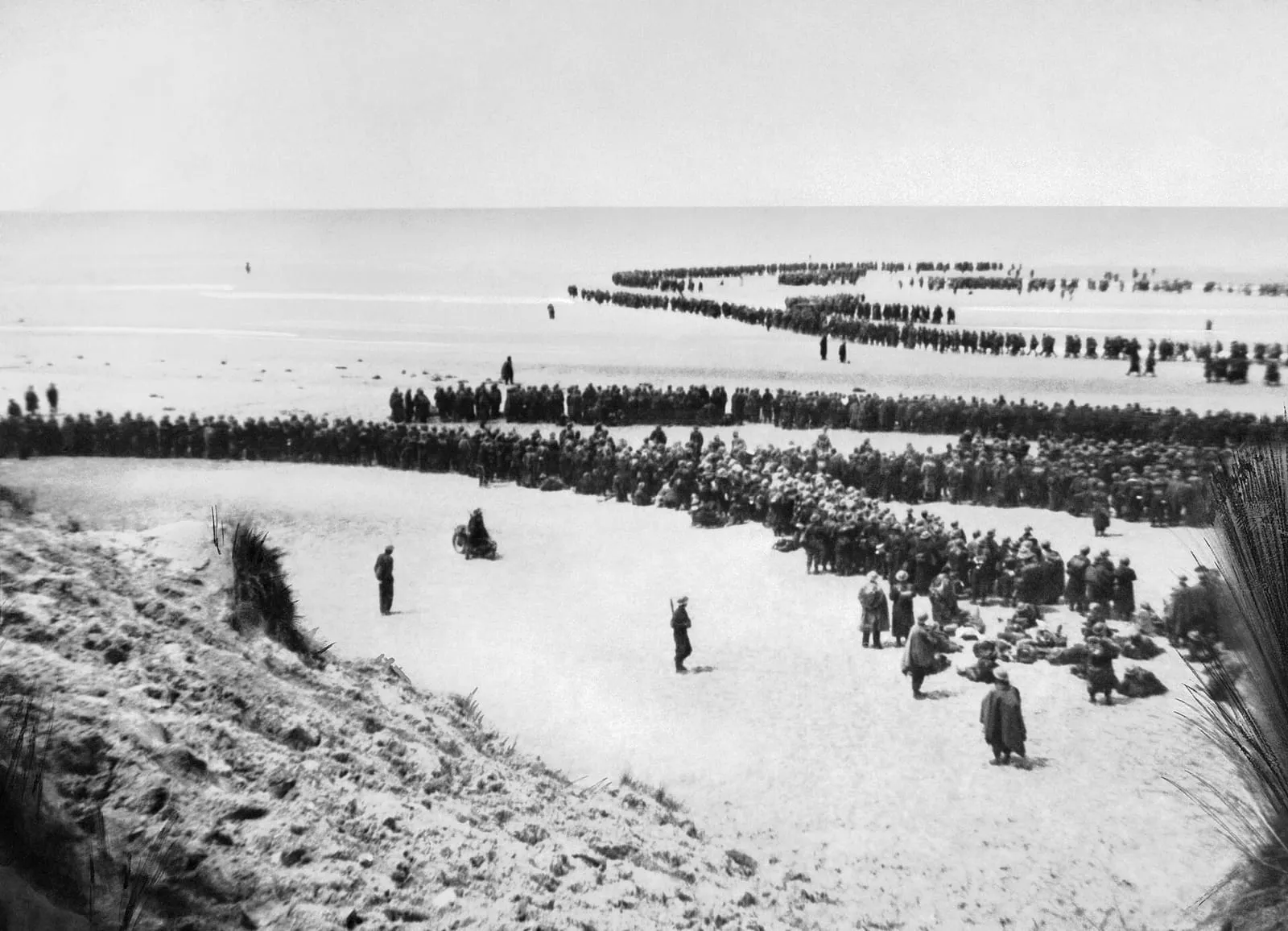
On 26 May 1940, a few minutes before seven in the evening, the British Admiralty signalled Dover: begin Operation Dynamo. This was the name given to the evacuation across the English Channel of the British Expeditionary Force and part of the French forces, cut off by the Germans in northern France and Belgium and squeezed into an ever narrower pocket around Dunkirk. The operation was directed from the tunnels beneath the castle at Dover by Vice Admiral Bertram Ramsay. It was hoped that some 45,000 men could be taken off within two days, before the Germans closed the port. Over nine days, under the bombs of the Luftwaffe, warships, ferries, trawlers and hundreds of small civilian craft carried 338,226 soldiers to England. The British Army lost almost all its equipment but kept its men, and Britain kept its ability to fight on.
Date and figures
Popular chronologies state that on 26 May the evacuation of 340,000 soldiers began, lasting until 3 June. The starting date is correct: the Admiralty issued the order to begin the operation on 26 May at 6.57 p.m., although Ramsay, without waiting for the formal decision, had already sent the first ships towards Dunkirk in the afternoon. The figure and the end date need to be made more precise. According to the British official history (L. F. Ellis, The War in France and Flanders 1939–1940), 338,226 men were carried to England under Dynamo, of whom about 198,000 were British and about 140,000 Allied soldiers, the great majority of them French, together with Belgians, Dutch and Poles. The last ship, the destroyer HMS Shikari, left the mole at Dunkirk at 3.40 a.m. on 4 June, and the Admiralty announced the end of the operation that afternoon. The night of 3–4 June was thus the last night of the evacuation, and the figure of 340,000 is a rounding. To this must be added some 28,000 men, mostly rear-area personnel, taken out of Dunkirk before 26 May.
Cut off by the sea
When Germany attacked in the west on 10 May, the best Allied forces, including the nine divisions of General Lord Gort’s British Expeditionary Force, advanced deep into Belgium. The main blow, however, came through the Ardennes. After the breakthrough at Sedan the German panzer divisions raced west and on the evening of 20 May reached the English Channel near Abbeville. The Allied armies in the north – the British, the Belgian and three French armies – were cut off from the rest of France.
The British began to think about evacuation earlier than they admitted to their ally. On 19 May the War Office considered for the first time the “evacuation of very large forces”, and on 20 May the first conference on the subject was held at Dover under Ramsay’s chairmanship. On the same day the Admiralty, on the initiative of Winston Churchill, who had been Prime Minister for ten days, began to assemble small craft capable of operating close to the French coast. The plan of the new Commander-in-Chief, General Maxime Weygand, who had replaced Gamelin, was to cut through the German wedge with attacks from the north and the south. The British counter-attack at Arras on 21 May had only a fleeting effect, and the French attack from the south never came. On the evening of 25 May, as the Belgian front in the north began to collapse, Gort on his own responsibility withdrew his divisions from the planned attack, threw them in to close the gap on the Belgian side and then turned the army towards the coast.
The retreat was helped by a decision of the enemy. On 24 May Adolf Hitler, on the advice of the commander of Army Group A, General Gerd von Rundstedt, halted the panzer divisions on the line of the Aa Canal, a dozen or so kilometres from Dunkirk, while Hermann Göring gave assurances that the Luftwaffe would deal with the encircled forces on its own. The halt order was rescinded only on the afternoon of 26 May, and the tanks moved off again the next day. In the meantime Boulogne fell (25 May), and on 26 May, after a stubborn defence, the British garrison of Calais surrendered. Of the three ports on the coast that were to supply or evacuate the BEF, only Dunkirk remained.
Ramsay at Dover
Ramsay, a retired officer recalled to service in August 1939, was Flag Officer Dover. His staff worked in tunnels cut into the chalk cliff beneath the castle, in a room that during the First World War had housed an electrical generator – a dynamo. Hence the code name of the operation. At the outset Ramsay had a few dozen ships at his disposal, mainly passenger ferries that had plied the Channel before the war, and a few destroyers. Over the following days hundreds were assembled.
Three routes led from Dunkirk to Dover. The shortest, Route Z, about 39 nautical miles long, ran along the French coast and from 27 May came within range of the German artillery near Calais, so that by day it became too dangerous. The longest, Route Y, at 87 miles, doubled the length of the voyage. The intermediate Route X, about 55 miles, first had to be swept of mines. Ramsay’s staff had about a thousand copies of charts made, marked the channels with buoys and set the rhythm of sailings so that one ship after another would arrive at Dunkirk round the clock.
A slow start
26 May was proclaimed a National Day of Prayer in Britain. King George VI attended a service at Westminster Abbey, and the clergy prayed for the soldiers “in mortal peril in France”. The public did not yet know the scale of the disaster, but was beginning to sense it.
The first full day of the evacuation was a disappointment. On 27 May a mere 7,669 soldiers reached English ports. That day the Luftwaffe attacked Dunkirk in full strength: in a dozen or so raids it destroyed the port installations and the oil tanks, and there was no way to fight the fires in the burning town, because the bombs had cut the water mains. According to some sources about a thousand inhabitants were killed. The port with its quays became unusable.
On the evening of 27 May Captain William Tennant, appointed by the Admiralty as Senior Naval Officer ashore, arrived in Dunkirk. He found the town in flames and crowds of soldiers on the beaches. He asked Dover to send every available vessel to the beaches east of the town, and at the same time tried something that nobody had planned: he directed ships to the East Mole, a narrow breakwater almost one and a half kilometres long with a wooden walkway, built to protect the harbour entrance rather than for ships to berth at. The attempt succeeded. The mole became the operation’s most important embarkation point.
The mole and the beaches
From 28 May the evacuation proceeded in two streams. Columns of soldiers, directed by naval officers, moved along the mole and boarded destroyers and ferries, which took several hundred men each, and destroyers as many as nine hundred. According to most estimates about two-thirds of all those evacuated were taken off from the harbour, mainly from the mole itself. The rest left from the wide, shallow beaches stretching from Dunkirk through Malo-les-Bains and Bray-Dunes to De Panne in Belgium. Large ships could not come close inshore; soldiers stood in queues for hours and then waded chest-deep into the water to reach the boats that ferried them to the ships waiting offshore. At De Panne and Bray-Dunes sappers drove lorries into the sea, weighted them with sandbags and linked them with planks to form makeshift piers.
The daily figures rose quickly: 17,804 men on 28 May, 47,310 on 29 May, 53,823 on 30 May and 68,014 on 31 May, the highest of the whole operation. On 29 May Rear Admiral Frederic Wake-Walker also put to sea, coordinating the movement of vessels off the coast from the decks of a succession of warships.
The little ships
The “little ships” became the legend of Dunkirk. As early as 14 May the Admiralty had broadcast an appeal to owners of self-propelled pleasure craft between 30 and 100 feet long to send in their particulars. From 27 May officials of the Ministry of Shipping and naval officers combed the moorings on the Thames and along the coast of south-east England, requisitioning yachts, motor boats, fishing boats, barges, tugs, lifeboats and paddle steamers, sometimes without their owners’ knowledge. They were assembled at Sheerness and Ramsgate. Most were manned by Royal Navy sailors, but many sailed with civilian crews: fishermen, boatmen, yacht owners. Charles Lightoller, once second officer of the Titanic, took his motor yacht Sundowner across with his son and brought back 127 soldiers.
The little ships arrived off Dunkirk from 28 May. Their main task was to ferry soldiers from the beaches to larger vessels, although many of them returned to England on their own with their decks packed with men. They carried only a minority of the evacuees directly, but without them evacuation from the beaches would have been impossible. After the war they became a symbol of an evacuation in which ordinary people came to the rescue of the army.
The Allies sent ships too. Alongside French, Belgian and Dutch vessels, the Polish destroyer ORP Błyskawica took part in the operation: from 26 May she covered the evacuation routes from the North Sea side, on 29 May she towed to Dover the destroyer HMS Greyhound, damaged from the air, with about five hundred soldiers on board, and on the night of 30–31 May she rescued survivors from the sunken French destroyer Siroco.
The sky over Dunkirk
Göring had promised that the air force would not let the British escape. The Luftwaffe inflicted heavy losses on the evacuation fleet, but did not achieve its aim. The weather hampered it: for several days low cloud hung over the coast, and smoke from the burning oil tanks shrouded the port. Its units were tired after two weeks of campaigning, and many of them were operating from airfields in Germany. More important was the fact that over Dunkirk it met, for the first time on a large scale, Supermarine Spitfire and Hawker Hurricane fighters flying from the English bases of No. 11 Group. Fighter Command flew several thousand sorties during the operation, often in formations too small to provide continuous cover.
The soldiers on the beaches did not see this. Most of the air fighting took place over the sea or inland, while over the beaches Junkers Ju 87s kept appearing. Many evacuees came back to England convinced that the RAF had abandoned them, and in the ports airmen were sometimes insulted. The losses on both sides were heavy and are given variously. According to figures cited in the literature, the RAF lost about 145 aircraft during the operation and the Luftwaffe about 156, some of them shot down by the ships’ anti-aircraft guns.
The hardest days
29 May was the worst day of the operation for the fleet. Just after midnight a German motor torpedo boat sank the destroyer HMS Wakeful with hundreds of soldiers on board, and a few hours later, in the same area, a submarine torpedoed HMS Grafton, which was picking up survivors. In the afternoon dive-bombers attacked the ships crowded at the mole. The destroyer HMS Grenade, the paddle steamer Crested Eagle and several passenger ships were sunk, and several destroyers were badly damaged. That evening the Admiralty, fearing the loss of ships needed to defend the country against invasion, withdrew its most modern destroyers. Ramsay persuaded the First Sea Lord, Admiral Dudley Pound, to return them the next day.
On the evening of 31 May, on orders from London, Lord Gort left for England. He handed over command of the British rearguard to General Harold Alexander. On 1 June the Luftwaffe again attacked in full force: the British destroyers Keith, Basilisk and Havant and the French Foudroyant were sunk, along with several other vessels. Even so, 64,429 men were evacuated that day. After these losses Ramsay and Tennant decided to stop the evacuation by day and from then on to conduct it only at night. On the night of 2–3 June the last of the British, Alexander among them, sailed away, and at 11.30 p.m. on 2 June Tennant signalled Dover: “BEF evacuated”.
The crimes at Le Paradis and Wormhoudt
The battalions holding the western and southern walls of the corridor to the sea often fought until their ammunition ran out, to gain time for the rest of the army. Two such episodes ended in atrocities. On 27 May, near the village of Le Paradis in the Pas-de-Calais department, a massacre of prisoners took place. Soldiers of the 2nd Battalion, Royal Norfolk Regiment, who had held out for many hours in the buildings of a farm, surrendered to a unit of the SS “Totenkopf” division. The SS men lined the prisoners up against the wall of a barn and mowed them down with machine guns, finishing off the wounded. Ninety-seven men were killed; two wounded men survived by hiding among the bodies. After the war their testimony made it possible to convict the company commander, Fritz Knöchlein. A British military court in Hamburg sentenced him to death, and the sentence was carried out in January 1949.
On 28 May near Wormhoudt soldiers of the Leibstandarte SS Adolf Hitler herded several dozen prisoners from the 2nd Battalion, Royal Warwickshire Regiment, the 4th Battalion, Cheshire Regiment and the artillery, as well as a few Frenchmen, into a barn, then threw grenades inside and shot those who survived. According to various findings about 80 men were killed. Responsibility was attributed to the battalion commander, Wilhelm Mohnke, but for lack of evidence he was never brought to trial, either in the 1940s or after the investigation was reopened in Germany in 1988.
The French rearguard
The success of the operation was decided to a great extent by the fighting of the French forces. Near Lille an encircled part of the French 1st Army, some 35,000–40,000 men, tied down seven German divisions, three of them armoured, from 28 to 31 May, so that they could not attack Dunkirk in that time. The Germans granted its defenders the honours of war. On the Dunkirk perimeter itself, based on canals and flooded ground, French units under Admiral Jean-Marie Abrial, commander of naval forces in northern France, increasingly took the place of the withdrawing British.
During the first days of the evacuation the French were taken off in small numbers, which caused bitterness and accusations that the British were saving themselves first. On 31 May, at a meeting of the Supreme War Council in Paris, Churchill assured Prime Minister Paul Reynaud that from then on the soldiers of both armies would be evacuated on equal terms. From 1 June the French were indeed taken off in larger numbers, and on 2, 3 and 4 June they formed the great majority of the evacuees. The price was that the rearguard of the French 12th and 68th Infantry Divisions fought to the end. On the morning of 4 June the Germans entered Dunkirk, and some 35,000–40,000 French soldiers who had covered the last nights of the evacuation went into captivity.
The balance sheet
According to official British figures, 861 British and Allied vessels took part in the operation, from the anti-aircraft cruiser HMS Calcutta and 39 destroyers down to lifeboats and barges, and 243 of them were sunk. The Royal Navy lost six destroyers (Grafton, Grenade, Wakeful, Basilisk, Havant and Keith), the French Navy three (Bourrasque, Siroco and Foudroyant), and 19 British destroyers were damaged.
The British Army came home without its equipment. Left behind in France were some 2,500 guns, tens of thousands of vehicles and motorcycles, hundreds of thousands of tons of ammunition, fuel and stores, and almost all the tanks sent to the Continent. Over the whole campaign, from 10 May to the armistice, the BEF lost about 68,000 men killed, wounded and taken prisoner. Tens of thousands of British prisoners made long marches on foot to camps in Germany. South of the Somme there still remained British units, which fought on alongside the French in June.
Place in the war
The evacuation from Dunkirk was at once a defeat and a deliverance. On 4 June, speaking in the House of Commons, Churchill called the course of the campaign “a colossal military disaster” and the rescue of the army “a miracle of deliverance”, but warned that “wars are not won by evacuations”. In the same speech he declared that the British would fight on the beaches, on the landing grounds, in the fields and in the streets, and would never surrender. German propaganda presented the fall of Dunkirk as the greatest victory in history, and on 5 June the Wehrmacht began the second phase of the campaign, the offensive southwards across the Somme, which within three weeks brought about the defeat of France.
For Britain the most important thing was that the cadre of the professional army had been saved: the officers, NCOs and experienced soldiers from whom the land forces were rebuilt in the years that followed. Without them Churchill’s government, which in the last days of May had rejected the idea of sounding out peace terms, would have been in a far weaker position. In the summer of 1940 Britain, though its army had been stripped of equipment, prepared to defend itself against invasion, and its fate was decided by the Battle of Britain. In France, on the other hand, the evacuation left a lasting bitterness, which German and later Vichy propaganda eagerly stoked. About 100,000 of the French evacuees were soon shipped back to France through the ports of Normandy and Brittany. Many of them were taken prisoner within a few weeks, and only a few stayed in England with General Charles de Gaulle.
Dunkirk entered the language. The “Dunkirk spirit” became the British term for a common effort in the face of disaster, and the event itself was for decades the subject of books and films. Historians point out, however, that the miracle was the result of the work of Ramsay’s staff, the self-sacrifice of sailors and airmen, Gort’s decision, the tenacity of the French rearguard and the mistakes of the German command. Ramsay, who directed the operation, four years later commanded the naval forces that carried the Allied armies back to France, to the beaches of Normandy.
Sources
Meanwhile
(04)Elsewhere, within a week.
- 24 May 1940 · ScandinaviaThe Allies decide to leave NorwayOn 24 May 1940 London decided, in secret from the Norwegians, to withdraw its troops from northern Norway. Defeat in France made the fight for Narvik pointless.
- 28 May 1940 · PoliticsThe War Cabinet crisisOn 25–28 May 1940 Halifax wanted to sound out peace terms via Mussolini. Churchill, backed by Chamberlain and Labour, won the government over to fighting on.
- 23 May 1940 · PoliticsThe internment of Oswald MosleyOn 23 May 1940 police detained Oswald Mosley and leading members of the British Union of Fascists. Churchill's government widened internment without trial.
- 31 May 1940 · Far EastThe bombing of ChongqingFrom 18 May 1940, in Operation 101, Japanese aircraft bombed Chongqing, China's wartime capital, day after day to break Chiang Kai-shek's will to resist.
Related events
(04)The same battle, people or subject.
- 4 June 1940 · Western FrontThe end of the Dunkirk evacuationOn 4 June 1940 the last ships left Dunkirk and the Germans entered the town. Between 30,000 and 40,000 French troops of the rearguard were taken prisoner.
- 24 May 1940 · Western FrontThe halt order before DunkirkOn 24 May 1940 Hitler approved halting the tanks before Dunkirk. By 26 May the Allies had strengthened their defence, and the Germans took Boulogne and Calais.
- 20 May 1940 · Western FrontThe Germans reach the English ChannelOn 20 May 1940 Guderian's tanks took Abbeville and that evening reached the sea at Noyelles. The Allied armies in Belgium and Flanders were cut off.
- 13 May 1940 · Western FrontThe breakthrough at SedanOn 13 May 1940, after eight hours of bombing, Guderian’s infantry crossed the Meuse at Sedan and Rommel at Dinant. On 15 May they broke into open country.