Turkey
İsmet İnönü
Commander of the Western Front (1920–1922), head of the delegation at Lausanne (1922–1923), Prime Minister of Turkey (1923–1924, 1925–1937, 1961–1965), President (1938–1950)
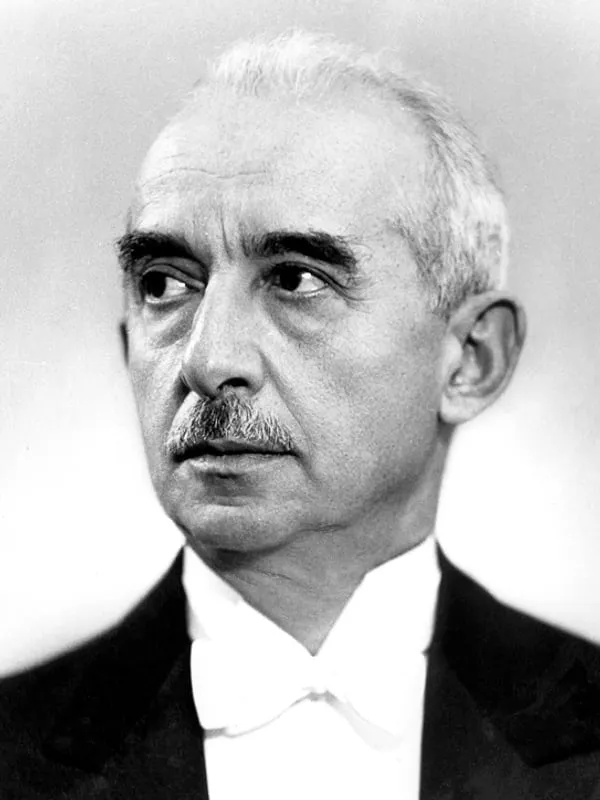
- Born:
- 24 September 1884, Smyrna (İzmir, Ottoman Empire)
- Died:
- 25 December 1973, Ankara
- Author:
- Łukasz
- Photo:
- autor nieznany (fotografia oficjalna), domena publiczna, Wikimedia Commons

For half a century İsmet İnönü was the second figure in Turkish politics, first at the side of Mustafa Kemal Atatürk and then as his successor. A staff officer of the Ottoman army, he commanded the Western Front in the war against the Greeks and in 1921 twice halted their advance near the village of İnönü, from which he later took his surname. As head of the Turkish delegation he negotiated the Armistice of Mudanya and the Treaty of Lausanne, which replaced the Treaty of Sèvres imposed on Turkey. For most of Atatürk’s rule he was prime minister and the executor of his reforms, but also of a harsh policy towards the Kurds and the minorities. After Kemal’s death in 1938 he became president and throughout the Second World War, despite pressure from Hitler and Churchill, kept Turkey neutral, entering the war on the Allied side only in February 1945. After the war he agreed to free elections, lost them and handed over power, and in the 1960s he was prime minister once again.
Youth and Yemen
Mustafa İsmet was born on 24 September 1884 in Smyrna, into the family of Reşit, an official of the military judiciary who came from Malatya in eastern Anatolia. Some sources attribute Kurdish origins to his father’s family, which his relatives denied. Because his father was repeatedly transferred, he spent his childhood in various towns, mainly in Sivas, where he completed military secondary school. In 1903 he graduated from the military engineering school in Istanbul as an artillery second lieutenant, and in 1906 he graduated top of his year from the General Staff Academy. He began his service with the Second Army in Adrianople (Edirne). He briefly joined the Committee of Union and Progress, but in 1909, after the suppression of the counter-revolution in Istanbul, during which his division marched on the capital, he left the committee.
In 1910–1913 he served in Yemen, where as chief of staff of the expeditionary corps he took part in suppressing the revolt of Imam Yahya and in the negotiations with him, which ended in an agreement that pacified the province for several years. Promoted to major, in 1913 he returned to Istanbul, then threatened by the Bulgarians in the First Balkan War, and in the autumn took part as a military adviser in the peace negotiations with Bulgaria.
The Great War
During the First World War İsmet rose rapidly. He served at Enver Pasha’s headquarters, and in 1915 became chief of staff of the Second Army and a colonel. On the Caucasus front in 1916 began his friendship with Mustafa Kemal, who then commanded a corps in the same army. İsmet’s activity in the first year of the war is disputed: some historians point out that as a staff officer, even before the government’s deportation orders of 1915 that opened the way to the Armenian genocide, he advocated removing Armenians from the areas near the front. His role has not been fully clarified.
In 1917 he commanded a corps on the Caucasus front and then in Palestine, where his III Corps defended the sector near Beersheba during the British offensive in the autumn of 1917. Together with Kemal he wrote reports warning against illusions about the situation on that front. After the Armistice of Mudros he worked at the war ministry in occupied Istanbul.
The Western Front
When the Allies formally occupied Istanbul in March 1920, İsmet escaped to Anatolia and reached Ankara on 9 April. He became a deputy in the Grand National Assembly and chief of the General Staff of its army, and the sultan’s court martial, as with Kemal, sentenced him to death in absentia. In November 1920 he took command of the Western Front, initially of its northern sector, facing the Greek army, which since the landing at Smyrna in May 1919 had occupied much of western Anatolia. His first task was to replace the volunteer bands with a regular army. He dealt with the guerrilla leader Çerkes Ethem, who refused to submit and went over to the Greeks.
In January 1921 Greek columns advanced on Eskişehir. On 10 and 11 January, at the village of İnönü in a pass before the city, İsmet’s troops threw them back in the first battle fought by Ankara’s regular army. İsmet was promoted to general, which carried the title of pasha. On 23 March the Greeks attacked again with larger forces, and after a week of heavy fighting, on 31 March, they once more had to fall back from İnönü. Kemal answered the report of victory with a telegram saying that İsmet had defeated not only the enemy but also the nation’s adverse fate. These two battles brought the Greco-Turkish War to a standstill for several months and convinced France and Italy that Ankara had to be reckoned with.
In the summer of 1921 came defeat. A great Greek offensive outflanked İsmet’s positions from the south and in July took Afyon, Kütahya and Eskişehir. Kemal ordered a retreat behind the Sakarya, and at the beginning of August the Assembly removed İsmet as chief of the General Staff and gave the post to Fevzi Pasha. İsmet nevertheless remained commander of the Western Front and fought at Kemal’s side in the Battle of the Sakarya, and in August 1922 in the great offensive that routed the Greek army at Dumlupınar and carried the Turks to Smyrna. On 31 August 1922 he was promoted to major general.
Mudanya and Lausanne
When the Turkish army reached the Straits and Britain threatened war, Kemal sent İsmet to negotiate with the Allies. At Mudanya on the Sea of Marmara, from 3 to 11 October 1922, İsmet negotiated with the British General Charles Harington and with French and Italian generals. The armistice they signed forced the Greeks to leave Eastern Thrace. At the end of October İsmet became foreign minister and head of the Turkish delegation to the Lausanne Conference.
It was his greatest success. A general with no diplomatic experience, and hard of hearing to boot, he faced the British Foreign Secretary, Lord George Curzon, who dominated the conference. İsmet stubbornly repeated the same demands, and when Curzon spoke he reputedly switched off his hearing aid, then set out his position after Curzon’s speech as though he had heard nothing. In February 1923 the conference broke down, but it resumed in April. On 24 July 1923 İsmet signed the Treaty of Lausanne. Turkey regained Eastern Thrace and freed itself from the capitulations, the privileges enjoyed by foreigners, and the new state won recognition as a full member of the international community. Mosul could not be recovered; its fate was to be decided by the League of Nations. The Lausanne settlement also included a compulsory population exchange with Greece, which affected more than one and a half million people.
Atatürk’s prime minister
After the proclamation of the republic on 29 October 1923 İsmet became its first prime minister. With a short break at the turn of 1924 and 1925 he held the office until 1937, carrying out Kemal’s reforms: the abolition of the caliphate, the ban on the fez, the new civil code and the Latin alphabet. It was he who proposed making Ankara the capital. He returned as prime minister in March 1925, when Sheikh Said’s Kurdish rebellion broke out in the east, and crushed it with the Law on the Maintenance of Order and the extraordinary Independence Tribunals. The same instruments were used to close down the opposition party and the independent press. His government drew up a reform plan for the east that envisaged the assimilation of the Kurds, a ban on the use of Kurdish in public offices, and rule by military inspectors-general. In 1930 the army suppressed the Kurdish rising at Ararat, massacring civilians in the Zilan valley in the process, and in 1937 it began the pacification of Dersim.
In economic policy İsmet favoured statism. After the Great Depression the state built railways, factories and banks, and in 1934 the first five-year plan was adopted, modelled on Soviet plans and financed partly by a Soviet loan. This led to a rift with Atatürk, who leaned towards a more liberal economic policy and had grown tired of his prime minister’s strong position. In the autumn of 1937 İsmet stepped down and the banker Celâl Bayar became prime minister. In 1934, under the Surname Law, Atatürk had given him the surname İnönü in memory of the victories of 1921.
Wartime president
When Atatürk died on 10 November 1938, the Assembly unanimously elected İnönü president the very next day. The party gave him the title of “National Chief” (Millî Şef) and made him its permanent chairman. He ruled in an authoritarian manner, surrounding himself with a cult modelled on his predecessor’s. In June 1939 he incorporated into Turkey the Hatay State, the former sanjak of Alexandretta, to which France agreed in order to win Turkey as an ally.
His foreign policy rested on a single principle: Turkey, which had fought almost without a break from 1911 to 1922, must not be dragged into a new war. In the spring of 1939, alarmed by Italy’s annexation of Albania, he concluded declarations of alliance with Britain and France, and on 19 October 1939 he signed a treaty of mutual assistance with them. He had counted on the Soviet Union being on the same side, but the Molotov–Ribbentrop Pact dashed these hopes, and in Moscow Vyacheslav Molotov presented the Turkish foreign minister with demands concerning the Straits. After the fall of France in June 1940 İnönü did not honour his alliance obligations, invoking the reservation that Turkey could not be drawn into a war with the USSR. On 18 June 1941, four days before the German attack on the Soviet Union, he signed a treaty of friendship with Germany, and in the autumn of that year he agreed to sell the Reich chromium, indispensable to its armaments industry. He rejected, however, the proposals of the German ambassador Franz von Papen, who promised Turkey gains at Greece’s expense, and refused to allow German troops to pass through to Iraq.
When the scales of victory tipped towards the Allies, the British began to apply pressure. In January 1943 Winston Churchill met İnönü in a railway carriage near Adana, and in December 1943, at the Second Cairo Conference, Churchill and Roosevelt together urged him to enter the war. İnönü set conditions the Allies could not meet, above all demanding arms and guarantees against the USSR. In April 1944 he halted chromium deliveries to Germany, in August he broke off diplomatic relations with it, and on 23 February 1945 Turkey declared war on Germany and Japan, which allowed it to become a founding member of the United Nations.
Neutrality had its price at home. Keeping more than a million men under arms ruined the economy, and bread was scarce. In November 1942 the government introduced a one-off capital levy (varlık vergisi), which businessmen from the minorities – Greeks, Armenians and Jews – paid at rates many times higher than Muslims. Those who could not pay were sent to labour camps in eastern Anatolia and their property was auctioned off. The levy was abolished in 1944 under Allied pressure. In February 1942 the Turkish authorities refused to let nearly eight hundred Jewish refugees from Romania disembark from the ship Struma and towed it out into the Black Sea, where a Soviet submarine sank it. One man survived. At the same time, in the 1930s and 1940s Turkey took in many émigré German scholars, and some Turkish diplomats saved Jews with Turkish citizenship in occupied Europe.
After the war
After 1945 Joseph Stalin demanded that Turkey cede Kars and Ardahan and grant the Soviet Union bases in the Straits. This threat pushed İnönü towards the United States, which in 1947 extended the Truman Doctrine to Turkey; in 1952 Turkey joined NATO. At home İnönü allowed the formation of the opposition Democrat Party. The 1946 election was not fair, but on 14 May 1950 his party lost a free election, and İnönü handed power to Adnan Menderes and Bayar without resistance. For ten years he led the opposition, harassed by an increasingly authoritarian government. After the military coup of 1960 he appealed in vain for clemency for Menderes, who had been sentenced to death. In 1961–1965, as prime minister, he headed three coalition governments and survived two attempted coups. In 1964, during the Cyprus crisis, he revoked the right of Greek nationals to reside in Istanbul, which led to the expulsion of more than ten thousand people. In 1972 he lost the struggle for the party leadership to the young Bülent Ecevit. He died in Ankara on 25 December 1973 and was buried in Atatürk’s mausoleum, opposite the tomb of his friend. His son Erdal was deputy prime minister in the 1990s.
Significance
İnönü belonged to the generation of officers who between 1911 and 1922 lived through successive wars, defeat and the partition of the empire, and then built a nation state on its ruins. At İnönü and at Lausanne he helped Turkey become the only defeated state of the First World War to overturn the treaty imposed on it – and to do so through negotiation rather than a new war. As prime minister he helped shape modern Turkey, but also its authoritarian and assimilationist character. As president during the Second World War he opted for a caution that his allies at the time saw as calculation, but which spared his compatriots the fate of Greece, Yugoslavia or Poland. According to a well-known anecdote, when years later a voter reproached him for the hunger of the war years, İnönü replied that yes, he had left him hungry, but he had not left him an orphan.
Sources
Commanded in battles
(01)Mentioned in battles
(01)Often appears with
People who appear in the same events.