Belgium
Leopold III
King of the Belgians (1934–1951), Commander-in-Chief of the Belgian Army (1939–1940)
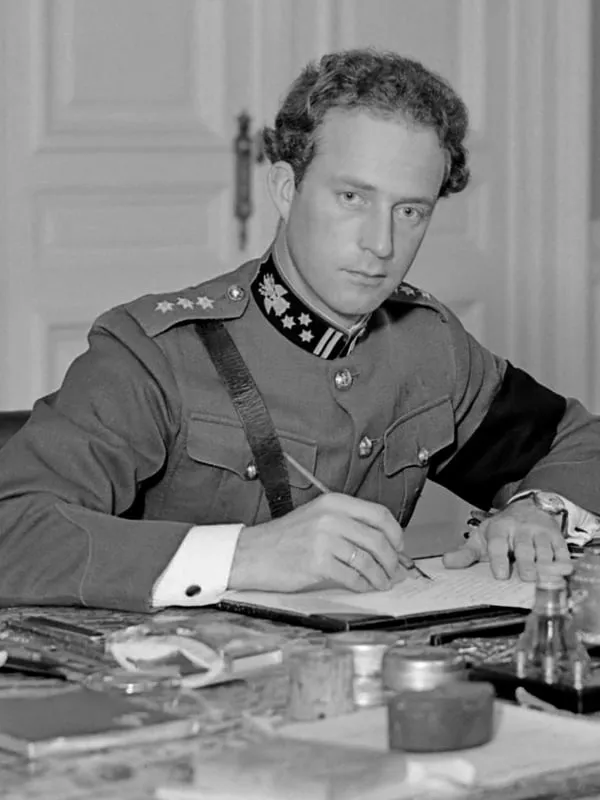
- Born:
- 3 November 1901, Brussels
- Died:
- 25 September 1983, Woluwe-Saint-Lambert (Brussels)
- Author:
- Natalia
- Photo:
- Willem van de Poll, CC BY-SA 3.0, Wikimedia Commons

Leopold III was the fourth King of the Belgians and the last monarch in Western Europe to command an army in the field in person during the Second World War. The son of the heroic “Soldier King”, Albert I, he came to the throne in 1934 and, after the remilitarisation of the Rhineland, took Belgium out of its alliance with France and staked everything on strict neutrality. When in May 1940 Germany invaded his country regardless, he directed its defence for eighteen days, and on 28 May, against the position of his government, he surrendered and remained in the country as a prisoner. That decision divided the king from the government, which carried on the war from London, and gave rise to the so-called Royal Question. After the war the dispute over his conduct split the Belgians almost to the point of civil war and in 1951 forced him to abdicate in favour of his son.
Childhood and the First World War
Leopold Philippe Charles Albert Meinrad Hubertus Marie Miguel was born on 3 November 1901 in Brussels, the first child of Prince Albert, nephew and heir of King Leopold II, and his wife Elisabeth of Bavaria. When his father came to the throne in 1909 as Albert I, Leopold, as heir, received the title of Duke of Brabant.
In August 1914 Germany invaded neutral Belgium. Albert I did not flee the country but for four years commanded the army on a strip of unoccupied Flanders behind the Yser, while Queen Elisabeth worked in field hospitals. This example was to weigh on his son’s whole life. In April 1915 the thirteen-year-old prince was enlisted as a private in the 12th Line Regiment and for a time went with it to the front. In the autumn of that year, however, his father sent him to Eton College in England, where he studied until 1919, returning for the holidays to his parents at De Panne. After the war he accompanied them on a triumphal tour of the United States, and in 1920–1922 he completed the Belgian Royal Military Academy and was commissioned as a second lieutenant in the Grenadier Regiment.
Astrid and accession to the throne
On 4 November 1926 in Stockholm Leopold married the Swedish princess Astrid, a niece of King Gustaf V. The young couple were exceptionally popular. They had three children: Joséphine-Charlotte (1927), later Grand Duchess of Luxembourg, Baudouin (1930) and Albert (1934), both later Kings of the Belgians. The prince travelled widely, to the Belgian Congo and Asia among other places, and was passionate about nature, ethnography and mountaineering.
On 17 February 1934 Albert I was killed while rock climbing at Marche-les-Dames on the Meuse. On 23 February Leopold took the constitutional oath and became King of the Belgians. A year and a half later, on 29 August 1935, the car he was driving left the road by Lake Lucerne near Küssnacht in Switzerland and struck a tree. Queen Astrid was killed instantly; the king was slightly injured. The Belgians mourned the queen’s death as a national tragedy, and Leopold himself, according to those close to him, became more withdrawn and mistrustful afterwards.
The policy of independence
After the First World War Belgium had tied itself to France through a military agreement of 1920 and the guarantees of Locarno. In March 1936 Hitler marched troops into the Rhineland, and France and Britain did not respond. Leopold III concluded that an alliance with a passive neighbour would drag Belgium into war without protecting it. On 14 October 1936, addressing a meeting of the Council of Ministers, he announced a “policy of independence”: Belgium would arm, but would not bind itself to any power. Domestic considerations also lay behind this policy, for the alliance with France met growing opposition in Flanders. In 1937 Britain and France released Belgium from its Locarno obligations, and in October of that year Germany gave an assurance that it would respect Belgian inviolability.
The king interpreted his constitutional powers more broadly than most parliamentary monarchs. He believed that in defence and foreign policy above all he had duties of his own, and he often acted through his personal military adviser, General Raoul Van Overstraeten, bypassing his ministers. In August 1939, on behalf of the states of the so-called Oslo Group, he made a radio appeal for peace, and together with Queen Wilhelmina of the Netherlands he offered the parties his good offices. When war broke out, he personally took command of the mobilised army on 3 September. On 27 October, in a broadcast to the American people, he declared that Belgium would fight if attacked, and in November he and Wilhelmina renewed their offer of mediation.
Neutrality meant refusing open staff talks with the French and British, although information about Belgian plans was passed to them in secret through the king’s advisers. The Allies responded with the Dyle Plan, which provided for their troops to enter Belgium only after a German attack. In January 1940, after the Mechelen incident, in which German attack plans fell into Belgian hands, Leopold III tried through Admiral Roger Keyes to obtain guarantees from London, but he would not agree to invite the Allies into the country before a German invasion.
The Eighteen Days
On 10 May 1940 Germany attacked the Netherlands, Belgium and Luxembourg. Leopold III, in the uniform of a lieutenant general, went to his headquarters at Breendonk without addressing parliament as his father had done in 1914, which the government noted with unease. On the very first day the Germans took Fort Eben-Emael and the bridges over the Albert Canal. In the Belgian campaign the Belgian Army, together with the French and British forces that had entered the country, defended first the Dyle Line and then, after the French front on the Meuse was broken at Sedan, fell back behind the Scheldt and to the Lys. On 16 May the government left Brussels, while the king stayed with the army.
From 20 May the Allied forces in Belgium were cut off from France. Leopold III concluded early on that the campaign was lost. At a conference at Ypres on 21 May he rejected a plan to withdraw to the Yser, which would have meant abandoning almost the whole country. On the morning of 25 May, at the château of Wijnendale near Torhout, he spoke for the last time with the Prime Minister, Hubert Pierlot, the Foreign Minister, Paul-Henri Spaak, and two other ministers. They urged him to leave with them and, like Haakon VII, to embody the fighting nation from exile. The king refused: as Commander-in-Chief he wanted to share the fate of his soldiers, and he believed that by remaining in the country he could better shield the Belgians from the occupier. He warned King George VI by letter that the army was close to collapse. On the evening of 27 May he accepted the German demand for unconditional surrender, and at 4 a.m. on 28 May the Belgian Army capitulated.
Leopold III regarded the capitulation as a military decision, not a political one. He concluded no agreement with Germany and did not take Belgium out of the war. The government in Paris, however, held that he had acted unconstitutionally and declared him “unable to reign”. The French Prime Minister, Paul Reynaud, publicly accused him of treason, and on 4 June in the House of Commons Winston Churchill reproached him for surrendering his army without warning his allies. Historians today generally agree that the Belgian Army could not have fought any longer and that the Allies knew of its situation. The dispute turns above all on whether the king should have stayed in the country against the will of his government.
Prisoner at Laeken
The Germans treated the king as a prisoner of war and held him under guard in the palace at Laeken. Hitler forbade him any political activity, and Belgium was governed by the German military administration of General Alexander von Falkenhausen. In the first months most Belgians were grateful to the king for staying with them, and some, including the socialist Henri de Man, saw him as the future leader of a renewed, authoritarian Belgium in a victorious German Europe. The king, however, did not take up such a role, and he soon distanced himself from de Man.
On 19 November 1940, through the good offices of his sister Marie-José, wife of the Italian crown prince, Leopold III was received by Adolf Hitler at the Berghof. He asked for the release of prisoners of war, better food supplies and an assurance of Belgian independence after the war. Hitler promised nothing, and the conversation was cool. The meeting itself, although it produced no agreement, was badly received by many Belgians and by the government in London. Even more damaging to the king was his marriage to Lilian Baels, the daughter of a Flemish politician. The religious ceremony took place in secret on 11 September 1941, before the civil one and thus in breach of Belgian law; the civil ceremony followed on 6 December. When Cardinal Joseph-Ernest Van Roey announced the marriage in early December in a letter to parish priests, the image of a prisoner king sharing the fate of his soldiers in the camps collapsed. Lilian was given the title of Princess de Réthy, not queen.
The king kept no contact with the government-in-exile. An envoy sent by Pierlot in 1944 to bring about a reconciliation was killed by the Germans before he received an answer. In January 1944 Leopold III drew up a “political testament” in case he should not be in the country at the moment of liberation. In it he demanded changes in the government, questioned the agreements concluded by the ministers in London and made no mention of the resistance, while treating the approaching Allies more as new occupiers. Churchill dismissed the text by remarking that the king, like the Bourbons, had “learnt nothing and forgotten nothing”.
On 7 June 1944, the day after the Normandy landings, the Germans, on the orders of Heinrich Himmler, deported the king to Hirschstein Castle in Saxony, and his family followed him. In March 1945 they were moved to Strobl near Salzburg, where they were freed by American soldiers at the beginning of May.
The Royal Question and abdication
Belgium was liberated in September 1944. On 20 September parliament, in view of the king’s “inability to reign”, appointed his brother, Prince Charles, as regent. Leopold III, freed in Austria, did not return to the country. The socialists, liberals and communists, who were strong above all in Wallonia and Brussels, regarded his conduct in 1940 and during the occupation as unworthy of a monarch. The Catholics and most Flemings took his side. The king settled in exile at Pregny-Chambésy near Geneva. A commission of jurists that he appointed found that he had not committed treason, but the dispute went on.
A referendum was held on 12 March 1950. In all, 57.7 per cent of voters supported the king’s return, but in Flanders the figure was about 72 per cent, in Wallonia about 42 per cent and in Brussels less than half. On 22 July 1950 Leopold III returned to Brussels. A general strike broke out in Wallonia, there were bomb attacks and marches on the capital, and on 30 July at Grâce-Berleur (PL) near Liège the gendarmerie shot dead three demonstrators. To prevent the country from breaking apart, on 1 August the king announced that he would hand over power to his son. On 11 August Baudouin took the oath as Prince Royal and assumed his father’s powers, and on 16 July 1951 Leopold III formally abdicated. The next day Baudouin I became king.
Last years
After his abdication Leopold III continued to live with Lilian at Laeken and, until Baudouin’s marriage in 1960, remained an influential adviser to the young king, which attracted criticism. He then moved to the Argenteuil estate near Brussels and devoted himself to his old passions: he made many scientific expeditions, among others to South America, New Guinea and Africa, collected natural history specimens and took photographs, and in 1972 he set up a foundation to support exploration and nature conservation. He died on 25 September 1983 in hospital in Woluwe-Saint-Lambert after heart surgery. He was buried in the royal crypt at Laeken, beside Queen Astrid.
Assessment
Leopold III was a monarch soldierly by conviction and independent by temperament, who valued his own judgement too highly and his government and parliament too little. His policy of neutrality did not keep Belgium out of the war, and it hampered cooperation with the Allies, who in May 1940 had to enter the country without agreed plans. In the campaign itself he commanded sensibly, and his army fought longer and better than the French and British were willing to admit after their defeat. The capitulation was militarily unavoidable, and because the king made no political agreement with Hitler and the government left the country with full authority, Belgium, unlike Pétain’s France, remained in the war on the Allied side. His mistake, on the other hand, lay in believing that he alone, as a prisoner, could protect the country, and in later steps that his opponents read as a readiness to come to terms with a victorious Reich. The Royal Question poisoned Belgian politics for a long time and deepened the divide between Flanders and Wallonia.
Sources
Commanded in battles
(02)Mentioned in battles
(01)Often appears with
People who appear in the same events.
On the timeline
(32)1937
1939
September
October
November
- 09
- The Dyle PlanOn 9 November 1939 at Vincennes Gamelin won approval for the Dyle Plan. If Belgium were attacked, the Allies would advance as far as the Antwerp–Namur line.
- The Venlo incidentOn 9 November 1939 SD men abducted two British intelligence officers at Venlo in the Netherlands, after luring them into talks with supposed conspirators.
1940
January
May
- 10
- Key eventGermany attacks in the WestOn 10 May 1940 the Wehrmacht struck the Netherlands, Belgium and Luxembourg. The Allies advanced into Belgium as Kleist's tanks entered the Ardennes.
- The capture of Fort Eben-EmaelOn 10 May 1940 gliders carrying German parachute sappers landed on the roof of the Belgian Fort Eben-Emael. The garrison surrendered the next day.