USSR
Mikhail Kalinin
Chairman of the All-Russian Central Executive Committee (1919–1938) and of the Central Executive Committee of the USSR (1922–1938), Chairman of the Presidium of the Supreme Soviet of the USSR (1938–1946), Politburo member (1926–1946)
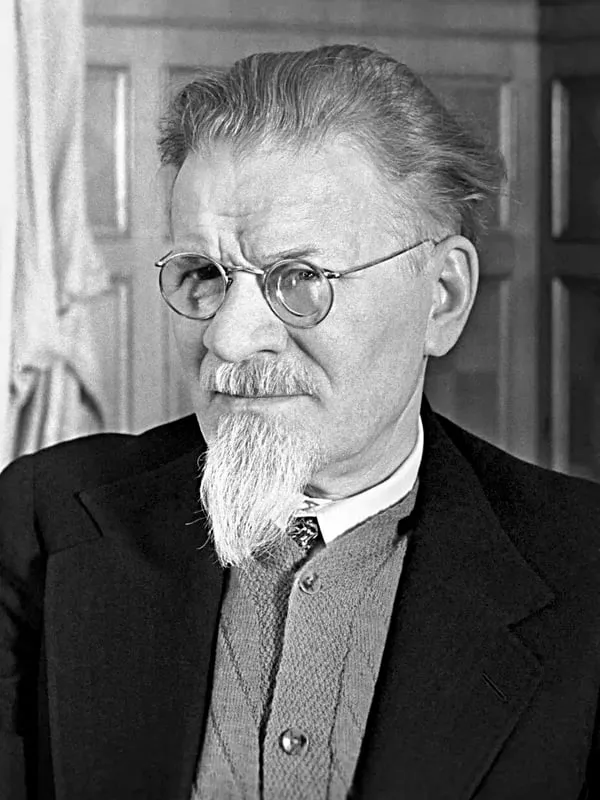
- Born:
- 19 November 1875, Verkhnyaya Troitsa, Tver governorate (Russia)
- Died:
- 3 June 1946, Moscow (USSR)
- Author:
- Natalia
- Photo:
- Fyodor Kislov / TASS, domena publiczna, Wikimedia Commons

For more than a quarter of a century Mikhail Kalinin was the formal head of the Soviet state: first of Soviet Russia, then of the Soviet Union. Propaganda called him the “All-Union Elder”, a kindly peasant with a little beard to whom anyone could write with their grievances. He had little real power, and the stronger Joseph Stalin became, the less he had. But it is his signature that stands under the decrees that opened the way to terror, under the acts of annexation of 1939–1940 and under the wartime ordinances, and in March 1940 he voted in the Politburo for the shooting of Polish prisoners of war. His wife spent several years of that time in the Gulag.
A peasant at the Putilov works
He was born on 19 November (7 November in the Julian calendar) 1875 in the village of Verkhnyaya Troitsa in the Tver governorate, into a peasant family. A former soldier taught him to read, and he then attended a small school run by the family of the local landowner. As a teenager he went to St Petersburg, worked in a cartridge factory and then as a lathe operator at the Putilov works, the largest factory in the capital. In 1898 he joined the Social Democrats. In the following years he was repeatedly arrested, imprisoned and exiled, among other places to the Caucasus and to Siberia, and in between he was active in St Petersburg and in Reval, today’s Tallinn. In 1906 he married Yekaterina Lorberg, who was of Estonian origin. He sided with the Bolsheviks, in 1912 became an alternate member of their Central Committee and was among the founders of the newspaper Pravda.
During the First World War he worked in the Petersburg underground; arrested at the end of 1916, he regained his freedom thanks to the February Revolution. In the spring of 1917, unlike Lenin, he leaned towards conditional support for the Provisional Government. In the autumn he was elected to the Petrograd city duma, and after the Bolshevik seizure of power he was the city’s mayor until August 1918.
The All-Union Elder
In March 1919 Yakov Sverdlov died; he had been chairman of the All-Russian Central Executive Committee (VTsIK), the formal head of state. On 30 March the Central Committee chose Kalinin to replace him, not without opposition. What counted was that he was a worker of peasant origin who could speak to the village, which in the civil war was wavering between the Whites and the Reds. Kalinin toured the country on agitation trains and received petitions; it was then that Leon Trotsky called him the “All-Russian Elder”. He also became a candidate member of the Politburo.
On 1 March 1921 Kalinin went to Kronstadt to calm the sailors, but the crowd at the meeting interrupted his speech and adopted the rebels’ resolution; after the Kronstadt rebellion the Red Army stormed the fortress. That summer he headed the government commission for the relief of the victims of the great famine on the Volga. From 30 December 1922 he was also one of the chairmen of the Central Executive Committee of the newly created USSR, and in January 1924 he announced Lenin’s death to the Congress of Soviets. In the struggle for Lenin’s inheritance he sided with Stalin, and from 1 January 1926 until his death he was a full member of the Politburo.
A signature under the terror
Kalinin was not one of Stalin’s hardest men. On collectivisation he was closer to the moderates, and in the spring of 1932, as famine was spreading in the countryside, he objected in writing to a plan to deport 38,000 peasant families expelled from the collective farms, which the Politburo did indeed reverse. But in August 1932 he signed the law on the protection of socialist property, known as the law of three ears of grain, under which peasants were sentenced to the Gulag and even to death. On the evening of 1 December 1934, the day of Kirov’s murder, he and the secretary Avel Yenukidze signed a resolution that cut investigations in terrorism cases to ten days, deprived the accused of a defence and of the right to clemency, and ordered sentences to be carried out at once. It became the legal basis for the mass executions of the following years. In 1935 he also signed a decree lowering the age of criminal responsibility to twelve.
Stalin tolerated his artless grumbling because he considered him harmless. On 17 January 1938 Kalinin became Chairman of the Presidium of the Supreme Soviet of the USSR, created by the new constitution. A few months later, on 25 October 1938, the NKVD arrested his wife on charges of links with Trotskyists. After torture in the Lefortovo prison she was sentenced in April 1939 to fifteen years in the camps. Kalinin, who had long since ceased to live with her, could not get her released. She regained her freedom only at the end of the war, after a plea he addressed to Stalin. In those years thousands of petitions from the families of the arrested kept arriving at Kalinin’s office; in some cases he managed to help, according to some accounts including the future Marshal Leonid Govorov.
Head of state in wartime
As the formal head of state Kalinin conducted correspondence with other heads of state. In 1933 he exchanged letters with President Franklin Delano Roosevelt that opened the way to recognition of the USSR by the United States. In April 1939 he congratulated Roosevelt on his appeal to Hitler and Mussolini, and in October, when Moscow presented its demands to Finland, he replied to Roosevelt’s message that the only issue was the security of Leningrad. In June 1940 the President of Lithuania, Antanas Smetona, asked him in a personal letter to soften the demands; Kalinin changed nothing, and a few days later the Red Army occupied Lithuania. The Supreme Soviet and its Presidium, which he chaired, gave legal form to the incorporation into the USSR of eastern Poland, the Baltic states and Bessarabia.
On 5 March 1940 the Politburo adopted Lavrentiy Beria’s proposal to shoot Polish prisoners of war and prisoners. Kalinin did not sign the document himself, but the secretary noted on it: “Kalinin – for”. This is described on the pages on the decision of 5 March and on the Katyn massacre. The policemen from the Ostashkov camp were shot in the spring of 1940 in the city that had borne his name since 1931: Kalinin, formerly Tver.
On 22 June 1941, the day of the German attack, Kalinin signed the decrees on martial law, military tribunals and mobilisation. On 28 August he signed the decree under which the Volga Germans were deported, the first of a series of acts by which whole nations were deported during the war. Real power, however, lay with the State Defence Committee, on which Kalinin did not sit. He presented decorations, received ambassadors, visited units and wrote propaganda pamphlets. In 1944 he underwent a serious operation, and on 29 March 1944, for his twenty-five years in office, he received the title of Hero of Socialist Labour. His signature also stands on the decree that proclaimed 9 May Victory Day.
Death and memory
On 19 March 1946, already terminally ill with cancer, Kalinin stepped down. He died in Moscow on 3 June 1946 and was buried in the Kremlin wall. On 4 July 1946 Königsberg, captured by the Red Army and a city with which Kalinin had had nothing to do, was renamed Kaliningrad. Tver regained its old name in 1990, while Königsberg still bears his name today.
Historians agree that Kalinin was a largely decorative figure. Nikita Khrushchev wrote that his office was nominal, and Kalinin himself told petitioners that he had no power and that they should turn to Vyacheslav Molotov. But it was he who gave Stalin’s decisions the form of law, and as a member of the Politburo he voted for the gravest of them. His story shows a mechanism in which even the highest-placed men of the state could not protect their own wives, and yet signed everything put in front of them.
Sources
Often appears with
People who appear in the same events.