Soviet Union
Nikita Khrushchev
First Secretary of the Communist Party (Bolsheviks) of Ukraine (1938–1949), member of the military councils of the Southwestern Direction and of the Southwestern, Stalingrad, Southern, Voronezh and 1st Ukrainian Fronts (1941–1944), lieutenant general (from 1943), Premier of the Ukrainian SSR (1944–1947)
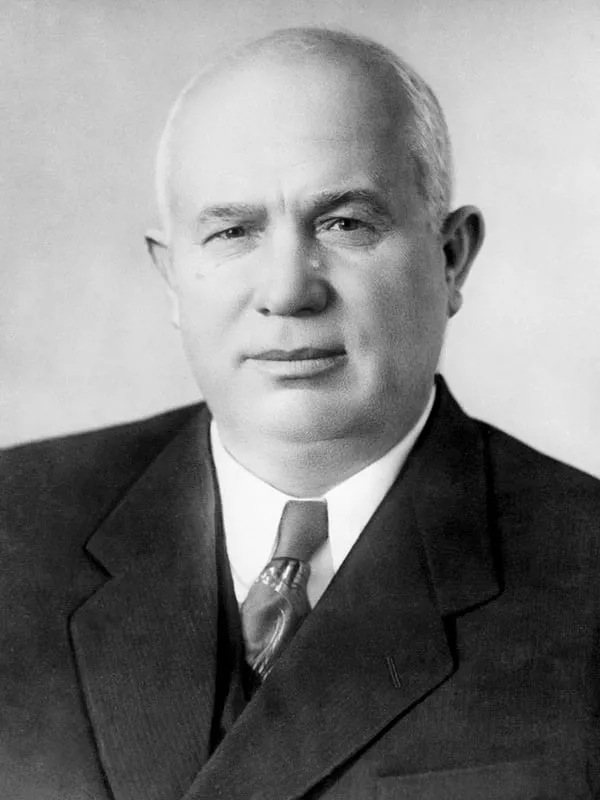
- Born:
- 15 April 1894, Kalinovka, Kursk Governorate (Russia; then the Russian Empire)
- Died:
- 11 September 1971, Moscow (Soviet Union)
- Author:
- Łukasz
- Photo:
- TASS, domena publiczna, Wikimedia Commons

Nikita Khrushchev is known above all as the Soviet leader who in 1956 denounced Stalin’s crimes and in 1962 brought the world to the brink of nuclear war. During the Second World War, however, he was one of Joseph Stalin’s closest associates and shared responsibility for his policies. As party chief in Ukraine from 1938 he presided there over the final phase of the Great Terror; in 1939 he oversaw the incorporation into the Ukrainian SSR of the lands of south-eastern Poland occupied by the Red Army; and in the war with Germany he sat on the military councils of fronts that were defeated at Kiev and Kharkov, then won at Stalingrad and Kursk and returned to the Dnieper and to Lwów. As the political guardian of the commanders and Stalin’s eye in their headquarters, he came to know many of the men who became marshals after the war, which mattered when he himself rose to power.
A metalworker from the Donbas
He was born on 15 April 1894 in the village of Kalinovka in the Kursk Governorate, close to today’s border with Ukraine, into a poor peasant family; he himself celebrated his birthday on 17 April, and that is the date Soviet encyclopaedias gave. He had only four years of schooling and as a boy herded cattle. In 1908 he followed his father to Yuzovka, today’s Donetsk, where he trained as a metal fitter and worked in a factory and in the mines. As a skilled worker he was not called up in the First World War, but he took part in strikes. He joined the Bolshevik party in 1918, and in the Civil War he was a political commissar with Red Army units in southern Russia. His first wife died of typhus at that time.
A career at Kaganovich’s side
After the Civil War he combined work at a mine with study at the workers’ faculty in Yuzovka and rose rapidly in the party apparatus. His patron was Lazar Kaganovich, party chief in Ukraine in the 1920s and later one of Stalin’s closest men. In 1929 Khrushchev came to Moscow to study at the Industrial Academy, but instead of studying he built a career: by 1934 he already headed the party in Moscow and sat on the Central Committee, and he received the Order of Lenin for building the Metro.
He took a full part in the Great Purge. He publicly demanded the execution of the defendants in the Moscow trials, approved the arrest of his colleagues, and in 1937 reported the arrest of more than 41,000 “criminal and kulak elements” in the Moscow region. At the beginning of 1938 Stalin sent him to Kiev as First Secretary of the Communist Party (Bolsheviks) of Ukraine, replacing Stanisław Kosior, who was later shot. In Ukraine, where the party leadership had already been decimated, the arrests accelerated further after his arrival. According to the party’s own findings of 1988, more than 167,000 people were arrested there in 1938–1940. In March 1939 Khrushchev became a full member of the Politburo.
Lwów, 1939
On 17 September 1939 the Red Army marched into Poland, and Khrushchev, on Stalin’s orders, followed the troops of the Ukrainian Front. He bore political responsibility for Eastern Galicia and Volhynia. Under his supervision temporary administrations, peasant committees and militias were set up, while the NKVD arrested officials, policemen, officers, landowners, political activists and clergy. On 22 October, amid propaganda and intimidation, “elections” were held to the People’s Assembly of Western Ukraine, which met in Lwów and asked to be joined to the Soviet Union. On 1 November Moscow annexed these lands, and a few weeks later Soviet citizenship was imposed on them.
Khrushchev directed their Sovietisation: the Ukrainisation of offices and schools, nationalisation, the introduction of collective farms, and the filling of posts with functionaries sent from the east. In February 1940 the first of the great deportations of Polish families into the depths of the Soviet Union set out from these lands. The deportations themselves were carried out by Lavrentiy Beria’s NKVD, but they took place on territory Khrushchev ruled as head of the republic’s party. In the summer of 1940 he spoke at a rally in Kishinev after the Soviet Union had forced Romania to give up Bessarabia and northern Bukovina.
Kiev and Kharkov
After the German attack Khrushchev remained party chief in Ukraine, and in August 1941 he became a member of the military council of the Southwestern Direction, to which the fronts in Ukraine were subordinate, and from the end of September also of the Southwestern Front, re-formed after its defeat. He was a political commissar on the grandest scale: he mediated between the commanders and Stalin, watched over their loyalty and organised the evacuation of industry and mobilisation. He also took part in organising the defence of Kiev. When in September 1941 the German pincers began to close behind the Dnieper, Stalin forbade the abandonment of the city, and in the Battle of Kiev the front commander, Mikhail Kirponos, was killed and hundreds of thousands of soldiers were taken prisoner. Accounts of Khrushchev’s role conflict. According to him, he and Marshal Semyon Budyonny proposed a withdrawal. According to Georgy Zhukov, writing after Khrushchev had removed him from power, it was the other way round.
In the spring of 1942 Khrushchev, together with Marshal Semyon Timoshenko and the Direction’s chief of staff, Ivan Bagramyan, persuaded Stalin to attack towards Kharkov. The offensive, launched on 12 May, ran within days into a German blow from the south. On 18 May Khrushchev telephoned Moscow asking for it to be halted, but Stalin refused. The troops in the Barvenkovo salient were encircled, and more than 200,000 soldiers were taken prisoner. Stalin summoned Khrushchev to Moscow and, according to his memoirs, let him understand that the members of the military council would answer for the defeat with their heads. In the end, however, Khrushchev returned to the front.
Stalingrad and Kursk
In the summer of 1942 he was a member of the military council of the Stalingrad Front, and from August also of Andrey Yeryomenko’s Southeastern Front. He spent most of the battle in the Stalingrad area. On 11 September, together with Yeryomenko, he entrusted the defence of the city to Vasily Chuikov. On Stalin’s instructions he was also, as he claimed, to keep watch on Rodion Malinovsky, commander of the 66th Army, who was suspected of disloyalty. He had no influence on the plan for Operation Uranus, prepared in secret in Moscow, but to the end of his life he was proud of his part in the battle, and in the years of his rule Soviet historiography greatly exaggerated his role. On 12 February 1943 he received the rank of lieutenant general.
In March 1943 Khrushchev’s son Leonid, a fighter pilot, was killed when he failed to return from an air battle; neither his aircraft nor his body was ever found. The circumstances of his death are disputed to this day, and the stories that circulated later, that he survived, collaborated and was shot on Stalin’s orders, have no basis in the documents.
From March to October 1943 Khrushchev was a member of the military council of Nikolai Vatutin’s Voronezh Front, which in the summer defended the southern face of the Kursk salient. In the autumn the front, renamed the 1st Ukrainian, reached the Dnieper, and on 6 November 1943 Khrushchev entered the liberated Kiev with the troops. In February 1944 he also became Premier of the Ukrainian SSR. He stayed with the 1st Ukrainian Front until August 1944, and on 30 July he spoke at a rally in Lwów, taken during the Lvov–Sandomierz offensive. From the first day the Soviet authorities treated the city as part of Ukraine, and the Home Army soldiers who had fought for it alongside the Red Army in the Lwów rising were disarmed and arrested. From Kiev Khrushchev also supervised Soviet partisans through the Ukrainian Staff of the Partisan Movement, among them those who in 1944 supported the Slovak uprising.
Ukraine after the war
After the Germans were driven out, Khrushchev rebuilt devastated Ukraine and at the same time restored the Soviet order there. In the west of the republic a war went on against the Ukrainian Insurgent Army, in which, according to Soviet reports, more than 110,000 people were killed in 1944–1946. Hundreds of thousands of inhabitants of western Ukraine were arrested or deported to the east, and the countryside was forcibly collectivised. In 1946–1947 Ukraine was struck by famine, made worse by the high compulsory grain deliveries that Khrushchev himself had earlier promised Stalin. When he asked for help he fell out of favour, and in 1947 he had to hand the party leadership to Kaganovich for several months. In December 1949 Stalin moved him to Moscow as a Central Committee secretary.
Leader of the Soviet Union
After Stalin’s death in March 1953 Khrushchev brought about Beria’s arrest, and in September he became First Secretary of the Central Committee of the CPSU. On 25 February 1956, at a closed session of the Twentieth Party Congress, he delivered the secret speech, in which he revealed some of Stalin’s crimes against the party and the army, including the scale of the purge of the Central Committee, and blamed the dictator for the defeats of 1941. He also condemned the deportation of whole nations, such as the Chechens and the Kalmyks, but he said nothing about the crimes committed against Poles, including Katyn, or about his own part in the terror. The thaw brought the rehabilitation of some victims and the release of hundreds of thousands of political prisoners from the camps, but in October 1956 Khrushchev flew to Warsaw to stop changes in the Polish leadership, and in November he ordered the crushing of the Hungarian uprising. From 1958 he was also Soviet Premier. In 1962 his decision to deploy missiles in Cuba set off the Cuban Missile Crisis, which ended in an agreement with President John F. Kennedy.
On 14 October 1964 his comrades in the party leadership removed him from power. He spent the rest of his life in retirement outside Moscow, recording memoirs that were smuggled to the West and published in 1970. He died in Moscow on 11 September 1971 and was buried in the Novodevichy Cemetery, not at the Kremlin Wall.
Assessment
Khrushchev’s wartime role is hard to assess, because he acted as a member of collective military councils and it is seldom possible to establish how much of their decisions was his. It is known that he shared responsibility for the disaster at Kharkov, and that the propaganda of his years in power inflated his merits at Stalingrad and in Ukraine. Military men who published memoirs under Brezhnev, when it was wiser not to write about Khrushchev at all, nevertheless usually portrayed him favourably. For Poles his wartime biography has above all one dimension: it was he who in 1939–1941 and from 1944 directed the policy that took Lwów and Volhynia from Poland and exposed their Polish inhabitants to arrest, deportation and expulsion. Eleven years after the war the same man became the first Soviet leader to admit that Stalin had been a criminal, though only to the extent that suited him.
Sources
Commanded in battles
(01)Mentioned in battles
(02)Often appears with
People who appear in the same events.