Soviet Union
Leonid Govorov
Commander of the 5th Army (1941–1942), commander of the Leningrad Front (1942–1945), Marshal of the Soviet Union (from 1944)
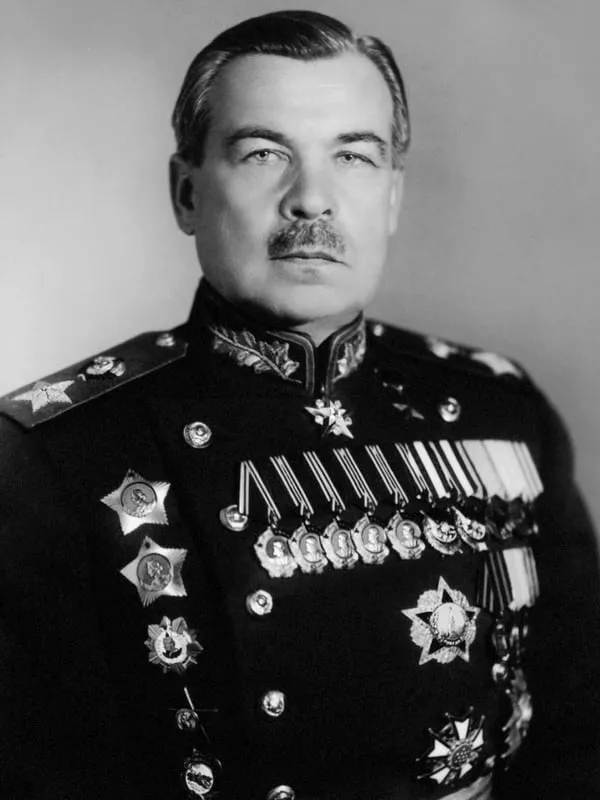
- Born:
- 22 February 1897, Butyrki, Vyatka Governorate (Russia; then the Russian Empire)
- Died:
- 19 March 1955, Moscow (Soviet Union)
- Author:
- Natalia
- Photo:
- Ministerstwo Obrony Federacji Rosyjskiej, CC BY 4.0, Wikimedia Commons

Leonid Govorov was the Soviet commander who for almost three years directed the defence of besieged Leningrad. An artilleryman by training and inclination, in the Civil War he served first in the White army of Admiral Aleksandr Kolchak, which weighed on his career for the rest of his life. Even so, in the war with Germany he grew into one of the most respected commanders of the Red Army: in January 1943 his troops broke a corridor through to the city, a year later they drove the Germans away from Leningrad, in June 1944 they took Vyborg, and in the autumn Estonia. He was a taciturn, severe professional, known for the meticulous preparation of every operation, although the fighting at Narva cost his front enormous losses.
Between Whites and Reds
He was born on 22 February 1897 in the village of Butyrki in the Vyatka Governorate, into a peasant family. He finished the modern school at Yelabuga on the Kama, and in 1916 he began studying in the shipbuilding department of the Petrograd Polytechnic. At the end of that year he was called up and sent to the Konstantinovsky Artillery School. In June 1917, as a second lieutenant, he joined a mortar battery in Tomsk, and in the spring of 1918, after the army fell apart, he went home.
In the autumn of 1918, when anti-Bolshevik forces took Yelabuga, he found himself in a battery of the 8th Kama Rifle Division, and in the spring of 1919 he took part in the offensive of Kolchak’s armies. In Soviet questionnaires he later wrote that he had been conscripted. In November 1919 he deserted, made his way to Tomsk and joined the anti-White rising in the city. At the beginning of 1920 he joined the Red Army and, as commander of an artillery battalion of the 51st Rifle Division, fought in the Crimea against Wrangel. In 1920 he was wounded twice, and for the fighting at Perekop he received the Order of the Red Banner.
Artilleryman and lecturer
In the 1920s and 1930s he climbed the rungs of an artillery career and completed one course after another: artillery courses, higher academic courses, the Frunze Military Academy and finally, in 1938, the newly opened General Staff Academy. During the Great Purge he was watched by the NKVD: his service with Kolchak was held against him, denunciations were made against him, and many of his superiors were arrested. He survived, according to some accounts thanks to the intercession of Mikhail Kalinin. In 1938 he became a lecturer in tactics at the Dzerzhinsky Artillery Academy, where he worked on breaking through fortified positions.
He put this knowledge to use in the Winter War, when as chief of staff of the 7th Army’s artillery he prepared the fire that in February 1940 helped break through the Mannerheim Line. In June 1940 he was made a major general of artillery, in August deputy inspector general of the Red Army’s artillery, and in May 1941 commandant of the Dzerzhinsky Academy.
At Smolensk and Moscow
After the outbreak of war with Germany he became chief of artillery of the Western Direction and then of the Reserve Front. In August 1941 he prepared the artillery fire for the Yelnya offensive, the first successful Soviet attack of the war. In October, during the German offensive on Moscow, he directed the artillery on the Mozhaisk line. When in the middle of the month the commander of the 5th Army, Dmitry Lelyushenko, was wounded, the artilleryman Govorov took over the army at Georgy Zhukov’s request. He convinced his superiors that holding Mozhaisk any longer made no sense and pulled the army back to the next line, and his carefully organised anti-tank defence barred the Germans’ way along the highways to Moscow. In November he was made a lieutenant general of artillery, and in January 1942, in the counter-offensive from Moscow, his army retook Ruza and Mozhaisk.
Leningrad
In April 1942 he took over the Leningrad Group of Forces, and in June, after the disaster of the 2nd Shock Army on the Volkhov, the whole Leningrad Front. He commanded it until the end of the war. He turned the besieged city, shelled daily by German siege artillery, into a fortress with an elaborate system of defences, and created a separate artillery corps to fight the German batteries, which over time reduced the effects of the shelling. In July 1942 he was admitted to the party without the usual candidate period. The first attempt to break through to the Volkhov Front, the Sinyavino operation of August and September 1942, failed but upset German plans to storm the city.
Govorov began planning the next operation, named “Iskra” (Spark), at the end of October 1942. On 12 January 1943 the troops of the Leningrad Front and of Kirill Meretskov’s Volkhov Front attacked towards each other south of Lake Ladoga and on 18 January met, opening a land corridor 8–11 kilometres wide to the city. Govorov was made a colonel general, and in November 1943 a general of the army. Further attacks in 1943, including Operation Polar Star, brought only small gains at heavy cost.
On 14 January 1944 the Leningrad Front struck from the Oranienbaum bridgehead and from Pulkovo, opening the Leningrad–Novgorod offensive. Within a few days the two assault groups had joined up, and the German 18th Army began to retreat. On 27 January Govorov and Andrei Zhdanov, with Stalin’s consent, announced the complete lifting of the blockade, and the city celebrated with salvoes from 324 guns.
Narva, Vyborg and Estonia
The pursuit came to a halt in February on the Narva, where the Germans, together with Estonian units, defended the neck of land between the Gulf of Finland and Lake Peipus. Despite Stalin’s demands for Narva to be taken by 17 February, one attack and landing after another in the Battle of Narva ended in defeat. According to figures cited by Estonian historians, from the beginning of January to March 1944 the front lost, counting the fighting at Leningrad, more than 227,000 killed, wounded and missing. In March Soviet aircraft destroyed the old town of Narva.
In June 1944 Govorov turned against Finland. After feigned preparations for an attack at Narva, the fleet secretly ferried part of the 21st Army from the Oranienbaum bridgehead to the Karelian Isthmus, and on 10 June, after a massive artillery preparation, the Leningrad Front opened the Vyborg–Petrozavodsk offensive. Within ten days it broke through three Finnish lines of defence. On 18 June Govorov was made a Marshal of the Soviet Union, and on 20 June his troops took Vyborg. The further advance, however, broke down in the Battle of Tali-Ihantala, and Finland, exhausted but not defeated, concluded in September the armistice that ended the Continuation War.
At the end of July Narva finally fell, but the attack on the Sinimäed hills broke against the German defence, and on 10 August Govorov called it off. In September, as the Germans began to withdraw from Estonia, his front set off in pursuit, on 22 September took Tallinn, and in the autumn, in landing operations, seized the islands of the West Estonian Archipelago as far as Saaremaa. From October Govorov also coordinated the operations of two Baltic fronts at Riga. On 27 January 1945 he was made a Hero of the Soviet Union.
Courland
From February 1945, while also commanding the 2nd Baltic Front, he directed the siege of the German Army Group Courland, shut in at the western tip of Latvia. Successive Soviet attacks there brought only small gains. Only on 8 May, as the whole Reich was surrendering, did its commander accept Govorov’s ultimatum and lay down his arms. At the end of May 1945 Govorov received the Order of Victory.
After the war
After the war he commanded the Leningrad Military District, was chief inspector of the ground forces, and from 1948 commander of the country’s air defence. In January 1948 he presided over the court of honour that found guilty a group of admirals headed by the former People’s Commissar of the Navy, Nikolai Kuznetsov, accused of handing secret documents to the Allies; the case then went to a military court, which sentenced three admirals to prison and demoted Kuznetsov. In 1954–1955 Govorov was commander-in-chief of the air defence forces and deputy Minister of Defence of the USSR, and directed their reconstruction for the age of jet aircraft and nuclear weapons. He suffered from serious heart disease. He died in Moscow on 19 March 1955, and the urn with his ashes was placed in the Kremlin Wall.
Assessment
Govorov was one of those Soviet commanders who came to the command of combined arms from the artillery and brought its methodical approach with them. He prepared the breakthroughs at Leningrad in 1943 and 1944 and on the Karelian Isthmus in 1944 carefully, with crushing superiority of fire, and they entered Soviet textbooks of operational art. Yet the same front bled for half a year at Narva, and his siege of Courland in the last months of the war brought no decision. To the people of Leningrad Govorov was associated above all with the defence of the city: of the 900 days of the blockade, almost 670 fell during his command.
Sources
Commanded in battles
(05)- 25 June 1941 – 19 September 1944Continuation WarScandinavia
- 8 September 1941 – 27 January 1944Siege of LeningradEastern Front
- 2 February – 10 August 1944Battle of Narva (1944)Eastern Front
- 9 June – 9 August 1944Vyborg–Petrozavodsk offensiveScandinavia
- 14 September – 24 November 1944Baltic offensive (1944)Eastern Front
Mentioned in battles
(03)Often appears with
People who appear in the same events.