Yugoslavia
Dušan Simović
Commander of the Yugoslav air force (1936–1938, 1940–1941), Chief of the General Staff (1938–1940, 1941), Prime Minister of Yugoslavia (1941–1942)
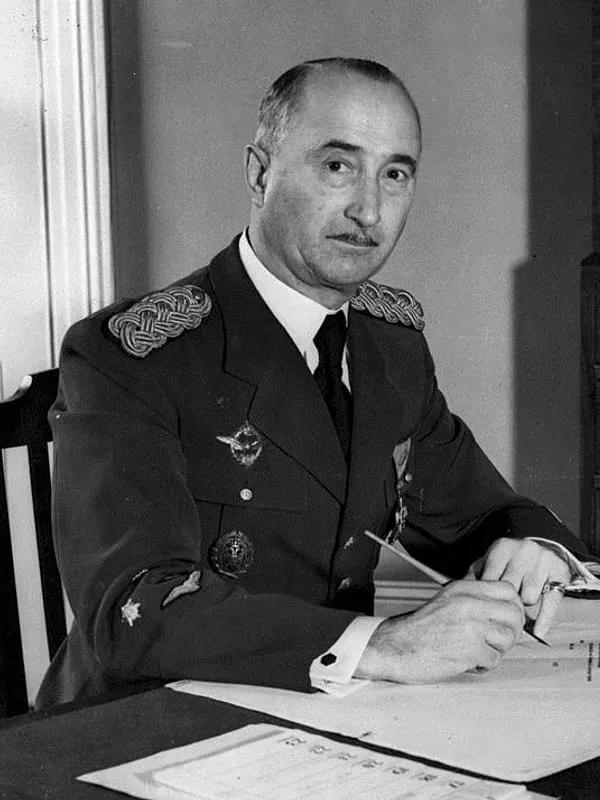
- Born:
- 28 October 1882, Kragujevac (Kingdom of Serbia)
- Died:
- 26 August 1962, Belgrade
- Author:
- Natalia
- Photo:
- autor nieznany, CC BY-SA 4.0, Wikimedia Commons

Dušan Simović was a Serbian officer who fought through the Balkan Wars and the First World War, then devoted his career to aviation and in the 1930s rose to the highest posts in the army of the Kingdom of Yugoslavia. He went down in history as the leader of the military coup of 27 March 1941 which, two days after Yugoslavia joined the Tripartite Pact, overthrew the regency of Prince Paul and the government of Dragiša Cvetković. The British press made him a hero who had said “no” to Hitler. In reality, as Prime Minister he tried to avoid war and did not repudiate the pact, but the coup was enough for Hitler to order the destruction of Yugoslavia. After the April defeat Simović headed the government-in-exile in London for several months, at odds with the politicians and with the young king, and after the war he returned to communist Yugoslavia.
An officer of the Serbian army
He was born on 28 October 1882 in Kragujevac in central Serbia. He completed primary school and two years of grammar school in his home town and then, fascinated by the army, moved to the Military Academy in Belgrade. In 1900 he was commissioned as a second lieutenant of artillery, and in 1905 he graduated from the academy’s higher school. In 1908 he married the daughter of a pharmacist from Valjevo; they had several children.
In the First Balkan War of 1912 and the Second of 1913 he fought as a staff officer, and in 1913 he was promoted to major. He went through the whole of the First World War with the Serbian army, right up to the Salonika front. In 1915 he became a lieutenant colonel, and in Macedonia he commanded the 7th Infantry Regiment. Even then he was interested in aviation and air defence, reading the works and reports of the Serbian aviation pioneer Mihailo Petrović.
In the autumn of 1918, as Austria-Hungary was falling apart, the Serbian government and Supreme Command sent him as their delegate to the National Council of Slovenes, Croats and Serbs in Zagreb. The Council then governed the short-lived State of Slovenes, Croats and Serbs and had to decide whether to unite with Serbia. In his reports Simović assured his superiors that most of the people of Zagreb supported unification, and he urged that the Council should not delay before Italy seized the Adriatic lands promised to it during the war. On 1 December 1918 the Kingdom of Serbs, Croats and Slovenes was proclaimed; in 1929 it was renamed the Kingdom of Yugoslavia.
Airman and chief of staff
In the new state Simović was promoted rapidly. He became a colonel in 1920, a brigadier general in 1925 and a major general in 1930. He devoted himself above all to building up military aviation and wrote on aviation and air defence. In 1936 he took command of the Yugoslav air force, and by the end of the 1930s he had risen to the rank of army general.
In May 1938, after the Anschluss of Austria had brought Germany to Yugoslavia’s borders, he became Chief of the General Staff. The French minister in Belgrade saw him as an opponent of the pro-German policy of Prime Minister Milan Stojadinović and an advocate of alliance with France. Simović drew up a plan for the defence of the entire territory of the state, including Croatia and Slovenia, with the intention of holding out until allies arrived and, in the event of defeat, withdrawing the army towards Greece and re-creating the Salonika front. Critics charged that the plan spread the forces along more than three thousand kilometres of frontier, and he himself admitted that it had been adopted for political reasons: the point was to show that Belgrade would not abandon any of the nations of the state to its fate. According to historians, among them Jozo Tomasevich, as early as 1938 Simović’s name was cropping up in the plans of conspirators dissatisfied with the government’s policy, and in the autumn of 1940 they approached him again. The government of the regent Paul, however, anxious not to provoke Germany, did not adopt his concept, and in April 1940 Simović had to hand over the post of chief of staff to General Petar Kosić. He returned to command of the air force.
The coup of 27 March
In the winter of 1940–1941 Yugoslavia found itself encircled. Germany was preparing an attack on Greece from Romania and Bulgaria, and Hitler was pressing the regent to join the Tripartite Pact. Simović made no secret of his views to foreign diplomats. In January 1941 he talked with President Roosevelt’s envoy, Colonel William Donovan, telling him that Germany would soon attack the Soviet Union. He also kept in contact with the British attachés and with people from the Special Operations Executive.
When on 25 March 1941 the Cvetković government signed the pact in Vienna, a group of air force officers organised by his deputy, Brigadier General Borivoje Mirković, decided to act. During the night of 26–27 March their units seized key points in Belgrade. The coup d’état was almost bloodless. The regents gave up power, the seventeen-year-old Peter II was declared of age, and Simović became Prime Minister and once again Chief of the General Staff. In the evening it was he who received Prince Paul at the War Ministry when the prince returned from Zagreb to relinquish power. The dispute over who had really directed the coup dragged on for years afterwards. Mirković claimed that he had taken the decision and organised everything himself and had invited Simović to take part. Simović, in memoirs published after his death, wrote that he had been at the centre of the whole undertaking and had himself assigned Mirković to the operation. Tomasevich considered Mirković’s account the better supported.
Prime Minister on the eve of the storm
Simović’s government was one of national unity. It included representatives of almost all the parties, from the Serbian Radicals and Democrats to the Croatian Peasant Party, the Slovenes and the Bosnian Muslims. Simović recognised the Serbo-Croat agreement of 1939 and persuaded the Croat leader Vladko Maček to become Deputy Prime Minister. He thought as a Yugoslav, not merely as a Serb. The Serbian historian Stevan K. Pavlowitch nevertheless judged him a patriotic general but a politically inept Prime Minister who wanted to play a great role and at bottom did not trust politicians.
The crowds cheering the coup in Belgrade and the speech by Winston Churchill, who declared that Yugoslavia had “found its soul”, created the impression that the new government had broken with the Axis. Simović, meanwhile, was doing everything he could to avoid war. He did not repudiate the Tripartite Pact, assured the German minister that Yugoslavia would honour its obligations, and appointed as Foreign Minister Momčilo Ninčić, who was regarded as a friend of Germany. He told the American minister that he was an opponent of the Axis, but Yugoslavia was too weak for war and an openly anti-German policy would shatter the country’s unity. He did not order general mobilisation at once, because he did not want to give Hitler a pretext. On 31 March he received the leader of Yugoslavia’s ethnic Germans and assured him that the German minority would not suffer discrimination.
It was all to no avail. Hitler had decided to destroy Yugoslavia as early as 27 March. On 1 and 2 April Simović held talks in Belgrade with the Chief of the Imperial General Staff, General John Dill, who had arrived in civilian clothes. Dill could promise neither troops nor equipment. The British corps of General Henry Maitland Wilson in Greece was too weak to move north. Simović complained of the lack of anti-tank and anti-aircraft guns and of the unfinished fortifications on the Bulgarian border. Dill later wrote that the Yugoslav leaders were full of fighting spirit, but the army was not ready and Simović wanted to gain time.
The April War
On 6 April 1941, the day of his daughter’s wedding, Germany attacked Yugoslavia and the Luftwaffe bombed Belgrade. The raids paralysed the government and its communications with the army. The army, strung out along the frontiers in accordance with Simović’s plan and still marching to its positions, had neither reserves nor air cover. The British historian John Keegan recalled in this context Frederick the Great’s maxim that he who defends everything defends nothing. Others, such as Robert Citino, observed that abandoning the Croatian and Slovenian lands without a fight was politically impossible. On 11 April Simović sent the armies an order to fight the enemy on their own initiative, without waiting for instructions from higher command. The government met for the last time on home soil in Bosnia and Montenegro, and on 15 April Simović flew with his family to Greece. The army’s capitulation was signed on 17 April.
The government-in-exile
Travelling via Jerusalem, where on 4 May he confirmed that the agreement with the Croats remained one of the foundations of the state’s policy, Simović reached London with the king in June 1941. The British press greeted them as heroes: the young king and the patriotic general who had sacrificed his country rather than submit to Hitler. In a radio address on 28 June Simović argued that the events of 27 March had delayed German plans against Turkey, the Middle East and the Soviet Union. He also demanded Istria, Trieste and Zadar for Yugoslavia after the war, which embarrassed the British government.
The government-in-exile was weak and divided. Maček and the Muslim ministers had stayed at home, and news of the Ustaše genocide of the Serbs in the Independent State of Croatia set the Serbian and Croatian ministers against one another. Yugoslav officers in Cairo, young and old, blamed each other for the defeat. Simović distrusted professional politicians and wanted to govern with people of his own choosing, while the ministers, led by Deputy Prime Minister Slobodan Jovanović, accused him of authoritarianism. King Peter chafed at his lecturing. In the autumn of 1941 news reached London of the units of Colonel Draža Mihailović, which had taken up the fight against the occupiers in the mountains of Serbia. Simović presented them as Yugoslavia’s contribution to the Allied war effort and on 13 October, together with the king, asked Churchill and Anthony Eden to help them. Mihailović, portrayed by the press as the new hero, also proved a convenient replacement for Simović as the symbol of resistance in the politicians’ eyes. At the end of 1941 the ministers collectively demanded his departure, and in January 1942 the king dismissed him. He was succeeded by Jovanović. The British government received the dismissal with displeasure. In January 1943 Simović retired.
After the war
In the following years Simović came out ever more clearly in favour of Josip Broz Tito’s Partisans. In BBC broadcasts he urged Serbs to join them, for which Mihailović called him a traitor. In June 1945 he returned from London to Belgrade. In 1946 he testified as a prosecution witness at the trial of Mihailović, who was sentenced to death and shot. He wrote many works on military subjects. He died in Belgrade on 26 August 1962.
Significance
Simović was the symbol of the moment when a small country, surrounded by Axis states, refused to submit to Hitler. That gesture cost Yugoslavia invasion, partition and years of occupation, civil war and genocide. Historians still argue whether the coup he led delayed the German attack on the Soviet Union; Simović himself maintained that it did. As a politician he proved less successful than as a soldier: as Prime Minister he continued the policy of the regent he had overthrown, and in exile he was unable to hold the government together. Yet his name has remained forever linked with 27 March 1941 and with the slogan “better war than the pact”, which the crowds in Belgrade were shouting at the time.
Sources
Commanded in battles
(01)Often appears with
People who appear in the same events.