- Category:
- Politics
- Date:
- 27 March 1941
- Author:
- Łukasz
- Tags:
- Yugoslavia, Adolf Hitler, Third Reich, United Kingdom
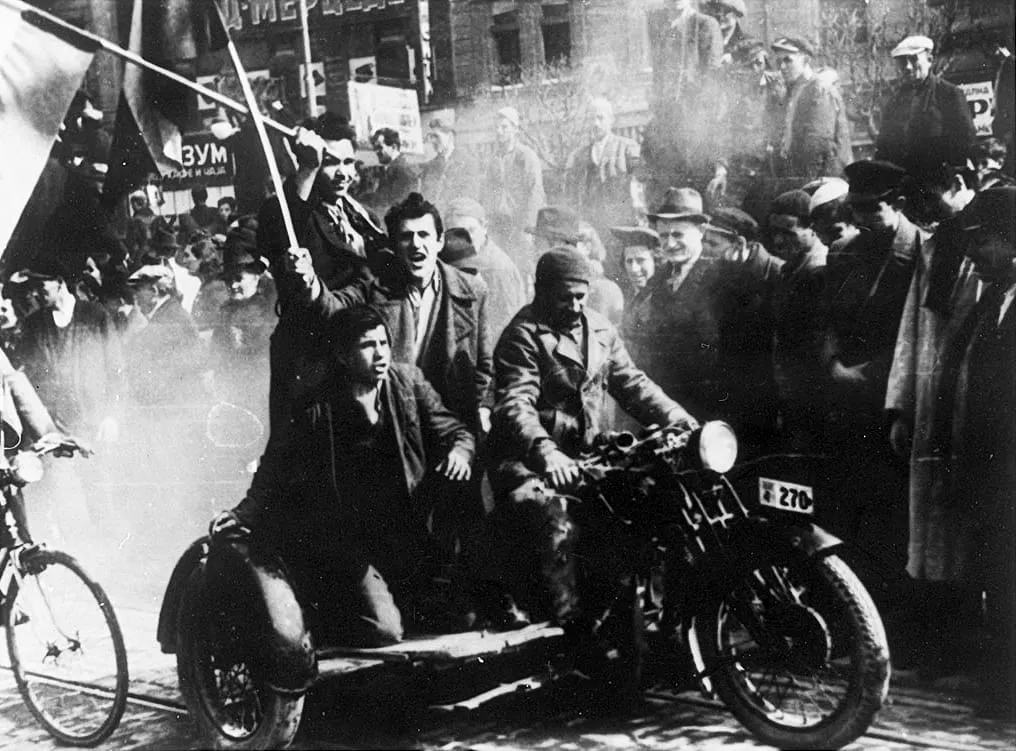
During the night of 26–27 March 1941, a quarter of an hour or so after two o’clock, units loyal to a group of air force officers began to seize the bridges over the Sava, the ministries, the General Staff, the post office, the radio station and the royal court in Belgrade and neighbouring Zemun. By morning it was all over. The conspirators had overthrown the government of Prime Minister Dragiša Cvetković, which two days earlier in Vienna had joined the Tripartite Pact, and removed from power the regency council headed by Prince Paul Karađorđević. The seventeen-year-old King Peter II was proclaimed of age, and the air force general Dušan Simović became Prime Minister. Crowds carrying Yugoslav, British and French flags poured into the streets of Serbian towns. In Berlin, that very same day, Adolf Hitler summoned his commanders and announced that Yugoslavia would be destroyed as a state. The coup that was meant to save the country’s honour sealed its invasion ten days later.
It is often said that “Crown Prince Peter” became King Peter II and took control of the state. Peter, however, had been king since the death of his father, Alexander I, assassinated in Marseille in October 1934. The coup did not give him the throne; it merely declared him of age prematurely – something that under the constitution was not due until September 1941, when he would turn eighteen. Real power passed into the hands of General Simović and his government.
A country in a trap
In 1941 the Kingdom of Yugoslavia was an encircled state. Since the Anschluss it had bordered the Reich; since the annexation of Albania it had bordered Italy along two stretches; and in the autumn of 1940 its neighbours Hungary and Romania had joined the Tripartite Pact. The war that Mussolini had begun against Greece was being fought just beyond its southern border. Before attacking the USSR, Hitler wanted to put the Balkans in order and eliminate the British foothold in Greece, and Yugoslavia lay on the flank of the planned Operation Marita. He preferred to win it over rather than conquer it, for he remembered how the Serbian army had fought in the Balkan Wars and in the First World War.
The regent, Paul, an Oxford-educated Anglophile, did not hide from Allied diplomats where his sympathies lay. He believed, however, that the country had nothing to fight with. The army was poorly armed and the state internally fragile. In August 1939 the regent had brought about the Cvetković–Maček Agreement, which created the autonomous Banovina of Croatia and brought the leader of the Croatian Peasant Party, Vladko Maček, into the government. Many Serbs saw it as a capitulation to the Croats, and many Croats as too meagre. Paul feared that a war with Germany would break the state apart along national lines.
At the beginning of 1941 the noose was tightening. On 14 February Hitler received Cvetković and the Foreign Minister, Aleksandar Cincar-Marković; on 1 March Bulgaria joined the pact and German troops marched into it. On 4 March the regent met Hitler secretly at the Berghof. The British, who were landing in Greece in those same days, pressed Belgrade not to give in, but they could promise no real military help. On 17 March the Crown Council agreed to accession to the pact; on 20 March three Serbian ministers – Branko Čubrilović, Srđan Budisavljević and Mihailo Konstantinović – left the government in protest; and on 25 March Cvetković and Cincar-Marković signed the protocol of accession in the Belvedere palace in Vienna. In the notes attached to the protocol Germany undertook not to demand the passage of troops across Yugoslav territory or Yugoslavia’s participation in the war. Even so, protests broke out in Belgrade. On 26 March demonstrators chanted “Bolje rat nego pakt, bolje grob nego rob” – “better war than the pact, better the grave than slavery”.
The airmen’s conspiracy
The coup was prepared by a small group of officers, most of them from the air force. The key role was played by the deputy commander of the air force, Brigadier General Borivoje Mirković, who by his own account had been thinking about a coup since 1937 or 1938 and had discussed it with many generals. He was helped by Major Živan Knežević of the Royal Guard and his brother Radoje, a professor and Democratic Party activist, who provided contacts with politicians. At the head of the undertaking stood the commander of the air force, Dušan Simović, a former Chief of the General Staff, whose name had featured in the conspirators’ plans for several years. Simović and Mirković later argued over which of them had been the real leader. The historian Jozo Tomasevich considered Mirković’s account the more credible.
The conspirators were united by Serbian patriotism, hostility to Germany and attachment to the tradition of Serbia in 1914–1918, but also by opposition to the agreement with the Croats and to the regent himself. They were supported – though not let into every secret – by some opposition politicians, nationalist organisations, a number of senior generals sidelined by Paul, and the hierarchy of the Serbian Orthodox Church. The Tripartite Pact gave them the pretext they had been looking for. Mirković later said that the signature in Vienna had settled the timing.
Cvetković returned from Vienna on 26 March. That night, at 2.15 a.m., the operation began. From the air base at Zemun, where Mirković had his headquarters, detachments set out which, under designated officers, seized the bridges over the Sava, the town hall, the police headquarters, the radio station, the ministries, the General Staff, the main post office and the royal court. A trusted post office official cut Belgrade’s communications with the rest of the country. Tanks and guns took up positions on the main streets. No one resisted. Prime Minister Cvetković was detained during the night and forced to resign. According to most accounts the coup cost the life of one man, who was killed by accident.
Without the regent
Prince Paul was asleep on a train at the time. On the evening of 26 March he had left Belgrade for a holiday in Slovenia, and in the morning he stopped in Zagreb. There Maček, informed of the coup, urged him to remain in Croatia and rely on units loyal to him. The local army commander assured him that the troops in Croatia would back him. Paul refused. He did not want to start a civil war, and his wife Olga and their children had stayed behind in Belgrade. In the evening he returned to the capital, where Simović took him to the War Ministry. There Paul and the two other regents, Radenko Stanković and Ivo Perović, renounced their powers. That same night the prince left with his family for Greece. The British later interned him in Kenya, and only towards the end of the war allowed him to move to Johannesburg in South Africa.
On the morning of 27 March the radio read out, in the King’s name, a proclamation to the nation in which Peter II called for obedience to the new government. The King knew nothing of it. According to many accounts the text was read by someone imitating his voice. Peter learned from the radio that he had come of age. In memoirs published after the war he described how he climbed down a drainpipe from the palace to join the conspirators. Leaflets bearing the proclamation were dropped from aircraft over the towns. On 28 March the King took his oath in the presence of Patriarch Gavrilo V, who had backed the coup on the radio; the Holy Synod of Bishops had already met on the matter on 27 March.
Simović formed a government of national unity, in which almost all parties were represented except the banned Communists and the far right. The deputy prime ministers were the historian Slobodan Jovanović and, after several days’ hesitation, Maček. Momčilo Ninčić became Foreign Minister. Two of the three ministers who had resigned on 20 March returned to the government. Simović himself also took back the post of Chief of the General Staff.
“Bolje rat nego pakt”
In Belgrade the coup was greeted with enthusiasm. For several days demonstrations went on in the streets of the capital, as well as in Cetinje, Podgorica, Split, Skopje and Kragujevac. The crowds carried Yugoslav flags alongside British, French and American ones, cheered the King, Britain and the army, and once again the cry “better war than the pact” could be heard. The demonstrations were joined by the Communists, outlawed since the early 1920s, who had played no part in the coup itself. There were also incidents directed against Germans, which Reich propaganda immediately blew up out of all proportion.
This enthusiasm, however, was largely Serbian. Among the Croats and Slovenes anxiety and resentment prevailed. The coup had been carried out by Serbian officers, many of whom looked with hostility on Croatian autonomy. Zagreb expected, rather, that the change of government would bring down upon the country a war that nobody there wanted. The Archbishop of Zagreb, Alojzije Stepinac, called on his priests to pray for the King and for Croatia and Yugoslavia to be spared from war, and in his diary he wrote bitterly of the gulf between Serbs and Croats. These divisions were soon to weigh heavily on the defence of the state.
In London the news was received as a victory. The Prime Minister, Winston Churchill, speaking on 27 March, declared that “early this morning the Yugoslav nation found its soul”. For the British, who were enjoying success in Africa, where they took Keren that same day, it was another good day. Churchill even hoped that, with Turkey’s help, a common front could be built in the Balkans. The governments-in-exile of Poland and Czechoslovakia congratulated the Yugoslavs, and in Greece the news was received with great joy.
The British role
For months the British had been trying to keep Yugoslavia from binding itself to the Axis. Diplomats worked on the regent, while the Special Operations Executive – the organisation for special tasks set up in 1940 under the minister Hugh Dalton – financed Serbian opposition groups in Belgrade and kept up contacts with the military. In January 1941 President Franklin Delano Roosevelt’s envoy, Colonel William Donovan, came to Belgrade and also talked to Simović. Churchill ordered contacts to be established with the regent’s opponents. On 26 March the British air attaché met Simović, and his deputy, who had intelligence links and was a friend of Mirković’s, is said, according to the historian Ivo Tasovac, to have told Mirković that the coup had to be carried out within 48 hours.
How large the British share was has been debated by historians for decades. Most believe that British intelligence helped and encouraged the conspirators, but that the initiative came from the Yugoslavs themselves. Harry Hinsley, author of the official history of British intelligence, wrote that the coup would have happened even without British encouragement, and SOE men working in Belgrade took a similar view. There have also been claims that the coup was backed by Soviet intelligence. These rest mainly on the memoirs of the NKVD officer Pavel Sudoplatov. The German legation in Belgrade was convinced that the British and the Russians were behind the coup.
Hitler: destroy Yugoslavia
The news from Belgrade reached Berlin on the morning of 27 March. Hitler, who two days earlier in Vienna had celebrated Yugoslavia’s accession to the pact, took the coup as a personal insult. He summoned to the Reich Chancellery Hermann Göring, the chief of the OKW, Wilhelm Keitel, and the chief of the operations staff, Alfred Jodl, and later also the Commander-in-Chief of the Army, Walther von Brauchitsch, his chief of staff, Franz Halder, and the Foreign Minister, Joachim von Ribbentrop.
The surviving record of this conference, later produced at the Nuremberg trials, conveys his train of thought. Hitler said that Yugoslavia had been an uncertain factor ahead of Operation Marita, and still more ahead of Barbarossa, and that it was a good thing the coup had happened now rather than during the war with the USSR. He resolved, “without waiting for possible declarations of loyalty from the new government”, to destroy Yugoslavia militarily and as a state. There were to be no diplomatic inquiries and no ultimatum. The blow was to be delivered “with merciless harshness” and at lightning speed, so as to frighten Turkey and ease the campaign in Greece. He intended to draw Italy, Hungary and Bulgaria into the war, promising them the Adriatic coast, the Banat and Macedonia. He wanted to guarantee the Croats autonomy. The Luftwaffe was to destroy the Yugoslav airfields and bomb the capital in successive waves of raids. The start of Operation Barbarossa would have to be postponed by as much as four weeks.
That same day Hitler received the Hungarian and Bulgarian envoys, Döme Sztójay and Parvan Draganov, and invited their countries to take part in the war. He let the Regent of Hungary, Miklós Horthy, understand that he could count on the Banat and Bačka. During the night a letter went to Mussolini in which Hitler announced that he would deal with Yugoslavia and asked the Italians not to undertake any new operations in Albania but merely to cover the border with Yugoslavia. Their spring offensive had in any case already collapsed. That same day Hitler signed Directive No. 25. It declared that the coup had changed the situation in the Balkans and that Yugoslavia, even if it gave assurances of loyalty, was to be treated as an enemy and crushed as quickly as possible. The Wehrmacht was to strike from the Graz area and from Bulgaria, converging on Belgrade, and Yugoslavia’s internal tensions were to be fanned by giving the Croats political assurances. Between conferences Hitler also received the Japanese Foreign Minister, Yōsuke Matsuoka, who had arrived in Berlin the day before.
The government that did not break the pact
The paradox of the coup was that the new government did not renounce the Tripartite Pact at all. Simović knew that Yugoslavia was not ready for war and that Britain had nothing but words to offer it. He did not order general mobilisation at once, so as not to provoke the Germans. On 30 March Ninčić, who before the war had been president of the Yugoslav–German Friendship Society, told the German minister, Viktor von Heeren, that Yugoslavia would honour all its international obligations, including its accession to the pact, provided its national interests did not suffer. Heeren could do nothing more. Berlin forbade him any contact with the Yugoslavs and recalled him, and at the beginning of April the legation was evacuated. The German press, as before the attacks on Poland and Czechoslovakia, wrote of the persecution of the Germans living there.
At the turn of March and April the Chief of the Imperial General Staff, General John Dill, came to Belgrade in civilian clothes for talks with Simović. They produced no joint plan. Dill could promise no help, and Simović wanted to gain time. The government also opened talks in Moscow and on 5 April concluded a treaty of friendship and non-aggression with the Soviet Union, which committed Stalin to no assistance whatsoever.
Its place in the war
On Sunday 6 April 1941 Germany attacked Yugoslavia and Greece simultaneously, and Luftwaffe aircraft bombed Belgrade in Operation Strafgericht (Punishment). Several thousand inhabitants were killed, though estimates vary widely. Italian and Hungarian troops entered Yugoslavia alongside the Wehrmacht. The Yugoslav army, not fully mobilised and strung out along the borders, fell apart in less than two weeks, helped along by desertions and mutinies in Croatian units. The capitulation was signed on 17 April. As early as 10 April the Independent State of Croatia had been proclaimed in Zagreb under the rule of Ante Pavelić’s Ustaše, and the rest of the country was divided between Germany, Italy, Hungary and Bulgaria. The King and the government fled through Greece and Palestine to London.
The coup of 27 March thus opened the way to one of the bloodiest occupations of the Second World War: to the Ustaše terror against Serbs, Jews and Roma, to German reprisals, to the resistance struggle and to the civil war between the Chetniks of Draža Mihailović and the communist Partisans of Josip Broz Tito, which ended in victory for the communists and the fall of the monarchy. Supporters of the regent’s policy argued after the war that without the coup Yugoslavia might have avoided war. The British official historian Ian Playfair saw it as a courageous gesture of defiance against German domination, made in the knowledge that an invasion would probably follow. Others, such as Alexander Prusin, regard it as a catastrophic mistake based on emotion and wishful thinking. In 1945 a court in communist Yugoslavia convicted Prince Paul for signing the pact, and in 2011 a court in Serbia rehabilitated him.
The debate also continues over whether the coup in Belgrade delayed the attack on the Soviet Union. Directive No. 21 provided for preparations to be completed by 15 May, and Operation Barbarossa began on 22 June 1941. Some historians, Tomasevich among them, regarded the events in Yugoslavia as one of the causes of this delay, and so indirectly as one of the reasons why the Germans failed to take Moscow before the winter. Martin van Creveld rejected this view, pointing out that the campaign in Yugoslavia went faster than planned and that the date of the attack on the USSR was determined by other factors, such as a late, wet spring and unfinished preparations. Craig Stockings and Eleanor Hancock, examining the German documents in 2013, concluded that the invasion of Yugoslavia did to some extent push that date back.
Sources
Meanwhile
(04)Elsewhere, within a week.
- 27 March 1941 · AfricaThe British take KerenOn 27 March 1941 the Italians abandoned Keren and British tanks drove into the town. After twelve days of assault Platt had opened the road to Asmara.
- 28 March 1941 · MediterraneanThe Battle of Cape MatapanOn 28 March 1941 Cunningham’s fleet, forewarned by Bletchley Park, damaged the Vittorio Veneto and that night sank three Italian cruisers and two destroyers.
- 24 March 1941 · MediterraneanRommel retakes El AgheilaOn 24 March 1941 a German reconnaissance battalion took El Agheila, its fort and wells – the first attack by Rommel, now reinforced with 5th Panzer Regiment.
- 31 March 1941 · MediterraneanRommel takes Mersa BregaOn 31 March 1941 the German 5th Light Division attacked at Mersa Brega. By evening it had broken through; the weak 2nd Armoured Division withdrew that night.
Related events
(04)The same battle, people or subject.
- 25 March 1941 · DiplomacyYugoslavia joins the Tripartite PactOn 25 March 1941 in Vienna, Premier Cvetković signed Yugoslavia’s accession to the Tripartite Pact. Secret notes spared it troop transit and military aid.
- 10 April 1941 · PoliticsThe Independent State of Croatia proclaimedOn 10 April 1941 Slavko Kvaternik proclaimed the Independent State of Croatia in Zagreb for Ante Pavelić. Power passed to the Ustaše, allies of the Axis.
- 8 July 1941 · PoliticsThe partition of YugoslaviaOn 8 July 1941 Germany and Italy signed a treaty in Berlin fixing their border in the Slovene lands, one of the last acts of the Axis partition of Yugoslavia.
- 6 April 1941 · BalkansGermany attacks YugoslaviaOn 6 April 1941 Germany invaded Yugoslavia without declaring war and the Luftwaffe bombed Belgrade. The partly mobilised army quickly fell apart.