Yugoslavia
Alexander I of Yugoslavia
Regent of Serbia and of the Kingdom of the Serbs, Croats and Slovenes (1914–1921), King of the Serbs, Croats and Slovenes (1921–1929), King of Yugoslavia (1929–1934)
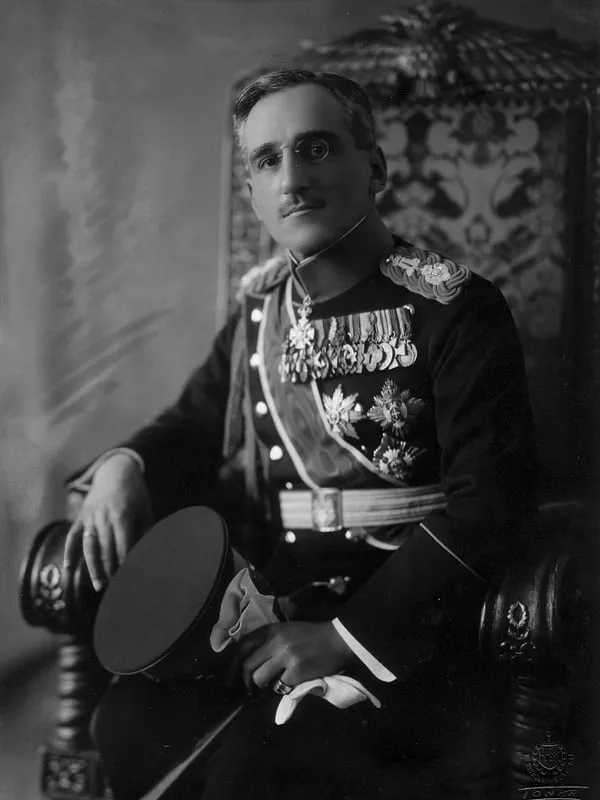
- Born:
- 16 December 1888, Cetinje (Principality of Montenegro)
- Died:
- 9 October 1934, Marseille
- Author:
- Natalia
- Photo:
- autor nieznany, domena publiczna, Wikimedia Commons

Alexander I Karađorđević was a soldier who commanded the Serbian army in the Balkan Wars and the First World War and then united the Serbs, Croats and Slovenes in a single state. The Serbs called him the Unifier. For fourteen years he tried to hold that state together, first as regent and constitutional king and, from 1929, as a dictator who banned political parties and gave the country the name Yugoslavia. His centralism alienated the Croats and won a hearing for extreme nationalists, while abroad his fiercest opponents were Fascist Italy and revisionist Hungary. He was one of the pillars of the French system of alliances in Central Europe and the Balkans. He was killed in an assassination in Marseille in 1934, and his death weakened that system just as Hitler’s Germany was beginning to break it apart.
An exile of the Karađorđević dynasty
He was born on 16 December 1888 (4 December by the Julian calendar) in Cetinje, the capital of Montenegro. He was the second son of Peter Karađorđević and Zorka, daughter of Prince Nicholas I of Montenegro. The Karađorđević family had for several decades been exiled from Serbia, which was ruled by the rival Obrenović dynasty. His mother died when he was two. His father took the children to Geneva, where Alexander went to school, and later he and his elder brother George were sent to the Corps of Pages in St Petersburg. The hospitality of Tsar Nicholas II and the years he spent in Russia made him a lifelong Russophile.
In 1903 conspirators from the Serbian army murdered King Alexander Obrenović and his wife in Belgrade, and Peter Karađorđević was called to the throne. Alexander returned to Serbia and joined the army. In 1909 his brother George, hot-headed and unpredictable, renounced his right to the throne after a scandal in which a servant he had kicked died. Alexander became heir.
The Balkan Wars and the Great War
In the First Balkan War of 1912 the crown prince commanded the Serbian First Army, which routed the Turks at Kumanovo and at Bitola. In the Second Balkan War of 1913 the Serbs defeated the Bulgarians on the Bregalnica and kept most of Macedonia. These victories made him popular, but they also drew him into a conflict with the secret organisation the Black Hand, influential in the army, led by Colonel Dragutin Dimitrijević, known as “Apis”, who wanted to decide the policy of the state. In June 1914 the ailing King Peter handed power to his son as regent.
A few days later Archduke Franz Ferdinand was killed in Sarajevo, and Austria-Hungary declared war on Serbia. Alexander was formally commander-in-chief, but operations were directed by the chiefs of staff, first Radomir Putnik. In 1914 the Serbian army twice drove the Austrians out of the country. In the autumn of 1915 it was attacked simultaneously by Germany, Austria-Hungary and Bulgaria. The regent, together with the army and thousands of refugees, crossed the mountains of Montenegro and Albania to the Adriatic in winter. The Serbs called this retreat the Albanian Golgotha. Allied ships carried the surviving soldiers to Corfu and then to the Salonika front.
In Salonika Alexander dealt with the Black Hand. In 1917 a military court sentenced Apis and his associates, accused of plotting against the regent’s life, and in June 1917 three of them were shot. The evidence was dubious, and the trial served above all to remove a rival. In July 1917 Prime Minister Nikola Pašić and the leader of the émigré Yugoslav Committee, Ante Trumbić, signed the Corfu Declaration, which announced a common state of the Serbs, Croats and Slovenes under the Karađorđević dynasty. In September 1918 the Serbian army took part in the breakthrough on the Macedonian front carried out by Louis Franchet d’Espèrey, and within a few weeks it reached Belgrade.
The Unifier
On 1 December 1918 in Belgrade the regent received a delegation of the National Council of Slovenes, Croats and Serbs from the former Austro-Hungarian lands and proclaimed their union with Serbia and Montenegro in the Kingdom of the Serbs, Croats and Slovenes. He began with a land reform that broke up the great estates. The state’s borders were set by the Treaties of Neuilly and Trianon and by negotiations with Italy over the Adriatic, from which Yugoslavia emerged with a sense of grievance, since Italy kept Istria and Zara (Zadar) and in 1924 annexed Fiume.
From the outset the new state was divided by a dispute over its constitution. The Serbs wanted a centralised state, a continuation of the Kingdom of Serbia; the Croats wanted autonomy. The Vidovdan Constitution of 28 June 1921, adopted without the Croats and without the Communists, entrenched centralism. The next day a Communist threw a bomb at the regent’s carriage, injuring bystanders. On 16 August 1921 Peter I died and Alexander became king. In June 1922 he married Princess Maria, daughter of King Ferdinand I of Romania. They had three sons: Peter (1923), Tomislav (1928) and Andrew (1929).
In foreign policy Alexander defended the post-war order. The kingdom concluded alliances with Czechoslovakia and Romania that formed the Little Entente, directed against Hungary, and in 1927 a treaty of friendship with France. The Bulgarian prime minister Aleksandar Stamboliyski sought an understanding, but after his overthrow and murder in 1923 the armed bands of the Internal Macedonian Revolutionary Organisation (IMRO) again harried Yugoslav Macedonia. The most dangerous adversary, however, was Benito Mussolini’s Italy, which made Albania its dependency and encircled Yugoslavia from the south. Alexander was an enemy of the Bolsheviks; he took in thousands of Russian émigrés, and Yugoslavia did not recognise the USSR until 1940.
The 6 January Dictatorship
Parliament was paralysed by quarrels. On 20 June 1928 the Montenegrin deputy Puniša Račić shot dead two Croatian deputies in the chamber and mortally wounded the leader of the Croatian Peasant Party, Stjepan Radić, who died in August. The Croatian deputies walked out of the parliament in Belgrade, and in talks with politicians the king even considered letting Croatia separate. He chose force instead. On 6 January 1929 he suspended the constitution, dissolved parliament and the political parties, introduced censorship and appointed a government headed by General Petar Živković. Thus began the 6 January Dictatorship.
On 3 October 1929 the state adopted the name Kingdom of Yugoslavia, and the old districts were replaced by nine banovinas, named after rivers and mountains and drawn so as to erase the historical borders of Croatia, Bosnia and Serbia. The king unified the law, taxation and education and sought to forge a single Yugoslav nation. Many Croats and Slovenes saw this as Serbian hegemony in disguise, and many Serbs as a renunciation of Serbian statehood. The police brutally suppressed the opposition. In February 1931 men connected with the police murdered the Croatian historian Milan Šufflay in Zagreb, provoking protests by intellectuals across Europe.
On 3 September 1931 Alexander granted the country a constitution that preserved his power: voting was open, not secret, and only nationwide groupings could put up lists. Most of the opposition boycotted the elections. The Great Depression devastated the agricultural economy, and the king halted the auctioning of peasant farms for debt. In November 1932 the leader of the Croatian Peasant Party, Vladko Maček, and Trumbić issued the so-called Zagreb Points, demanding a federation. Maček was sent to prison. The most radical Croats followed Ante Pavelić, who trained terrorists of the Ustaše organisation in Italy and Hungary. Their bomb attacks and their raid on a gendarmerie post in the Velebit mountains in 1932 foreshadowed the civil war that the dictatorship was supposed to prevent.
The Balkans for the Balkan peoples
Adolf Hitler’s rise to power worried Alexander, because the annexation of Austria would make Germany Yugoslavia’s direct neighbour. On this one issue he agreed with Mussolini, with whom he was otherwise waging a cold war. The watchword of his policy became “the Balkans for the Balkan peoples”. In the autumn of 1933 he met Tsar Boris III of Bulgaria, and on 9 February 1934 Yugoslavia signed the Balkan Pact with Greece, Romania and Turkey, guaranteeing the borders on the peninsula. When the military in Sofia broke up IMRO in May 1934, the king hoped that Bulgaria too would join the agreement, and in September 1934 he paid it a visit.
He received with great caution the plans of the French foreign minister Louis Barthou, who visited Belgrade in June 1934. Barthou wanted to bring the USSR into a security system against Germany and to reconcile Yugoslavia with Italy in order to win Mussolini over to the defence of Austria. Alexander did not trust Italy, which harboured the Ustaše. He nevertheless accepted an invitation to France.
Death in Marseille
On 9 October 1934, shortly after coming ashore in Marseille, the king was killed in an open car by the bullets of the Bulgarian Vlado Chernozemski, an IMRO gunman acting on behalf of the Ustaše. Barthou was also mortally wounded in the shooting. The Marseille assassination was one of the first to be captured by newsreel cameras. The eleven-year-old Peter II became king, and power was exercised in his name by a regency council headed by Prince Paul Karađorđević. Alexander was buried in the Church of St George in Topola on Oplenac hill, the dynasty’s mausoleum built by his father.
Significance
Alexander maintained good relations with Poland, which, like Yugoslavia, belonged to the French system of alliances in East-Central Europe. In 1923 he received the Grand Cross of the Order of Virtuti Militari. He believed that only a strong, centralised state under the dynasty could survive between Italy, Hungary and Bulgaria. He united Yugoslavia but failed to integrate it, and the dictatorship he imposed to save the unity of the state deepened its divisions. Many contemporaries, Mussolini among them, believed that only his personal authority held the country together, and his assassins built their plans on that conviction.
After his death Yugoslavia did not fall apart at once, but it changed course. Regent Paul and Prime Minister Milan Stojadinović distanced themselves from France and drew closer to Italy and Germany. In 1939 an agreement with Maček gave the Croats an autonomous banovina, but it came too late. On 25 March 1941 the regent’s government joined the Tripartite Pact; two days later officers overthrew the regency, and on 6 April Germany, Italy and Hungary attacked Yugoslavia. Pavelić, the organiser of Alexander’s assassination, became head of the puppet Independent State of Croatia, whose regime murdered hundreds of thousands of Serbs, Jews and Roma. The state that Alexander had tried to unite by force disintegrated in civil war and occupation, and after 1945 it was reborn as Josip Broz Tito’s communist federation. The Karađorđević dynasty never returned to power.
Sources
Often appears with
People who appear in the same events.