Yugoslavia
Prince Paul of Yugoslavia
Regent of the Kingdom of Yugoslavia on behalf of King Peter II (1934–1941)
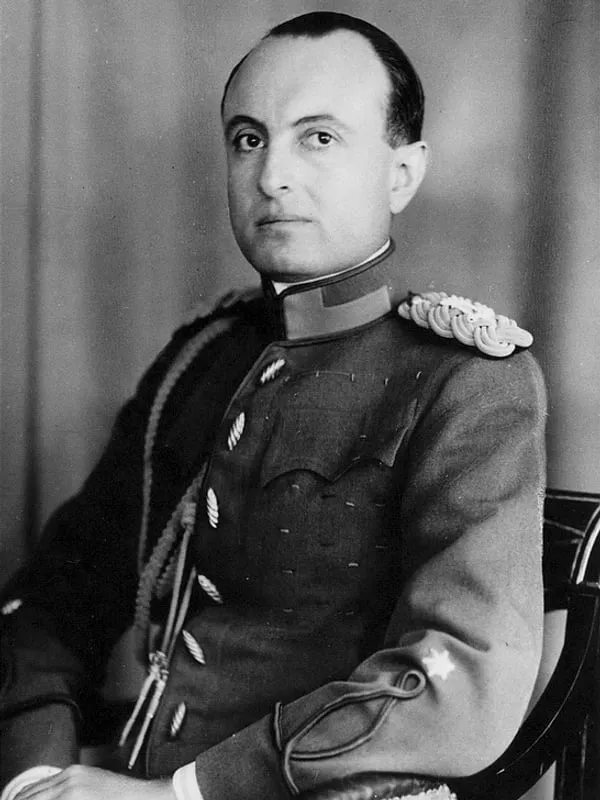
- Born:
- 27 April 1893, St Petersburg (Russian Empire)
- Died:
- 14 September 1976, Paris
- Author:
- Łukasz
- Photo:
- Royal Palace, domena publiczna, Wikimedia Commons

Prince Paul Karađorđević was a man who never wanted to rule, yet for six and a half years he held supreme power in one of the most difficult states in Europe. An Oxford-educated lover of the arts, a friend of the British aristocracy and brother-in-law of the Duke of Kent, he became Regent of Yugoslavia after the murder of his cousin King Alexander I, charged with handing the country over intact to the under-age King Peter II. His regency fell in the years when France was losing its influence in the Balkans and Germany and Italy were closing their pincers around Yugoslavia. He tried to save it through a settlement with the Croats and through neutrality, and when there was no more room for that, in March 1941 he agreed to accession to the Tripartite Pact. Two days later he was overthrown by army officers, and a little over a week after that Germany attacked Yugoslavia. He spent the rest of his life in exile, regarded by some as a traitor and by others as a realist whom no one wanted to understand.
A childhood without a homeland
He was born on 27 April 1893 (15 April in the Julian calendar) in St Petersburg. He was the only son of Prince Arsen Karađorđević, the younger brother of the future King Peter I of Serbia, and of a Russian aristocrat, Aurora Demidova. The Karađorđević family had been living in exile for several decades, because Serbia was ruled by the rival Obrenović dynasty. His parents’ marriage soon broke down, and the boy was brought up in Geneva in the household of his uncle Peter, together with Peter’s sons George and Alexander. The family called him “Toto”.
In 1903 conspirators from the Serbian army murdered the last Obrenović, King Alexander, in Belgrade, and Peter Karađorđević was called to the throne. Paul went with him to Serbia but never put down roots there as his cousin Alexander did, who became heir to the throne and a soldier. He was educated in Belgrade and Geneva and then went to England to study at Christ Church, Oxford. England shaped him for life. He made friends among young aristocrats and politicians, said that he felt himself an Englishman, and shared their love of art, books and society.
The war interrupted his studies. After the outbreak of the First World War, which Austria-Hungary began by attacking Serbia, he joined the Serbian army, although according to his biographers he served only briefly and without distinction: from November 1914 to May 1915, and then for a few months of 1917 on the Salonika front. He spent most of the war in London, where he lobbied for the Serbian cause among his acquaintances in the British elite. He took his Oxford degree only after the war.
The prince collector
In 1918 the Kingdom of Serbs, Croats and Slovenes came into being, and Alexander, king from 1921, turned it into a centralised state in which the Croats felt subordinated to the Serbs. In this period Paul lived mainly in London and only occasionally visited Belgrade. On 22 October 1923, in Belgrade, he married Princess Olga, daughter of Prince Nicholas of Greece and the Russian Grand Duchess Elena, and granddaughter of King George I of Greece. The Duke of York, the future King George VI, was a witness at the wedding, and Olga’s sister Marina married his brother, the Duke of Kent, in 1934. Paul and Olga had three children: Alexander (1924), Nikola (1928) and Elizabeth (1936).
In 1924 Paul returned to Yugoslavia. Alexander valued his company, calling him a witty conversationalist of broad horizons and a cool mind, and reportedly considered entrusting him with some kind of viceregal role in Zagreb. He dropped the idea because he judged that his cousin was too sympathetic to Croat demands for a federal state. Paul did not criticise the constitution in public, but he believed that Serbian politicians were deluding themselves in expecting Croat discontent to fade away of its own accord. Removed from politics, he devoted himself to his family and to his art collection, which he built up at exhibitions and auctions across Europe. He later founded a museum bearing his name in Belgrade, and most of his collection of Italian, French and Dutch painting ended up in the National Museum in Belgrade.
Regent by testament
On 9 October 1934, in Marseille, Vlado Chernozemski, a gunman of a Bulgarian-Macedonian revolutionary organisation working with the Croatian Ustaše, shot King Alexander dead. That evening the safe containing the King’s testament was opened at the palace in Belgrade. Alexander, who had already survived two assassination attempts, had laid down that until his eleven-year-old son Peter came of age, power was to be exercised by a three-member regency council chaired by Paul. The other regents were Radenko Stanković and Ivo Perović, but from the outset the prince had the decisive voice. The regency was to last until 6 September 1941, the King’s eighteenth birthday. Alexander chose Paul, as historians later wrote, partly because he knew that his cousin would never reach for his son’s throne.
Paul was handed enormous power and made little use of it. The Yugoslavia of his time was called “a dictatorship without a dictator”. By conviction he was more a Yugoslav than a Serb and inclined towards liberalisation, but he believed it his duty to hand the kingdom over to Peter in the state in which he had received it, and for a long time he resisted constitutional change. A French diplomat wrote that his undoubted qualities – balance, taste and Oxford charm – were useless in a country where only the argument of force counted. The British historian Donald Cameron Watt observed that under pressure his nerve failed him and that by nature he was more inclined to give way than to resist.
The Regent’s first disappointment was France. The investigation into the assassination pointed to the help given to the killers by Italy and Hungary, but Prime Minister Pierre Laval, then seeking an understanding with Mussolini, let Belgrade know that Paris would not support accusations against Rome. Paul concluded that the alliance with France was not worth much, and after the remilitarisation of the Rhineland in March 1936 he stopped believing that the French could come to the aid of anyone in Central Europe.
The Stojadinović years
On 24 June 1935 the Regent appointed the economist Milan Stojadinović Prime Minister. The new government led the country out of the economic crisis by basing its exports of food and raw materials – copper, bauxite and ores – on trade with Germany, which became Yugoslavia’s main partner. In foreign policy Stojadinović, with the Regent’s tacit consent, drifted away from the Little Entente and France. In January 1937 he concluded a pact of eternal friendship with Bulgaria, and on 25 March 1937, without warning his allies, an agreement with Italy. Paul hoped that the rapprochement with Rome would make the British take more interest in the Balkans, and he informed the British minister of it in advance. Poland was on good terms with Yugoslavia at the time; in 1936 the Regent received the Order of the White Eagle.
In time Paul came to fear his Prime Minister, who admired Mussolini, surrounded himself with uniformed party youth and talked of bringing Yugoslavia into the Axis. He refused to go along with the plans for the partition of Albania being hatched by Stojadinović and Ciano. When in February 1939, after elections in which the opposition won nearly 45 per cent of the vote, several ministers left the cabinet, the Regent dismissed Stojadinović and appointed a government under Dragiša Cvetković with instructions to reach agreement with the Croat leader Vladko Maček.
Between Berlin and London
In the spring of 1939 Yugoslavia’s position deteriorated sharply. Since the Anschluss it had bordered on the Reich; in March Germany occupied Bohemia and Moravia, and in April Italy invaded Albania and stood on Yugoslavia’s southern border. Paul did not protest, which alienated Turkey. At the beginning of June 1939 he paid an official visit to Germany. Hitler received him with extraordinary pomp: a reception at the Reich Chancellery, a gala at the opera, a great Wehrmacht parade and a stay at Hermann Göring’s estate. The Germans hoped that the Regent would leave the League of Nations or join the Anti-Comintern Pact. Paul refused, giving way only on minor economic matters, and Ribbentrop is said afterwards to have called him “a block of wood”.
In July he went to London, where he was received by George VI and awarded the Order of the Garter, which Hitler took as proof that the prince’s heart lay with England. Paul advised Lord Halifax that in the event of war with Germany the British should deal at once with the Italian fleet and air force, even if Italy declared neutrality, and that the French and British should land at Salonika. Only such a front, as in the First World War, could in his view allow Yugoslavia to resist Germany. In London his warnings were taken as a sign of nervousness. It was at this time that Yugoslavia’s gold reserves began to be shipped to London.
At home the Regent did what Alexander had refused to do: on 26 August 1939 Cvetković and Maček concluded an agreement creating the autonomous Banovina of Croatia, with its own Sabor and Ban. Maček became Deputy Prime Minister. The agreement placated moderate Croats, but many Serbs, especially in the army, felt that the Regent had handed Serbian lands in Bosnia and the Krajina over to the Croats. This resentment was to weigh heavily in March 1941.
Neutrality on credit
When Germany attacked Poland in September 1939, Yugoslavia declared its neutrality. The Regent hoped for a French and British victory, but he was terrified of the Wehrmacht and knew that his army, poorly armed and internally divided, would not withstand a German blow. He increased copper deliveries to the Reich in return for promises of arms, for which Yugoslavia paid in advance, and kept telling Western diplomats that he would join the Allies once they landed at Salonika. He even looked for a counterweight in Moscow: in June 1940 Yugoslavia, one of the last European states to do so, established diplomatic relations with the Soviet Union, and the Regent tried to buy arms there.
The fall of France in June 1940 robbed him of his last illusions about the West, and the Italian attack on Greece in October and the accession of Hungary and Romania to the Tripartite Pact in November closed the ring around Yugoslavia. Hitler wanted to conclude a “grand bargain” with the Regent: a guarantee of the frontiers in exchange for binding Yugoslavia to the Axis. Paul played for time. In February 1941 Prime Minister Cvetković and Foreign Minister Aleksandar Cincar-Marković went to see Hitler but referred the decision back to the Regent. On the other side, Churchill and Roosevelt demanded more than neutrality from Belgrade, although they could offer no real help.
March 1941
On 1 March 1941 Bulgaria joined the Tripartite Pact, and the Wehrmacht took up positions on its border with Yugoslavia. On 4 March Paul travelled in secret to the Berghof. Hitler promised him a guarantee of his frontiers and Salonika; the Regent replied that his wife’s Greek origins, his own sympathy for England and his distrust of Italy all argued against such a decision. He warned that if he followed Hitler’s advice he would no longer be in Belgrade in six months’ time. He parted from Hitler reserving his decision. On his return he convened the Crown Council, at which the Minister of War, General Petar Pešić, gave a devastating assessment of the army’s chances. Belgrade negotiated notes in which Germany and Italy undertook to respect the country’s sovereignty, not to demand the passage of troops or military assistance, and to give it Salonika after the war. In mid-March the Regent also handed over to the British the interned Stojadinović, around whom a pro-German opposition might have gathered.
On 20 March three Serbian ministers resigned from the government in protest, but Paul assured the German minister that he would not change his decision, since he considered it consistent with the country’s true interests. On 25 March, in Vienna, Cvetković signed Yugoslavia’s accession to the Tripartite Pact. The next day demonstrators in Belgrade chanted “Better war than the pact”, and that evening the Regent left by train for a rest in Slovenia. During the night air force officers under General Dušan Simović carried out a coup d’état and proclaimed Peter II of age. Paul learned of it in Zagreb. Maček urged him to stay in Croatia and rely on loyal troops, but the Regent did not want to start a civil war, and his wife and children had remained in Belgrade. On the evening of 27 March he returned to the capital, renounced power together with the other regents and that same night left with his family for Greece. Ten days later Germany attacked Yugoslavia, which capitulated on 17 April; its territory was carved up by the occupiers.
Prisoner in Kenya
The British, who until recently had been courting the Regent, treated him as a traitor. At the end of April 1941 they took him and his family to the British Colony of Kenya, where they lived in the neglected Oserian estate on Lake Naivasha under house arrest, forbidden to leave its grounds. The British press portrayed him as a Nazi sympathiser. Churchill was implacable towards him and rejected the pleas of the Duchess of Kent, Olga’s sister, that they be allowed to move to England. When the Duke of Kent was killed in an air crash in 1942, Olga was able to fly to London for a time, but without her husband. Paul owed his release from his Kenyan isolation to an old friend, the Prime Minister of South Africa, Jan Smuts, who obtained Churchill’s consent to his transfer. Towards the end of the war Paul and his family settled in Johannesburg.
Exile and the dispute over his memory
He never returned to Yugoslavia. In 1945 the communist authorities declared him an enemy of the state, and the state commission for the investigation of crimes committed by the occupiers and their collaborators named him a war criminal, among other things for joining the Tripartite Pact. His property was confiscated. In the late 1940s Paul settled in Paris and spent his summers at the Villa Demidoff near Florence in Tuscany, where his friends included the art historian Bernard Berenson. In 1954 his younger son Nikola was killed in a car accident in England. Paul died in Paris on 14 September 1976 and was buried in the Bois-de-Vaux cemetery in Lausanne.
For a long time historians were divided in their assessment of his role. In Tito’s Yugoslavia he was a symbol of betrayal. A British biography by Neil Balfour and Sally Mackay published in 1980 called him a “maligned friend of Britain”, while the Serbian historian Srđa Trifković wrote of him as a tragic figure: the eternal outsider, a refined lover of the arts thrown into the dark world of Balkan politics, an incorrigible Anglophile forced to deal with England’s enemies, who in the end was not loved in Belgrade, not trusted in Berlin and disregarded in London. On 14 December 2011 a court in Belgrade rehabilitated the prince, and on 6 October 2012 his remains, together with those of Olga and their son Nikola, were moved to the Karađorđević mausoleum in the Church of St George on Oplenac hill in Topola, where King Alexander also lies.
Paul’s story illustrates the position of the small states of Central Europe and the Balkans in 1939–1941. The Regent, who did not believe in a German victory and whose heart was on England’s side, concluded that a country divided along national lines and poorly armed would not survive a war with the Reich, and tried to buy it time with a signature hedged about with secret reservations. Some Serbs, especially in the army, saw that signature as a disgrace and overthrew the regency, and Hitler, for whom the mere appearance of disloyalty was enough, responded with a campaign that destroyed the Yugoslav state and opened the way to four years of occupation, terror and civil war.
Sources
Mentioned in battles
(02)Often appears with
People who appear in the same events.