United Kingdom
Oswald Mosley
Member of the House of Commons (1918–1931), Chancellor of the Duchy of Lancaster (1929–1930), leader of the British Union of Fascists (1932–1940)
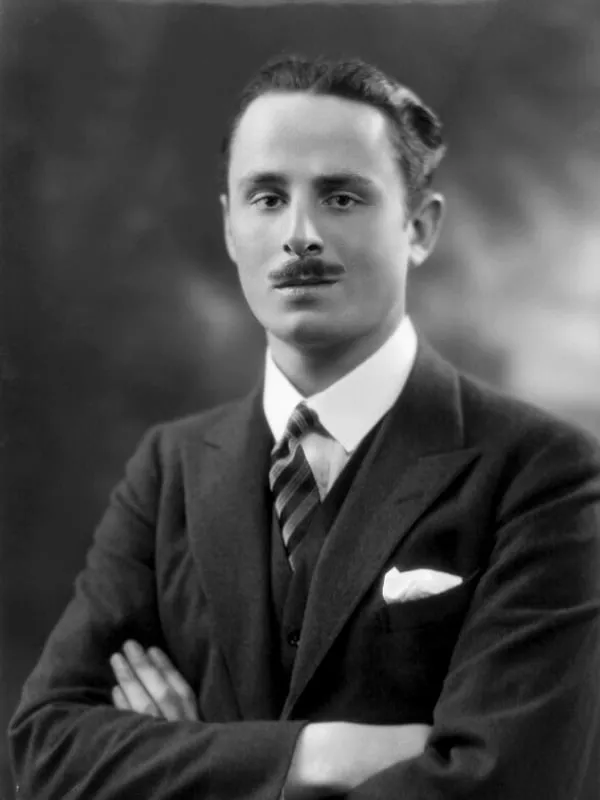
- Born:
- 16 November 1896, London (Mayfair)
- Died:
- 3 December 1980, Orsay (France)
- Author:
- Natalia
- Photo:
- Bassano Ltd, domena publiczna, Wikimedia Commons

Sir Oswald Mosley was one of the most promising British politicians of his generation: the youngest member of the House of Commons after the First World War, a brilliant orator and a minister in a Labour government whom some saw as a future occupant of Downing Street. Instead he became the leader of British fascism. The British Union of Fascists, which he founded in 1932, imitated first Mussolini and then, ever more openly, Hitler; it staged antisemitic marches through London’s East End and called for peace with the Third Reich until the very last moment. In May 1940, as the Germans swept through France, Churchill’s government interned him without trial. After the war Mosley never regained any significance, but to the end of his life he never renounced his past.
Youth and war
Oswald Ernald Mosley was born on 16 November 1896 in the London district of Mayfair, the eldest son of Sir Oswald Mosley, 5th Baronet, of a Staffordshire landed family. His parents separated when he was five; he was brought up by his mother and by his grandfather, the 4th Baronet, whom the boy adored. He was educated at Winchester College, where he made his name as a fencer, and in January 1914 he entered the Royal Military College at Sandhurst. Within a few months he was expelled for his part in a brawl.
The outbreak of war gave him a second chance. As an officer of the 16th Lancers he went to the Western Front, then transferred to the Royal Flying Corps as an observer and pilot. He injured his leg in a flying accident, and a return to the trenches made the injury worse; he walked with a slight limp for the rest of his life. He spent the last years of the war behind a desk at the Ministry of Munitions and the Foreign Office. The experience of the front shaped him for good: all his life he presented himself as the voice of the “war generation”, which must never allow another slaughter.
From the Conservatives to Labour
In December 1918, aged 22, Mosley won the Harrow seat near London as a Conservative candidate. On 11 May 1920 he married Lady Cynthia Curzon, daughter of the Foreign Secretary George Curzon; King George V and Queen Mary attended the wedding. That same year he broke with the governing party. He condemned the reprisals of the Black and Tans in Ireland and answered them with fierce attacks on the government of David Lloyd George. He crossed to the opposition benches and twice held his seat as an Independent.
In 1924 he joined the Labour Party, a sensation for an aristocrat with a title in prospect. In the general election in the autumn of 1924 he challenged Neville Chamberlain in Birmingham Ladywood and lost by just 77 votes. He returned to the Commons in December 1926 at a by-election in Smethwick. In 1928 he inherited the baronetcy. In 1929 his wife, too, became a Labour MP.
After Labour’s victory in 1929, Ramsay MacDonald made him Chancellor of the Duchy of Lancaster, in effect a minister without portfolio, with the task of tackling unemployment. After the Wall Street Crash unemployment rose sharply, and Mosley put forward a programme that went down in history as the Mosley Memorandum: public works financed by loans, higher pensions, protection of the home market by tariffs, and economic planning directed by the state. The economist John Maynard Keynes thought well of it, but the Chancellor of the Exchequer, Philip Snowden, and most of the cabinet rejected it. In May 1930 Mosley resigned, and in the autumn he narrowly lost a vote on his programme at the party conference.
The New Party and the road to fascism
At the turn of February and March 1931 Mosley and a group of MPs founded the New Party. It was meant to break the inertia of the “old parties”, but it soon began to drift towards authoritarianism: Mosley created stewards’ squads to protect its meetings, and some of his associates, alarmed by this direction, left. In the general election of October 1931 none of the party’s candidates won a seat, and Mosley, standing in Stoke-on-Trent, left Parliament for good.
In January 1932 he travelled to Rome, where he was received by Benito Mussolini. He came back convinced that fascism – with a corporate economy, a strong executive and a disciplined mass movement – was the only answer to the crisis. On 1 October 1932 he announced the creation of the British Union of Fascists (BUF). Its members wore black shirts modelled on those of the Italian squadristi, greeted one another with the raised arm and believed in their “Leader”. According to documents revealed after the war, the movement received substantial subsidies from Rome for several years.
The Blackshirts
The beginnings were promising. In January 1934 Lord Rothermere’s Daily Mail published an article headed “Hurrah for the Blackshirts!”, and membership was estimated at several tens of thousands. The turn for the worse came with a great rally at London’s Olympia hall on 7 June 1934, at which the Union’s stewards brutally beat opponents who interrupted Mosley’s speech. A few weeks later the Night of the Long Knives in Germany showed the British where fascism could lead. Rothermere withdrew his support, and members began to drift away.
Mosley responded by radicalising. From 1934 antisemitism took up more and more of his speeches: he accused “international financiers” and “Jewish interests” of ruining British industry and pushing the country towards war. The Union concentrated on London’s East End, home to a large Jewish community. On 4 October 1936 thousands of anti-fascists blocked its march through the district; the clashes with the police, who were trying to clear a path for the fascists, went down in history as the Battle of Cable Street. The Commissioner of Police called the march off. Parliament responded with the Public Order Act, which from 1 January 1937 banned political uniforms and gave the police the power to prohibit marches.
Two days after Cable Street, on 6 October 1936, Mosley secretly married in Berlin Diana Guinness, née Mitford, his mistress of many years, whose sister Unity Mitford was one of Hitler’s personal acquaintances. Mosley’s first wife, Cynthia, had died in 1933. The wedding took place in the home of Joseph Goebbels, and Adolf Hitler was among the guests. That same year the movement took the name British Union of Fascists and National Socialists, shortened in 1937 to British Union. During the abdication crisis Mosley took the side of Edward VIII and demanded that the nation be allowed to decide the King’s fate. The Union never entered Parliament. It put up no candidates at all in the 1935 general election, and in the 1937 London County Council elections in three East End districts it won close to a quarter of the vote in places, but no seats. In 1937 Mosley dismissed most of his paid officials, among them William Joyce, who founded his own, even more pro-Nazi group and during the war became a German propagandist.
Against the war
In 1938–1939 Mosley campaigned under the slogan “Mind Britain’s Business”: Britain should look after its empire and keep out of the affairs of Eastern Europe, and a war over Czechoslovakia or Poland would, he claimed, be a war in the interests of Jewish finance. On 16 July 1939 at Earls Court he addressed a crowd estimated at anywhere between eleven and thirty thousand people, one of the largest rallies in the history of British politics. After the declaration of war on Germany he called on his members to obey the law, but kept up his agitation for peace and demanded that talks be opened after Hitler’s October peace offer. Union candidates won a few hundred votes each at by-elections.
Internment
When in May 1940 Germany struck at the Netherlands, Belgium and France and Britain was gripped by fear of a “fifth column”, the government of Winston Churchill changed course. Under the extended Defence Regulation 18B, Mosley was arrested on 23 May 1940 and held in Brixton prison; in the following weeks hundreds of Union members were detained, and on 10 July the movement was banned. Diana Mosley was taken to Holloway women’s prison at the end of June, eleven weeks after the birth of her son Max. None of them was charged. In July 1940 Mosley spent many hours answering the questions of an advisory committee chaired by the barrister Norman Birkett, which concluded that he should remain in detention. From December 1941, after Churchill intervened, the couple were allowed to live together in a separate part of Holloway prison.
In November 1943 the Home Secretary, Herbert Morrison, released them on account of Mosley’s illness, phlebitis. The decision provoked protests from trade unions and part of the press, but the House of Commons backed it. Until the end of the war the Mosleys remained under house arrest and police supervision, and they recovered their passports only in 1949.
After the war
In 1948 Mosley founded the Union Movement, which proclaimed the slogan “Europe a Nation”: the union of white Europe in a single state, with Africa as its hinterland. As before the war, the new movement’s meetings ended in brawls. In 1951 Mosley left the country, settling in Ireland and then in France, at Orsay near Paris. He returned to British politics twice. In 1959, after the race riots in Notting Hill, he stood in Kensington North calling for the compulsory repatriation of Caribbean immigrants and won 8.1 per cent of the vote; in 1966, in Shoreditch and Finsbury, he won just 4.6 per cent.
Mosley was one of the first writers in Europe to relativise and cast doubt on the Holocaust: he did not deny the existence of the camps, but claimed that Hitler had not known of the crimes, and he attributed the images from the liberated camps to hunger and epidemics caused by Allied bombing. In 1968 he published an autobiography, My Life, in which he portrayed himself as a misunderstood reformer rather than a leader of the far right. He died on 3 December 1980 at Orsay. He had five children: three from his first marriage and two sons from his second. The younger of these, Max Mosley, was president of the Fédération Internationale de l’Automobile (FIA) from 1993 to 2009.
Significance
Mosley was the ablest and best-known British fascist, and at the same time the best proof that fascism in Britain had no chance of power. At the height of its popularity the movement had several tens of thousands of members but never won a single parliamentary seat; the violence of its stewards, its antisemitism and its evident links with Rome and Berlin repelled most voters, who through the crisis of the 1930s stayed loyal to the Conservatives and Labour. Yet his career shows how close to the centre of British politics the fascination with Mussolini and Hitler could reach: Mosley was the son-in-law of a Viceroy of India and a minister in MacDonald’s government, and he was married in Hitler’s presence. His internment in May 1940 became a symbol of the moment when Britain, standing alone against the Third Reich, was ready to suspend basic civil liberties to prevent a repetition of the Norwegian scenario.
Sources
Often appears with
People who appear in the same events.