Germany
Wilhelm Groener
Chief of Field Railways (1914–1916), head of the War Office (1916–1917), First Quartermaster General (1918–1919), Minister of Transport (1920–1923), Reichswehr Minister (1928–1932)
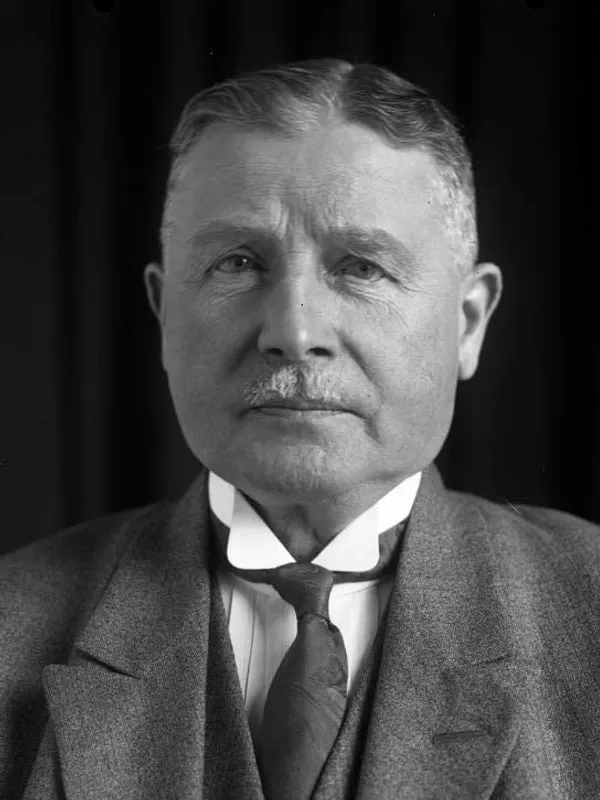
- Born:
- 22 November 1867, Ludwigsburg (Württemberg)
- Died:
- 3 May 1939, Potsdam-Bornstedt
- Author:
- Natalia
- Photo:
- Georg Pahl, CC BY-SA 3.0 DE, Wikimedia Commons

Wilhelm Groener was one of the ablest organisers of the Imperial German Army and one of the few of its generals who understood that modern war is waged not by armies alone but by entire societies. In 1914 his railwaymen carried millions of soldiers to the frontiers; in 1916–1917 he directed the German war economy, and in 1918 the German occupation of Ukraine. In the last weeks of the war he replaced Erich Ludendorff, and it was he who on 9 November 1918 told Wilhelm II that the army no longer stood behind him. A day later he concluded an agreement with Friedrich Ebert under which the army recognised the revolutionary government and the government relied on the army. In the Weimar Republic he served as a minister, and in 1932, as Reichswehr Minister and Minister of the Interior, he banned Hitler’s paramilitary formations, the SA and the SS. For this he lost office, and his fall opened the way for the men who a few months later handed power to Hitler. Groener thus belongs to the history of the road to the Second World War twice over: as a co-author of the compromise on which the republic was built, and as one of its last defenders within the army.
The General Staff’s railwayman
He was born on 22 November 1867 in Ludwigsburg in Württemberg, the son of a paymaster in a Württemberg regiment. He was not of noble birth, which was rare among those who rose so high in the German army. In 1884 he joined a Württemberg infantry regiment, in 1893–1896 he completed the War Academy in Berlin, and in 1899 he was posted to the Great General Staff. That same year he married Helene Geyer. Over the following years, with breaks for regimental service, he worked in the Staff’s railway section, and in 1912 he became its head. He regarded himself as a disciple of Alfred von Schlieffen and subordinated the entire transport network to Schlieffen’s concept of a swift strike against France through Belgium.
The railways and the War Office
In August 1914 Groener became Chief of Field Railways at Supreme Headquarters. The mobilisation and transport of an army of several million men to the frontiers went smoothly, and the credit was given chiefly to him. All the more painful for him was the defeat on the Marne, for which he blamed the Chief of the General Staff, Helmuth von Moltke. In the years that followed his trains shifted divisions between the Western and Eastern Fronts, and their capacity set the limits of operations. In 1915 he was promoted to Generalmajor and awarded the Pour le Mérite.
In 1916, when Hindenburg and Ludendorff took over the Supreme Command and demanded a dramatic increase in armaments production, Groener was placed on 1 November at the head of the new War Office (Kriegsamt) attached to the Prussian War Ministry. The office was to direct the raw materials, armaments and manpower of the whole country. In the Reichstag Groener defended the Auxiliary Service Law of December 1916, which introduced compulsory labour for men aged 17 to 60 but in return gave the trade unions a share in arbitration committees and workers’ committees. He treated the trade unionists as partners, which the industrialists regarded as weakness. When in the summer of 1917 he proposed limiting employers’ war profits, he was dismissed in August. His work at the War Office convinced him that Germany’s economic resources were limited and undermined his faith in victory. At the same time, during the strikes of spring 1917, he called anyone who went on strike while the army faced the enemy a scoundrel, which the left did not forget for a long time.
Ukraine, 1918
After a few months commanding a division and a corps on the Western Front, at the turn of February and March 1918 Groener took over a corps that was entering Ukraine after the Central Powers had made peace with the Ukrainian People’s Republic, and in the spring he became chief of staff of Field Marshal Hermann von Eichhorn’s army group in Kiev. His staff in practice directed the whole of German policy in Ukraine. The aim was grain and raw materials for starving Germany. When the left-leaning Central Rada failed to meet German expectations, the Germans backed the coup of General Pavlo Skoropadskyi, who on 29 April proclaimed himself Hetman. Groener took part in preparing this change. In conversations with officers he repeated antisemitic theories about “Jewish Bolshevism”, something historians today clearly note.
Ludendorff’s successor
After Ludendorff’s dismissal on 26 October 1918 the Kaiser appointed Groener First Quartermaster General, in effect the director of operations alongside Paul von Hindenburg. Sources date the appointment variously, between 26 and 30 October. The choice was decided by his administrative experience and his reputation as a general with whom the Social Democrats could talk. He found an army retreating along the whole front and allies begging for an armistice. After news of the sailors’ mutiny and further defeats at the front, on 6 November he demanded that an armistice delegation be sent at once.
For a long time he would not hear of the Kaiser’s abdication, fearing for the cohesion of the army, and on 6 November he rejected Friedrich Ebert’s request that he persuade Wilhelm II to abdicate. On 9 November at Spa, when the Kaiser spoke of marching on Berlin at the head of the army, Groener, relying on a survey of front-line commanders, told him that the army would return home in good order under its generals, but not under the Kaiser’s command. He is said to have remarked then that the oath to the colours was now no more than an empty word. According to some historians, that same day he also let Berlin understand that full abdication was a matter of moments, which prompted the Chancellor, Max von Baden, to announce it. The monarchists never forgave him.
The pact with Ebert
On the evening of 10 November Groener telephoned Ebert, head of the new government. The army recognised the government and promised to bring the troops home in good order, while the government was to support the officers in maintaining discipline and supply and in fighting Bolshevism. Hindenburg approved the agreement. After the Armistice of Compiègne Groener directed the return of several million soldiers from across the Rhine within the deadlines imposed by the victors. In December he urged Ebert to take firm action against the mutinous sailors in Berlin and forced a watering-down of the resolutions of the Congress of Councils on democratising the army. The pact allowed the republic to survive its first months, but it also preserved the old officer corps, with its influence and its spirit.
At the beginning of 1919 Supreme Headquarters, which had earlier moved from Spa to Kassel, transferred to Kolberg, today Kołobrzeg, from where the defence of the Reich’s eastern borders was directed. The army and the volunteer units of the Grenzschutz (Border Guard) were then fighting in Greater Poland, where an uprising had broken out in December 1918, and in the Baltic states. In June 1919, when the government asked whether the army could resist if the Treaty of Versailles were rejected, Groener judged resistance hopeless. Hindenburg agreed with him but left it to Groener to convey the answer to the politicians, which in the eyes of the right made Groener the guilty one. After Hindenburg’s departure he continued to run Supreme Headquarters, and on 30 September 1919 he retired.
Minister of the Weimar Republic
In June 1920 he became Minister of Transport as a non-party expert, and until August 1923, in successive governments, he rebuilt the war-ravaged railways and supported fledgling civil aviation, hampered by the prohibitions of the Treaty of Versailles. He then spent several years writing works on the history of the war, among them a study of the Schlieffen Plan critical of Moltke. In January 1928, when his predecessor Otto Geßler had to step down after a scandal over the navy’s secret funds, President Hindenburg appointed Groener Reichswehr Minister. Groener wanted to expand the army as far as possible while anchoring it more firmly in the life of the republic. His closest collaborator was General Kurt von Schleicher, whom he had known for years and treated almost as a son, and to whom, as head of the minister’s office, he entrusted the army’s political affairs.
From 1930 he supported the government of Heinrich Brüning, which governed by presidential decree, and in October 1931 he also took over the Ministry of the Interior. He long wavered over the National Socialist movement. As Reichswehr Minister he tried to win the SA over to the state and to bring it into a non-partisan organisation for pre-military training, while as Minister of the Interior he had to combat its unconstitutional ambitions. The Prussian Minister of the Interior, the Social Democrat Carl Severing, had been demanding a ban on the SA since 1930. In the spring of 1932, under pressure from the governments of the federal states, which had supplied evidence that the SA was preparing a coup, Groener obtained on 13 April a presidential decree banning the SA and the SS. It was the most serious blow dealt to Hitler’s forces before 1933.
Downfall
The ban turned against Groener. Schleicher, who wanted an understanding with the Nazis and the inclusion of the SA in the state’s defence plans, began behind his back to persuade Hindenburg that the minister had lost the army’s confidence. Groener’s private life also counted against him: in 1930, after the death of his first wife, he had remarried, and a few months after the wedding a son was born to him, which was mocked in officers’ circles. On 10 May 1932, defending the ban in the Reichstag, he performed poorly and was shouted down by NSDAP deputies. A few days later Schleicher told him that the army no longer wanted him as minister, and Groener gave up the Reichswehr Ministry. At the end of May the whole Brüning government fell, and Groener lost the Ministry of the Interior as well. The new government of Franz von Papen, with Schleicher as Reichswehr Minister, quickly lifted the ban on the SA and SS. Eight months later Hitler was Chancellor.
Groener spent his last years in Bornstedt near Potsdam, writing his memoirs. Schleicher was murdered by the SS in the “Night of the Long Knives” on 30 June 1934. Groener died of acute hepatitis on 3 May 1939, four months before the German invasion of Poland. The Wehrmacht high command forbade officers to attend his funeral, and according to accounts only one general, Kurt von Hammerstein-Equord, already removed from the service, came in uniform to the cemetery in Stahnsdorf.
Assessment
German historians see Groener above all as a realist who in 1918–1919 helped to preserve the unity of the state and ensure the survival of the first German republic. His biographer in the Neue Deutsche Biographie stressed the sobriety of a general who at the War Office understood what industrial war meant and won the trust of Social Democratic workers. Critics point out that the pact with Ebert also preserved the old officer corps, which never became loyal to the republic, and that as minister Groener himself had brought on Schleicher, who toppled him in 1932. His antisemitic remarks of 1918 are also noted. To the monarchists he was the man who betrayed the Kaiser, to the radical left the general who helped crush the revolution, and to the Nazis the minister who tried to disband them. His fate shows the limits of the Weimar compromise: the army he had saved for the republic in 1918 turned away from him in 1932, when he sought to use it against the republic’s enemies.
Sources
Often appears with
People who appear in the same events.