- Category:
- Military
- Front:
- Western Front
- Date:
- 17 February 1940
- Author:
- Natalia
- Tags:
- Erich von Manstein, Adolf Hitler, Wehrmacht, France
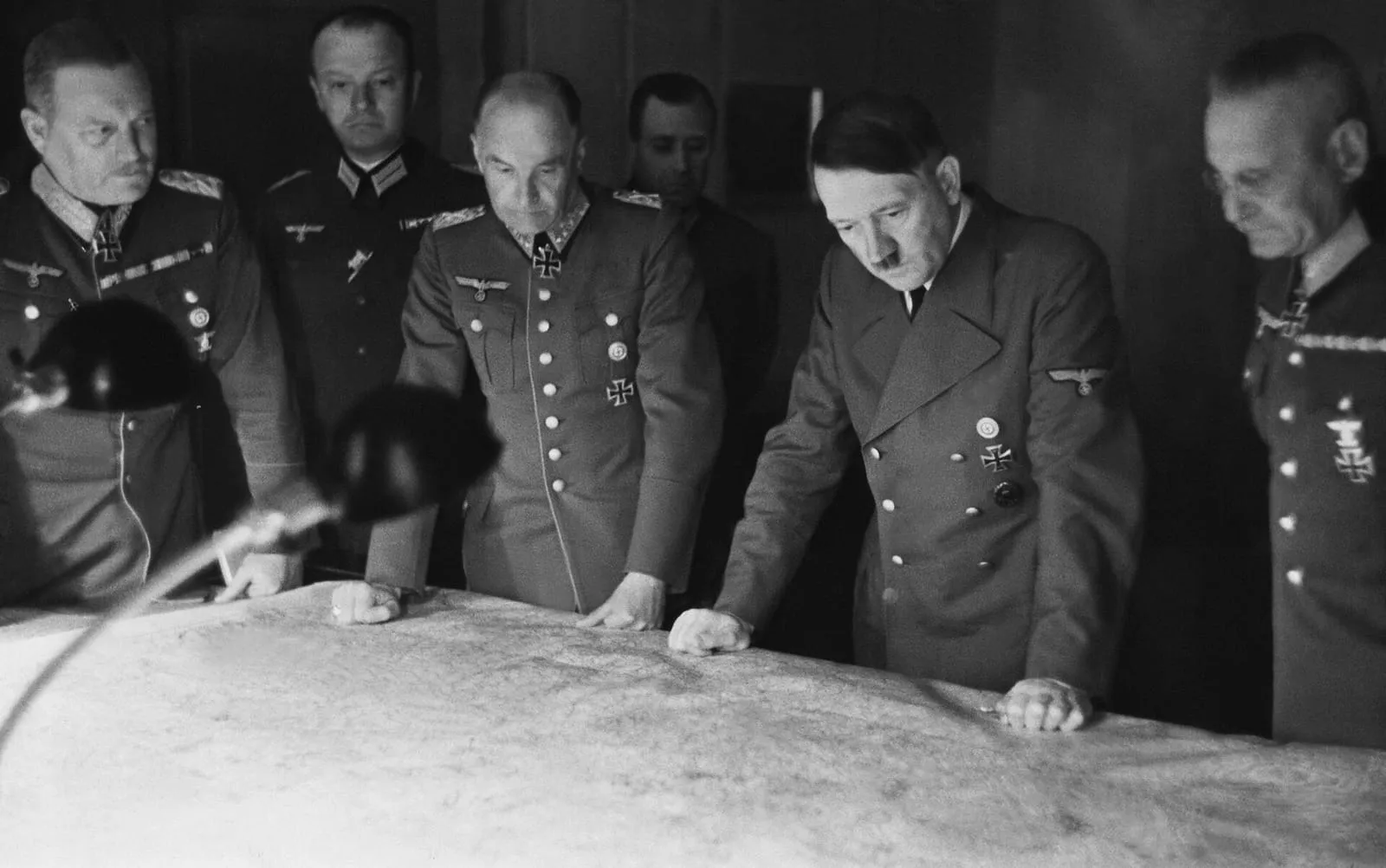
On 17 February 1940, at the New Reich Chancellery (PL) in Berlin, Adolf Hitler gave a breakfast for several generals who had recently taken command of newly formed corps. Among them was Lieutenant General Erich von Manstein, until recently chief of staff of Army Group A in Koblenz, who for three and a half months had been writing one memorandum after another demanding that the main thrust in the west be shifted from the plains of central Belgium to the wooded Ardennes. After the meal Hitler invited him into his study and listened to his argument for about an hour. The next day he instructed the army command to base the offensive plan on this concept, and on 24 February the Army High Command (OKH) issued a new, fourth version of Case Yellow (“Fall Gelb”), in which the weight of the attack rested on Army Group A and a thrust through the Ardennes towards Sedan. This was the plan that brought Germany victory over France in May and June 1940.
War chronologies associate two dates with this event. Under 9 February they state that Manstein was given command of XXXVIII Panzer Corps, which removed him from planning the invasion of France, and under 17 February that he presented Hitler with a plan for an invasion through the Ardennes. The second date is correct. The first needs qualifying. Manstein had been appointed commander of XXXVIII Army Corps as early as 27 January 1940; on 9 February he merely left Koblenz and went on a short leave to his home in Liegnitz (Legnica), from where he was to go on to Stettin (Szczecin), the seat of his new headquarters. Nor was it a panzer corps: it was an ordinary infantry corps, being formed in Military District II and, for the sake of secrecy, called “Fortification Construction Staff 38” (Festungsbaustab 38) until May 1940. It was designated a panzer corps only in January 1945, in the Courland Pocket. What is true is that the transfer was meant to remove Manstein from planning the campaign in the west. As it turned out, it had the opposite effect.
The dispute over the direction of the thrust
Since the autumn of 1939 the German command had been divided over where to strike the main blow in the west. In Directive No. 6 of 9 October, Hitler had ordered preparations for an offensive through Luxembourg, Belgium and the Netherlands. The OKH, run in practice by the Chief of the General Staff, General Franz Halder, issued two versions of the plan in October and a third at the turn of January and February. In all of them the main blow was to be delivered by Colonel General Fedor von Bock’s Army Group B, advancing through central Belgium. Colonel General Gerd von Rundstedt’s Army Group A was merely to cover its left flank.
From 31 October 1939 Manstein, Rundstedt’s chief of staff, argued in his memoranda that such an offensive would collide head-on with the French and British forces, which would advance deep into Belgium at the first news of an attack, and would push them back towards the Somme but not destroy them. Germany would gain the coast and a slice of France, and the front would then congeal into positional warfare, which the Reich, cut off by the blockade, could not win. He therefore proposed shifting the weight of the attack to the south: Army Group A was to pass through the Ardennes in southern Belgium and Luxembourg, force the Meuse in the area of Sedan and strike west towards the lower Somme, into the rear of the Allied armies in Belgium. The commander of XIX Corps, General Heinz Guderian, when asked by Manstein, confirmed that tanks could get through the Ardennes, and suggested that after breaking through the front the panzer divisions should not turn aside but race all the way to the English Channel.
The Chief of the Army General Staff, General Franz Halder, and the Commander-in-Chief of the Army, Colonel General Walther von Brauchitsch, rejected these proposals. Only a few narrow roads led through the Ardennes; armoured columns would stretch along them for days and, once spotted by enemy aircraft, might be destroyed before they reached the Meuse. To the dispute over substance was added personal rivalry. In 1938 Manstein had been regarded as the likely successor to General Ludwig Beck as Chief of the General Staff, but after the Blomberg–Fritsch affair he was sent off to command a division and the post went to Halder. Brauchitsch did not pass the memoranda from Koblenz on to Hitler. The last of them was written on 12 January 1940.
Sidelined
The winter changed the situation. On 10 January, in the Mechelen incident, documents concerning the offensive fell into Belgian hands, and on 16 January Hitler postponed the offensive until the spring and demanded that it be built “on a new basis”. Halder began reworking the plan, but decided to get the troublesome critic out of the way. On 27 January Manstein learned that he was to take over XXXVIII Corps in Stettin. Formally it was a distinction, and the OKH justified it by saying that a general of his seniority was at last owed a corps command. In practice the transfer cut him off from planning the campaign in the west, and the corps, which was only just being formed in Pomerania, was not to play an important role in it. In February General Georg von Sodenstern became chief of staff of Army Group A.
Before Manstein left, on 7 February, Army Group A held a war game in Koblenz in which Halder took part. It rehearsed the offensive under the existing plan and exposed what Manstein had been repeating for months: Guderian’s corps on its own would be unable to force the Meuse at Sedan and hold on beyond it unless it received far larger forces. Guderian wanted to cross the river with the panzer divisions alone, without waiting for the infantry. According to Guderian’s account, Halder considered this idea unreasonable and wanted the attack across the Meuse to be launched together with the infantry, on the ninth or tenth day of the offensive at the earliest. In his diary, however, he noted that the OKH would have to decide by the third day at the latest whether to mount a coordinated attack in strength across the Meuse. On 9 February Manstein left Koblenz. At the next war game, on 14 February at 12th Army headquarters in Mayen, Halder recorded that Guderian and the commander of XIV Motorised Corps, General Gustav Anton von Wietersheim, clearly did not believe in success. Guderian is said to have remarked then that Manstein was exactly what was needed now.
The road to the Reich Chancellery
The idea survived thanks to two officers in Koblenz. The operations officer of Army Group A, Lieutenant Colonel Günther Blumentritt, and Major Henning von Tresckow, later one of the leaders of the military opposition to Hitler, took advantage of a visit to Koblenz by Hitler’s chief adjutant, Colonel Rudolf Schmundt, a friend of Tresckow’s. They outlined Manstein’s concept to him, and Schmundt, struck by the fact that an army group staff general was thinking about Sedan in exactly the same way as Hitler, reported it to his superior at the beginning of February – on 2 February, according to most studies. Hitler, who as early as the autumn of 1939 had proposed sending armoured forces via Arlon towards Sedan, recognised his own ideas in it. On 13 February the head of the Wehrmacht High Command’s operations staff, Major General Alfred Jodl, recorded in his diary Hitler’s words that the panzer divisions should be concentrated in the direction of Sedan, because the enemy did not expect the main blow there.
Schmundt also made sure that Hitler heard Manstein in person. Newly appointed corps commanders were required to report to the Reich Chancellery, which provided an opportunity for a meeting without the OKH’s knowledge and without offending Brauchitsch and Halder. On 17 February Manstein, together with four other newly appointed corps commanders, attended a breakfast with Hitler. According to some accounts, the guests also included Major General Erwin Rommel, who in mid-February had taken command of the 7th Panzer Division. The conversation at table was general, and Hitler, as Manstein recalled, showed off an astonishing knowledge of the latest technical developments in the armaments of every country.
The conversation in the study
As the guests were taking their leave, Hitler asked Manstein into his study. Schmundt was present and, according to some studies, Jodl. Manstein set out his reasoning in the form he had given it in his memoranda of December and January. The aim of the offensive in the west must be to decide the war on land, not to capture the coast and bases for the air force and navy. An attack by Army Group B through Belgium would run into the enemy’s strongest forces and would end, at best, on the Somme. The main blow must therefore be struck by Army Group A, through the Ardennes, across the Meuse between Dinant and Sedan and on towards the mouth of the Somme, into the rear of the Allied armies that would have entered Belgium. For this it needed not one panzer corps but a strong concentration of mobile troops and additional armies: one to drive west, and another to shield the southern flank against a French counter-offensive by advancing to meet it.
In his post-war memoirs Manstein wrote that Hitler had grasped with astonishing speed the ideas that Army Group A had been working on for months, and agreed with them completely. Hitler, however, did not like him. According to notes kept by those around him, he said after the general had left that he was certainly an exceptionally able man with great operational talent, but that he did not trust him. Manstein returned to Pomerania and took no further part in work on the plan.
The turn in the OKH and the plan of 24 February
On 18 February Hitler summoned Brauchitsch and Halder and set out his intentions, which coincided with what he had heard from Manstein the day before. Some historians describe this as a ready-made concept being imposed on the army command. Others, especially the German military historian Karl-Heinz Frieser, author of the most important study of the 1940 campaign, point out that Halder had already changed his mind. The war games of 7 and 14 February had convinced him that the attack on Sedan would either receive much larger forces or fail altogether, and even before the meeting at the Reich Chancellery he had begun to shift the weight of the plan southwards. Hitler, Halder and the absent Manstein had thus reached the same conclusion by different routes. The difference was that the decision was now taken at the highest level.
On 24 February 1940 the OKH issued the fourth deployment directive for Case Yellow (Aufmarschanweisung Nr. 4). It reversed the existing plan. Army Group A, reinforced by the 4th Army transferred from Army Group B, was to force the Meuse between Dinant and Sedan and advance towards the mouth of the Somme. Most of the panzer and motorised divisions were transferred to it: in the final deployment of May 1940, seven of the ten panzer divisions. Army Group B, with three panzer divisions, was to attack the Netherlands and northern Belgium so noisily as to convince the Allies that this was the main axis of the offensive and draw their forces deep into Belgium. Colonel General Wilhelm von Leeb’s Army Group C remained on the defensive facing the Maginot Line. In March the panzer divisions of Army Group A were combined into a group under General Ewald von Kleist.
Halder, who had opposed Manstein’s idea since the autumn, now worked it out carefully, but in his own way. His plan contained no armoured dash to the coast. The Meuse was to be forced by infantry, the bridgeheads were to be filled with infantry divisions, and the panzer divisions were to advance together with them rather than independently and far ahead of them. He also rejected the idea of a simultaneous thrust to the south to forestall a French counter-offensive. That in May the tanks of Kleist and Guderian raced straight to the English Channel after breaking through the front on the Meuse was largely the doing of the panzer commanders themselves, often in defiance of their superiors’ orders.
Sichelschnitt: a name given later
The plan of 24 February is often called the “Manstein Plan” or “Operation Sichelschnitt” (“sickle cut”). The second name does not come from German documents. The order bore the dry title of a deployment directive, and the thrust through the Ardennes itself had no code name at all. The vivid phrase “sickle cut” gained currency after the war, most often attributed to Winston Churchill, and German generals adopted it in their memoirs. Hence the belief that it was the operation’s official name.
The dispute over authorship has been running since the 1950s. Halder claimed after the war that he was the plan’s father, since he had been thinking of shifting the weight of the attack to Sedan as early as the autumn of 1939, and that Manstein’s original concept had been too traditional. Third Reich propaganda attributed the victory to the genius of the leader, and Hitler himself later said that of all the generals with whom he had discussed the plan of attack in the west, only Manstein had understood him. Historians today credit Manstein with the operational idea, Guderian with its armoured development and Halder with turning it into a workable plan, and they stress that Hitler had been looking for a similar solution since the autumn.
The other side
The plan struck at the Allies’ weakest point. The French Commander-in-Chief, General Maurice Gamelin, assumed that the Germans would attack, as in 1914, across the plains of Belgium, and in November 1939 he adopted the Dyle Plan: once the Germans entered Belgium, the best French armies and the British Expeditionary Force were to advance to the Antwerp–Namur line. The Mechelen documents only confirmed him in this belief. The sector facing the Ardennes, considered difficult terrain for large formations, was held by the weak 2nd and 9th Armies, with many reserve divisions. In March Gamelin extended the plan still further with the “Breda variant”, sending his main reserve, the 7th Army, as far as the Netherlands.
Place in the war
The breakfast meeting of 17 February was one of the most momentous conversations of the war. On 10 May 1940 the Wehrmacht attacked the Netherlands, Belgium and Luxembourg. The Allies advanced deep into Belgium as planned, and Kleist’s panzer group passed through the Ardennes. On 13 May the Germans forced the Meuse at Sedan and at several other points, and on 20 May Guderian’s tanks reached the English Channel near Abbeville, cutting off the Allied armies in Belgium. More than 330,000 soldiers were evacuated to England from the Dunkirk pocket, but almost all their equipment was left on the beach. On 22 June France signed an armistice. Polish units re-formed in France also fought in the campaign.
Manstein himself watched this victory from the second rank. His corps went into action only after the front on the Meuse had been broken, and in June, in the second phase of the campaign, it crossed the Somme and was the first to reach the Seine. The swift victory over France confirmed Hitler in his belief in his own military genius and stripped the generals, who in the autumn had considered the offensive madness, of what authority they had left. The conviction that the risky improvisation of May 1940 could be repeated under any conditions weighed on the plan for the attack on the Soviet Union in 1941, and the myth of the “Blitzkrieg”, built on a victory no one in Germany had expected, survived long after the war.
Sources
Meanwhile
(04)Elsewhere, within a week.
- 15 February 1940 · ScandinaviaThe Red Army breaks the Mannerheim LineOn 11 February 1940 the Red Army broke the Mannerheim Line at Lähde. On 15 February Mannerheim ordered a retreat and the Russians entered Summa.
- 15 February 1940 · AtlanticGermany widens the U-boat warContrary to popular chronologies, no new order came on 15 February 1940. The zones where U-boats sank even neutral ships unwarned had grown since January.
- 14 February 1940 · ScandinaviaVolunteers for FinlandOn 14 February 1940 the British government allowed volunteers to serve in the Finnish army. Swedes, Hungarians, Americans and Estonians also went to Finland.
- 11 February 1940 · DiplomacyThe German–Soviet commercial agreementOn 11 February 1940 Germany and the USSR signed a trade agreement in Moscow. Soviet grain, oil and ores were to flow to the Reich for machinery and arms.
Related events
(04)The same battle, people or subject.
- 31 October 1939 · Western FrontThe Manstein PlanOn 31 October 1939 Army Group A sent Erich von Manstein’s memorandum to the OKH. The main blow in the west was to shift south, towards the Ardennes.
- 10 May 1940 · Western FrontGermany attacks in the WestOn 10 May 1940 the Wehrmacht struck the Netherlands, Belgium and Luxembourg. The Allies advanced into Belgium as Kleist's tanks entered the Ardennes.
- 24 May 1940 · Western FrontThe halt order before DunkirkOn 24 May 1940 Hitler approved halting the tanks before Dunkirk. By 26 May the Allies had strengthened their defence, and the Germans took Boulogne and Calais.
- 16 January 1940 · Western FrontHitler postpones the attack in the WestOn 16 January 1940 Hitler put off the attack in the West until spring, swayed by snow, frost and the plans lost at Mechelen. It was to be rebuilt anew.