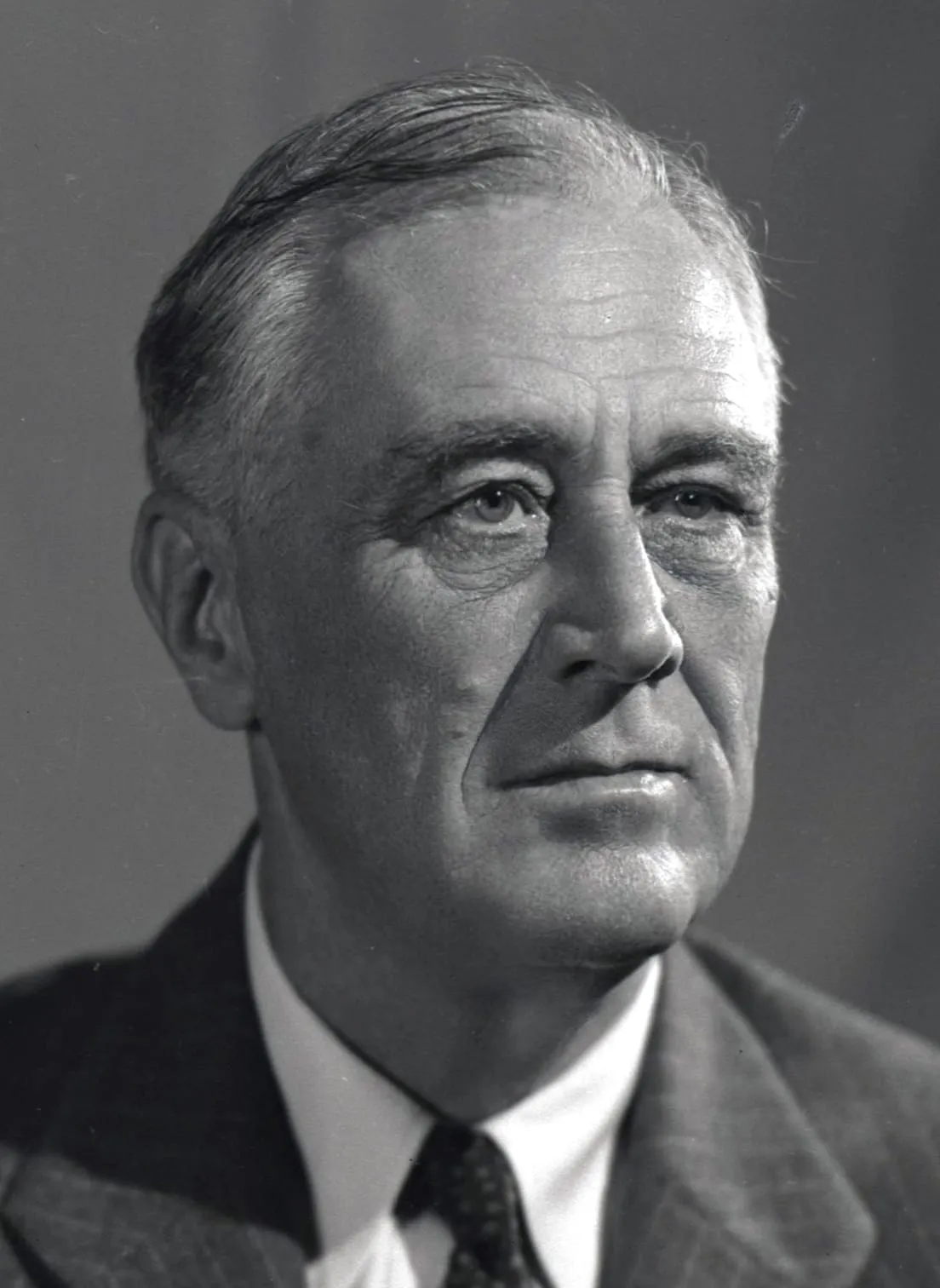
On Tuesday 7 November 1944 Americans elected a president during a great war in which millions of their soldiers were fighting, for the first time since 1864. The winner was the incumbent, Franklin Delano Roosevelt, who defeated the Republican Governor of New York, Thomas Dewey, and became the first and only person in the history of the United States to be elected to a fourth term. He had been in office since March 1933: in 1932 he had beaten Herbert Hoover, in 1936 Alf Landon, and in November 1940 he had become the first to win a third term, breaking the two-term custom that all his predecessors had observed since the days of George Washington.
Calling this victory unprecedented and unrepeated is precise. No president before Roosevelt served more than two terms, and none after him can do so: the 22nd Amendment to the Constitution, adopted after his death precisely in response to his four victories, forbids it. Yet the 1944 election was also the least impressive of those victories, and the president who won it was already a gravely ill man. He did not live to see even the fourth month of his new term.
The candidates
Washington had known since the summer that Roosevelt would seek a fourth term. On 11 July 1944 the president announced that he would accept the nomination, although “for himself” he would have preferred to go home to the Hudson River. The Democratic convention in Chicago (19–21 July) nominated him without difficulty but quarrelled fiercely over the vice-presidential candidate. Party leaders, alarmed by the president’s appearance and by rumours of his illness, did not want to leave the left-leaning Henry Wallace in a post from which he might soon succeed Roosevelt. In the end the vice-presidential nomination went to a little-known senator from Missouri, Harry Truman, chairman of the Senate committee investigating waste in the defence industry.
The Republicans had nominated Dewey at the end of June, also in Chicago. The 42-year-old governor, known in the 1930s as an implacable New York prosecutor fighting organised crime, represented the moderate, eastern wing of the party. He was no isolationist: he accepted American participation in the war and the idea of a post-war international organisation, the framework of which was just then being agreed at the Dumbarton Oaks Conference. His running mate was the conservative Governor of Ohio, John W. Bricker. Had Dewey won, he would have been the first president born in the 20th century.
A wartime campaign
Dewey found himself in a difficult position. He could not attack the conduct of a war that in the autumn of 1944 was going the Allies’ way: in August Paris had been liberated, in September American troops reached the German border, and in October they landed in the Philippines. He therefore concentrated on domestic policy: criticism of the New Deal, the growth of the bureaucracy and the administration’s alleged extravagance, as well as fears of post-war unemployment. The Republicans portrayed the government as a bunch of “tired old men” – a clear allusion to the president’s health – and argued that sixteen years of one man’s rule threatened the constitutional order.
The Democrats’ ties with the trade unions, especially with the political action committee of the CIO federation led by Sidney Hillman, became a sharp campaign issue. The Republicans popularised the slogan “Clear it with Sidney”, attributing to Roosevelt the claim that Hillman was to approve the choice of vice-presidential candidate. In a radio speech in Oklahoma City at the end of September Dewey accused the president of having become “indispensable” to corrupt big-city party machines and to American communists, and called his cabinet a motley collection.
Roosevelt had at first announced that he would not run an ordinary campaign, because he had a war to fight. He changed his mind when the polls showed that his lead over Dewey was not as secure as had been thought. On 23 September in Washington, at a dinner with members of the Teamsters union, he delivered a broadcast speech that went down in history as the “Fala speech”. In it he ridiculed the Republican charges, especially the rumour that he had sent a warship at the taxpayers’ expense to fetch his dog, the Scottish terrier Fala, supposedly left behind in the Aleutians. The Republicans, he said, were not content with attacking him, his wife and his sons; they were now attacking his little dog – and Fala, being Scotch, on hearing of the expense, had his “Scotch soul” made furious. The hall roared with laughter, and commentators judged it one of the most effective speeches of the president’s career: it showed Roosevelt confident and witty, and cast Dewey as the man answering in irritation.
One of the most powerful weapons at Dewey’s disposal he laid aside himself. Word had reached the Republicans that even before the attack on Pearl Harbor the Americans had been breaking Japanese diplomatic codes, which opened the way to charges that the administration could have foreseen the Japanese strike. At the end of September the Army Chief of Staff, General George Marshall, twice sent a trusted intelligence officer to Dewey with a letter asking the candidate not to raise the matter, since the Japanese were still using some of the same cipher systems and reading them was saving the lives of American soldiers in the Pacific. According to those involved, Dewey reluctantly agreed and kept silent about the code-breaking until the end of the campaign.
The president’s health
Throughout the campaign a matter of which the public knew only part was unfolding in the background. Since March 1944 Roosevelt’s doctors had known that the president was suffering from very high blood pressure and heart failure; from then on the navy cardiologist Howard Bruenn watched over him almost constantly. Officially the president’s chief physician, Admiral Ross McIntire, insisted that Roosevelt was healthy for his age. But photographs from the summer – a gaunt face, sunken cheeks – and a shaky appearance at the Bremerton naval base in August fed the rumours.
Roosevelt answered them with an effort that contemporaries saw as a show of strength and later historians as a risk to his health. On 21 October he rode for about four hours in an open car through four boroughs of New York in cold, driving rain, greeting the crowds, and in the evening he delivered a speech on foreign policy defending the plan for a post-war organisation of united nations. In the days that followed he spoke in Philadelphia, at Soldier Field in Chicago before a crowd the press put at more than 100,000, and on 4 November in Boston. The rumours of ill health died down for a time. Today we know they were justified.
The soldiers’ vote
The 1944 election raised, for the first time on such a scale, the problem of soldiers’ voting. Some eleven million Americans were under arms, scattered from Europe to the islands of the Pacific. Electoral law was a matter for the states, and Congress was divided over whether the federal government could issue a uniform ballot for the forces. The Democrats, counting on the soldiers’ votes, wanted a simple federal ballot; the Republicans and some Southern Democrats – defending the states’ right to set voting rules (and in practice also the poll tax and other barriers to Black voters) – demanded that everything be left to the states. The act passed in the spring of 1944 was a compromise: the federal ballot could be used only by soldiers from states that permitted it, and only if they had not received a state ballot. Roosevelt considered it inadequate and let it become law without his signature.
Despite these obstacles the armed forces and the postal service carried out one of the largest electoral operations in the country’s history. Estimates of the number of military votes cast vary between sources from about 2.5 million to over 3 million. Ballots travelled by military mail to ships and foxholes and then back to the states, where they were sometimes still being counted several weeks after the election.
The Polish-American vote
The campaign had a dimension that bore directly on Poland. Several million Americans of Polish descent, concentrated in the great cities of the North and Midwest – Chicago, Detroit, Buffalo, Milwaukee, Pittsburgh – were an important part of the Democrats’ electoral coalition. At the end of 1943 in Tehran Roosevelt had given Stalin to understand that he agreed in principle to moving Poland’s borders westward, but that because of these voters he could not say so publicly before the election. The president of the Polish American Congress, Karol Rozmarek (PL), pressed for unequivocal support for Poland’s independence and borders. On 11 October, the anniversary of the death of Casimir Pulaski, Roosevelt received a Polish-American delegation at the White House and allowed himself to be photographed in front of a map of pre-war Poland; at the end of October in Chicago, after a conversation with the president, Rozmarek announced his support for him. Roosevelt made no concrete commitments about the borders. Most Polish Americans voted for him, and many of their leaders later concluded that they had been deceived at Yalta.
Election night and the results
The president spent election day at his family home at Hyde Park on the Hudson, where he voted, and in the evening followed the incoming returns in the dining room, pencil in hand, with tally sheets for the individual states. By around midnight it was clear that he had won; as was his custom, he went out to greet the neighbours who had come to the house with torches. Dewey conceded in a radio address in the early hours of 8 November but neither telephoned the president nor sent a telegram of congratulation. Roosevelt replied with a cool telegram: “I thank you for your statement, which I heard over the air a few minutes ago.”
According to the official results Roosevelt won 25,612,916 votes (53.4 per cent) and Dewey 22,017,929 (45.9 per cent). The president carried 36 states with 432 electoral votes; Dewey won 12 states and 99 electoral votes. Compared with his earlier victories it was the most modest result: the popular-vote margin was about 3.6 million votes and 7.5 percentage points, less than in 1940. Dewey took Ohio, Wisconsin and Wyoming from the Democrats, while Roosevelt won Michigan. In his home state of New York the president won only thanks to votes cast on the lines of two left-wing state parties, the American Labor Party and the Liberal Party, which also backed him. Dewey had a personal satisfaction as well: he carried Hyde Park itself. In the congressional elections the Democrats gained about twenty seats in the House of Representatives and kept clear majorities in both houses.
Commentators and historians agree that the result was decided above all by the war. Most voters judged that in its decisive phase, and at a time when peace would have to be made, they should not change a leader they had known for twelve years. The successes of the campaign’s final weeks – the American landing on Leyte and the victory at Leyte Gulf, the advances on the Western Front – only strengthened that conviction.
The result was received with relief in London. Winston Churchill, who since 1940 had built a close, if not tension-free, partnership with Roosevelt, sent him warm congratulations. For the Allies the result meant continuity: only a few weeks earlier, at the Moscow Conference, Churchill had been agreeing the division of influence in the Balkans, while the questions of Poland and post-war Europe awaited a meeting of the whole “Big Three”.
Place in the war
The victory of 7 November 1944 ensured that the United States would finish the war under the same political leadership, with the same commanders and according to the same strategy: Germany first, then Japan, and finally an international organisation to secure the peace. For the Polish government-in-exile, however, it meant the end of the illusion that after the election Washington would openly defend Poland’s eastern borders. A few weeks later, on 24 November, Prime Minister Stanisław Mikołajczyk, unable to obtain either American guarantees or his own government’s consent to concessions to Moscow, resigned.
On 20 January 1945 Roosevelt took the oath for the fourth time, in a modest ceremony on the South Portico of the White House, without the traditional parade. Two days later he set off for the Yalta Conference, where in February 1945 he agreed with Churchill and Stalin on the post-war order in Europe, including Poland’s borders and government, and on the terms of the USSR’s entry into the war against Japan. He returned exhausted. On 12 April 1945 he died of a cerebral haemorrhage at Warm Springs, Georgia, less than three months after his inauguration and less than a month before Germany’s surrender. He was succeeded by Truman, who had been vice-president for only 82 days and learned of the atomic bomb project only after taking office. It was Truman who brought the war to its end, decided to drop the bombs on Hiroshima and Nagasaki and opened the era of the Cold War. The choice of vice-president made in Chicago in July thus proved to be one of the most important political decisions of 1944.
The fourth term remained the only one in history. The Republicans, who won a majority in Congress in 1946, pushed through the 22nd Amendment to the Constitution in 1947, limiting the presidency to two elected terms. After ratification by the required number of states it came into force on 27 February 1951, turning into a constitutional rule the custom that Roosevelt had broken in 1940 and swept aside four years later. Dewey, nominated again by the Republicans in 1948, lost that time to Truman. The 1944 election went down in history as proof that American democracy could hold a normal, fair election in the middle of a world war, and as the last victory of the president who had led the United States through the Great Depression and almost to the end of the Second World War.
Sources
Meanwhile
(04)Elsewhere, within a week.
- 5 November 1944 · PacificThe raid on SingaporeOn 5 November 1944 B-29s from India bombed the Singapore naval base, disabling its great dry dock for three months – the first of a series of raids.
- 10 November 1944 · Western FrontV-2s over EnglandOn 10 November 1944 Churchill admitted in the Commons that German rockets had been falling on England for weeks. The blasts had been blamed on faulty gas mains.
- 12 November 1944 · ScandinaviaThe sinking of the TirpitzOn 12 November 1944 RAF Lancasters with Tallboy bombs sank the battleship Tirpitz off Tromsø. Between about 950 and over 1,200 sailors were killed.
- 1 November 1944 · Western FrontOperation InfatuateOn 1 November 1944 British commandos landed on Walcheren at Vlissingen and Westkapelle. South of the Scheldt the Canadians took Knokke and Zeebrugge.
Related events
(04)The same battle, people or subject.
- 4 February 1945 · DiplomacyThe Yalta ConferenceOn 4–11 February 1945 at Yalta Roosevelt, Churchill and Stalin agreed on the occupation of Germany, Poland’s borders and government, UN rules and war on Japan.
- 9 October 1944 · DiplomacyThe Moscow Conference of 1944On 9 October 1944 Churchill flew to Moscow. Talks with Stalin brought the percentages agreement on the Balkans, a clash over Poland and a pledge on Japan.
- 30 January 1945 · MediterraneanThe Malta ConferenceOn 30 January 1945 British and American chiefs of staff met on Malta to agree the plan for the attack on Germany before Yalta. Roosevelt joined on 2 February.
- 11 July 1944 · PoliticsRoosevelt's fourth candidacyOn 11 July 1944 Roosevelt wrote to Hannegan that he would accept a fourth-term nomination, though his doctors had known of his heart disease since March.