1943–1945: The Italian campaign
Battle of Salerno
- Dates:
- 9–16 September 1943
- Front:
- Mediterranean
- Location:
- The Gulf of Salerno (Kingdom of Italy): the beaches between Maiori and Salerno and Paestum, the Sele plain with Battipaglia, Eboli and Persano, the hills of Altavilla and the Sorrento peninsula passes leading to NaplesOn the battle map →
- Sides:
- United States and United KingdomDwight Eisenhower, Harold Alexander, Mark Clark, Ernest Dawley, Richard McCreery, Henry Kent Hewitt, Andrew Cunningham, Bernard Law MontgomeryNazi GermanyAlbert Kesselring, Heinrich von Vietinghoff, Rudolf Sieckenius
- Result:
- Allied victory. The Salerno beachhead survived the German counter-offensive of 12–14 September, and on 16 September patrols of the Fifth and Eighth Armies made contact. That same day the commander of the German Tenth Army proposed breaking off the battle, and from 18 September the Germans withdrew north towards the Volturno; on 1 October the Allies entered Naples. The Germans nevertheless managed to delay the Allies and avoid encirclement, and the Fifth Army's losses were markedly higher than the German ones.
- Author:
- Natalia
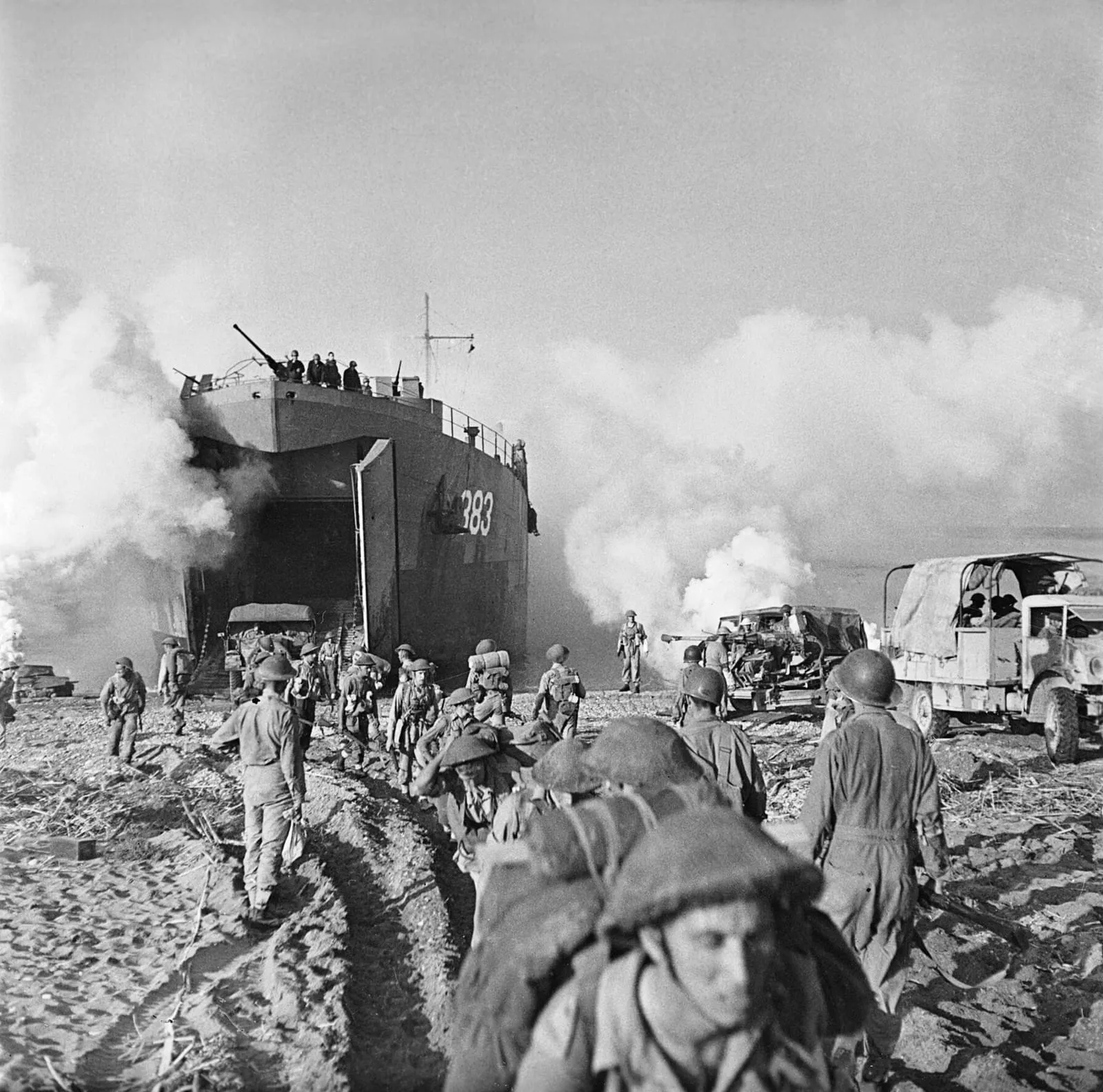
The Battle of Salerno, fought as part of the Allied amphibious operation codenamed Avalanche, was the first major landing by the Western Allies on the European mainland in the Second World War and the severest test their amphibious forces faced before Normandy. On the night of 8–9 September 1943 – just a few hours after Italy’s surrender had been announced – the American-British Fifth Army of General Mark Clark landed on the beaches of the Gulf of Salerno, some 50 kilometres south-east of Naples. The troops, who had heard of the Italian armistice aboard ship, expected an easy landing. Instead they ran into a determined defence by the German 16th Panzer Division and, a few days later, a counter-offensive by the whole German Tenth Army, which on 13 September brought the beachhead to the brink of disaster. Clark then ordered plans to be drawn up for re-embarking part of his forces. The beachhead was saved by field artillery, naval gunfire, massed air attacks and the dropping of paratroopers, and on 16 September, as patrols of the British Eighth Army approached from the south, the Germans broke off the battle.
Name and dates
The codename Avalanche covered the whole landing in the Gulf of Salerno and the fighting to hold the beachhead. It was one of three Allied entries into the Italian peninsula in early September 1943: on 3 September the British Eighth Army crossed the Strait of Messina into Calabria (Operation Baytown), and on 9 September, simultaneously with Salerno, the British 1st Airborne Division was landed from warships in the port of Taranto (Operation Slapstick).
The battle is taken to have begun on 9 September 1943 – the first landing craft reached the shore at around 3.30 a.m. Its end is taken to be 16 September: on that day patrols of the Eighth Army met troops of the Fifth Army south of the beachhead, and the commander of the German Tenth Army, General Heinrich von Vietinghoff, proposed to Kesselring that the battle be broken off and a withdrawal begun (approval reached him on the night of 16–17 September). Some historians date the battle up to 18 September, when the Germans actually began to disengage from the beachhead, or even to the capture of Naples on 1 October.
Background
After the conquest of Sicily in August 1943 the Allies had to decide what to do next. As early as May, at the Trident Conference in Washington, they had agreed that after Sicily Italy should be knocked out of the war, although the Americans regarded the Mediterranean as a secondary theatre compared with the planned landing in France. The overthrow of Mussolini on 25 July and secret talks with the government of Marshal Pietro Badoglio hastened the decisions. In August, at the Quebec Conference, Roosevelt and Churchill approved the plan for a landing on the mainland, and on 3 September the armistice with Italy was signed at Cassibile, to be announced on the eve of the landing.
The Allied Commander-in-Chief in the Mediterranean, General Dwight Eisenhower, entrusted the landing to Mark Clark’s US Fifth Army, which came under General Harold Alexander’s 15th Army Group. The objective was Naples – the largest port in southern Italy and essential for supplying an army on the mainland. The Gulf of Salerno was chosen above all because it lay at the limit of the range of Spitfire fighters flying from Sicily; beaches closer to Naples, in the Gulf of Gaeta, were out of their reach. The flat plain of the Sele and the long sandy beaches favoured unloading, but the mountains that ringed them in a semicircle gave the defenders a perfect view over the entire beachhead. The plan was prepared in haste, in about 45 days, and for lack of shipping the Fifth Army could put only three divisions into the first wave – less than half the force used in Sicily.
At the same time, on 3 September, Bernard Montgomery’s British Eighth Army crossed the Strait of Messina in Operation Baytown. It was to tie down the Germans in Calabria and march north, but more than 300 kilometres of mountain roads, systematically demolished by the retreating Germans, separated it from Salerno. A drop by General Matthew Ridgway’s US 82nd Airborne Division was also planned – first on the passes above Salerno, then, in Operation Giant II, on the airfields near Rome, where the paratroopers were to support the Italians. The latter operation was cancelled at the last moment, on 8 September, when it became clear that the Italians were unable to secure the airfields.
The Germans expected a landing. From the end of July they had been moving division after division into Italy, and in case of Italian betrayal they had Operation Achse ready. Northern Italy was commanded by Field Marshal Erwin Rommel (Army Group B), the south by Field Marshal Albert Kesselring. On 22 August General Heinrich von Vietinghoff’s Tenth Army was formed under Kesselring, with two corps: XIV Panzer Corps (commanded in an acting capacity by General Hermann Balck) with the Hermann Göring Panzer-Parachute Division, the 15th Panzergrenadier Division and the 16th Panzer Division, and General Traugott Herr’s LXXVI Panzer Corps with the 26th Panzer Division, the 29th Panzergrenadier Division and the 1st Parachute Division. Kesselring considered the Gulf of Salerno one of the most likely landing sites, and it was there that General Rudolf Sieckenius’s 16th Panzer Division was positioned.
Opposing forces
The Fifth Army consisted of two corps. North of the Sele, between Salerno and the river mouth, General Richard McCreery’s British X Corps landed with the 46th and 56th Infantry Divisions; its left flank was covered by three battalions of US Rangers under Lieutenant Colonel William Darby, who landed at Maiori, and by Brigadier Robert Laycock’s British commandos (No. 2 Commando and No. 41 (Royal Marine) Commando) at Vietri sul Mare. They were to seize the passes of the Sorrento peninsula, through which the roads to Naples ran. South of the Sele, near the ruins of the Greek city of Paestum, General Ernest Dawley’s US VI Corps landed with General Fred Walker’s 36th (“Texas”) Infantry Division, which had never been in action; General Troy Middleton’s 45th Infantry Division formed the floating reserve. In all, with the follow-up units and the 82nd Airborne Division, the Fifth Army was to have eight divisions at its disposal in the course of the battle.
The sectors of the two corps were separated by some ten to twenty kilometres and the bed of the Sele, and at first no forces were assigned to fill this gap. Another weakness of the plan was the decision not to precede the landing on the American beaches with a naval bombardment: the commanders were counting on surprise, although Admiral Hewitt warned that it could not be achieved in the gulf. The British carried out a short bombardment on their beaches.
The naval forces – the Western Naval Task Force, numbering more than 600 warships, transports and landing craft – were commanded by Vice Admiral Henry Kent Hewitt from the flagship USS Ancon, which also carried Clark. Cover from seaward was provided by Vice Admiral Algernon Willis’s British Force H, with battleships and aircraft carriers, under the command of the Commander-in-Chief Mediterranean, Admiral Andrew Cunningham. Because land-based aircraft from Sicily could stay over Salerno for only a quarter of an hour or so, Seafires from the carrier HMS Unicorn and four escort carriers (Rear Admiral Philip Vian’s Force V) also operated over the beaches.
On the German side only the 16th Panzer Division met the first blow. Sieckenius deployed it in four battle groups, a few kilometres inland, on the hills commanding the plain; the Italian coastal batteries were disarmed or taken over by the Germans on the evening of 8 September, after the armistice was announced. The remaining divisions of the Tenth Army were around Naples, Gaeta and in Calabria and still had to reach the battlefield – short of fuel and under constant air attack.
Course: the landing (9 September)
The convoys sailed from ports in North Africa and Sicily on 3–6 September. On the evening of 8 September, while they were already at sea, the troops heard Eisenhower’s radio announcement of Italy’s surrender. Many concluded that the landing would be a walkover – officers tried in vain to dampen this mood. That same night the Germans began disarming the Italian units around the gulf and occupied their positions.
At around 3.30 a.m. on 9 September the first waves of infantry reached the beaches. A much-repeated story attaches to the 36th Division’s units at Paestum, according to which German loudspeakers on the shore called out in English: “Come on in and give up. We have you covered”; the account comes from participants’ memoirs and cannot be confirmed with certainty. What is certain is that from the first minutes the Americans came under fire from artillery, mortars and tanks, directed from observation posts on Monte Soprano. The landing ship LST 336 took 18 hits, some landing craft turned back, and the 141st Infantry Regiment was unable to get off the beach all day. The 142nd and 143rd Regiments fared better. The crisis was overcome only when minesweepers had cleared the inshore waters and destroyers could close to within a hundred metres of the shore, and the cruisers USS Philadelphia and Savannah began shelling the German tanks.
In the British sector the Rangers and commandos landed almost unopposed and seized the passes above Maiori and Vietri, and the commandos took Salerno itself after a fight. The 46th and 56th Divisions, by contrast, had to fight their way ashore under fire and with the help of naval gunfire; the 56th Division captured Montecorvino airfield but not the hills above it, so the airfield remained within range of German guns and was useless for many days. From dawn the Luftwaffe attacked the beaches and the ships. By the end of the first day the Fifth Army held two separate beachheads a few kilometres deep, but had nowhere reached its assigned objectives, and a gap still yawned between the corps along the Sele.
Course: the struggle to expand the beachhead (10–12 September)
For the next three days both sides were racing against time. The Allies tried to widen the beachhead and link up the two corps; the Germans tried to hold the hills and bring up reinforcements. On 10 September British fusiliers of the 56th Division took Battipaglia, a road junction at the mouth of the Sele valley, but the very next day they were driven out by German counter-attacks. Clark, who visited the front on 10 September, concluded that X Corps would not be able to break through eastwards quickly and join hands with the Americans. He therefore moved VI Corps’ boundary north of the Sele and committed most of Middleton’s 45th Division to the gap, but as a result the American forces were stretched along a broad, shallow front.
German reinforcements arrived piecemeal – fuel and transport were short and the roads were being bombed – and were immediately formed into improvised battle groups. The 29th Panzergrenadier Division and part of the 26th Panzer Division came up from Calabria, the Hermann Göring Division and elements of the 15th Panzergrenadier Division from around Naples, and Kesselring released part of the 3rd Panzergrenadier Division from around Rome as soon as it became clear that the Italian forces near the capital no longer posed a threat. Allied reinforcements, meanwhile, arrived according to a pre-arranged timetable and were limited by the number of ships.
The Luftwaffe was more active over Salerno than it had been anywhere for months. In 36 hours the flagship Ancon sounded more than thirty air-raid alerts. On 11 September German Dornier Do 217 bombers used a new weapon against the ships – the Fritz X radio-guided glide bomb. One of them pierced a gun turret of the cruiser USS Savannah, killing nearly 200 sailors; the ship was brought to Malta only with difficulty. Two days later a similar bomb badly damaged the British cruiser HMS Uganda. The carriers, which were to have left after the first day, stayed off Salerno longer because Montecorvino airfield was still under fire and could not receive fighters.
On 12 September X Corps went over to the defensive – all its battalions were in the front line and it had no reserves left. In the south the 36th Division advanced towards the hills around Altavilla, but around midday a counter-attack by the 29th Panzergrenadier Division shattered the 1st Battalion of the 142nd Regiment. That day Clark moved his headquarters ashore. Alexander reported that the Fifth Army was badly short of infantry on land.
Course: the crisis (13–14 September)
On 13 September Vietinghoff launched his main counter-offensive. Battle groups of the Hermann Göring Division struck the northern flank of X Corps, but the main weight fell on the junction of the two corps, in the Sele valley, and on the Americans. In the morning the 36th Division captured Altavilla, but by nightfall it had been driven out. In the afternoon two German battle groups set off from Persano, overran the 1st Battalion of the 157th Regiment of the 45th Division, crossed the Sele and almost destroyed the 2nd Battalion of the 143rd Regiment. Tanks and panzergrenadiers pushed deep into the corridor between the Sele and its tributary the Calore, towards beaches that were only a few kilometres away.
The attack was halted at the confluence of the two rivers. Two field artillery battalions of the 45th Division fired over open sights at the tanks, warships shelled the approaches, and Walker put gunners, drivers, cooks, clerks and anyone else he could gather into a makeshift defensive line. At Fifth Army headquarters, meanwhile, plans were being prepared for the worst case: moving Clark’s headquarters to a ship (Operation Brass Rail) and evacuating an entire corps and shifting it to the other beachhead (“Sealion” for X Corps, “Seatrain” for VI Corps). Hewitt halted unloading in the American sector in order to make landing craft ready. McCreery and Cunningham protested, and the sailors explained that an evacuation from a beach under fire would be practically impossible. Under pressure from both superiors and subordinates Clark remained ashore; he later denied having seriously considered withdrawing his troops, but the episode long weighed on his reputation.
On the evening of 13 September Clark asked Ridgway for immediate help. That same night around 1,300 paratroopers of Colonel Reuben Tucker’s 504th Parachute Infantry Regiment jumped over the beachhead, guided by radio beacons, and at dawn went into the line on the right flank of VI Corps. The following night around 2,100 men of Colonel James Gavin’s 505th Regiment were dropped. The 509th Parachute Battalion was less fortunate: some 600 of its men were dropped on the night of 14–15 September around Avellino, behind German lines, to hamper the movement of reinforcements; scattered over a wide area, the battalion had no effect on the course of the battle and suffered heavy losses.
On 14 September the Germans renewed their attacks, probing for a weak spot, but the shortened and reinforced American line held, and German tank losses were high. The commander of the Allied air forces in the Mediterranean, Air Chief Marshal Arthur Tedder, threw every available aircraft into supporting the Fifth Army, including the heavy strategic bombers, which bombed Battipaglia, Eboli and the approach roads – more than a thousand tons of bombs were dropped in the course of the day. In the afternoon the last regiment of the 45th Division came ashore and Clark could now keep it in reserve, a sign that the worst was over.
Course: the turning point and the link-up with the Eighth Army (15–18 September)
On 15 September the bombers and warships kept up their fire with almost the same intensity as the day before. The British battleships HMS Warspite and Valiant appeared off the beaches with their 15-inch (381 mm) guns; although their salvoes made up only a small part of the total weight of naval fire, they raised the spirits of the troops ashore. That day Alexander visited the beachhead, and in the British sector the 7th Armoured Division – the famous “Desert Rats” – began to come ashore. The 325th Glider Infantry Regiment of the 82nd Division was also landed from the sea.
That day Kesselring reported to the Wehrmacht high command that Allied superiority in the air and at sea had forced LXXVI Panzer Corps onto the defensive and that the outcome of the battle depended on a final attack by XIV Corps; if that too failed, the Tenth Army would have to break off the fighting so as not to be crushed. On 16 September battle groups of the Hermann Göring Division made one more attack on X Corps, without success. Among those killed in this fighting was Captain Henry Wellesley of No. 2 Commando, then Duke of Wellington. That same day Fritz X bombs hit the battleship Warspite: one exploded in a boiler room, while another, a near miss, tore open her side. Without propulsion, the ship was towed to Malta.
On 16 September Vietinghoff reported to Kesselring that he was unable to neutralise the superiority of Allied air power and naval gunfire, and that the Eighth Army approaching from the south threatened to outflank him. He proposed breaking off the battle and withdrawing, anchoring his right wing on the mountains above Salerno. Kesselring gave his consent on the night of 16–17 September. From 18 September the Germans began methodically disengaging from the beachhead, covered by rearguards and road demolitions, towards a prepared line on the Volturno.
Under pressure from Alexander, who on 10 and 12 September urged Montgomery to speed up his advance and tie down the Germans, the Eighth Army sent light forces ahead along the Calabrian coast. On 16 September patrols of its 5th Infantry Division made contact with patrols of the US 36th Division south of the beachhead, near Vallo di Lucania. The first to cover that route, in fact, were war correspondents, who had got ahead of the troops on their own initiative. The main body of the Eighth Army, however, was still far away, and the battle was decided by the Fifth Army itself with the help of the air forces and the navy. Montgomery later presented his advance as an important factor in saving the beachhead; most historians regard his role as secondary – the Eighth Army’s haste contributed to the German decision to withdraw rather than to repelling their attack.
Meanwhile, behind the beachhead, an incident occurred that became known in Britain as the Salerno mutiny. On 16 September several hundred veterans of the 50th and 51st Divisions, brought from Tripoli in the belief that they were returning to their own units, refused to be posted as replacements to the 46th and 56th Divisions. After the intervention of McCreery, who admitted that a mistake had been made, most of them complied, but 192 soldiers were court-martialled in Algeria; all were found guilty and three sergeants were sentenced to death. The sentences were commuted to penal servitude and then suspended.
After the Germans had gone, the Fifth Army moved off towards Naples on 19 September. On 20 September Clark relieved the commander of VI Corps, Ernest Dawley, whom he – like Eisenhower and Alexander, who had visited the front – considered too indecisive in the critical days; he was replaced by General John P. Lucas. The British fought their way through the passes of the Sorrento peninsula, and on 1 October Allied troops entered a devastated Naples, whose inhabitants had risen against the Germans a few days earlier. The port, wrecked by the Germans, was put back into operation by the Allies within a few weeks.
Losses
Casualty figures vary depending on the time frame adopted. According to the tallies cited by, among others, the American historian Rick Atkinson, the Fifth Army’s losses in Operation Avalanche came to about 12,500 men: around 2,000 killed, 7,000 wounded and 3,500 missing (mostly captured or killed). The greater part was borne by the British X Corps, which according to British figures had lost more than 6,000 men by mid-September. The strength of the Allied forces in the beachhead had risen to about 190,000 by 16 September. The Germans, who committed elements of six divisions (about 100,000 men), lost about 3,500 men according to the same estimates, including several hundred killed, as well as a considerable number of tanks, destroyed mainly by artillery and naval gunfire. At sea, bombs, including guided Fritz Xs, hit several dozen Allied vessels; a few ships were sunk, among them the hospital ship Newfoundland, while the cruisers Savannah and Uganda and the battleship Warspite were put out of action for many months.
Significance
Salerno was the Western Allies’ first victory on the European mainland, but a victory won with difficulty and at a heavy price. The beachhead gave the Allies Naples and, together with the simultaneous capture of Taranto, Bari and Brindisi and the Foggia airfields, bases from which they could supply their armies in Italy and bomb southern Germany, Austria and the Balkans. Italy’s surrender and the Allied entry onto the mainland forced the Germans to take over the defence of the entire peninsula as well as the Italian occupation zones in the Balkans and in France.
The battle exposed weaknesses in planning and command. The landing was spread over too wide a front, with too few troops and a gap between the corps, and without a preliminary bombardment on the American beaches; hopes that Italy’s surrender would open the road to Naples or even Rome proved illusory. Clark emerged from the battle with the reputation of a commander who had not lost his head under pressure, but also with an image tarnished by the evacuation plans; the removal of Dawley was the first of several controversial personnel decisions in the Fifth Army. The lessons of Salerno – especially regarding the importance of naval gunfire, tactical air power and the rapid commitment of reserves to a beachhead – were applied in planning the subsequent landings at Anzio and in Normandy.
For the Germans the battle was a defensive success. Vietinghoff inflicted markedly heavier losses on the Allies than he suffered himself and withdrew the Tenth Army in good order. Hitler, who had initially been inclined to give up southern and central Italy and make a stand only in the Apennines, became convinced that Kesselring could stop the Allies far to the south. In November 1943 he gave him command of the whole of Italy and transferred Rommel to France. In the months that followed the Germans defended one line after another – the Volturno, Barbara, Bernhardt and Gustav Lines – and the Italian campaign turned into a slow, bloody war of attrition in the mountains, with the battles of Monte Cassino and Anzio, which lasted until the surrender of the German forces in Italy on 2 May 1945.