United States
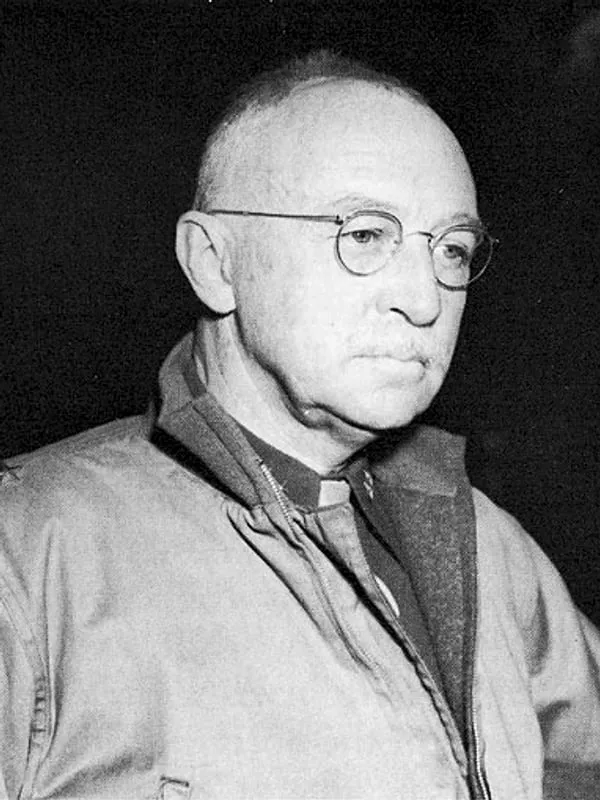
John P. Lucas
Commander of the 3rd Infantry Division (1941–1942), III Corps (1942–1943), VI Corps (1943–1944) and the Fourth Army (from 1944), Major General (1941)
- Born:
- 14 January 1890, Kearneysville (West Virginia, United States)
- Died:
- 24 December 1949, Great Lakes (Illinois, United States)
- Author:
- Łukasz
- Photo:
- autor nieznany, domena publiczna, Wikimedia Commons

John Porter Lucas, known in the army as “Old Luke”, was a career officer who throughout his service was regarded as a dependable, thoughtful and well-liked commander – and who went down in history above all as the general of Anzio. In January 1944 his VI Corps landed behind the German Gustav Line with complete surprise, but instead of driving inland he consolidated a beachhead that the Germans soon sealed off. A month later he was relieved. To some he became the symbol of a squandered opportunity; to others, a scapegoat made to carry the blame for an ill-conceived operation.
A Virginian from West Point
He was born on 14 January 1890 in Kearneysville, Jefferson County, West Virginia, into a family that had been settled in the area for generations. After local schools he entered the Military Academy at West Point, graduating in 1911 55th in a class of 82. He was commissioned into the cavalry and spent his first years of service in the Philippines.
In 1914 he returned to the United States and joined the 13th Cavalry Regiment, which was guarding the Mexican border. On the night of 8–9 March 1916 the forces of Pancho Villa raided the small town of Columbus, New Mexico, where the regiment was stationed. Lieutenant Lucas, roused from sleep, made his way barefoot and alone through the raiders from his quarters to the guard tent, organised a defence with a single machine gun and held on until the rest of his unit arrived, then led it in driving off the attack. He took part in General John Pershing’s punitive expedition into Mexico and afterwards served as aide to General George Bell.
The Great War and the interwar years
When the United States entered the First World War, Lucas served under Bell in the 33rd Infantry Division, which was being formed in Texas from the Illinois National Guard. In January 1918 he was promoted to major and given command of the division’s signal battalion, with which he sailed to France. On 23 June 1918, near Amiens, he was badly wounded by a fragment of a German shell – the first casualty in his battalion. He was treated in England and the United States and never returned to the division.
After the war he taught military science at the University of Michigan in Ann Arbor, and in 1920 he transferred from the cavalry to the field artillery, where he spent the rest of his career. He completed the artillery school at Fort Sill and stayed on there as an instructor, graduated from the Command and General Staff School at Fort Leavenworth in 1924, and then spent five years teaching at Colorado Agricultural College in Fort Collins, where he also took a master’s degree. He commanded an artillery battalion at Fort Bliss, graduated from the Army War College in Carlisle in 1932, and from 1932 to 1936 worked in the personnel division of the General Staff in Washington. He was known for his love of polo – the polo field at Fort Sill now bears his name.
From division to corps
In May 1940 Lucas became a colonel and commander of the 1st Field Artillery Regiment at Fort Sill, and in October a brigadier general and artillery commander of the 2nd Infantry Division in Texas. The rapid expansion of the army before the United States entered the war brought him promotion to major general in August 1941 and command of the 3rd Infantry Division at Fort Lewis, with which he practised amphibious landings in Puget Sound. A few months later he took over III Corps in Georgia and spent more than a year there preparing units for service overseas.
In the spring of 1943 Dwight Eisenhower, an acquaintance from the interwar years, brought him to the Mediterranean as his personal deputy and observer. In that role Lucas followed the invasion of Sicily. After the disastrous parachute drops in which some of the transport aircraft were shot down by Allied anti-aircraft fire, he advised Eisenhower to abandon airborne divisions as too large and too difficult to employ. In August 1943 Eisenhower sent him to Sicily, together with Brigadier General Frederick Blesse, to deal with the slapping incidents involving Patton; Lucas had long been a friend of George Patton, who in the end kept his command. In September he briefly commanded II Corps after Omar Bradley left for England.
On 20 September 1943, in the last days of the Battle of Salerno, General Mark Clark gave him command of VI Corps in place of the relieved Ernest Dawley. Lucas, six years Clark’s senior, was now subordinate to a commander of whom his diary did not always speak kindly. He led the corps through the crossing of the Volturno and the fighting for the Winter Line in the mountains, in rain, mud and cold. He looked after his men and disliked wasting their lives in frontal attacks, but his notes from those months show growing weariness and pessimism. In December the VI Corps staff was withdrawn from the line and assigned to the landing at Anzio.
Anzio
From the outset Lucas had no faith in Operation Shingle. He considered two divisions too few and the time for preparation – a few weeks – too short. He wrote in his diary that he was being put ashore with inadequate forces and would be landed in a jam, that the whole affair had “a strong odor of Gallipoli” and that “the same amateur” was still on the coach’s bench – a dig at Winston Churchill. By his own account, before the force sailed Clark advised him: “Don’t stick your neck out, Johnny.” His final orders told him to seize and secure a beachhead and then to advance “on” the Alban Hills – with no timetable.
On 22 January 1944 VI Corps landed at Anzio and Nettuno almost without loss. Lucas spent the following week landing troops and supplies and building up his defences while he waited for reinforcements. In that time Field Marshal Albert Kesselring gathered more troops around the beachhead than the Allies had managed to put ashore. A belated attack on Campoleone and Cisterna on 30 January broke down, and at Cisterna two Ranger battalions were killed or captured. In February the Germans went over to the counter-offensive; on 16–20 February, during Operation Fischfang, the beachhead came close to breaking and was saved only by massed fire from artillery, warships and aircraft.
The defence held, but the patience of Lucas’s superiors had run out. Churchill likened the landing to “a stranded whale”, and General Harold Alexander, commanding the Allied armies in Italy, concluded that Lucas was tired and too passive. On 22 February 1944 Clark relieved him of command of VI Corps, which passed to Major General Lucian Truscott, until then commander of the 3rd Division. For a few weeks Lucas was nominally Clark’s deputy, then returned to the United States, embittered and convinced that Clark and the British had made him a scapegoat.
The Anzio controversy
The verdict on Lucas is one of the most enduring controversies of the Italian campaign. His critics – led by Churchill, Alexander and many later historians – believe that he threw away a unique opportunity. In the first days after the landing the roads into the Alban Hills lay open, and a determined thrust could have cut the highways supplying the German Tenth Army at Cassino and forced Kesselring to withdraw. The British historian John Keegan wrote that Lucas achieved “the worst of both worlds”, exposing his own troops to risk without imposing any on the enemy.
Lucas’s defenders, among them the American historian Martin Blumenson, author of a monograph on the battle, and to some extent Truscott as well, reply that two divisions could not have held both the beach and hills more than 30 kilometres away. Columns pushed inland would have been cut off and destroyed by German reinforcements converging from every side, and a thinly held beachhead might have been thrown back into the sea. Lucas, moreover, carried out his orders as they were worded; it was Clark who did not demand that he march on the hills. The planners were responsible for the inadequate forces and the vague objective, and in the final reckoning the beachhead held and played its part in the May offensive. Most historians now take a middle position: the operation was ill-conceived, but a more energetic commander could at least have taken Cisterna and Campoleone before the Germans did, and could have better prepared the beachhead for a later breakout.
Last years
Despite his removal, Lucas received both the Army and the Navy Distinguished Service Medals and the Silver Star for the fighting in Italy. The Navy citation stressed that the two reinforced divisions of VI Corps had tied down as many as twelve enemy divisions at Anzio. In March 1944 he became deputy commander and then commander of the Fourth Army at Fort Sam Houston in Texas, which trained units for the front. He never returned to combat.
After the war, from 1946 to 1948, he headed the American military advisory group attached to the government of Chiang Kai-shek in Nanjing, while China was in the grip of civil war with the Communists. In 1948 he became deputy commander of the re-established Fifth Army in Chicago. He died suddenly, still on active duty, on 24 December 1949 in the naval hospital at Great Lakes near Chicago, at the age of 59. He was buried in Arlington National Cemetery.
Significance
Lucas was a typical member of the generation of officers who built the American army between the wars: conscientious, well educated, solicitous of his men, and better suited to training and administration than to improvisation on the battlefield. At Anzio he was handed an operation he did not believe in, with forces he considered too weak and orders that permitted caution. His decisions saved the beachhead from destruction but did not give the Allies what Churchill had expected. The dispute over whether he was guilty of wasting an opportunity or the victim of other men’s mistakes has made the name of a general who, Anzio aside, never suffered a defeat a byword in the historiography for excessive caution.
Sources
Commanded in battles
(01)Mentioned in battles
(01)Often appears with
People who appear in the same events.