Italy
Ugo Cavallero
Under-Secretary of State for War (1925–1928), commander of troops in Italian East Africa (1937–1939), Chief of the General Staff and of the Comando Supremo (1940–1943), Marshal of Italy (1942)
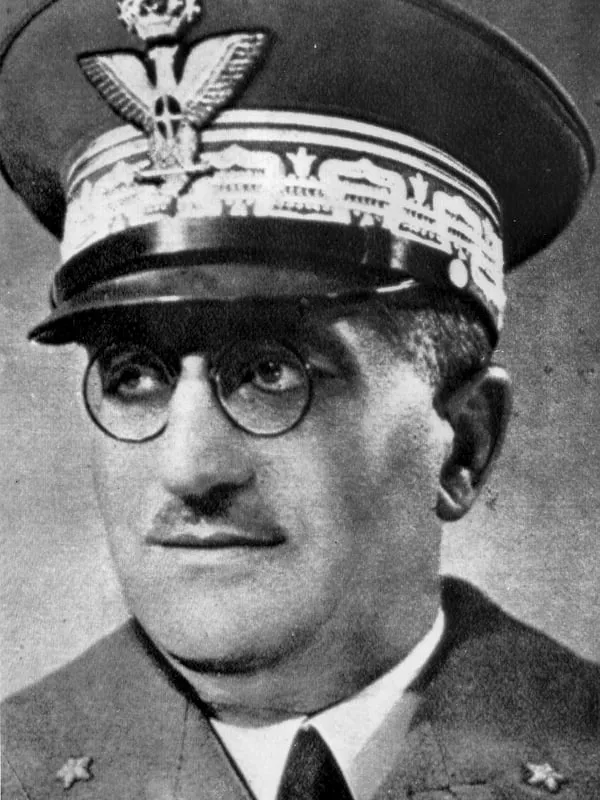
- Born:
- 20 September 1880, Casale Monferrato (Kingdom of Italy)
- Died:
- 14 September 1943, Frascati (Italy)
- Author:
- Łukasz
- Photo:
- autor nieznany, domena publiczna, Wikimedia Commons

Ugo Cavallero was the ablest and at the same time the most controversial of the generals who directed Fascist Italy’s war. A staff officer with a mathematical education and co-author of the plans for the victorious battles of 1918, later a politician, an armaments industry manager and a colonial commander in Ethiopia, he succeeded Marshal Pietro Badoglio as Chief of the General Staff in December 1940, at a moment when the Italian army was losing in Albania and in Africa at the same time. His enemies, led by Galeazzo Ciano, regarded him as a courtier who told Mussolini what he wanted to hear. Some historians see in him the only Italian commander who understood that the war in Africa would be decided by command of the sea. He died in September 1943 in circumstances that have never been explained.
Early life and the First World War
He was born on 20 September 1880 in Casale Monferrato in Piedmont, into the well-to-do family of Gaspare Cavallero and Maria Scagliotti. In 1898 he entered the military academy at Modena, from which he graduated in 1900 as a second lieutenant of infantry. He also studied mathematics at the University of Turin, had a good command of German and English, and in 1911 passed out of the war college at the top of his course.
During the Italo-Turkish War and the fighting against Arab resistance that continued after it, he served in Libya as a staff officer, and in 1913 he received the bronze medal for military valour. After Italy entered the First World War in May 1915 he was posted to the operations office of the Supreme Command (Comando Supremo), where he remained until the end of the war. After the defeat at Caporetto in the autumn of 1917 he became head of the operations office as a lieutenant colonel and a close collaborator of the deputy chief of staff, General Badoglio. He played a large part in drawing up the plans for the defence on the Piave in June 1918 and for the offensive that ended in victory at Vittorio Veneto in the autumn of 1918. At only thirty-eight he became a brigadier general, and in 1919 he represented Italy on the Inter-Allied Military Committee at Versailles.
Politician and industrialist
In 1920, convinced that with a surplus of senior generals he would not advance quickly, he went on the inactive list at his own request and took up a career in industry. Among other things he was a director of the Pirelli company. In these years he drew close to the Fascists, and in particular to Roberto Farinacci, one of the party’s most radical leaders.
In May 1925, when Mussolini took over the service ministries himself, he appointed Cavallero Under-Secretary of State for War. In practice it was Cavallero who ran the ministry, and together with Badoglio, Chief of the General Staff from 1925, he carried out the reorganisation of the army. In 1926 he became a senator, and in 1927 a major general. Co-operation with his former superior, however, soon turned into bitter rivalry. Cavallero is credited with the reform of 1927 that sharply curtailed the powers of the Chief of the General Staff. At one military ceremony the two generals publicly refused to salute each other. In 1928, at the instigation of King Victor Emmanuel III, Cavallero had to leave the government. As a parting gift he was made a count.
He returned to industry as chairman of the Ansaldo company in Genoa, one of the main manufacturers of ships, guns and armour plate. In 1933 he had to leave after a scandal: the armour plate supplied for one of the cruisers did not match the samples, whose markings had been falsified. His personal responsibility was never proved, but the affair dogged him for years. He then served as a delegate to the Disarmament Conference in Geneva.
Ethiopia
At the end of 1937 Cavallero returned to active service and became commander of the troops in Italian East Africa, conquered less than two years earlier after the capture of Addis Ababa. The country had not been pacified, and the new viceroy, Prince Amedeo, Duke of Aosta, wanted to replace the terror of Marshal Rodolfo Graziani’s rule with a policy of conciliation. Cavallero, meanwhile, largely against the viceroy’s wishes, conducted successive “operational cycles of grand colonial policing” against the Ethiopian resistance and abandoned attempts to negotiate with its leaders.
The most notorious of these actions was the sweep against the forces of Abebe Aregai in northern Shewa in the spring of 1939, planned by Cavallero and Colonel Orlando Lorenzini. As part of it, on 9–11 April 1939, Italian colonial troops and Alpini besieged the cave of Zeret (Gaja Zeret), in which wounded insurgents, old men, women and children had taken refuge. The cave was shelled by artillery and attacked with poison gas, and many of those who surrendered were shot. The death tolls given by researchers range from about 800 to more than 5,000. Earlier, in March, in the course of the same operations, aircraft had dropped bombs filled with mustard gas on the insurgents’ hideouts. For decades the massacre was forgotten in Italy; when in 2011 his home town named its public gardens after Cavallero, the decision provoked protests.
His disputes with the viceroy led to Cavallero’s recall to Italy in the spring of 1939. Mussolini, however, did not sideline him.
The Pact of Steel
After his return from Africa Cavallero became vice-chairman of the Italo-German military and economic commission established under the secret protocol of the Pact of Steel of 22 May 1939. In that capacity, at the beginning of June 1939, he took to Berlin Mussolini’s memorandum of 30 May, in which the Duce wrote that war with the Western powers was inevitable but that Italy would be ready for it only after 1942. When in August 1939 Hitler decided to strike at Poland, Rome invoked this memorandum and declared “non-belligerence”. In 1940 Cavallero was promoted to general of the army, but when in June Italy declared war on France and Britain he was given no command.
Chief of the General Staff
His opportunity came from the failure of others. When the attack on Greece turned into a disaster and the Greeks took Korçë, Mussolini looked for culprits, and when Cavallero’s old friend Farinacci attacked the General Staff in the press, Badoglio submitted his resignation on 26 November. On 4 December Mussolini accepted it and appointed Cavallero as his successor. According to the Italian biographical dictionary, he formally took up the post on 6 December.
The new chief of staff inherited a desperate situation. At the beginning of December the Greeks took Gjirokastër, and the commander of the troops in Albania, General Ubaldo Soddu, reported that further resistance was impossible. On 9 December the British launched Operation Compass in Egypt, which within two months destroyed Graziani’s army. Cavallero went to Albania and for several weeks supervised Soddu, and on 30 December he took command of the army group himself, combining it with the post of chief of staff. His duties in Rome were carried out by his deputy, General Alfredo Guzzoni. In those same weeks Rome asked Germany for help several times. On 19 December, on Mussolini’s orders, it was Cavallero who made an urgent request for military support to the German general at Italian headquarters, Enno von Rintelen.
In Albania Cavallero proved a better organiser than his predecessors. He put the chain of command in order, brought in new divisions and, at the end of January 1941, after the loss of the Klisura pass, halted the Greek offensive. He could not, however, turn the tide of the war. The spring offensive that he and Mussolini launched on 9 March 1941, hoping to win a victory with their own forces before the Germans arrived, collapsed after a fortnight or so with heavy losses. The outcome of the Greco-Italian War was decided by the German invasion of 6 April 1941. Cavallero used it to follow up the retreating Greeks and recover southern Albania as far as the Greek border, and his troops repulsed a Yugoslav attack on Shkodër and advanced along the Dalmatian coast to Dubrovnik.
The Comando Supremo
In May 1941 Cavallero returned to Rome and set about rebuilding the high command. A law of 27 June 1941 transformed the former General Staff, essentially an advisory body, into the Comando Supremo, a command with real authority over the chiefs of staff of the army, navy and air force. For the first time since entering the war, Italy had an institution capable of co-ordinating the operations of all the armed services.
Italy’s war, however, was now shaped by two factors that Cavallero could not change: the preponderance of Germany, which from February 1941 had its own corps in Libya under Erwin Rommel, and the will of Mussolini, which Cavallero seldom opposed. The most damaging consequence of this compliance was the dispatch of troops to the Eastern Front. Mussolini wanted to take part in the war against the Soviet Union, and in July 1941 he sent an expeditionary corps there, followed in 1942 by the whole Eighth Army.
Historians do, on the other hand, credit Cavallero with an accurate grasp of the nature of the war in North Africa. Between May 1941 and June 1942 he travelled to Libya thirteen times and understood that Rommel’s successes in the desert would remain fruitless as long as the British on Malta were sinking the supply convoys. From the end of 1941 he was the chief advocate of a landing on the island, called Operation C3 by the Italians and Herkules by the Germans, and prepared it with great energy. He often clashed with Rommel, who was formally his subordinate. At the end of April 1942 Hitler and Mussolini approved the plan, but when Rommel took Tobruk on 21 June they chose to pursue the enemy deep into Egypt, and the landing was postponed indefinitely. On 1 July 1942 Cavallero was made a Marshal of Italy, chiefly so that he would not be outranked by Rommel, who had received his field marshal’s baton a few days earlier. A few days later Rommel’s offensive came to a halt at El Alamein, partly because Malta was once again cutting the supply lines.
In the autumn of 1942, after the Second Battle of El Alamein and the Allied landings in North Africa in Operation Torch, Cavallero directed the evacuation of Libya and the improvised establishment of a bridgehead in Tunisia. On 31 January 1943, after the loss of Libya and the destruction of the army on the Don, Mussolini dismissed Cavallero and replaced him with General Vittorio Ambrosio. The dictator needed a scapegoat.
Downfall and death
After Mussolini was overthrown on 25 July 1943, the new prime minister, Marshal Badoglio, almost immediately had his old rival arrested, accusing him of preparing a Fascist coup. Released after the King intervened, Cavallero was arrested again on 23 August on a charge of involvement in a highly dubious plot and held in the military prison at Forte Boccea. There he dictated a lengthy memorandum to the head of military intelligence, General Giacomo Carboni, in which he claimed to have been conspiring against Mussolini since November 1942. The memorandum failed to convince Badoglio but compromised its author in the eyes of the Germans: when the King and the government fled Rome after the announcement of the armistice on 8 September, the document is believed to have been left on the prime minister’s desk, and it fell into German hands.
On 12 September 1943 the Germans, who had seized Rome, freed Cavallero and took him to the headquarters of Field Marshal Albert Kesselring, German Commander-in-Chief South, at Frascati. Kesselring, a personal friend, offered him on Hitler’s behalf the command of those Italian forces willing to go on fighting alongside Germany. Cavallero refused. On the morning of 14 September 1943 he was found dead, with a gunshot wound to the head, in the garden of the Hotel Belvedere at Frascati, on the very day he was to be taken to Munich. Some sources give the date of his death as 13 September.
The circumstances of his death are still disputed. The Germans presented it as suicide. Against this version it is pointed out that Cavallero was left-handed, while the wound was in his right temple. Historians leave open whether the marshal, facing deportation to Germany and compromised by his memorandum, took his own life or was killed by the Germans. All that is certain is that he had firmly refused any further collaboration with them. The Germans buried him with military honours.
Assessment
Cavallero’s record was a matter of dispute from the start. His harshest critic was Ciano, who in his diary portrayed him as a flatterer feeding Mussolini false figures on armaments production and accused him of enriching himself from the war. The Germans valued him as a partner, which tended to count against him in Rome. Lucio Ceva, author of his entry in the “Dizionario Biografico degli Italiani” and of a study of the Comando Supremo, considers Ciano’s criticism to have stemmed largely from a struggle for power, and credits Cavallero with merits that Badoglio lacked: an understanding of the war in the Mediterranean and of the importance of Malta, and the creation of an efficient high command. The same scholar nevertheless reproaches him for not standing up to Mussolini when he knew better: the ten divisions sent to Russia swallowed almost all of the army’s modern artillery and more than 16,000 vehicles, which were then lacking in Africa.
Cavallero is a figure characteristic of the Fascist military establishment: in Ethiopia he took part in colonial violence, chemical weapons included, and in December 1940 he became the executor of Italy’s transition from a “parallel war” to a war waged on Germany’s terms. His diary for 1940–1943, published in 1948 under the title “Comando Supremo”, is one of the basic sources for the history of Italy’s war.
Sources
Commanded in battles
(01)Mentioned in battles
(08)Often appears with
People who appear in the same events.
On the timeline
(30)1939
1940
1941
January
- 19
- The British offensive in East AfricaOn 19 January 1941 British and Indian troops entered Kassala, abandoned by the Italians, and pushed into Eritrea. The offensive on Italian East Africa began.
- Hitler and Mussolini meet at the BerghofIn January 1941 Mussolini, beaten in Libya and Albania, met Hitler at the Berghof. He was promised troops for Libya but told nothing of plans against the USSR.