Battle of Dunkirk
- Dates:
- 26 May – 4 June 1940
- Front:
- Western Front
- Location:
- Dunkirk and its surroundings in French Flanders and the Belgian coast: the perimeter along the canals from Gravelines through Bergues and Furnes (Veurne) to Nieuport (Nieuwpoort), the beaches of Malo-les-Bains, Bray-Dunes and De Panne, the line of retreat from the Lille and Ypres area, and the waters of the Strait of Dover and the southern North SeaOn the battle map →
- Sides:
- United KingdomLord Gort, Bertram Ramsay, Harold AlexanderFranceJean-Marie Abrial, Georges BlanchardNazi GermanyGerd von Rundstedt, Fedor von Bock
- Result:
- The Germans took Dunkirk and captured 30,000–40,000 troops, mostly French, but the Allies evacuated 338,226 men to England, including the core of the British Army.
- Author:
- Natalia
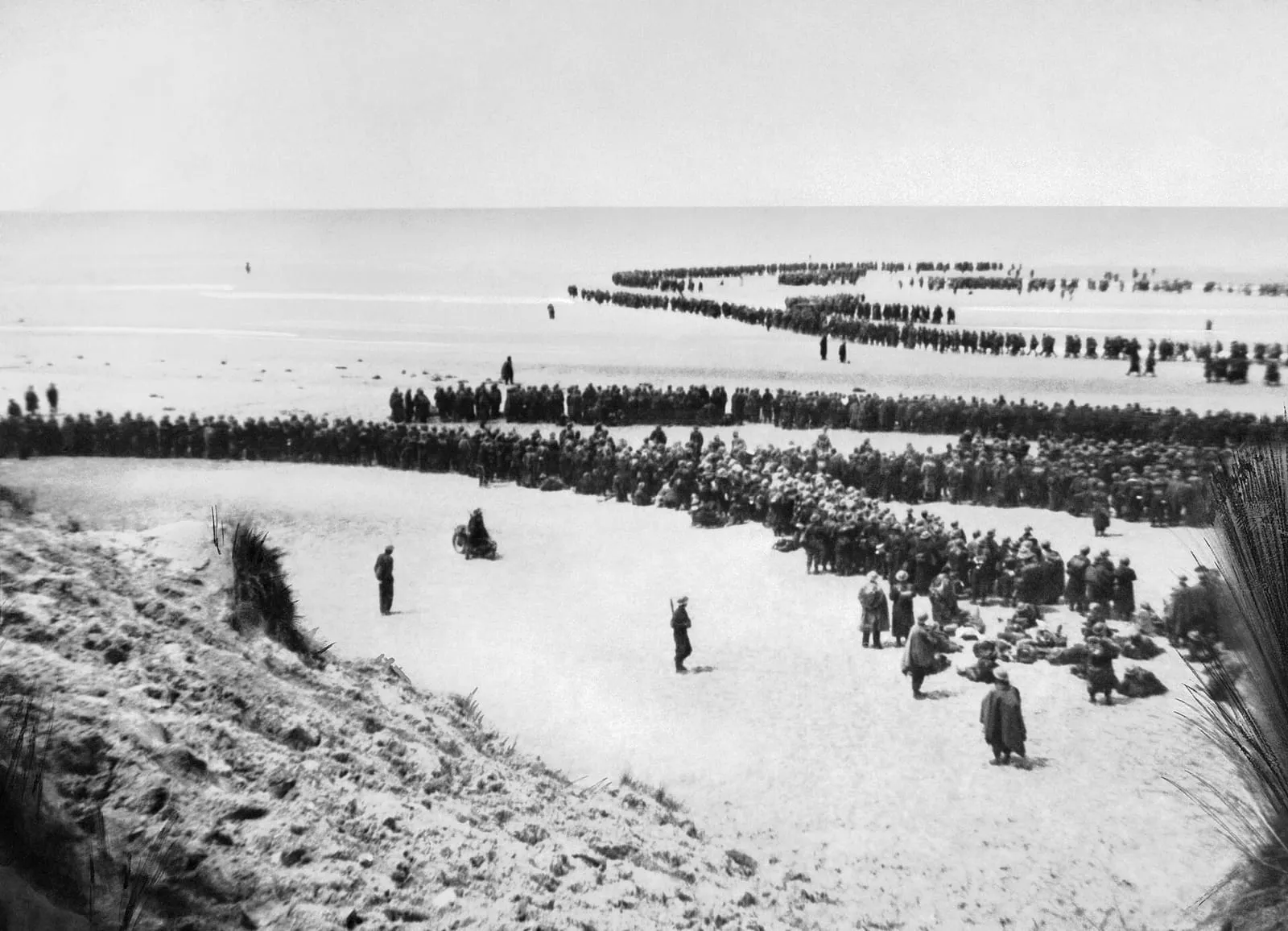
The Battle of Dunkirk was the final act of the first phase of the campaign in the West and one of the most famous operations of the Second World War. At the end of May 1940 the British Expeditionary Force, the remnants of the French First Army and other units of the 1st Army Group, and the crumbling Belgian front were cut off by German panzer divisions from the rest of France and pushed back towards the sea. The only way out was the port of Dunkirk and the beaches stretching east of it. On the evening of 26 May the Admiralty ordered the start of Operation Dynamo, directed from Dover by Vice-Admiral Bertram Ramsay. For nine days Royal Navy warships, merchant ships, fishing boats and hundreds of small private craft ferried troops across the Channel, while British and French units held the perimeter along the canals around the town under incessant Luftwaffe attack. When the operation ended on 4 June, 338,226 men had reached England, many times more than anyone had expected. Left behind on the beaches, however, were all the British Army’s heavy equipment and tens of thousands of French rearguard troops, who went into captivity. Winston Churchill called the evacuation “a miracle of deliverance”, but at once added that “wars are not won by evacuations”.
Name and dates
In Britain the word “Dunkirk” means above all the evacuation, that is, Operation Dynamo. The name came from a room in the tunnels cut into the cliffs beneath Dover Castle that had housed an electrical generator during the First World War (the dynamo room) and in 1940 accommodated Ramsay’s command post. The French speak of the Battle of Dunkirk (bataille de Dunkerque), stressing the fight of the French divisions that covered the perimeter to the end. German communiqués presented the closing of the pocket in Flanders as the greatest battle of encirclement of all time.
The battle is taken to begin on 26 May 1940. That day the Secretary of State for War, Anthony Eden, authorised Lord Gort to withdraw the army towards the coast for evacuation; at 6.57 p.m. the Admiralty signalled Dover to begin Operation Dynamo; and Adolf Hitler allowed his panzer divisions to resume the advance halted since 24 May. It ended on 4 June: in the morning the Germans entered Dunkirk and accepted the surrender of the last defenders, and at 2.23 p.m. the Admiralty announced the end of the operation. Some studies date the evacuation from 27 May, the first full day of sailings (the figure of 338,226 evacuees is likewise given for 27 May – 4 June), while others include the removal of rear-echelon troops from Dunkirk from 20 May onwards.
Background
On 10 May 1940 Germany attacked the Netherlands, Belgium, Luxembourg and France. In line with the Dyle Plan, the best Allied armies, including the divisions of Lord Gort’s British Expeditionary Force (BEF), advanced into Belgium to stop General Fedor von Bock’s Army Group B. The main blow, however, came further south. The panzer divisions of General Gerd von Rundstedt’s Army Group A passed through the Ardennes, in line with Erich von Manstein’s concept, broke through the front at Sedan on 13 May and on 20 May reached the English Channel at Abbeville. The Allied armies in the north – the BEF, General Georges Blanchard’s French First Army and the Belgian army – were cut off from the main French forces.
The new Commander-in-Chief, General Maxime Weygand, who had replaced Gamelin on 19 May, planned simultaneous attacks from the north and the south to sever the German wedge. The British counter-attack at Arras on 21 May gave the Germans a fright but was not followed up, and the attack from the south never came. On 23 May General Gaston Billotte, the co-ordinator of the Allied forces in the north, died after being injured in a car accident two days earlier, and his place at the head of the 1st Army Group was taken by Blanchard, who no longer had either the time or the means to master the situation. As early as 19 May Gort had begun to reckon with a retreat to the sea, and from 20 May the Admiralty at Dover, on Churchill’s instructions, was gathering shipping and planning an evacuation, at that stage still regarded as a last resort.
On 24 May the German tanks stood on the line of the Aa Canal, a dozen or so kilometres from Dunkirk, when Hitler, on Rundstedt’s advice, confirmed the halt order. The aim was to spare the exhausted panzer divisions from fighting in the marshy terrain of Flanders and to preserve them for the second part of the campaign, against the rest of France. Hermann Göring assured Hitler that his air force alone would destroy the encircled forces. On 25 May Boulogne fell. That same evening, as the Belgian front began to collapse in the north, Gort on his own responsibility withdrew two divisions earmarked for the attack southwards and threw them north to close the gap between Ypres and the Ypres–Comines canal. This decision, contrary to Weygand’s plan, saved the BEF from being cut off from the sea. On 26 May Britain held a National Day of Prayer, and King George VI attended a service in Westminster Abbey.
Forces and plans
Several hundred thousand Allied troops were caught in the pocket: the main body of the BEF with its rear-echelon units and a dozen or more French divisions, mainly of the First Army, as well as General Bertrand Fagalde’s XVI Corps, which defended the approaches to Dunkirk from the west. On the evening of 26 May the pocket was a corridor some hundred kilometres long and several dozen wide, reaching from the coast to the area of Lille. On Gort’s orders General Ronald Adam, commander of the British III Corps, and General Fagalde prepared a semicircular perimeter around Dunkirk along the canals, from Gravelines through Bergues and Furnes to Nieuport on the Belgian coast. The French held the western sector, the British the eastern. The ground, criss-crossed by canals and ditches, had been partly flooded by opening the sluices and was unsuitable for tanks.
Naval command at Dunkirk was exercised by Admiral Jean-Marie Abrial, commander of the French naval forces in the north (Amiral Nord), whose headquarters was in “Bastion 32”, a casemate of the old town fortifications. The British at first did not tell him of their intentions. On the British side the evacuation was directed by Ramsay, Flag Officer Dover, and on the spot by his representative, Captain William Tennant, sent over on 27 May with a party of officers and ratings as Senior Naval Officer Dunkirk. The original plan assumed that some 45,000 men could be lifted in two days before the Germans closed the port.
From the east the pocket was attacked by the armies of Bock’s Army Group B: the Sixth Army and General Georg von Küchler’s Eighteenth Army, which at the end of May took over the siege of the perimeter. To the west and south stood the panzer and motorised groups of Ewald von Kleist, including Heinz Guderian’s corps, and the Fourth Army of Rundstedt’s Army Group A. In the air were General Albert Kesselring’s Air Fleet 2 and General Wolfram von Richthofen’s VIII Air Corps with its Ju 87 dive bombers. On the other side of the Channel stood the RAF’s Fighter Command, which covered the evacuation from airfields in England with Hurricane, Spitfire and Defiant fighters, but could not maintain a constant presence over the beaches.
Course of the battle: the retreat into the perimeter (26–28 May)
The halt order was rescinded on the afternoon of 26 May, and the German tanks moved off again on the morning of 27 May. That same day, 26 May, Calais capitulated; its defenders under Brigadier Claude Nicholson had tied down a German panzer division for several days. The two-day pause, however, had been enough for the Allies to man the canal line and strengthen strongpoints such as Cassel, Hazebrouck and Wormhout, which covered the retreat of the main forces from the south. On 26 May Gort and Blanchard agreed to withdraw behind the Leie (Lys). The British 2nd Division, defending the corridor from the south, was worn down to the strength of a brigade, but it allowed other divisions and part of the French First Army to get through.
27 May was one of the hardest days for the defenders. In a dozen or so raids the Luftwaffe set fire to Dunkirk’s oil tanks and wrecked the port installations. Thick smoke hung over the town for many days. An estimated thousand or so inhabitants were killed. On the eastern flank General Alan Brooke’s II Corps, with General Bernard Montgomery’s 3rd Division, beat off an attack by three German divisions on the Ypres–Comines canal and at Wytschaete on 27 and 28 May. Traffic jams on the roads of retreat, especially at the bridge in Poperinge, were bombed, and the retreating units abandoned and destroyed vehicles, guns and stores.
At the southern end of the corridor SS troops committed two war crimes. On 27 May at Le Paradis a company of the SS Totenkopf Division machine-gunned 97 prisoners of the 2nd Battalion, Royal Norfolk Regiment, against a barn wall; they had surrendered after running out of ammunition. Two survived. The company commander, Fritz Knöchlein, was sentenced by a British military court in 1948 and hanged in January 1949. On 28 May men of the 2nd Battalion of the Leibstandarte SS Adolf Hitler regiment herded a group of prisoners from the Royal Warwickshire Regiment, the Cheshire Regiment and the Royal Artillery, together with a few Frenchmen, into a barn near Wormhout, then threw grenades among them and opened fire. Some 80 men died; the figures given in the sources range from about 80 to about 90. The battalion commander, Wilhelm Mohnke, was held responsible; he denied the accusations and never stood trial.
At 4 a.m. on 28 May the guns fell silent on the Belgian front. King Leopold III capitulated unconditionally, having earlier warned the Allies that his army was at the limit of its endurance, but without agreeing the decision itself with them. A gap more than 30 kilometres wide opened between Ypres and the sea. Brooke closed it by shifting the exhausted 3rd, 4th and 50th Divisions along the canals towards the coast. At Nieuport the armoured cars of the 12th Lancers got there ahead of the Germans. At the same time, also on 28 May, five divisions of the French First Army were encircled around Lille. Under General Jean-Baptiste Molinié they held out until the night of 31 May – 1 June, tying down several German divisions, including panzer divisions. When some 35,000 French troops finally laid down their arms in Lille, the Germans granted them the honours of war. The commander of the First Army, General René Prioux, was captured on 29 May at his headquarters in Steenwerck.
Course of the battle: the beaches, the mole and the little ships
The first day of sailings was a disappointment. On 27 May only 7,669 men reached England, because the port had been wrecked, and from the flat sandy beaches the ships could take men off only by boat. That evening Captain Tennant noticed that the harbour’s east mole, a narrow concrete-and-timber breakwater more than a kilometre long, had survived the bombing. Although it had not been built for ships to berth against, destroyers and passenger steamers could come alongside it. The mole became the main embarkation point: according to British figures, about two-thirds of all the evacuees were taken off from the harbour, chiefly from the mole, and about a third from the beaches stretching from Malo-les-Bains through Bray-Dunes to De Panne. Soldiers waited for hours in queues on the dunes and in the water, often up to their chests. At Bray-Dunes and De Panne makeshift piers were built from lorries driven into the sea.
The ships sailed by three routes. The shortest, along the French coast, came under fire from German artillery near Calais. The other two, through minefields and shoals, were longer, and the longest took about four hours each way. Ramsay sent out hundreds of copies of charts to the vessels, had buoys laid along new channels and arranged the sailing schedule so that there were always ships at the mole. According to British tallies, 861 vessels took part in the evacuation: an anti-aircraft cruiser, 39 British destroyers, French destroyers, minesweepers, fishing boats, ferries, pleasure steamers, hospital ships, tugs, barges and yachts. Under the Polish flag the destroyer ORP Błyskawica operated off Dunkirk; from 26 May she patrolled the coast, and on the night of 27–28 May, together with HMS Vivacious, she reconnoitred the possibility of evacuating directly from the port.
A special place in memory is held by the “little ships”. As early as 14 May the Admiralty broadcast an appeal to owners of motor boats to register their craft. In the last days of May several hundred yachts, fishing boats, lifeboats and barges sailed for Dunkirk from the Thames and the south coast of England, some with civilian crews, some manned by the Navy. The first arrived on 28 May. Their main task was to ferry soldiers from the shallows to the larger ships lying further offshore. Many of them sank or were abandoned.
29 May was the hardest day for the fleet. The destroyers HMS Grenade, bombed at the mole, HMS Wakeful, torpedoed by the German E-boat (PL) S-30 with the loss of almost all of the several hundred troops she had embarked, and HMS Grafton, hit by a submarine, were all lost. Bombs sank the paddle steamer Crested Eagle and several passenger ships. The Admiralty then withdrew its most modern destroyers, but the very next day, at Ramsay’s insistence, returned them to the operation. On 29 May 47,310 men were evacuated, and on 30 May 53,823. That day low cloud and smoke from the burning port hampered the German airmen. From 30 May growing numbers of French troops were also taken off; at first they had given way to the British at embarkation.
Course of the battle: holding the perimeter (29 May – 2 June)
By 30 May all the British divisions and more than half of the French First Army, which had broken out of Lille, were behind the canal line. Brooke sailed for England, and Montgomery took over his corps. On 31 May Gort, following orders from London not to let himself be taken prisoner, handed over command of the rearguard to General Harold Alexander, commander of the 1st Division, and in the evening returned to England. Alexander was instructed to hold out as long as possible without hazarding his forces hopelessly, and to co-operate with Abrial. That same day in Paris, at a meeting of the Supreme War Council, Churchill assured Prime Minister Paul Reynaud that the evacuation would proceed on equal terms for both armies, “arm in arm”, and that the British would form the rearguard. This declaration did not dispel French grievances: in the first days of the evacuation, while the French command still hoped to hold the perimeter, far fewer French than British troops had got away.
31 May was a record day: 68,014 men were evacuated. The Germans attacked along the whole length of the perimeter. At Nieuport they almost broke through, and at Furnes guardsmen of the 2nd Battalion, Coldstream Guards turned back panicking British soldiers at gunpoint. In the afternoon the Germans forced the canal at Bulskamp but got bogged down in the waterlogged meadows. In the evening British bombers broke up a German concentration in front of Nieuport. During the night the British units on the eastern flank fell back to a new, shorter line closer to Dunkirk, abandoning the beaches at De Panne.
On 1 June, in fine weather, the Luftwaffe inflicted the heaviest losses on the fleet. The destroyers HMS Keith, HMS Basilisk and HMS Havant, the French Foudroyant, minesweepers and several passenger ships went down. Earlier, on 30 and 31 May, the French had lost the destroyers Bourrasque and Siroco. Even so, 64,429 men were evacuated that day. In the evening Ramsay decided that daylight embarkation within range of German artillery and aircraft was too costly, and from 2 June the ships came in only at night. Meanwhile the Germans had closed to within a few kilometres of the port, and the French were increasingly taking over the defence. On 2 June General Lucien Janssen, commander of the French 12th Motorised Infantry Division, was killed by bombs at Fort des Dunes near Leffrinckoucke. Late on the evening of 2 June Tennant signalled Ramsay: “BEF evacuated”. The last British rearguard units, about 4,000 men, sailed during the night of 2–3 June.
Course of the battle: the last nights (3–4 June)
After the British left, the perimeter was defended by French divisions, including the 12th Motorised Division, General Beaufrère’s 68th Infantry Division and the remnants of the 2nd Light Mechanised Division. Their resistance allowed the evacuation to be prolonged by two nights. According to the Admiralty’s daily returns, 26,256 men were brought to England on 2 June, 26,746 on 3 June and, after the last night of the evacuation, 3–4 June, another 26,175 on 4 June, almost all of them French. In the final hours Admiral Abrial and his staff left Dunkirk. Many of the rearguard soldiers who had defended the canals to the end did not reach the mole in time.
On the morning of 4 June the Germans entered the town. At about 10.20 a.m. a swastika flag was raised over the quay, and on the beach at Malo-les-Bains the last men of the 12th Division went into captivity. The number of prisoners taken at Dunkirk is put by various sources at between about 30,000 and about 40,000. They were almost all French. At 2.23 p.m. the Admiralty announced the end of Operation Dynamo.
Losses
According to the British Admiralty’s returns, 338,226 troops were evacuated from Dunkirk between 27 May and 4 June. On the first full day the figure was 7,669, on 28 May 17,804, on 29 May 47,310, on 30 May 53,823, on 31 May 68,014 and on 1 June 64,429, followed by some 26,000 on each of the last three nights. According to the British official history (Lionel Ellis), the evacuees included about 198,000 British and about 140,000 French, Belgian, Polish and Dutch troops. Other tallies give about 215,000 British and about 123,000 French. Before the operation began, between 20 and 26 May, another 28,000 or so men had been taken off, mostly from rear-echelon units.
The human cost of the battle itself is hard to separate from that of the whole campaign. Some studies estimate that about a thousand British and a dozen or more thousand French soldiers were killed during the evacuation, but these figures are uncertain. In the whole campaign in France, from 10 May to the end of June, the British Expeditionary Force lost about 68,000 killed, wounded, missing and captured. The Dunkirk Memorial commemorates more than 4,500 BEF soldiers of the 1940 campaign who have no known grave. In all, several tens of thousands of French troops were taken prisoner at Dunkirk and in the Lille pocket. The sources do not give separate figures for German losses in the fighting for the perimeter.
Of the 861 vessels that, according to Ellis, took part in the evacuation, 243 were sunk, including six British and three French destroyers. Nineteen British destroyers were damaged. Losses in the air are disputed. According to some tallies the RAF lost 145 aircraft during the operation, including at least 42 Spitfires, and the Luftwaffe 156; according to others (Basil Liddell Hart) Fighter Command lost 106 aircraft and the Germans about 135. Yet other estimates speak of 177 British aircraft of all types and 240 German ones. The soldiers on the beaches, who seldom saw the fighting waged high above or far from the shore, bore a grudge against the RAF, but its pilots inflicted serious losses on the Luftwaffe for the first time.
The British Army lost almost all its heavy equipment. Over the whole campaign it left behind in France 2,472 guns, some 65,000 vehicles, some 20,000 motorcycles, more than 75,000 tons of ammunition, some 165,000 tons of fuel and almost all of the 445 tanks sent to the Continent. Dunkirk, bombed from the air and shelled by artillery, was largely destroyed.
Significance
The Battle of Dunkirk ended in an Allied defeat on land: the Germans took the whole coast from the Netherlands to the mouth of the Somme and smashed the Belgian army, the best French divisions and the British Expeditionary Force, and the army that returned to England had no guns, tanks or vehicles. At the same time the evacuation saved the men: the professional cadre of the British Army, the officers and NCOs from whom the divisions that later fought in Africa, Italy and Normandy were to grow. Future commanders such as Brooke, Montgomery and Alexander had their first schooling in war at Dunkirk. Had the BEF gone into captivity, Churchill’s government, which in those very days was arguing in the War Cabinet over the possibility of negotiations, would have been in a much weaker position against the advocates of compromise.
On 4 June 1940 Churchill gave an account of the evacuation in the House of Commons and ended his speech with the words: “we shall fight on the beaches, we shall fight on the landing grounds, we shall fight in the fields and in the streets, we shall fight in the hills; we shall never surrender”. In British collective memory Dunkirk – the “miracle of Dunkirk” – became a symbol of the common effort of soldiers and civilians, the “Dunkirk spirit”. In France it left bitterness over British priority in the first days of the evacuation and over the loss of the rearguard, and most of the evacuated French troops were sent back almost at once to the ports of Normandy and Brittany, where a few weeks later they again ended up in captivity or at the front.
The reasons for the German halt order of 24 May are still disputed. Most historians reject the version Hitler put forward in 1945, that he had wanted to spare the British in order to make peace easier. The order stemmed rather from the caution of Rundstedt and of Hitler himself, from concern for the tanks needed for the rest of the campaign and from trust in Göring’s assurances. The diaries of the Army Chief of Staff, Franz Halder, show that the army high command opposed the halt.
As early as 5 June the Germans began the second part of the campaign (Case Red), striking south across the Somme and the Aisne. The British troops remaining in France, including the 51st Highland Division, which capitulated at Saint-Valery-en-Caux on 12 June, fought on alongside the French. Between 15 and 25 June Operation Aerial evacuated nearly 192,000 more troops from the ports of western France, including more than 24,000 Poles of General Władysław Sikorski’s army. The Polish Armed Forces were then rebuilt in Britain. The experience of Dunkirk, an evacuation under pressure from a superior air force, mattered for the subsequent war in the air: a few weeks later Fighter Command, which had husbanded its squadrons despite French appeals, went into the Battle of Britain.