India
Mahatma Gandhi
Leader of the Indian National Congress (from 1920), creator of satyagraha, leader of the Quit India campaign (1942)
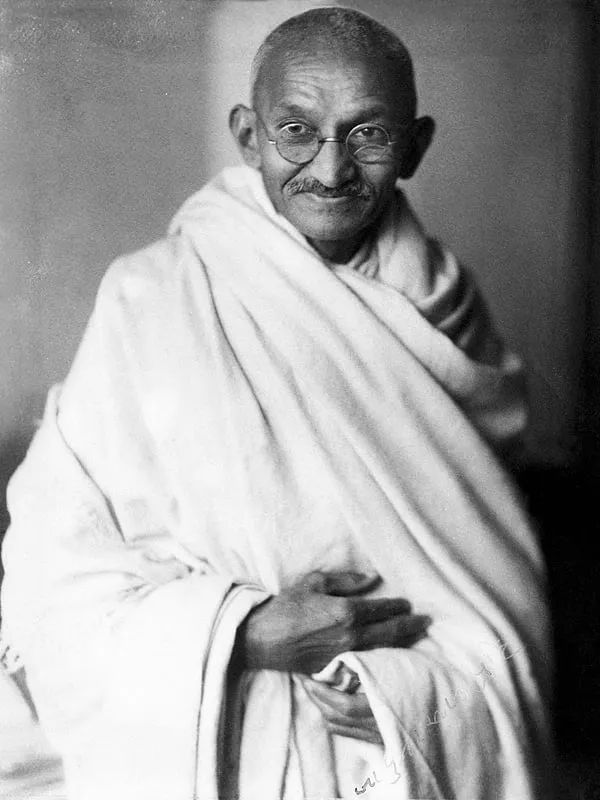
- Born:
- 2 October 1869, Porbandar (Kathiawar, British India)
- Died:
- 30 January 1948, New Delhi (India)
- Author:
- Natalia
- Photo:
- Elliott & Fry, domena publiczna, Wikimedia Commons

Mohandas Karamchand Gandhi, called the Mahatma (“Great Soul”), was the best-known opponent of the British Empire in the first half of the twentieth century and the creator of a method of political struggle he called satyagraha – “holding fast to truth”. A London-trained lawyer, he spent twenty years defending the rights of Indians in South Africa, and after returning to India he turned the elite Indian National Congress into a movement of millions. During the Second World War he faced a dilemma that no other leader of a colonial people resolved: he condemned Hitler and fascism, but refused to support a war waged by a state that denied his own country its freedom. His campaigns of 1940–1942 and his imprisonment during the war ensured that after 1945 the British could no longer hold on to India.
Childhood and London
He was born on 2 October 1869 in Porbandar, a small princely state on the Kathiawar peninsula on the Arabian Sea, into a Hindu family of the merchant caste. His father Karamchand was diwan, or chief minister, to the ruler of Porbandar and later of Rajkot. His deeply religious mother Putlibai brought him up in the Vaishnava tradition, and the Jain milieu of Gujarat taught him reverence for all life, fasting and vegetarianism. In 1883, at the age of 13, he was married to Kasturba, who was the same age. They had four sons who survived into adulthood.
In September 1888 he went to London to study law, having promised his mother that he would not touch meat, alcohol or women. For a time he tried to become an English gentleman, taking lessons in dancing and French, but his real circle became London’s vegetarians and theosophists, at whose urging he read the Bhagavad Gita for the first time, as well as the New Testament. On 10 June 1891 he was called to the bar and returned to India. As a lawyer in Bombay he had no success – reportedly at his first hearing he could not get a word out.
South Africa
In 1893 he accepted a one-year contract with an Indian merchant firm in Natal and arrived in Durban in May. About two weeks after his arrival, on 7 June 1893, he was thrown out of a first-class compartment at Pietermaritzburg because he was “coloured”. The night he spent in the cold station was, by his later account, a turning point: he resolved not to go home but to fight discrimination. He stayed in South Africa for more than twenty years. In 1894 he founded the Natal Indian Congress, and in 1903 the weekly Indian Opinion. During the Second Boer War he organised some thousand Indian stretcher-bearers who carried the wounded from under fire, among other places at the Battle of Spion Kop, hoping that loyalty to the Crown would win Indians equal rights. Historians point out that the young Gandhi fought for the rights of Indians, not of black Africans, and shared many of the prejudices of his age. His views on the matter changed over time.
On 11 September 1906, at a mass meeting in Johannesburg, the Indians of the Transvaal swore not to submit to a law requiring them to register with their fingerprints. Thus was born satyagraha: the mass, open breaking of an unjust law, without violence and with a readiness to accept punishment. Gandhi drew on the Bhagavad Gita, the Sermon on the Mount, the essay on civil disobedience by Henry David Thoreau and the writings of Leo Tolstoy, with whom he corresponded. The campaign lasted seven years. Thousands of Indians, Gandhi and his wife among them, went to prison, and in 1913 a miners’ strike and a protest march forced the government of Jan Smuts into a compromise in 1914. In July 1914 Gandhi left South Africa for good.
Return to India
On 9 January 1915 he landed in Bombay as a hero. On the advice of his political mentor Gopal Krishna Gokhale he spent a year travelling around the country third class, getting to know India before speaking out on politics. He founded an ashram near Ahmedabad and abandoned European dress. In 1917, at Champaran in Bihar, he took the side of tenant farmers forced to grow indigo and wrung concessions from the authorities; in 1918 he supported a strike by Ahmedabad mill workers and the peasants of Kheda district, who after a failed harvest were refusing to pay tax. In the last year of the First World War he even recruited Indians for the British Army – with very little success.
The turning point came in 1919. Gandhi regarded the Rowlatt Acts, which allowed people suspected of subversion to be imprisoned without trial, as a betrayal of wartime promises, and called for a nationwide hartal – a day of strike and fasting. On 13 April 1919 British troops opened fire on an unarmed crowd at Jallianwala Bagh in Amritsar; according to official figures 379 people were killed, according to Indian figures many more (the Amritsar massacre). Gandhi broke with loyalism. In 1920, allied with the Muslim movement in defence of the Caliphate, he proclaimed the non-cooperation campaign: a boycott of British schools, courts, offices, titles and cloth. Congress adopted his programme and a new organisation that turned it into a mass party. The spinning wheel and khadi, homespun cloth, became the symbols of the movement.
When on 4 February 1922 a crowd at Chauri Chaura set fire to a police station, killing more than twenty policemen, Gandhi called off the whole campaign against the wishes of his colleagues. He was arrested on 10 March 1922 and on 18 March sentenced to six years’ imprisonment for sedition. He was released in February 1924 after an appendix operation. In 1924 he served as President of Congress for the only time, but in the 1920s he was mainly concerned with harmony between Hindus and Muslims, the fight against untouchability and spinning.
The Salt March and the 1930s
On 26 January 1930 Congress proclaimed India’s Independence Day. In March Gandhi made the salt tax, which weighed most heavily on the poorest, the symbol of the struggle. From 12 March to 6 April 1930 he walked with 78 companions from Ahmedabad to Dandi on the sea, a distance of some 390 kilometres, and there picked up a lump of salt from the beach, breaking the state monopoly (the Salt March). Millions followed him. He was arrested on 5 May, and at least 60,000 people were sent to prison. Time magazine named him its Man of the Year for 1930. On 5 March 1931 the Viceroy, Lord Irwin, later Lord Halifax, concluded an agreement with him: the campaign was suspended in exchange for the release of prisoners and Congress’s participation in the Round Table Conference in London. Winston Churchill spoke indignantly of a “seditious Middle Temple lawyer, now posing as a fakir”, striding half-naked up the steps of the Viceroy’s palace to parley on equal terms with the representative of the King-Emperor. The two men’s mutual dislike was to outlast the war.
In the autumn of 1931 Gandhi travelled to London, but the conference dealt with the rights of minorities and princes rather than the transfer of power. On the way home he met Benito Mussolini in Rome. After his return he was imprisoned again on 4 January 1932. When the government of Ramsay MacDonald granted separate electorates to the untouchables, Gandhi began a fast “unto death” in Yerwada prison in Poona on 20 September 1932. It ended with a compromise with the untouchables’ leader Bhimrao Ramji Ambedkar, the so-called Poona Pact of 24 September. In 1934 Gandhi resigned from Congress, judging that his presence stifled the party’s diversity, but he remained its undisputed spiritual leader. He settled at the Sevagram ashram near Wardha. After the 1937 elections he allowed Congress to take office in the provinces. In 1939 he brought about the departure from the Congress presidency of Subhas Chandra Bose, who rejected the principle of non-violence.
Facing Hitler and the war
Gandhi believed that non-violence worked everywhere, even against dictatorships. In November 1938, after the Kristallnacht pogrom, he wrote in his weekly Harijan that his sympathies were with the Jews and that a war against Germany in their defence would be justified, if any war could ever be justified. At the same time he advised German Jews to resist without violence, which outraged many, including the philosopher Martin Buber, who replied with an open letter. On 23 July 1939 Gandhi wrote a short letter to Adolf Hitler, asking him to prevent war. The British authorities did not forward it. A second, longer letter, dated 24 December 1940, called the humiliation of Czechoslovakia, “the rape of Poland” and the swallowing of Denmark monstrous acts, but repeated that India was resisting both Nazism and British imperialism.
When the Viceroy declared on 3 September 1939 that India was at war, Gandhi told him at Simla that his sympathies lay with Britain and France, and spoke with emotion of the possible destruction of London. Congress, however, took a different view from his: it did not reject the war on principle, but demanded freedom in return. When London did not promise that freedom, the Congress governments in the provinces resigned. In the summer of 1940, during the Battle of Britain, Gandhi issued an appeal “To Every Briton” urging the British to resist the Germans without arms, even at the price of occupation. In Britain it was received with disbelief.
In September 1940 Congress entrusted him with leading the struggle against the government. Gandhi chose a limited form that was not meant to paralyse the war effort: individual satyagraha. From 17 October 1940 activists chosen by him, and later rank-and-file members of Congress, publicly called for no help to be given to the war effort and allowed themselves to be arrested. By December 1941 more than 25,000 people had been imprisoned. After Churchill’s reservation that the Atlantic Charter did not apply to India, Gandhi responded with silence. At the end of December 1941, when Japan had entered the war and most Congress leaders were ready to support the defence of India in exchange for a national government, he asked to be relieved of the leadership. In January 1942 he named Jawaharlal Nehru as his successor.
Quit India and prison
The fall of Singapore and the Japanese advance in Burma changed his position. Gandhi concluded that the British presence was drawing a Japanese attack on India, and that a free India could come to terms with Japan on its own or resist it without violence. Congress rejected the offer brought by Stafford Cripps in March 1942; Gandhi is credited with calling it a “post-dated cheque”. On 8 August 1942, at a meeting of the All-India Congress Committee in Bombay, he called on the British to leave India and issued the slogan “Do or die”. The resolution declared that a free India would join the Allies and allow their armies to defend themselves against Japan on its territory.
On the morning of 9 August Gandhi and the entire Congress leadership were arrested. The country was engulfed by strikes, riots and sabotage of railways and telegraph lines. The Viceroy, Lord Linlithgow, wrote to Churchill of “by far the most serious rebellion since 1857”. The army and police crushed the movement within a few months; according to government figures some thousand people were killed, according to Indian estimates many more, and tens of thousands were arrested. Gandhi was held in the Aga Khan Palace in Poona. His long-serving secretary Mahadev Desai died there on 15 August 1942. In February and March 1943 Gandhi undertook a 21-day fast against accusations that he was responsible for the violence; the authorities prepared for his death. On 22 February 1944 Kasturba died in captivity. On 6 May 1944, seriously ill, he was released by the new Viceroy, Archibald Wavell.
In September 1944 Gandhi held talks with the leader of the Muslim League, Muhammad Ali Jinnah, but failed to persuade him to drop the demand for a separate Muslim state, Pakistan. During the war many Indians took a different path: some 2.5 million volunteers served in the Indian Army, while Bose formed the Indian National Army alongside the Japanese. Gandhi rejected both paths.
Independence, partition and death
After the war the government of Clement Attlee decided to hand over power to India. Gandhi opposed the partition of the country along religious lines to the end, but the Congress leaders, including Nehru and Vallabhbhai Patel, saw it as the only way out of the civil war that had begun with the bloody riots in Calcutta in August 1946. For several months Gandhi walked from village to village in the massacre-torn district of Noakhali in eastern Bengal. On 15 August 1947, when India and Pakistan became independent, he took no part in the celebrations but fasted in Calcutta, and his fast of 1–4 September halted the riots there. In the Punjab partition cost the lives of hundreds of thousands, and millions were forced to flee.
On 13 January 1948 in Delhi he began his last fast: for peace between the communities and for the payment to Pakistan of its share of the assets of British India. Hindu nationalists saw this as betrayal. On 30 January 1948, as he walked to evening prayers in the garden of Birla House in New Delhi, he was shot at close range by Nathuram Godse, who was linked to the Hindu far right. Godse and his accomplice Narayan Apte were hanged on 15 November 1949. “The light has gone out of our lives,” Nehru said on the radio that evening.
Significance
Gandhi did not win independence on his own, nor the kind he wanted: India was born divided, and his vision of self-sufficient villages lost out to Nehru’s plans for industrialisation. Even so, he did more than anyone else to make the national movement embrace millions of people and to strip British rule of legitimacy in their eyes. The Second World War was the hardest test of his ideas. His conviction that non-violent resistance could stop Hitler was incomprehensible to most of his contemporaries, and his opposition to the war – limited though it was – put him in open conflict with Churchill at a time when the empire was fighting for survival. At the same time it was the war, into which India had been drawn without its consent, and the Quit India movement that closed the road back to the pre-war order. After the war Gandhi’s method became a model for many movements, from the civil rights struggle of Martin Luther King to Nelson Mandela’s resistance to apartheid. His birthday, 2 October, is a national holiday in India and, worldwide, the International Day of Non-Violence.
Sources
Mentioned in battles
(01)Often appears with
People who appear in the same events.