1944–1945: The liberation of Western Europe
Operation Dragoon
- Dates:
- 15 August – 14 September 1944
- Front:
- Western Front
- Location:
- Southern France: the coast of the Var department between Cavalaire-sur-Mer and Saint-Raphaël, the islands of Port-Cros and Levant, the Le Muy and Draguignan area, Toulon and Marseille, the Provençal Alps and Grenoble, the Rhône valley with Montélimar, Avignon and Lyon, and Burgundy and Franche-Comté as far as Dijon and the foothills of the VosgesOn the battle map →
- Sides:
- United States, France and alliesAlexander Patch, Lucian Truscott, Jean de Lattre de Tassigny, Henry Kent HewittNazi GermanyJohannes Blaskowitz, Friedrich Wiese
- Result:
- Allied victory. On 15 August 1944 the US VI Corps landed on the coast of Provence at small cost, while an airborne force seized the Le Muy area. The French Army B took Toulon and Marseille on 28 August, several weeks ahead of schedule, and the Americans cut the German Nineteenth Army's line of retreat at Montélimar, though they could not close the trap. Lyon was liberated on 3 September, and on 11–12 September the forces from the south linked up in Burgundy with the US Third Army. By American estimates the Germans lost about 7,000 killed, about 21,000 wounded and more than 130,000 prisoners, but the core of Army Group G withdrew in good order to the Vosges. Allied losses were about 15,500 Americans and more than 10,000 French.
- Author:
- Natalia
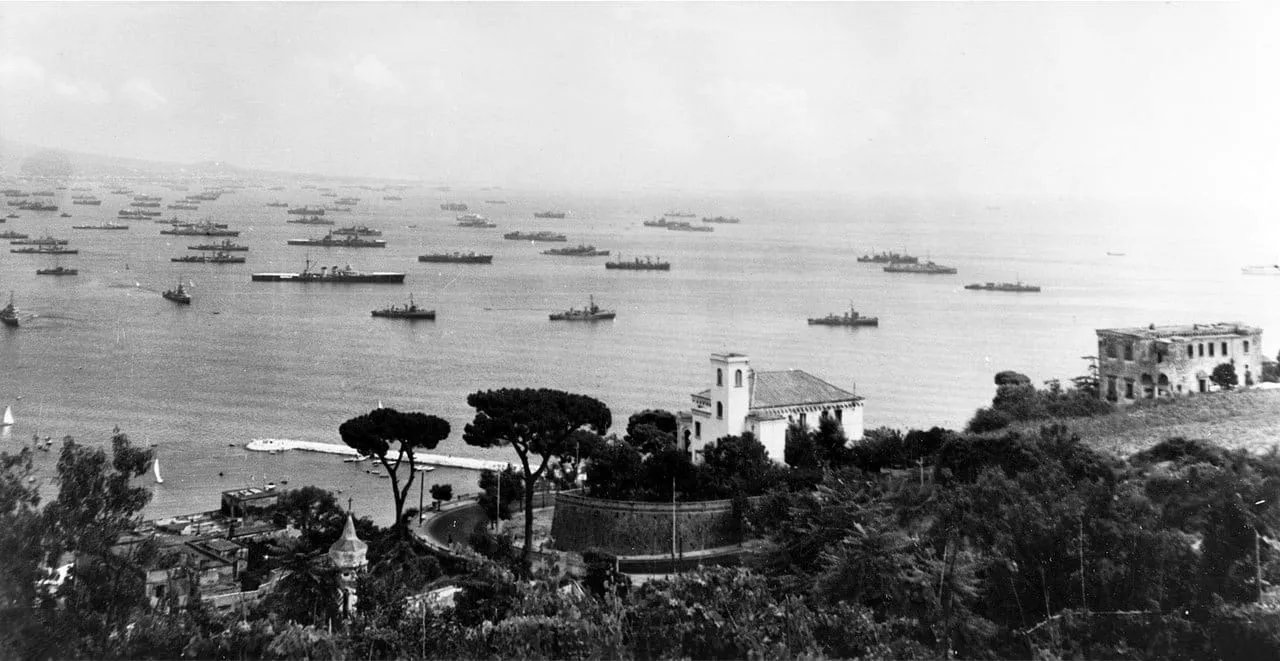
Operation Dragoon – the Allied landing on the Mediterranean coast of France on 15 August 1944 and the campaign that followed, in which almost the whole of the south of the country was liberated in less than a month – was the second great invasion of occupied France, alongside Normandy. The US Seventh Army of General Alexander Patch, with General Jean de Lattre de Tassigny’s French Army B in the second wave, came ashore on the French Riviera against almost no opposition, and over the following weeks captured the great ports of Toulon and Marseille and advanced more than 500 kilometres up the valley of the Rhône into Burgundy. The operation remains controversial to this day: the British opposed it for many months before it began, and historians differ in their verdict on its outcome – a rapid victory and the capture of the ports, but the escape of most of the German Nineteenth Army.
Name and dates
The plan for a landing in southern France was drawn up under the code name Anvil – it was to be the anvil on which the hammer of the invasion from the north would fall. The name was changed to Dragoon on 1 August 1944, a few weeks after the operation had been finally approved; the popular story that Winston Churchill chose it because he had been “dragooned” into the operation is an anecdote, not a documented fact. In France the operation is known as the landing in Provence (débarquement de Provence).
The start of the operation is clear-cut: on the night of 14/15 August 1944 commandos landed on the islands and headlands of the coast, before dawn airborne troops came down inland, and at 8 a.m. on 15 August the first waves of infantry hit the beaches. The end date is a matter of convention. It may be set at 14 September 1944, when the Allied command halted the pursuit and the Seventh Army and Army B, already joined up with the forces arriving from Normandy, came under General Jacob Devers’s 6th Army Group, which on 15 September was placed under Supreme Headquarters Allied Expeditionary Force (SHAEF). Some authors end the campaign with the link-up with the Third Army on 11–12 September; others carry it on to the fighting in the Vosges in the autumn of 1944.
Background
The idea of a landing in the south of France came from American planners, and at the Tehran Conference at the end of 1943 it was backed by Joseph Stalin, who preferred to see the Western Allies in Provence rather than in the Balkans. It was agreed then that, as far as landing craft allowed, a landing on the Mediterranean coast would take place at the same time as the invasion of Normandy. The plan soon ran up against reality. The enlargement of Operation Overlord from three beaches to five swallowed up landing ships, and the stalemate after the landing at Anzio tied down more of them in Italy. In the spring of 1944 Anvil was postponed until after the Normandy invasion.
After the Normandy landings the dispute flared up again in full force. The Americans – the Army Chief of Staff General George Marshall, President Franklin Delano Roosevelt and General Dwight Eisenhower – wanted Marseille and Toulon as ports for the dozens of divisions waiting in the United States, because the Normandy ports and artificial harbours could not keep up with unloading. Charles de Gaulle also backed the operation: for him the participation of several hundred thousand French soldiers in the liberation of their own country was a political matter of the first importance. Churchill and the British Chiefs of Staff preferred to exploit the victory at Rome: after the Allied entry into Rome on 4 June they wanted to pursue the Germans into northern Italy and then through Istria and the Ljubljana Gap towards Vienna and Hungary. General Harold Alexander, commander of the Allied armies in Italy, argued that his forces could destroy the Germans south of the Alps if nobody took them away from him.
At the beginning of July 1944 the Americans got their way: the Combined Chiefs of Staff instructed General Henry Maitland Wilson, the Supreme Allied Commander in the Mediterranean, to prepare a landing for August. The Italian front gave up General Lucian Truscott’s US VI Corps with the 3rd, 36th and 45th Infantry Divisions, as well as General Alphonse Juin’s French Expeditionary Corps. Churchill did not give in until the very end – as late as 4 August he proposed diverting the landing force to the ports of Brittany, but Roosevelt and Eisenhower refused. Historians explain his obstinacy in different ways: some see in it above all concern for the Italian campaign, others – especially after the war, in the light of the division of Europe – the idea of forestalling the Red Army in Central Europe, which Churchill himself emphasised in his memoirs.
On the German side, southern France, occupied in November 1942 in Operation Anton, was defended by Colonel General Johannes Blaskowitz’s Army Group G. On the Mediterranean coast stood its Nineteenth Army under General of Infantry Friedrich Wiese – weakened infantry divisions (the whole of Army Group G then numbered 11 divisions, four of them static divisions without transport), each stretched over an average of 90 km of coast and partly manned by Ostlegionen made up of former Soviet prisoners of war – together with its only armoured formation, the 11th Panzer Division, on the west bank of the Rhône. The best units had been taken away to Normandy over the summer. Blaskowitz knew he could not repel a strong landing, but after the 20 July plot nobody in the high command dared propose a timely withdrawal to Hitler. Meanwhile, in the mountains of Provence and the Alps, the units of the French Forces of the Interior (FFI), subordinated to General Marie-Pierre Koenig, were growing; the US official history puts their strength in the south at about 75,000 men, most of them poorly armed.
Opposing forces
The operation was directed by Wilson from his headquarters at Caserta near Naples, and commanded directly by General Patch. The invasion fleet – the Western Task Force, more than 880 warships and transports plus several hundred landing craft – was led by Vice Admiral Henry Kent Hewitt, a veteran of the landings in North Africa, Sicily and Salerno. Fire support came from American battleships (among them USS Texas, which had bombarded Normandy two months earlier), the British Ramillies and the French Lorraine, some 20 cruisers and nine escort carriers. General Ira Eaker’s Mediterranean Allied Air Forces numbered, according to various tallies, more than 3,400 aircraft, most of them flying from airfields on Corsica and Sardinia; the Luftwaffe had about 200 aircraft in southern France.
On the first day three American divisions of VI Corps were to land: General John O’Daniel’s 3rd Infantry Division on Alpha Beach in the Bay of Cavalaire, the 45th Division on Delta Beach near Sainte-Maxime and Saint-Tropez, and the 36th Division on Camel Beach near Saint-Raphaël. The flanks were covered by commandos: the American-Canadian First Special Service Force on the islands of Port-Cros and Levant, and French commandos from Africa at Cap Nègre. Inland, in the Argens valley near Le Muy, General Robert T. Frederick’s 1st Airborne Task Force was to drop – about 9,000 Americans and British of the 2nd Independent Parachute Brigade. Behind VI Corps came the French Army B: seven divisions, most of them from the Army of Africa – Algerians, Moroccans, Tunisians, Senegalese, French colonists, tabors of goumiers – among them veterans of Monte Cassino and the 1st Free French Division. In all, about 150,000 soldiers landed in the first days, and by the end of the operation more than half a million had passed through the beaches and ports of the south.
According to the US official history, the Germans had 285,000–300,000 men in southern France, including rear-area troops and services, of whom 85,000–100,000 were within immediate reach of the landing area. The coast was defended by some 75 medium and heavy batteries – some dating from the Vichy period – and the approaches to Toulon by, among other things, a turret with two 340 mm guns from the battleship Provence, scuttled in the harbour in 1942. The chain of command was fragmented: the occupation troops, the army, the Luftwaffe and the Kriegsmarine each answered to separate German authorities. German intelligence expected a landing in mid-August but did not know where; on 13 August Blaskowitz began moving the 11th Panzer Division to the east bank of the Rhône, too late for it to arrive before the landing.
Course of the operation
The landing (15 August)
Operations began on the night of 14/15 August. Men of the First Special Service Force scaled the rocky shores of Port-Cros and Levant; on Levant a menacing coastal battery turned out to be camouflaged dummies, while on Port-Cros the German garrison held out in an old fort until 17 August, when it was shelled by Ramillies. French commandos destroyed the batteries on Cap Nègre, while a naval detachment that landed at Pointe de l’Esquillon on the eastern flank walked into a minefield and was mostly taken prisoner. Feint landings and drops of dummy paratroopers near La Ciotat and Cannes were meant to mislead the defenders.
Before dawn the transport aircraft of the 1st Airborne Task Force appeared over the Argens valley. Fog scattered some of the paratroopers far from their drop zones, but the airborne troops seized the hills and bridges around Le Muy, and took the town itself, which held out on the first evening, on 16 August, capturing some 700 prisoners. From 6 to 7.30 a.m. more than a thousand aircraft bombed the coast, then the warships took over the bombardment, and at 8 a.m. the first landing craft reached the beaches.
On Alpha and Delta resistance was weak: soldiers of the Ostlegionen surrendered in droves, and mines were the greatest danger. The 3rd Division pushed inland, while the 45th Division took Saint-Tropez and Sainte-Maxime and linked up with the paratroopers the same day. Camel was harder going: on Red sector near Saint-Raphaël German guns drove back the approaching landing craft despite a raid by 90 B-24 bombers and fire from the sea, so the landing commander switched the assault to Green sector. In the evening a Do 217 bomber hit the landing ship LST-282 with a Henschel Hs 293 radio-guided glide bomb. According to American figures, losses on the first day were 95 killed and 385 wounded – a fraction of those on Omaha Beach. By evening about 60,000 soldiers and more than 6,000 vehicles were ashore. Churchill, who had fought the plan to the last moment, watched the landing from the deck of the destroyer HMS Kimberley.
The withdrawal order and the breakout from the beachhead (16–20 August)
German resistance was chaotic. The paratroopers cut off the headquarters of General Ferdinand Neuling’s LXII Corps at Draguignan, and Neuling was taken prisoner on 18 August. Wiese, with no contact with Blaskowitz, on 16 August threw an improvised battle group under General Richard von Schwerin, about four battalions, into a counter-attack near Le Muy and Les Arcs; after a day of fighting against the 45th Division it withdrew under cover of darkness. From 16 August the first divisions of the French Army B came ashore on the beaches near Saint-Tropez and Cavalaire.
On the night of 16/17 August, as the Falaise pocket was closing in the north, Adolf Hitler approved the OKW’s plan to withdraw Army Group G. Its forces in the south and on the Atlantic coast were to fall back to a line running from Sens through Dijon to the Swiss border, two divisions – the 148th and 157th – were to withdraw into the Alps, and the garrisons of Toulon and Marseille were to hold out as fortresses to the last man. The Allies learned the contents of the order almost immediately thanks to Ultra decrypts. For Truscott this meant that instead of a prepared defence on the Rhône he faced a pursuit.
Toulon and Marseille (20–28 August)
The plan assumed that Army B would first take Toulon and only then Marseille, and not until several weeks after the landing. De Lattre, seeing that the German defence was falling apart, struck at both ports almost simultaneously, before he had even landed all his forces. General Edgard de Larminat’s corps attacked Toulon from the east, along the coast through Hyères, while General Joseph de Goislard de Monsabert’s 3rd Algerian Infantry Division bypassed the city to the north, cut the road to Marseille and turned west. On 20 and 21 August the French broke into the ring of forts around Toulon, defended by the 242nd Infantry Division and Kriegsmarine crews. By 26 August the city was in French hands, but the fortress commandant, Rear Admiral Heinrich Ruhfus, was still holding out on the Saint-Mandrier peninsula. Late in the evening of 27 August he agreed to surrender, and on the morning of 28 August his garrison laid down its arms. The harbour was littered with the wrecks of the fleet that the French themselves had scuttled in November 1942 and of ships later sunk by the Germans in the entrances to the basins.
In Marseille an uprising by the FFI and the communist Francs-Tireurs et Partisans broke out on 21 August, and striking workers came out onto the streets. General Hans Schaefer, commander of the 244th Infantry Division, did not evacuate the population, and his garrison broke up into isolated strongpoints. Algerian riflemen, goumiers and French tanks, called in by the insurgents, entered the city centre on 23 August, and on 25 August stormed the hill crowned by the basilica of Notre-Dame de la Garde. Schaefer signed the surrender on 28 August; the batteries on the Frioul islands gave up a day later. According to French figures, the capture of Toulon cost Army B some 2,700 killed and wounded and the Germans about 1,000 killed and 17,000 prisoners; in Marseille the French lost about 1,800 men and some 11,000 Germans were taken prisoner. Both ports were taken several weeks earlier than the plan had envisaged, but German engineers had managed to destroy the quays, cranes and basins.
Task Force Butler and Montélimar (18–29 August)
North-east of the beachhead, Truscott sent out a motorised battle group under Brigadier General Frederic Butler – a tank battalion, a tank destroyer battalion, lorried infantry and artillery – with orders to reach the rear of the German Nineteenth Army. Advancing through country from which the FFI partisans had already driven the Germans, Task Force Butler took Digne on 18 August, Sisteron on 19 August and Gap on 20 August, and then swung west towards the Rhône. On 22 August FFI partisans entered Grenoble, followed by the US 143rd Infantry Regiment of the 36th Division; the German 157th Reserve Division, retreating into the Alps, had left the city, and its inhabitants were already welcoming authorities installed by the Resistance.
On 21 August Butler occupied the hills north of Montélimar overlooking Route Nationale 7 and the railway along the Rhône – the only escape route for the German columns. Too weak to close the valley, he shelled it with artillery while waiting for General John Dahlquist’s 36th Division. Wiese threw in General Wend von Wietersheim’s 11th Panzer Division, hurrying over from the west bank of the river; for a week a battle raged for the hills and the road in which the Americans could not permanently block the passage, nor could the Germans drive them off the high ground. According to the US official history, the decisive factor was a shortage of fuel and ammunition: Truscott could send help from the 45th Division only once the French victories at the ports allowed him to concentrate on the north. Most of the Nineteenth Army, including the core of the 11th Panzer Division, broke through to the north. On the night of 28/29 August the Americans entered Montélimar and cleared the town on 29 August, and by the same day they had destroyed the last columns in the valley – which the soldiers called “death alley” – leaving thousands of burnt-out vehicles, guns and dead horses behind. South of Montélimar, the retreating Germans abandoned Avignon on 25 August, and FFI partisans and Americans moved in.
Pursuit up the Rhône and the junction of the fronts (30 August – 14 September)
After escaping from the valley at Montélimar, the Nineteenth Army fell back rapidly northwards, covered by the 11th Panzer Division. The US 3rd and 45th Divisions and the French II Corps tried to overtake it on parallel roads on both sides of the Rhône and through the Alpine foothills, but the Allied columns were constantly waiting for fuel brought up by lorry from beaches several hundred kilometres away. On 2 September the 36th Division reached the outskirts of Lyon, where partisans were fighting the Milice and the Germans were blowing up the bridges over the Rhône and the Saône. On 3 September the French 1st Free French Division and FFI units entered the city; apart from about 2,000 who were taken prisoner, the Germans had already gone north.
On the eastern flank the Americans took Besançon on 8 September, and the French took Dijon on 11 September. At the same time German garrisons from the Atlantic coast and the Pyrenees were trekking from south-western France towards Burgundy through country controlled by the partisans. According to German figures cited by historians, some 88,000 men set out northwards, of whom about 19,000 were captured on the way and about 60,000 reached Army Group G’s new line. One of these columns, under General Botho Elster, nearly 20,000 strong, did not make it in time and surrendered to the Americans on the Loire after the operation had ended.
On 11 and 12 September – the dates differ depending on the source and the place – the spearheads of the forces from the south made contact with General George Patton’s Third Army, advancing from Normandy through Champagne. The meeting most often cited is that between a detachment of the 1st Marine Fusilier Regiment of the 1st Free French Division and the 12th Cuirassier Regiment of General Philippe Leclerc’s 2nd Armoured Division at Nod-sur-Seine near Châtillon-sur-Seine; further meetings followed over the next few days around Saulieu and Dijon. The Allied front now ran unbroken from the North Sea to Switzerland, and German units that had not managed to slip through the gap between the two fronts were cut off.
On 14 September Truscott, who was still hoping to push quickly through the Belfort Gap towards the Rhine, was ordered to halt his advance. The troops had to regroup, and Army Group G managed to establish a new defensive line at the foot of the Vosges. The next day the Seventh Army and Army B became part of the 6th Army Group, under Eisenhower’s command, and at the end of September Army B was renamed the French First Army.
Losses
Figures for losses are incomplete and vary with the source and the time frame adopted. According to US Army tallies cited in the literature, American losses in the operation came to about 15,500 killed, wounded and missing, and French losses – according to the US official history and the German history of the war – to more than 10,000. The landing of 15 August itself was one of the least costly of the whole war. Historians (Detlef Vogel, Jeffrey Clarke and Robert Ross Smith, Steven Zaloga) estimate German losses at about 7,000 killed, about 21,000 wounded and more than 130,000 prisoners, including the garrisons of Toulon and Marseille and soldiers captured during the retreat from south-western France. The exact number of FFI members killed and of civilian victims is unknown; the latter include the victims of the bombing that preceded the landing and of the reprisals that retreating German units carried out against the population and the partisans.
Significance
In less than four weeks Operation Dragoon drove the Germans out of the whole of southern France and joined two Allied fronts into one, stretching from the North Sea to the Swiss border. Its most lasting result was the ports. After the destruction, Toulon and Marseille were quickly rebuilt, and with them the railways of the Rhône valley; according to American figures, nearly 525,000 tons of supplies were unloaded in the ports of southern France in October 1944 – more than a third of all the cargo then delivered to the Western Front. Dozens of American divisions shipped straight from home also passed through Marseille. This mattered a great deal to the armies fighting in the north, which ground to a halt in September for lack of fuel and ammunition.
The operation hastened the collapse of Vichy. On 17 August the Germans removed Prime Minister Pierre Laval from Paris, and on 20 August Marshal Philippe Pétain from Vichy – first to Belfort and then to Sigmaringen in Germany. In the liberated south, power was taken over by representatives of the Provisional Government of the French Republic. Army B – several hundred thousand soldiers, most of them from North Africa and the colonies – won itself a place in the liberation of the country, which de Gaulle used in his disputes with the Allies over France’s standing. As the French First Army it later fought in the Vosges and Alsace, and in 1945 it crossed the Rhine.
Assessments of the operation remain contested. American authors, led by the official history, regard it as a great success: a vast area was liberated and the ports captured at little cost. It was criticised, however, by Bernard Montgomery and by British writers, notably Chester Wilmot, who argued that it took the best divisions away from Italy – where Alexander’s weakened armies, after the liberation of Florence, stalled on the Gothic Line in the autumn – and that these troops would have been of more use in the north or in a drive on Vienna ahead of the Red Army. Other historians reply that the Balkan plan was logistically unrealistic and that the ports of Provence proved indispensable to the armies in the west. There is general agreement, however, that the Allies failed to achieve their operational aim: for lack of fuel and with pursuit forces that were too weak, they did not trap the Nineteenth Army in the Rhône valley, and Blaskowitz led most of his troops away to the north, where in the autumn they defended the Vosges and Alsace.