1944–1945: The liberation of Western Europe
The Ruhr Pocket
- Dates:
- 1–18 April 1945
- Front:
- Western Front
- Location:
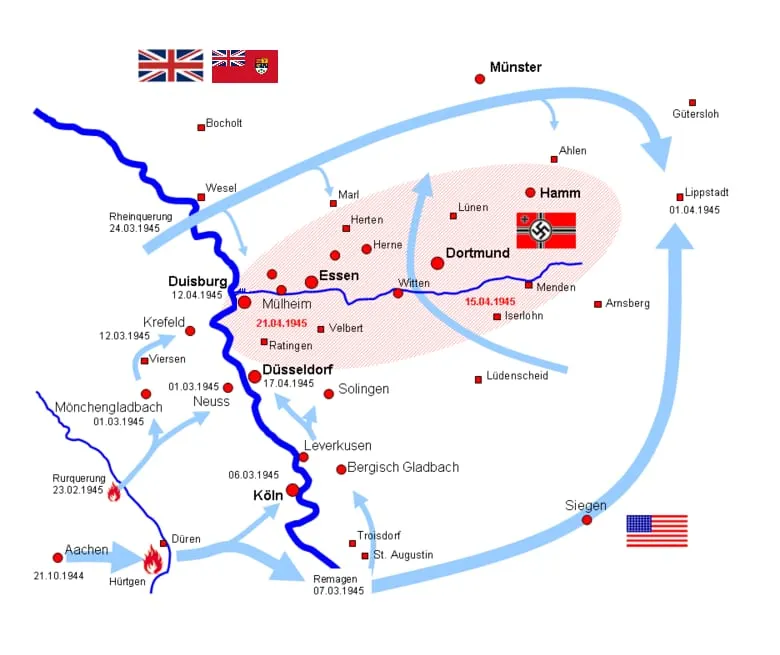
- The Ruhr, the Sauerland, the Siegerland and the Bergisches Land in Westphalia and the northern Rhineland – an area of about 100 by 120 km between the Rhine in the west, the river Lippe and the Rhine–Herne Canal in the north, Lippstadt and Paderborn in the east, and the river Sieg in the southOn the battle map →
- Sides:
- United StatesOmar Bradley, William Simpson, Courtney Hodges, Matthew RidgwayNazi GermanyWalter Model, Josef Harpe, Gustav-Adolf von Zangen
- Result:
- United States victory. On 1 April 1945 the spearheads of the US Ninth and First Armies met at Lippstadt, trapping Army Group B in a pocket. On 14 April the pocket was split in two on the Ruhr at Hattingen; on 15 April Field Marshal Walter Model dissolved the army group, and on 18 April organised resistance ceased. According to the US official history some 317,000 soldiers were taken prisoner, more than 20 generals among them; American losses came to about 10,000 killed, wounded and missing. Model committed suicide on 21 April.
- Author:
- Łukasz
Name and dates
The Ruhr Pocket (German Ruhrkessel) is the name given to the encirclement and destruction of Field Marshal Walter Model’s German Army Group B in the Ruhr and the uplands around it in April 1945. It was the largest encirclement battle fought by the Western Allies in the entire war and the last great operation on the Western Front in which whole armies faced each other. Polish literature also uses the names “the Battle of the Ruhr” and “the Ruhr operation”; the former should not be confused with the RAF bombing campaign of spring 1943, which the British also called the Battle of the Ruhr. The Americans sometimes spoke of the “Rose Pocket”, in memory of General Maurice Rose, commander of the 3rd Armored Division, who was killed near Paderborn on 30 March as his division was closing the ring.
The battle is taken to begin on 1 April 1945, Easter Sunday. That afternoon the spearheads of the 2nd Armored Division of the Ninth Army, advancing from the north out of the Wesel bridgehead, and of the 3rd Armored Division of the First Army, advancing from the south out of the Remagen bridgehead, met at Lippstadt. The ring was still thin and was sealed over the following days by arriving infantry divisions; it was regarded as fully closed by about 4 April. The battle is taken to end on 18 April, when the last organised German units in the western part of the pocket laid down their arms. Isolated groups held out for a few more days, and the commander of the encircled forces, Model, took his own life on 21 April in a forest between Duisburg and Ratingen.
The pocket covered an area of roughly 100 by 120 kilometres. It was bounded by the Rhine in the west, by the river Lippe and the canals of the industrial basin in the north, and by the river Sieg in the south. Inside lay the densely built-up heart of German heavy industry – Essen, Dortmund, Duisburg, Bochum, Gelsenkirchen, Wuppertal, and Düsseldorf on the right bank of the Rhine – and, to the south and east, the wooded, hilly Sauerland and Siegerland. According to German estimates some five million people were in the pocket: inhabitants of the ruined cities, refugees, prisoners of war and forced labourers.
Background
For decades the Ruhr had been Germany’s industrial heart. Its coal mines, steelworks and armaments plants – led by the Krupp concern in Essen – had produced most of Germany’s hard coal and steel before the war. Even the Allied plans drawn up before the Normandy landings assumed that capturing or cutting off the Ruhr would be one of the conditions for defeating the Reich. The region had also long been a target for bombers: in the spring of 1943 the RAF waged a months-long campaign of raids against it, known as the Battle of the Ruhr, which included the famous attack on the Möhne and Eder dams. In the autumn of 1944 and the winter of 1945 the raids on the region’s cities and railway junctions grew heavier still. By the end of March 1945 virtually no coal was reaching the rest of the Reich from the Ruhr; Joseph Goebbels noted as much in his diary on 26 March.
The Supreme Allied Commander in Europe, Dwight Eisenhower, never intended to take the Ruhr by frontal assault. A densely built-up industrial area with millions of inhabitants could turn into a trap like Stalingrad. The plan therefore called for envelopment: Field Marshal Bernard Montgomery’s British 21st Army Group, which included General William Simpson’s US Ninth Army, was to bypass the Ruhr to the north, and General Omar Bradley’s 12th Army Group to the south.
The way was opened by the Rhine crossings of March 1945. On 7 March the 9th Armored Division of General Courtney Hodges’s First Army captured the bridge at Remagen intact; within two weeks the Americans had expanded the bridgehead there to hold several corps. On the night of 23–24 March Montgomery’s forces crossed the Rhine at Rees and Wesel in Operation Plunder, supported by the largest single-day airborne operation of the war, Operation Varsity. The Ninth Army crossed south of Wesel, just above the northern edge of the Ruhr.
On the German side, the Western Front had been commanded since 10 March by Field Marshal Albert Kesselring, who had replaced Gerd von Rundstedt. Model’s Army Group B – bled white and stripped of reserves after its defeat in the Ardennes and the fighting on the Rhine – held the sector from the Rhine in the north to the Sieg and the Lahn in the south. Its two armies, the Fifth Panzer Army and the Fifteenth Army, were committed mainly against the Remagen bridgehead. Divisions numbered a few thousand men apiece, tanks, fuel and ammunition were short, and gaps were patched with training units, Luftwaffe anti-aircraft artillery, the Volkssturm and boys from the Hitler Youth. On 19 March Adolf Hitler issued the Nero Decree, ordering the destruction of industrial, transport and supply installations before the enemy arrived; the armaments minister Albert Speer, together with some industrialists and commanders, sabotaged its execution.
Closing the ring (25 March – 4 April)
On 25 March the First Army broke out of the Remagen bridgehead. Its VII Corps under General J. Lawton Collins, led by the 3rd Armored Division, swung north and drove through Marburg towards Paderborn – in one of the fastest advances of the campaign the tanks covered more than 100 kilometres a day. To its left advanced III Corps, and on the western flank of the bridgehead General Matthew Ridgway’s XVIII Airborne Corps, which took over the sector along the Sieg. Meanwhile, in the north, the Ninth Army was breaking out of the Wesel bridgehead onto the Westphalian plain: its XIX Corps, with the 2nd Armored Division, pushed east along the Lippe, while XVI Corps screened the northern edge of the Ruhr.
Model saw the danger and pressed for permission to withdraw his troops from the Ruhr before the ring closed. Hitler refused. German counter-attacks in front of Paderborn – made among others by Waffen-SS training units from the nearby training grounds – delayed the Americans by only a few days. On the evening of 30 March General Maurice Rose was killed in an ambush near Paderborn, the highest-ranking US Army ground officer in Europe to be killed by enemy action. On 1 April, Easter Sunday, patrols of the 3rd and 2nd Armored Divisions met at Lippstadt. Army Group B, part of the 1st Parachute Army and countless rear-echelon units were cut off from the rest of the Reich.
The ring was tightened over the following days, and on 4 April the Ninth Army, until then under Montgomery, reverted to Bradley’s command. From then on Bradley directed the whole operation against the pocket, and his two armies – Simpson’s from the north and Hodges’s from the south and east – were to squeeze the encircled forces. The western edge along the Rhine was secured by the newly formed US Fifteenth Army under General Leonard Gerow. Eighteen divisions were assigned to eliminating the pocket, grouped mainly in three corps: the Ninth Army’s XVI Corps in the north and the First Army’s III Corps and XVIII Airborne Corps in the south and east; in the first days units of VII and XIX Corps also held the eastern edge of the pocket. The remaining forces of the 12th Army Group – the bulk of the First and Ninth Armies and George Patton’s Third Army – pressed on eastwards towards the Elbe, in line with Eisenhower’s decision of late March (his cable to Stalin of 28 March) to abandon the advance on Berlin in favour of a thrust through the centre of Germany. On 31 March Eisenhower issued a proclamation calling on German soldiers and civilians to stop fighting.
Forces in the pocket
The number of men encircled took the Americans by surprise. The 12th Army Group’s intelligence initially put it at about 150,000; in reality, according to various estimates, the pocket held between about 300,000 and 370,000 soldiers (the figure most often given is 320,000–370,000). Model had at his disposal the remnants of some 19–21 divisions: General Gustav-Adolf von Zangen’s Fifteenth Army, Colonel General Josef Harpe’s Fifth Panzer Army and two corps of the 1st Parachute Army. Those trapped included General Fritz Bayerlein’s LIII Corps, General Heinrich von Lüttwitz’s XLVII Panzer Corps, and the remnants of the Panzer Lehr Division, the 116th and 9th Panzer Divisions and the 3rd Panzergrenadier Division.
These numbers, however, were misleading as to real fighting strength. A large share of those encircled were rear-service troops, crews of Luftwaffe anti-aircraft batteries, members of paramilitary organisations, wounded men in hospitals and Volkssturm members. According to findings cited in American literature, only a fifth of Model’s men, about 75,000, had infantry weapons, and roughly as many again had only pistols. There were a few dozen tanks and assault guns, and fuel and ammunition for a few weeks of sparing combat. Army Group B’s staff calculated that food stocks, which also had to feed millions of civilians, would run out after about three weeks. The pocket also held more than 20 Wehrmacht generals and Admiral Werner Scheer, commander of the replacement district in Essen.
Civil authority and command of the Volkssturm lay with the Gauleiter of South Westphalia, Albert Hoffmann, who had been appointed Reich Defence Commissioner for the area. To the very end he called for resistance “to the last round” and ordered the ruthless hunting down of deserters.
“Fortress Ruhr”
Hitler declared the Ruhr a “fortress”. Army Group B was neither to surrender nor to attempt a breakout – it was to tie down as many American forces as possible, much as the Sixth Army had been ordered to do at Stalingrad two years earlier. Model asked for supply by air, but given the Allies’ total air superiority the request was turned down. Supreme headquarters promised relief: at the beginning of April General Walther Wenck’s Twelfth Army was being formed from the last reserves, mainly officer cadets and training units, and according to the original plans it was to strike west from the Harz and break the ring. That attack never took place – the American spearheads reached the Elbe before Wenck’s army was ready. Model quickly realised that neither relief nor the “wonder weapons” promised by propaganda would arrive.
The Nero Decree and the orders to destroy the Ruhr’s industry, mines and power stations before giving up the region were for the most part not carried out. Model did not insist on demolishing the plants, and industrialists and some officials protected them; in practice it was mainly bridges and some transport installations that were blown up. The mines were not flooded and most of the machinery survived. The Ruhr thus proved a fortress in name only: cut off from supplies, and with its coal unable to leave the encirclement in any case, it was of no industrial value to the Reich, and its defence served solely to tie down enemy troops.
Squeezing the pocket (4–13 April)
The Americans attacked the pocket from all sides almost immediately. In the north the Ninth Army’s XVI Corps, which had been standing on the Rhine–Herne Canal, struck south into the densely built-up belt of industrial cities. On 4 April the 95th Infantry Division crossed the Lippe and the 75th Infantry Division the Dortmund–Ems Canal. Along the canal and around Dortmund the Germans resisted stubbornly until about 9 April and counter-attacked several times. On 6 April the Americans took bomb-wrecked Hamm with its great marshalling yard, and in the following days Unna and Werl. On 7 April the 79th Infantry Division forced the Rhine–Herne Canal in the central part of the Ruhr and on 10 April took Bochum. The 17th Airborne Division, fighting here as ordinary infantry, entered Essen on 10 April, and then Mülheim and the right-bank part of Duisburg. The next day Alfried Krupp von Bohlen und Halbach, owner of the Krupp concern, was arrested at the Villa Hügel in Essen. On 13 April, after several days of fighting in the suburbs, the 75th and 95th Infantry Divisions took Dortmund – one of the most heavily damaged cities in the Ruhr.
In the south the attack by III Corps and XVIII Airborne Corps, launched on 5 and 6 April, made slower progress. The Sauerland and Siegerland, four-fifths covered by forest and cut by deep river valleys, favoured the defence: the Germans held every stream, wood and small town with roadblocks and the fire of their few assault guns and anti-aircraft guns. Heavy fighting took place for Siegen, whose capture opened the way for the Americans into more open country. Progress was about 10 kilometres a day. On 7 April the skies cleared and aircraft of IX and XXIX Tactical Air Commands began attacking columns of troops – motorised and horse-drawn – without pause. Rationing of artillery ammunition was also lifted: XVI Corps’ artillery alone fired more than 259,000 rounds in two weeks.
By 11 April German resistance had clearly broken. Units now defended only roadblocks on the main roads and built-up areas, supported by single tanks, assault guns or light anti-aircraft guns. The pocket had shrunk by roughly half. Many soldiers, especially in the Volkssturm, simply went home; in some cities – such as Essen and Duisburg – mayors or residents came out to meet the Americans with white flags. Elsewhere, particularly where SS units were stationed or fanatical Party officials were active, every street was fought for. On 10 April, near Meschede in the Sauerland, the Americans detained the former vice-chancellor Franz von Papen.
Splitting the pocket and the collapse of Army Group B (12–18 April)
On 12 April an attack was launched from the south to cut the pocket in two. A battle group of the First Army’s 86th Infantry Division moved swiftly through the hilly Sauerland along the valleys of the Volme and the Lenne towards Hagen and the Ruhr river. On 14 April units of the First and Ninth Armies met on the Ruhr at Hattingen; some German sources give the date as 15 April. The pocket broke into a smaller eastern part, around Iserlohn, Hemer and Menden, and a larger western part, taking in Wuppertal, Düsseldorf and the Bergisches Land. That same day Model lost contact with most of his subordinate headquarters, and von Zangen’s Fifteenth Army, whose staff no longer controlled any of its divisions, ceased to exist as an operational formation. On 14 April, in Herdecke, Albert Vögler, head of the Vereinigte Stahlwerke concern and Speer’s plenipotentiary for Ruhr industry, took his own life.
Resistance collapsed fastest in the eastern part of the pocket. On 14 April Hemer was handed over to the Americans without a fight; its prisoner-of-war camp, Stalag VI A, held about 23,000 prisoners, most of them Soviet, thousands of them sick. On 15–16 April (sources differ on the day) General Bayerlein’s LIII Corps, with the remnants of the 116th and 9th Panzer Divisions and several infantry divisions, surrendered to the 7th Armored Division near Iserlohn and Menden – the American division took more than 20,000 prisoners within a few hours. A formal surrender of an entire formation was, however, the exception; in Hagen and Hohenlimburg fighting went on in places until 17 April, when the defence of the eastern part of the pocket finally fell apart.
Model had no intention of capitulating. His chief of staff, General Carl Wagener, urged him to save the lives of soldiers and civilians by surrendering, but the field marshal replied that Hitler would never permit it and that the surrender of a German field marshal was out of the question. He found a middle way: on 15 April he dissolved Army Group B. He discharged the youngest and oldest soldiers, issuing them with discharge papers; non-combatants were allowed to surrender from 17 April, when the ammunition was expected to run out, and fighting units were given the choice of trying to break out in organised groups or laying down their arms and going home. This was in effect tacit consent to surrender. According to one account, Ridgway sent an officer under a white flag to Model’s headquarters with a letter calling on him to surrender; Model refused, invoking the oath he had sworn to Hitler.
The dissolution order had not yet reached everyone when mass surrenders began on 16 April. Whole columns of German soldiers marched into captivity, often unescorted, and the Americans could not keep up with taking them to the rear. On 16 April the Americans took Wuppertal, and on 17 April they entered Solingen without a fight. That day paratroopers of the 17th Airborne Division captured General Harpe, who was trying to cross the Rhine to reach German forces in the Netherlands. Near Ratingen the staff of Army Group B was taken prisoner. In Düsseldorf a group of citizens and police officers, among them the architect Aloys Odenthal and Lieutenant Colonel of Police Franz Jürgens, tried on 16 April to seize power and hand the city over to the Americans without a fight (“Action Rhineland”). On the orders of Gauleiter Friedrich Karl Florian the SS and police crushed the plot, and Jürgens and several other participants were shot during the very last night before the troops arrived. Thanks to the contact with the Americans, however, a planned heavy air raid on the city was called off. On 18 April the Americans took Düsseldorf virtually without a fight, and organised resistance in the western part of the pocket ceased. Isolated groups held out in the Bergisches Land and on the edge of Duisburg until 21 April.
Model’s end
After dissolving the army group, Model wandered the forests between Düsseldorf and Duisburg with a small group of staff officers. According to those around him, he considered slipping through the American lines towards the Harz but soon abandoned the idea. He is said to have told his officers that in ancient times defeated commanders took poison. Some biographers also link his decision to the news that the Soviet Union had named him a war criminal – for reprisals and scorched-earth policy in the occupied territories, including Latvia – and that, if captured, he faced being handed over to the Soviets. On 21 April 1945 Model shot himself in a forest near Lintorf (now part of Ratingen), between Duisburg and Düsseldorf. His adjutant buried him on the spot; in 1955 the field marshal’s son moved his remains to the war cemetery at Vossenack in the Hürtgen Forest, where in the autumn of 1944 Model’s troops had fought the Americans in one of the hardest battles on the Western Front.
The other commanders met varying fates. Harpe, Bayerlein, von Lüttwitz and von Zangen went into American captivity and were released after a few years. General Joachim von Kortzfleisch, who commanded improvised units in the south-eastern part of the pocket, was killed on 20 April in a skirmish in the Sauerland. Gauleiter Hoffmann went into hiding in civilian clothes and was not arrested until the autumn of 1945.
Civilians, forced labourers and the crimes of the final weeks
For the people of the Ruhr, April 1945 was the end of a years-long nightmare of air raids, but also a time of great uncertainty. Cities such as Dortmund, Essen, Duisburg and Bochum lay in ruins: in many districts the Americans passed through entire blocks of which only the walls remained. There was no water, electricity or gas, since the blown bridges over the Ruhr had also carried the supply mains. People lived in cellars and air-raid bunkers, and food stocks were running out. Most civilians greeted the arrival of American troops with relief that the fighting was ending, but also with disbelief that the war was lost – even though as late as early April Gauleiter Hoffmann’s propaganda was presenting the encirclement as a planned “defensive success”.
The pocket held hundreds of thousands of forced labourers and prisoners of war – Poles, Soviet citizens, French, Dutch, Italians and others. In the final weeks before the Allied troops arrived they became victims of a series of crimes. From February 1945 the Gestapo, the SS and the Wehrmacht murdered forced labourers, political prisoners, deserters and criminal prisoners in and around the Ruhr, “emptying” prisons and camps before the front arrived. In Dortmund in the spring of 1945 some 300 people were shot in the Rombergpark and the Bittermark forest, among them many forced labourers and German opponents of the regime. Between 20 and 23 March, in the Arnsberg Forest in the Sauerland, SS and Wehrmacht units murdered 208 forced labourers, most of them Soviet citizens and Poles, many of them women. On 13 April the Gestapo shot about 70 prisoners, mostly political opponents, in the Wenzelnberg ravine near Solingen. In Hagen at least 50 people were killed, some only hours before the Americans arrived. According to the findings of German historians, on 7 April Model ordered that inmates of prisons and jails be handed over to the Gestapo for “screening”, which for many of them meant death.
For the forced labourers and prisoners of war, the arrival of the Americans meant freedom. Hundreds of thousands of starving, sick and exhausted people were liberated; at Stalag VI A in Hemer, where according to German estimates more than 20,000 prisoners, mostly Soviet, had been buried in two camp cemeteries over the years of the war, thousands of sick men were found, many of them with tuberculosis. The liberated, without food or shelter, often looted shops, warehouses and farms, and there were also acts of revenge against Germans. The military authorities began gathering them in camps for displaced persons (DPs), most of whom returned to their home countries in the following months; many Poles and Soviet citizens, however, did not want to go back under communist rule. After the troops arrived, mass graves from the final weeks were also discovered, and the Americans often compelled the local population to exhume the victims.
Losses
According to the US official history (Charles B. MacDonald, The Last Offensive), some 317,000 German soldiers were taken prisoner in the Ruhr Pocket, including 24 generals and one admiral – twice as many as intelligence had assumed. In his memoirs Eisenhower gave a figure of more than 325,000 prisoners and 30 generals. It was one of the largest surrenders of the war, exceeding Stalingrad and Tunisia in the number of prisoners. The prisoners were taken to makeshift camps on the left bank of the Rhine, the so-called Rhine meadow camps (Rheinwiesenlager), among them Büderich and Rheinberg, where for many weeks they camped in the open behind barbed wire in very poor sanitary conditions. Many were released as early as the summer of 1945.
American losses in the fighting for the pocket are estimated at about 10,000 killed, wounded and missing, including about 2,000 killed and missing. The Ninth Army alone lost 341 killed, 121 missing and nearly 2,000 wounded; the losses of the First Army, fighting in more difficult terrain in the south, were roughly three times as great. The number of German soldiers killed is not known. According to German estimates, a total of about 10,000 soldiers, Volkssturm members, civilians, prisoners of war and forced labourers died in the fighting from the end of March.
Contrary to Allied fears and Hitler’s orders, the industrial region was not wrecked in the fighting. The cities had been destroyed by years of bombing, but most of the machinery, moved into shelters or dispersed, survived or needed only minor repairs, and the mines were not flooded. This made it possible after the war to resume the mining of coal – so badly needed by devastated Europe – relatively quickly.
Significance
The Ruhr Pocket was the last great battle on the Western Front and one of the Wehrmacht’s greatest defeats of the entire war. In two and a half weeks Army Group B – the strongest German force in the west, which as recently as December 1944 had been conducting the Ardennes offensive – ceased to exist. After the Falaise Pocket of August 1944 it was the second great encirclement the Western Allies inflicted on the Germans, but this time almost no one escaped the trap. Between the Rhine and the Elbe there was no longer any cohesive force capable of halting the Allied armies.
The destruction of the pocket opened the way for the Americans through the centre of Germany. While the fighting for the Ruhr was still going on, their spearheads reached the Elbe near Magdeburg, and on 25 April patrols of the First Army met the Red Army at Torgau. The Reich was cut in two, and its most important industrial region was in Allied hands. The British, Montgomery among them, later argued that too many American divisions had been committed to eliminating a pocket that could simply have been surrounded and starved out, instead of being sent towards Berlin; the American side saw it as the decisive blow that broke the Wehrmacht’s back in the west.
For the region itself, April 1945 meant the end of the war three weeks earlier than for the rest of Germany. In June 1945 the Americans were replaced by the British – the Ruhr became part of the British occupation zone. The dispute over the future of this industrial heart of Germany, and over control of its coal and steel, was among the most important problems of post-war Europe, and its resolution a few years later was the coal and steel community – the beginning of Western European integration.