- Category:
- Military operations
- Front:
- Eastern Front
- Date:
- 5 December 1941
- Author:
- Łukasz
- Battle:
- Battle of Moscow
- Tags:
- Red Army, Wehrmacht, Georgy Zhukov, Joseph Stalin
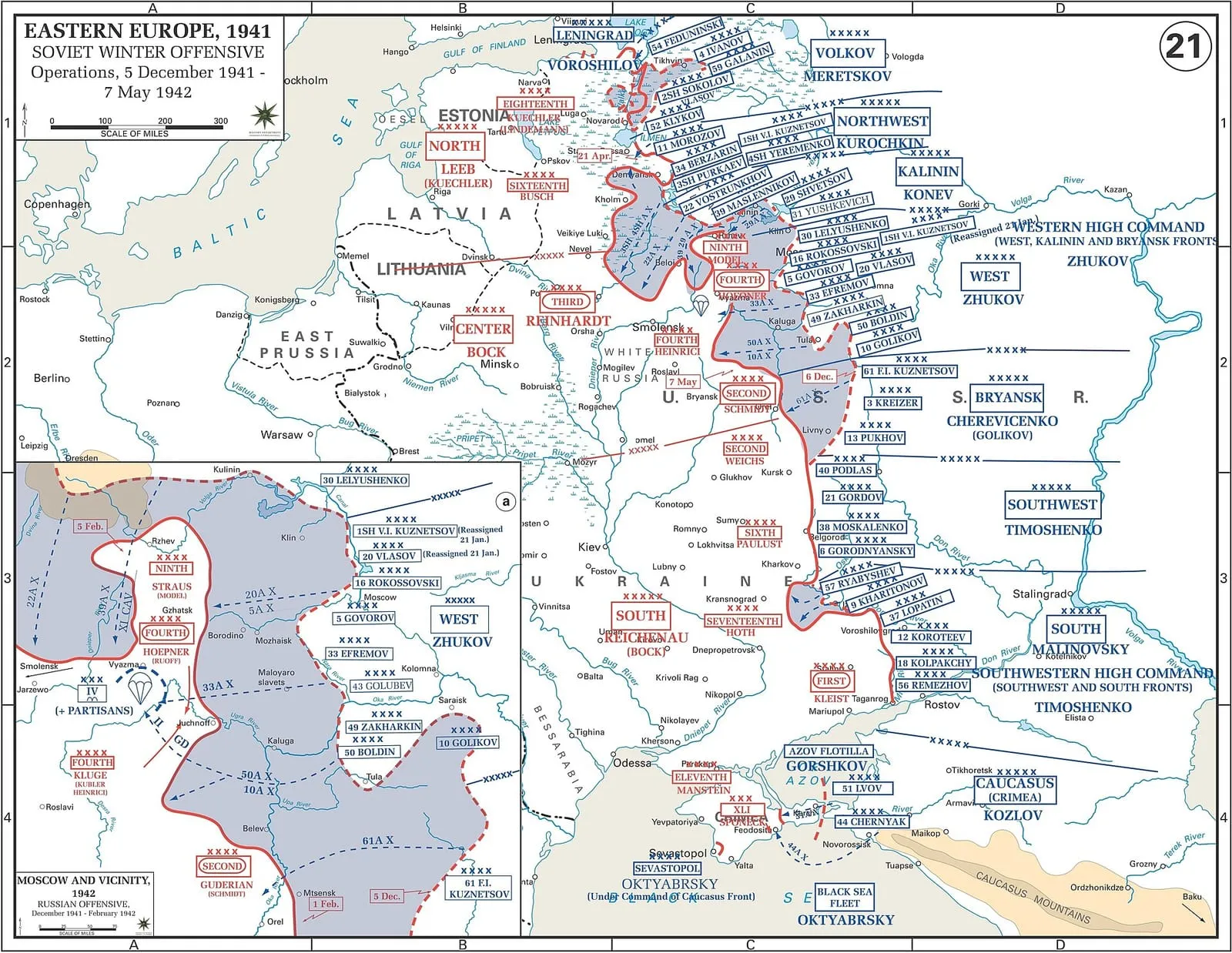
On 5 December 1941, in more than twenty degrees of frost, the Red Army went over to the counter-offensive at Moscow. In the morning the troops of Colonel General Ivan Konev’s Kalinin Front attacked north of the capital, followed the next day by General of the Army Georgy Zhukov’s Western Front and the right wing of the South-Western Front. The German Army Group Centre, which only a few days earlier had still been trying to break through at Khimki and Naro-Fominsk, was taken by surprise: its divisions were exhausted, stretched out over hundreds of kilometres and without fortified positions. Over the following weeks the Wehrmacht, for the first time in this war, fell back along an entire sector of the front.
Popular chronologies describe these days in three entries. Under 5 December they state that the Germans broke off their attack on Moscow 11 miles (about 18 kilometres) from the city, and that the USSR counter-attacked in a heavy snowstorm; under 8 December, that the Red Army liberated Kamenka, Krasnaya Polyana and Kryukovo, and that the Germans never again came within artillery range of Moscow; under 16 December, that the German offensive at Moscow came to a complete halt. These entries need some additions. The distance of 18 kilometres can at most be measured to the city limits of the time; the nearest German positions were 25–30 kilometres from the Kremlin. The first days of the counter-offensive were above all bitterly cold – about 25 degrees of frost were recorded in Moscow at the time – while the heavy blizzards came on 10–15 December. Finally, the German offensive did not “come to a halt” on 16 December, since it had been suspended on 5–6 December; by the middle of the month the Germans were already in retreat, and on that day Adolf Hitler forbade any further withdrawal.
Reserves
The counter-offensive was made possible by the reserves that the Stavka had been assembling since October, as the Germans advanced on Moscow. Behind the front, on the Volga and in the interior, new armies were being formed, while regular divisions were brought in from the Far East, Transbaikalia and Central Asia. Joseph Stalin could strip these regions because in the autumn he became increasingly confident that Japan would not attack the USSR. This was confirmed by the reports from Tokyo of Richard Sorge, arrested in October, although historians disagree about how much weight Stalin gave them. In these same days Japan turned decisively south: on 1 December an Imperial Conference resolved to go to war with the United States and Britain, and on 2 December the fleet received the signal to attack.
The popular image of the “Siberian divisions” that saved Moscow is exaggerated. According to research by David Glantz and Alexei Isaev, among others, units from the Far East amounted – depending on how they are counted – to anything from a few to a dozen or more divisions: they were valuable because they were at full strength and well trained, but they formed a minority of the troops that took part in the counter-offensive. The new armies mattered more. At the end of November the Stavka gave Zhukov Lieutenant General Vasily Kuznetsov’s 1st Shock Army, the 20th Army of Major General Andrei Vlasov – the same Vlasov who was captured in 1942 and went over to the Germans – and Lieutenant General Filipp Golikov’s 10th Army. The first two took up positions north of the capital, where the threat was greatest; the third in the south-east, against Guderian’s wedge.
Zhukov’s plan, approved by Stalin on 30 November, did not yet envisage the destruction of the whole of Army Group Centre. Its aim was to remove the immediate threat to Moscow: to strike at both German wedges, which were outflanking the capital from the north, via Klin and Solnechnogorsk, and from the south, around Tula. The Kalinin Front was to pin down the German 9th Army at Kalinin and break into the rear of the German forces around Klin. According to Soviet figures, some 1.1 million men, fewer than 800 tanks and about 1,400 aircraft took part in the counter-offensive – fewer tanks and men than Army Group Centre possessed, according to Soviet estimates. Superiority was achieved only on selected sectors. Surprise was decisive: on 4 December the intelligence branch of the German General Staff assessed that the Red Army was incapable of any major offensive without large reinforcements.
The first days
On the morning of 5 December the 31st and 29th Armies of the Kalinin Front attacked across the frozen Volga south-east and west of Kalinin. Progress was slight at first, but the Germans were forced to keep divisions here that were badly needed before Moscow. That same day Colonel General Heinz Guderian broke off his attack around Tula, and the forward divisions of the 3rd and 4th Panzer Groups went over to the defensive. Field Marshal Fedor von Bock’s Army Group Centre headquarters did not formally order the attack halted and a switch to the defensive until the evening of 6 December.
On 6 December the Western Front moved off. In the north Major General Dmitry Lelyushenko’s 30th Army, reinforced with fresh divisions from the Urals and Siberia, broke through the front north of Klin and by the evening of 7 December had advanced some 25 kilometres; the 1st Shock Army crossed the Moscow Canal near Dmitrov and on 7–8 December retook Yakhroma, where the Germans had crossed the canal at the end of November. In the south the 10th Army and Major General Pavel Belov’s 1st Guards Cavalry Corps struck Guderian’s exposed flank; Mikhailov was retaken on 7 December and Venyov on 9 December. Further south the troops of Marshal Semyon Timoshenko attacked at Yelets on 6 December, recaptured the town on 9 December and by the middle of the month had encircled and destroyed part of the German 2nd Army.
The hardest fighting was directly in front of Moscow, on the sector of the 20th and 16th Armies, where the Germans were defending fortified villages on the Leningrad highway and around present-day Zelenograd. The settlement and station of Kryukovo on the Moscow–Klin railway, taken on 30 November by the German 5th Panzer Division, changed hands several times according to Russian studies. On 7 December the 8th Guards Rifle Division – formerly Panfilov’s division – and the 44th Cavalry Division attacked it after a short artillery preparation, and on 8 December, after night raids by assault groups and the repulse of a German counter-attack, the Germans withdrew from Kryukovo and the neighbouring village of Kamenka. The same day the 331st Rifle Division and the 28th Rifle Brigade retook Krasnaya Polyana, today part of the town of Lobnya, the closest point to the Kremlin occupied by sizeable German forces. In 1966 the remains of an unknown soldier from a mass grave beside the Leningrad highway near Kryukovo were moved to the foot of the Kremlin wall, to the Tomb of the Unknown Soldier.
The frequently repeated remark that from 8 December the Germans were no longer within artillery range of Moscow must be treated with caution. Soviet and Russian accounts say that the Germans brought heavy guns up to Krasnaya Polyana to shell the capital, but there is no firm evidence of this. What is true is that after 8 December the front moved rapidly away from the city, and German ground forces never again came close to Moscow.
Directive No. 39 and Hitler’s order
On 8 December Hitler signed Directive No. 39. In it he explained that a severe winter had arrived “surprisingly early” and that supply difficulties made it necessary to halt all major offensive operations on the Eastern Front immediately and go over to the defensive. The troops were to hold areas important to the enemy, rest and prepare to resume operations in 1942; the directive permitted shortening of the front only to a limited extent. At headquarters it was still not understood that this was not a pause in the German advance but a major enemy offensive.
The Germans retreated in the frost, abandoning frozen tanks, guns and lorries that could neither be started nor dragged out of the snow. Soviet ski columns and cavalry units outflanked the withdrawing divisions and attacked supply trains and headquarters in the rear. Solnechnogorsk was retaken on 12 December, Klin during the night of 14–15 December, and Istra on 15 December. On 16 December troops of the Kalinin Front entered Kalinin – after Rostov-on-Don, one of the first large cities recovered by the Red Army. On 13 December the Sovinformburo issued a communiqué on “the failure of the German plan to encircle and capture Moscow”, with photographs of Zhukov and the army commanders who had taken part; newspapers all over the world wrote of the Wehrmacht’s first great retreat.
The German commanders, especially Guderian and the commander of the 4th Panzer Group, Colonel General Erich Hoepner, wanted to fall back to shorter, more favourable lines. Hitler, who feared that a retreat in such conditions would turn into a rout, like that of Napoleon’s Grande Armée in 1812, forbade any major withdrawals on 16 December, and on 18 December confirmed this with an order demanding “fanatical” resistance from the troops in the positions they held, regardless of enemy forces on their flanks and in their rear. To this day it is disputed whether this order saved Army Group Centre from disintegration, as many German generals claimed after the war, or whether it needlessly bled divisions white in hopeless positions. Dismissals soon followed. Bock gave up his command on 18–19 December, and on 19 December Hitler removed the Commander-in-Chief of the Army, Field Marshal Walther von Brauchitsch, and took over the post himself.
On 20 December the Red Army retook Volokolamsk, and by the end of the month the advance in the north had reached the Lama and Ruza rivers, where the Germans managed to halt on prepared positions. In the centre Naro-Fominsk was retaken on 26 December. In the south the 50th Army broke into Kaluga on 21 December and, after several days of street fighting, cleared it on 30 December.
Burnt villages
The front, as it moved west, left a devastated land behind it. For both armies the winter was a struggle for a roof over their heads: whoever held a village with warm cottages had a chance of surviving the night. As early as 17 November the Stavka, in Order No. 0428, had ordered the burning of settlements behind the German lines to deprive the enemy of quarters; the sabotage units that carried it out, among them groups of volunteers from Moscow, set fire to villages together with their inhabitants’ belongings. The Germans retreating in December did the same on a far larger scale: many units were under orders to destroy the places they abandoned, and the inhabitants were often driven out into the frost. Soldiers took warm clothing, felt boots and food from the peasants.
From the first days of the counter-offensive the Soviet authorities documented the destruction and the crimes in the recovered territory, and the press wrote about them extensively. In Klin the house-museum of Pyotr Tchaikovsky was vandalised, in Istra the Cathedral of the Resurrection in the New Jerusalem Monastery was blown up, and at Yasnaya Polyana, where Guderian’s headquarters had been quartered in November, a special commission of the USSR Academy of Sciences recorded at the end of December the damage to Leo Tolstoy’s estate. Some of these reports served propaganda, but many were later confirmed by historians’ research and by German documents. The people of the recovered villages returned to ashes, and dugouts and communal quarters in the surviving cottages were their only shelter for many months.
Place in the war
The counter-offensive at Moscow was the Red Army’s first great victory and the Wehrmacht’s first serious defeat of the Second World War. By 7 January 1942 the Germans had been thrown back 100–250 kilometres from the capital. The plan to defeat the Soviet Union in a single lightning campaign, on which Hitler’s entire strategy rested, had collapsed. According to Krivosheev’s tally, the Red Army lost 139,586 killed, missing and captured and 231,369 wounded and sick in the counter-offensive (5 December – 7 January). Army Group Centre lost more than a hundred thousand men in December alone, together with most of its tanks, hundreds of guns and tens of thousands of vehicles.
The counter-offensive coincided with events that changed the character of the whole war. On 7 December Japan attacked the American fleet at Pearl Harbor, and on 11 December Germany and Italy declared war on the United States. Within a week Hitler, whose troops were retreating from Moscow, had the Soviet Union, Britain and the United States ranged against him. Against Zhukov’s warnings, Stalin decided at the beginning of January 1942 to widen the counter-offensive into a general offensive along the entire front, from Leningrad to the Crimea. The exhausted Soviet armies, however, failed to destroy Army Group Centre: the front came to rest around Rzhev and Vyazma, and the fighting for that salient consumed hundreds of thousands of soldiers in 1942. But Moscow had been saved, and the myth of the invincible Wehrmacht had been shaken.
Sources
Meanwhile
(04)Elsewhere, within a week.
- 7 December 1941 · PacificThe attack on Pearl HarborOn 7 December 1941 aircraft from six Japanese carriers struck Pearl Harbor. 2,403 Americans were killed and four battleships of the Pacific Fleet were sunk.
- 3 December 1941 · Crimes and repressionActions in the Wilno Ghetto in DecemberBetween 3 and 22 December 1941 Germans and Lithuanians took people from the Wilno Ghetto to Ponary three more times. At least 850 people were killed.
- 3 December 1941 · SocietyThe conscription of women in BritainIn early December 1941 Churchill announced the call-up of unmarried women aged 20–30 and of men up to 51. The Act was passed on 18 December.
- 7 December 1941 · Crimes and repressionThe Night and Fog decreeOn 7 December 1941 Keitel signed Hitler's guidelines, later called the Nacht und Nebel decree. Suspected resisters in the West vanished secretly into the Reich.
Related events
(04)The same battle, people or subject.
- 2 October 1941 · Eastern FrontOperation TyphoonOn 2 October 1941 Army Group Centre advanced on Moscow. Within days Bock’s tanks broke through and were encircling Soviet armies at Vyazma and Bryansk.
- 28 November 1941 · Eastern FrontThe Germans reach the Moscow–Volga CanalOn the night of 27–28 November 1941 a 7th Panzer Division battlegroup crossed the Moscow Canal at Yakhroma. A 1st Shock Army counter-attack threw it back.
- 15 November 1941 · Eastern FrontThe November offensive on MoscowOn 15 November 1941, with the ground frozen, Army Group Centre resumed its advance on Moscow. Panzer groups were to bypass the capital to north and south.
- 5 January 1942 · Eastern FrontStalin orders a general offensiveOn 5 January 1942 Stalin, overruling Zhukov, ordered attacks on all fronts. On 7 January the Moscow counter-offensive ended, but the Germans held their front.