Germany
Walther von Brauchitsch
Commander-in-Chief of the Army (1938–1941), Colonel General, field marshal from 1940
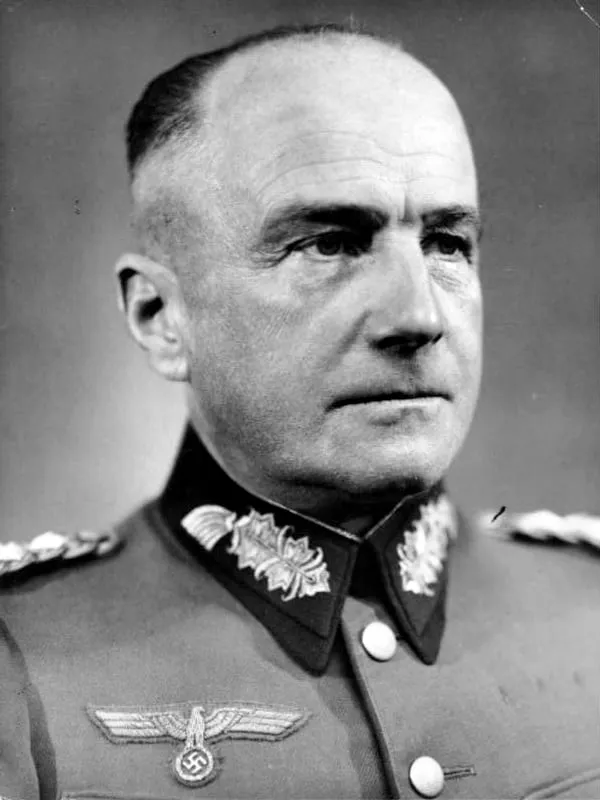
- Born:
- 4 October 1881, Berlin (German Empire)
- Died:
- 18 October 1948, Hamburg (British occupation zone of Germany)
- Author:
- Łukasz
- Photo:
- autor nieznany, CC BY-SA 3.0 DE, Wikimedia Commons

For almost four years, from February 1938 to December 1941, Walther von Brauchitsch was Commander-in-Chief of the German Army. It was he who formally led the army that invaded Poland in 1939 and in the following years conquered France, the Balkans and the western part of the Soviet Union. He came from a Prussian military family and was a capable staff officer, but he owed his post to the fact that Adolf Hitler saw in him a man easy to manage. Several times he contemplated opposing Hitler’s war plans; each time he backed down. He signed orders that opened the way to crimes in Poland and the USSR. After the defeat at Moscow Hitler laid the blame on him and took command of the army himself. Brauchitsch died in British custody before he could be brought to trial.
Origins and the First World War
Walther Heinrich Alfred Hermann von Brauchitsch was born in Berlin on 4 October 1881, the sixth of seven children of the cavalry general Bernhard von Brauchitsch. The Brauchitsch family came from Silesia and had given Prussia officers for generations. Walther attended first the French Gymnasium in Berlin and then the cadet corps at Potsdam and Lichterfelde, where he served as a page to the Empress Augusta Victoria. In March 1900 he was commissioned as a second lieutenant in a Guards grenadier regiment, but soon transferred to the 3rd Guards Field Artillery Regiment. He remained faithful to the artillery for the rest of his career.
In 1910 he married the wealthy Elisabeth von Karstedt, with whom he had three children. Their son Bernd became adjutant to Hermann Göring during the Second World War. Walther’s nephew was the famous racing driver Manfred von Brauchitsch.
In 1909 Brauchitsch was posted to the Great General Staff even though he had not attended the War Academy – a rare distinction. He spent the First World War as a staff officer on the Western Front: with XVI Corps at Metz and in the Argonne, with the 34th Division at Verdun, and in 1917–1918 with the 11th Division, the 1st Guards Reserve Division and the Guards Reserve Corps. He fought on the Aisne and in Flanders, among other places. He ended the war as a major, with the Iron Cross, both classes, and the House Order of Hohenzollern.
In the Reichswehr
Brauchitsch remained in the 100,000-man Reichswehr. He served on staffs and in the ministry’s artillery department, where he worked on the new organisation of the artillery and its cooperation with the infantry. In 1927 he became chief of staff of the 6th Division in Münster, in 1928 a colonel, and from 1930 he headed the training department of the Truppenamt, the disguised general staff. In October 1931 he was promoted to Generalmajor, and in March 1932 he became Inspector of Artillery. Unlike many officers, he did not express political views. He did not defend the Republic, but nor did he openly attack it.
Career in the Third Reich
On 1 February 1933, two days after Hitler took power, Brauchitsch took over command of Military District I in Königsberg and the 1st Division from Werner von Blomberg, who had become Reichswehr Minister. In East Prussia, which bordered on Poland and Lithuania, the army was preparing to defend the province and to expand its forces there in wartime. Here Brauchitsch clashed with Gauleiter Erich Koch, and later with Heinrich Himmler when the latter wanted to replace military guards with SS men. But this was a matter not of principle but of the army’s prerogatives. In October 1933 Brauchitsch became a Generalleutnant, in 1935 commander of I Army Corps, and in 1936 General of Artillery. In April 1937 he took command of Army Group 4 in Leipzig.
His great opportunity came with the crisis of early 1938. When Blomberg had been removed through a scandal over his marriage, and the Commander-in-Chief of the Army, Werner von Fritsch, through a fabricated charge of homosexuality, Hitler looked for a general to replace him who would obey him and be accepted by the officer corps. Brauchitsch’s candidacy was backed by Fritsch himself and by the generals, and it suited Hitler that the general was in a difficult personal situation. For years he had wanted a divorce in order to marry Charlotte Rüffer, but lacked the money for a settlement with his wife. According to historians’ findings, Hitler helped him, and the funds – some 80,000 Reichsmarks according to various sources – made the new commander dependent on the dictator. On 4 February 1938 Brauchitsch became Commander-in-Chief of the Army and a Colonel General. At the same time several dozen senior officers were retired or transferred, and Brauchitsch did not stand up for them. He divorced in April and in September married Charlotte, an ardent supporter of Hitler.
Brauchitsch’s role in the Czechoslovak crisis was ambiguous. In the summer of 1938 the Chief of the General Staff, Ludwig Beck, urged him to have the generals jointly refuse to take part in a war which, in their view, was bound to end in defeat. Brauchitsch presented Beck’s memorandum to Hitler but, contrary to Beck’s intentions, did not support a collective protest. Beck resigned in August, and his successor Franz Halder and a group of conspirators counted on Brauchitsch to lead the army against the dictator if Hitler gave the order to attack. Brauchitsch never clearly agreed. The Munich Agreement made the problem disappear. In April 1939 Hitler presented him with the Golden Party Badge.
The war with Poland
Brauchitsch was one of the chief executors of Case White. On 25 March 1939 Hitler instructed him to start working on the “Polish question”. On 23 May he attended the conference at the Reich Chancellery at which Hitler announced that he would attack Poland at the first opportunity. On 15 June the OKH (the Army High Command) issued his directive for the deployment of the army, drawn up by Halder’s staff. On 22 August at the Berghof he heard the speech in which Hitler announced the “complete destruction of Poland”. On the evening of 25 August he gave assurances that the troops could still be halted.
In the September Campaign Brauchitsch commanded, from Zossen and from a field headquarters, all the ground forces fighting in Poland: Fedor von Bock’s Army Group North and Gerd von Rundstedt’s Army Group South. The campaign was not a “Blitzkrieg” in the later sense of the word: the panzer divisions operated as part of the armies, and victory was decided by superior strength and envelopment from three sides. The crisis on the Bzura in the second week of September forced the OKH to regroup some of its forces from around Warsaw. On 30 September Brauchitsch was awarded the Knight’s Cross of the Iron Cross.
Hitler also gave him executive authority in the occupied territories. As early as 1 September Brauchitsch issued a proclamation to the Polish population, and the army exercised military administration until 25 October. He knew of the tasks of the Einsatzgruppen, because before the war the OKH had agreed with Reinhard Heydrich the rules for their operations in the army’s rear, and he quickly learned of the mass executions of Operation Tannenberg. Protests from within the army, among them those of General Johannes Blaskowitz, who from November 1939 wrote about the crimes of the SS and police, found no support from him. In early 1940, according to historians’ findings, in an order to commanders he justified ruthless methods against Poles and Jews by the need to secure German “living space”. Earlier, on 4 October 1939, Hitler had proclaimed an amnesty for soldiers and SS men who had committed crimes in Poland.
From Zossen to Moscow
In the autumn of 1939 Hitler wanted to attack France as early as November. Brauchitsch and Halder considered this madness, and in opposition circles there was again talk of a coup. On 5 November Brauchitsch presented his objections to Hitler and accused the infantry of lacking the fighting spirit of 1914. Hitler flew into a rage, accused him of cowardice and threatened to root out the “spirit of Zossen”, where the OKH had its headquarters. Brauchitsch returned shaken and broke off contact with the conspirators. The attack was postponed dozens of times because of the weather. Brauchitsch and Halder at first rejected Erich von Manstein’s plan to make the main thrust through the Ardennes, and moved its author to the command of a corps. Once Hitler had adopted the Manstein plan, the OKH worked it out in detail.
The victory over France in June 1940 was the peak of Brauchitsch’s career. On 19 July 1940 Hitler made him a field marshal, together with eleven other generals. That same month the dictator ordered him to begin preparations for war with the USSR. In 1941 the army under his command conquered Yugoslavia and Greece, and on 22 June it attacked the Soviet Union. Brauchitsch did not object to the “war of annihilation” that Hitler announced to the generals on 30 March 1941. The OKH prepared the decree restricting military jurisdiction and the Commissar Order, to which Brauchitsch added only remarks about maintaining discipline.
The first months of the campaign brought great encirclements, but in the summer Brauchitsch and Halder quarrelled with Hitler over the direction of the advance. The dictator halted the march on Moscow for several weeks in order to take Ukraine. The autumn offensive bogged down in mud and frost, and on 5 December the Red Army went over to the counter-offensive. In November Brauchitsch suffered a heart attack. On 19 December 1941 Hitler accepted his resignation and took command of the army himself. He reportedly told Halder that this little matter of operational command was something anyone could do.
Last years
Brauchitsch was transferred to the reserve and never met Hitler again. He spent most of the rest of the war at the Tři Trubky hunting lodge in the Brdy hills near Příbram, which he had received from the state. After the 20 July plot of 1944, in which many of his former subordinates were killed or executed, he publicly condemned the conspirators and in the Völkischer Beobachter welcomed Himmler’s appointment as commander of the Replacement Army. He later explained to Halder that he had done so to save a relative.
In the summer of 1945 he was arrested by the British. He testified as a witness at Nuremberg, and together with Halder, Manstein and other generals wrote a memorandum on the German army in the years 1920–1945 that presented the army as Hitler’s apolitical instrument. It became one of the foundations of the myth of the clean Wehrmacht. In 1948 the British announced that he would be tried before a military court in Hamburg. Brauchitsch, almost blind and gravely ill, died on 18 October 1948 in a British military hospital in Hamburg, of pneumonia or heart failure according to different sources.
Assessment
Historians judge Brauchitsch harshly. Helmut Krausnick saw him as an outstanding professional who lacked the strength of character to stand up to Hitler. Ian Kershaw called him a spineless man who was afraid of the dictator. The conspirators of 1938–1939 despised him for his vacillation, and Hitler, who had chosen him himself, eventually made him a scapegoat. Brauchitsch was a typical representative of a generalship that embraced the Nazi state as a chance to restore Germany’s military power and carried out orders even when they meant the murder of civilians and prisoners of war. As Commander-in-Chief of the Army in 1939–1941 he shares responsibility for the crimes committed in Poland and the Soviet Union, although he was never tried for them.
Sources
Commanded in battles
(01)Mentioned in battles
(09)Often appears with
People who appear in the same events.
On the timeline
(43)The 40 most important of 43 events. All tagged “Walther von Brauchitsch” (1) →
1937
1939
March
April
August
September
- 01
- Key eventGermany invades PolandAt dawn on 1 September 1939 the Wehrmacht attacked Poland from the north, west and south without declaring war. The Slovak army struck alongside the Germans.
- The defence of the Polish Post Office in GdańskOn 1 September 1939 Polish postal workers held the Polish Post Office in Gdańsk for about 14 hours. After their surrender 38 were sentenced to death and shot.
October
1940
1941
February
March
April
June
July
August
September
October
November
- 28
- The Red Army retakes RostovOn 28 November 1941 the Germans began leaving Rostov under attack by three Soviet armies; next day it was free. Rundstedt fell back to the Mius and was sacked.
- The Germans reach the Moscow–Volga CanalOn the night of 27–28 November 1941 a 7th Panzer Division battlegroup crossed the Moscow Canal at Yakhroma. A 1st Shock Army counter-attack threw it back.