Germany
Albert Forster
NSDAP Gauleiter in Danzig (1930–1945), head of state of the Free City of Danzig (1939), Reichsstatthalter of Reichsgau Danzig-West Prussia (1939–1945)
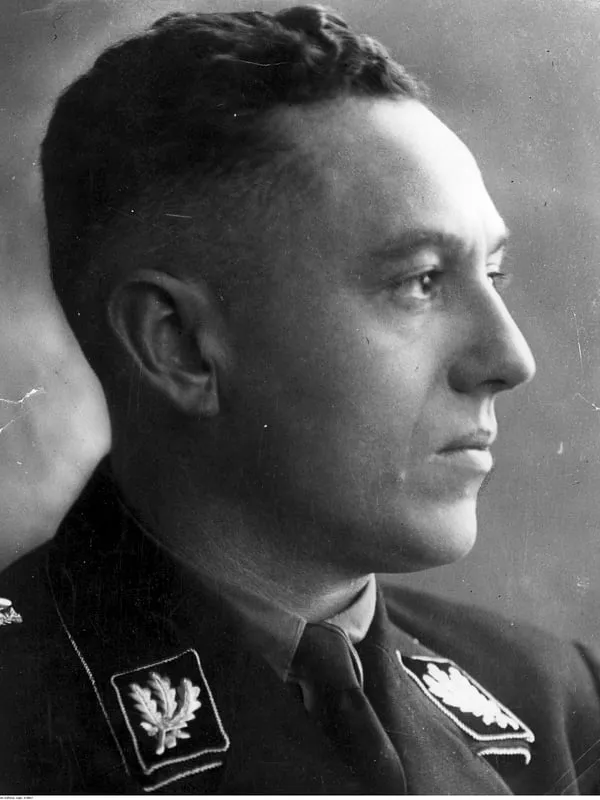
- Born:
- 26 July 1902, Fürth (Bavaria, German Empire)
- Died:
- 28 February 1952, Warsaw
- Author:
- Natalia
- Photo:
- autor nieznany, domena publiczna, Wikimedia Commons

Albert Forster was the man who turned the Free City of Danzig into a Nazi bridgehead and then incorporated it into the Reich. A bank trainee from Franconia, a protégé of the antisemite Julius Streicher and a confidant of Adolf Hitler, he became the NSDAP’s Gauleiter in Gdańsk (Danzig) in 1930 at the age of 28. For nine years he brought the city under his control in defiance of a constitution guaranteed by the League of Nations; in 1939 he stoked the Danzig crisis that became the pretext for war, and on 1 September he proclaimed the city’s annexation to the Reich. As Reichsstatthalter of Reichsgau Danzig-West Prussia he bore responsibility for the murder of tens of thousands of Poles and Jews and for the forced Germanisation of Pomerania. After the war the Polish Supreme National Tribunal sentenced him to death. He was executed in Warsaw in 1952.
Youth in Franconia
Albert Maria Forster was born on 26 July 1902 in Fürth in Bavaria, the youngest of six children of a prison official. He attended elementary school and a classical grammar school, which he left in 1920, and after a commercial apprenticeship worked as a clerk at a local bank. He was drawn into the National Socialist movement early: in November 1923, just before the Munich Putsch, he joined the NSDAP and the SA. After the party was banned he was active in its stand-in, the Greater German National Community, and in 1924 the bank dismissed him for his political activity. He then earned his living selling subscriptions to the antisemitic weekly Der Stürmer and became friends with its publisher, the Gauleiter of Franconia, Julius Streicher. In 1925, after the party was refounded, he rejoined it with membership number 1924, and in 1926 he joined the SS. He led the party in Fürth and, from 1928, in the district of Middle Franconia. He was an effective speaker and organiser and also worked in a nationalist association of commercial employees.
In the election of 14 September 1930, in which the NSDAP became the second-largest force in Germany, Forster became one of the youngest members of the Reichstag. A few weeks later, on 15 October 1930, Hitler appointed him Gauleiter in Danzig, where the local party was weak and riven by quarrels. According to German sources he had been recommended to Hitler by Hermann Göring, who had visited the city that summer. Forster arrived in Danzig on 24 October 1930.
Gauleiter of Danzig
The Free City of Danzig, detached from Germany by the Treaty of Versailles and placed under the protection of the League of Nations, was ideal ground for Nazi agitation: almost all its inhabitants were German, and few had accepted separation from the Reich. Forster founded a party newspaper, the Danziger Beobachter (later the Danziger Vorposten), and within two years multiplied the party’s membership several times over. His appointment, however, started a feud with the local activist Arthur Greiser, who was pushed aside to become his deputy, that lasted for the rest of their lives.
After Hitler came to power in the Reich, the Nazis won the elections to the Danzig Volkstag on 28 May 1933 with an absolute majority. Hermann Rauschning became President of the Senate; he sought an understanding with Poland but soon fell out with Forster and stepped down in November 1934, to be replaced by Greiser. Although Forster held no state office in the Free City, he ruled through the party and its men in the Senate. In 1934 he married Gertrud Deetz; the wedding took place in the Reich Chancellery, with Hitler and Rudolf Hess as witnesses.
Step by step Forster eliminated the opposition: the Social Democrats, the Communists, the Catholic Centre and the German Nationalists. Newspapers were shut down, opponents were locked up in “protective custody”, and Jews were driven out of economic and public life. Complaints to the League of Nations achieved nothing. The Irish High Commissioner Seán Lester, who defended the constitution, became the target of a campaign of vilification and left in 1937, while his successor, Carl Jakob Burckhardt, largely confined himself to smoothing over disputes. As long as Hitler was courting Poland after the non-aggression declaration of 1934, however, Berlin restrained the Danzig Nazis in matters concerning Poland. In November 1938, as in the Reich, synagogues were set on fire and Jewish shops destroyed in Danzig and Sopot (Zoppot), and most of the roughly ten thousand Jews of Danzig emigrated before the outbreak of war.
The Danzig crisis
After Ribbentrop’s demands on Poland, Forster became one of the chief executors of the campaign meant to prepare the ground for war. He carried out Berlin’s instructions: he gave fiery speeches about a “return to the Reich” and harassed Polish customs officers and railwaymen, while quietly turning the demilitarised city into an armed camp, with weapons smuggled in from East Prussia, the SS-Heimwehr Danzig and an entire brigade under a German general. He travelled repeatedly to see Hitler and relayed his words to Burckhardt, sometimes reassuring, sometimes threatening. It was to this situation that Neville Chamberlain responded in July, warning against settling Danzig’s fate by faits accomplis. On 23 August 1939 the Danzig Senate, in breach of the constitution, made Forster head of state.
On the morning of 1 September, as the battleship Schleswig-Holstein was shelling Westerplatte, Forster proclaimed the annexation of the Free City to the Reich. That same day he watched the assault on the Polish Post Office from an armoured car, while the Danzig police and the SS arrested thousands of Poles from lists prepared in advance. On 19 September he welcomed Hitler to Danzig, where the Führer celebrated the city’s “return” in the Artus Court.
Reichsstatthalter of Danzig-West Prussia
On 8 September 1939 Forster became head of the civil administration of the West Prussia military district, and on 26 October, when Hitler’s decree incorporating western Poland into the Reich came into force, Gauleiter and Reichsstatthalter of the new Reichsgau Danzig-West Prussia. It comprised the former Free City, Polish Pomerania with Bydgoszcz and Toruń, and the Marienwerder (Kwidzyn) administrative district. Hitler gave his Gauleiters in the east a free hand: within ten years the Reichsgau was to become “purely German”, and no one would ask about the methods.
In the autumn and winter of 1939 Pomerania saw one of the greatest crimes of the early war. The Einsatzgruppen, SS units (among them Kurt Eimann’s Danzig battalion) and the Volksdeutscher Selbstschutz, made up of local ethnic Germans, murdered Polish teachers, priests, officials, landowners, activists and anyone considered an enemy, as well as Jews and the mentally ill, as part of Operation Tannenberg, launched in September, and the so-called Intelligenzaktion. In the forests of Piaśnica near Wejherowo 12,000–14,000 people were killed, according to Poland’s Institute of National Remembrance, and many others at Szpęgawsk, Fordon, Klamry and dozens of other places. Forster was not formally in command of the SS, but as the highest authority in the Reichsgau he inspired and approved this policy. According to Polish sources, on 27 November 1939 in Bydgoszcz he said that whoever belonged to the Polish nation “must disappear”. The Central Office for the Investigation of National Socialist Crimes in Ludwigsburg later estimated the number of victims in his Reichsgau at 52,000–60,000, the overwhelming majority murdered in the first months of the occupation. Thousands were deported to the General Government or imprisoned in the Stutthof camp.
Forster differed from the other Nazi governors in his method of Germanisation. Whereas Heinrich Himmler and Greiser, the Reichsstatthalter of the neighbouring Warthegau, relied on racial selection and mass deportations, Forster aimed to report to Hitler as quickly as possible that his Reichsgau was German. He entered the inhabitants of Pomerania en masse on the German People’s List (Deutsche Volksliste) without requiring proof of descent, and punished refusal with deportation or the camp. By some estimates around two-thirds of the Polish population of the Reichsgau were classified as German in this way, and the men were then called up into the Wehrmacht. Himmler and Greiser complained to Hitler, but he told them to come to terms with Forster. According to one account, Forster scoffed that if he looked like Himmler he would not talk about race. He also waged bitter disputes with Himmler’s representative in the Reichsgau, the Higher SS and Police Leader Richard Hildebrandt, who was recalled in 1943.
Downfall
In September 1944 Forster took command of the Volkssturm in his Reichsgau. In the winter of 1945, as the Red Army entered Pomerania, he delayed the evacuation of the population while hundreds of thousands of refugees poured into Danzig. In March he went to see Hitler in Berlin, convinced that the city could not be held, and came back assuring everyone that the Führer would save Danzig. A few days later he fled to the Hel peninsula, and on 4 May he left by ship for the west, for Schleswig-Holstein. On 27 May 1945 the British arrested him in Hamburg, and in August 1946 they handed him over to Poland as a war criminal.
Forster was tried before the Supreme National Tribunal in Gdańsk in April 1948. The trial lasted from 5 to 29 April. The tribunal found him guilty of membership of a criminal organisation, the murder of the Polish population and of Jews, mass deportations, forced Germanisation and the plunder of property, and sentenced him to death. The execution of the sentence was deferred. Forster wrote pleas for clemency, and the case dragged on for years for reasons that have never been explained. On 28 February 1952 he was taken from Gdańsk to Warsaw and hanged the same day in Mokotów prison. His wife was not informed of his death until 1954, which gave rise to unconfirmed rumours that he had lived longer.
Significance
Forster was a typical member of the second rank of Nazi leaders: he created no ideology, but carried out Hitler’s will faithfully and brutally, relying on his personal trust. In Danzig he showed how easily the Nazis could take over a state protected by international guarantees when the guarantors were unwilling to defend it. In 1939 he was one of the main actors in the crisis that Hitler used as a pretext for the invasion of Poland. As Reichsstatthalter he bears responsibility for the deaths of tens of thousands of the inhabitants of Pomerania and for the attempt to strip an entire province of its national identity. His trial was, alongside Greiser’s trial in 1946, the most important trial of a Nazi Reichsstatthalter before a Polish court.
Sources
Often appears with
People who appear in the same events.
On the timeline
(15)1919
1920
1939
March
April
July
September
- 01
- Key eventGermany invades PolandAt dawn on 1 September 1939 the Wehrmacht attacked Poland from the north, west and south without declaring war. The Slovak army struck alongside the Germans.
- The defence of Westerplatte beginsAt 4.45 a.m. on 1 September 1939 the battleship Schleswig-Holstein shelled the Polish depot on Westerplatte. Its garrison beat off two assaults that day.
- Germany annexes the Free City of DanzigOn 1 September 1939 Albert Forster proclaimed the Free City of Danzig part of the Reich, and the Reichstag confirmed it by law. Arrests of Poles began.
- The defence of the Polish Post Office in GdańskOn 1 September 1939 Polish postal workers held the Polish Post Office in Gdańsk for about 14 hours. After their surrender 38 were sentenced to death and shot.
- Hitler’s Reichstag speechOn 1 September 1939 Hitler told the Reichstag at the Kroll Opera House that since 5.45 Germany had been “returning fire”. He cast the war as self-defence.