- Category:
- Diplomacy
- Date:
- 1 December 1925
- Author:
- Natalia
- Tags:
- Germany, France, Gustav Stresemann, Poland
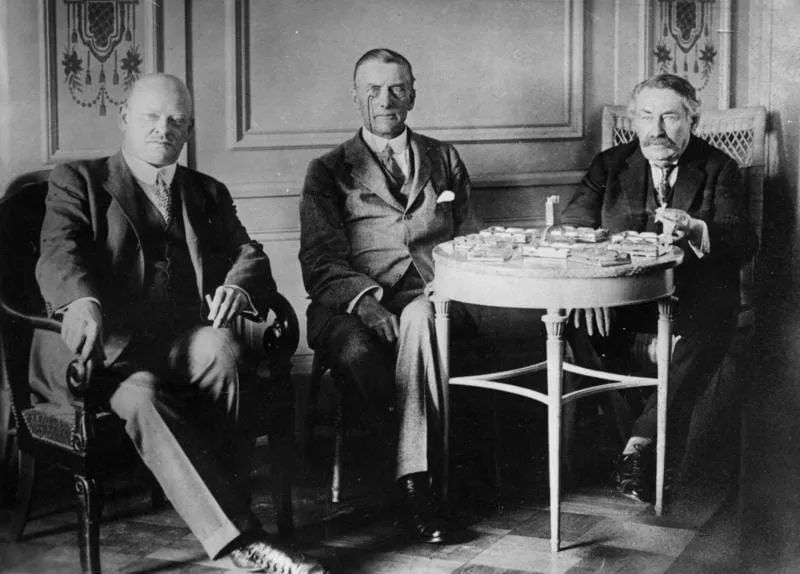
On 1 December 1925, in the building of the British Foreign Office in London, representatives of Germany, France, Great Britain, Italy, Belgium, Poland and Czechoslovakia signed a set of agreements that have gone down in history as the Locarno Treaties. They had been negotiated a few weeks earlier, on 5–16 October, in the Swiss resort of Locarno on Lake Maggiore, where their texts were initialled on 16 October. The most important of them, the Rhineland Pact, was the first agreement since the end of the war that Germany concluded with its former enemies as an equal partner rather than as a defeated nation having terms dictated to it. In it Germany voluntarily recognised its western border as drawn by the Treaty of Versailles and the demilitarisation of the Rhineland, while Great Britain and Italy became guarantors of this settlement. Germany did not recognise its eastern borders with Poland and Czechoslovakia.
War chronologies sometimes state that the agreements were “ratified on 14 September 1926”. This is a shorthand: the parliaments had approved them earlier, and it was on 14 September 1926, a few days after Germany’s admission to the League of Nations, that the instruments of ratification were deposited in Geneva, at which point the agreements came into force.
French security
After 1919 France lived with the feeling that it had won the war but not the peace. Germany had a larger population and stronger industry, and the guarantees promised in Paris by Woodrow Wilson and David Lloyd George collapsed when the United States Senate rejected the Treaty of Versailles. The French therefore sought security on their own: in the occupation of the Rhineland, in strict enforcement of the treaty and in alliances with Belgium, Poland and Czechoslovakia. In 1923 Prime Minister Raymond Poincaré went so far as to occupy the Ruhr to force Germany to pay reparations. The occupation drove Germany into hyperinflation, but it also drained French finances and exposed France’s isolation: Great Britain and the United States openly condemned Paris’s unilateral action. The compromise came in 1924 with the Dawes Plan, which settled reparations and allowed the French to withdraw from the Ruhr without losing face.
The question of security remained open. In the autumn of 1924 the Labour government of Ramsay MacDonald and the French Prime Minister Édouard Herriot drew up in Geneva a protocol for the peaceful settlement of disputes, which was to supplement the League of Nations Covenant with a system of arbitration and compulsory sanctions. The Conservative government of Stanley Baldwin, which took office in November 1924, was unwilling, however, to take on commitments all over the world. In March 1925 the new Foreign Secretary, Austen Chamberlain, announced to the League Council that Great Britain would not accept the protocol. London was prepared at most to guarantee the frontier on the Rhine, which it regarded as the frontier of its own security. It had no intention of guaranteeing the borders of Eastern Europe. Chamberlain wrote in 1925 that no British government would ever risk “the bones of a British grenadier” for the Polish Corridor.
Stresemann’s initiative
Under the Treaty of Versailles the Allies were to leave the first, Cologne, occupation zone in the Rhineland in January 1925. On 5 January, however, they announced that their troops would stay, because the Inter-Allied Military Control Commission had uncovered numerous breaches of the disarmament provisions. The German Foreign Minister, Gustav Stresemann, decided to meet the French halfway. On the advice of the British ambassador in Berlin, Lord D’Abernon, an idea from 1922 was revived, and in a memorandum sent to London on 20 January and to Paris on 9 February Germany proposed a pact among the states with an interest in the Rhine: a renunciation of war, recognition of the western border and arbitration agreements.
Stresemann was no pacifist and did not renounce the aims of German nationalism. He wanted the Allied troops to leave the Rhineland early, the control of disarmament to end and Germany to return to the ranks of the great powers. Above all, he wanted to prevent France from renewing a pact with Great Britain directed against Germany and to loosen the ties between Paris and Warsaw. Recognising the western border, which could not be changed anyway, was the price he was prepared to pay to keep a free hand in the east. On 7 September 1925, before leaving for Locarno, he wrote to the former Crown Prince Wilhelm that the aims of German policy were to ease reparations, protect Germans abroad, recover Gdańsk (Danzig), the Polish “Corridor” and part of Upper Silesia, and, in the more distant future, union with Austria. First, however, he added, Germany had to “get the strangler off its neck”, that is, rid the Rhineland of the occupier.
In Paris the initiative was received with distrust. The French ambassador in Berlin warned that Germany intended to treat its western and eastern borders quite differently. Herriot had no time to reply, as his government fell in April 1925. The Foreign Ministry was taken over by Aristide Briand, who believed that French security could no longer be built on coercion and that Germany had to be drawn into a system of mutual obligations. France set its conditions: Belgium must take part in the pact, the agreements would come into force only once Germany joined the League of Nations, and the guarantees should also cover the arbitration agreements with Poland and Czechoslovakia. Germany objected to the last condition, and the British backed it. In September lawyers from the five states prepared draft texts in London, and the ministers were invited to Switzerland.
The Locarno conference
The conference opened on 5 October 1925. Germany was represented by Chancellor Hans Luther and Stresemann, France by Briand, Great Britain by Chamberlain, Belgium by its Foreign Minister Émile Vandervelde and Italy by Senator Vittorio Scialoja. Towards the end of the talks Benito Mussolini arrived briefly, keen to show that Fascist Italy belonged among the powers deciding the fate of Europe. Poland was represented by its Foreign Minister, Aleksander Skrzyński, and Czechoslovakia by Edvard Beneš. Neither sat at the main table, and they were admitted to the talks only on matters that directly concerned them.
The conference had no chairman and no rigid agenda. Much was settled in the corridors, on walks and during a famous motor-boat trip on the lake. The hardest issue proved to be the dispute over Article 16 of the League Covenant, which obliged members to take part in sanctions against an aggressor and to allow League forces to pass through their territory. Germany, disarmed and bordering on Poland, did not want France to be able to march across its soil in the event of a Polish–Soviet war, and above all did not want to spoil its relations with Moscow. In those same days German and Soviet officials signed a trade agreement in Moscow, and before the conference Georgy Chicherin had come to Berlin to warn the Germans against aligning themselves with the West against the USSR. In the end the powers agreed in a collective note that each League member would take part in sanctions to the extent compatible with its geographical position and military strength. Germany took this as recognition of its right to neutrality.
On 16 October 1925, Chamberlain’s 62nd birthday, the final protocol and the draft agreements were initialled. Briand spoke of the beginning of an “era of trust”, crowds in the streets of Locarno cheered, and newspapers across Europe wrote of the arrival of genuine peace.
Seven agreements
The Locarno package comprised seven documents. The most important was the treaty of mutual guarantee between Germany, Belgium, France, Great Britain and Italy, known as the Rhineland Pact. In Article 1 the parties guaranteed the maintenance of the territorial status quo on the German–Belgian and German–French borders, their inviolability, and observance of Articles 42 and 43 of the Treaty of Versailles on the demilitarised zone, which covered the left bank of the Rhine and a strip 50 kilometres wide east of the river. In Article 2 Germany and Belgium, and Germany and France, undertook never to attack or invade each other. The exceptions were legitimate self-defence, including against a “flagrant violation” of the demilitarised zone, and action at the request of the League of Nations. If either side broke these undertakings, Great Britain and Italy were to come to the aid of the victim once the League Council had established the violation, or immediately in the case of a flagrant one. The guarantee worked both ways: it protected France against a German invasion like that of 1914, but it also protected Germany against French intervention like that in the Ruhr in 1923.
Attached to the pact were four German arbitration agreements: with France, Belgium, Poland and Czechoslovakia. The parties undertook to settle disputes before conciliation commissions, the Permanent Court of International Justice or the League Council. The agreements with Poland and Czechoslovakia looked similar to the western ones but differed in the most important respect: they made no mention of the inviolability of borders, and nobody guaranteed them. Finally, France concluded separate treaties of guarantee with Poland and with Czechoslovakia, promising assistance in the event of unprovoked German aggression. Germany refused to allow them to be named in the text of the Rhineland Pact. The whole package was to come into force once Germany became a member of the League of Nations.
Signature in London
In Germany the agreements caused a storm. The right could not accept that Germany was voluntarily renouncing Alsace-Lorraine and Eupen-Malmedy, while the Reichswehr command under General Hans von Seeckt feared losing its freedom of action in the east. The Communists saw Locarno as preparation for a “capitalist” war against the Soviet Union. At the end of October the ministers from the nationalist German National People’s Party left Luther’s government. Even so, on 27 November the Reichstag approved the agreements by 291 votes to 174 with the support of the Social Democrats, and the act was signed by President Paul von Hindenburg, who had been elected a few months earlier with the votes of the same right wing that was now crying treason. In Great Britain the House of Commons approved the agreements by an overwhelming majority.
On 1 December 1925, in the Foreign Office reception room in London, later named the Locarno Room, the final texts and the collective note on Article 16 were signed. Chamberlain, as host of the ceremony, spoke of a day that opened a new chapter in the history of Europe. The day before, 30 November, the Allies had begun evacuating the Cologne zone, a year late. As it had announced, Luther’s government resigned on 5 December, immediately after returning from London. Chamberlain was soon afterwards made a Knight of the Garter by the King.
Poland and Locarno
In Warsaw the agreements were seen as a defeat. Throughout the year Polish diplomacy had striven to have the Polish–German border given the same guarantees as the western one, but it found no support in either London or Rome, and France was unwilling to break off the talks over the issue. Skrzyński argued that the arbitration agreement and the new French guarantee were better than nothing. His critics replied that Locarno had divided Europe’s borders into secure ones and less secure ones. Since June 1925 Germany had been waging a tariff war (PL) against Poland, counting on economic hardship to force Warsaw into concessions over Gdańsk and Pomerania. On top of this came the collective note on Article 16, which in practice meant that in the event of war League assistance would not pass through Germany.
The most dangerous change, however, concerned the alliance with France. The alliance of 1921 assumed that if Germany attacked Poland, France would strike Germany from the west. After Locarno a French entry into the Rhineland could be regarded as a violation of the Rhineland Pact unless the League Council or the circumstances unambiguously identified Germany as the aggressor. Józef Beck – then a staff officer, military attaché in Paris in 1922–1923 and later Foreign Minister – is credited with the remark that Germany had been officially invited to strike east in return for peace in the west. Józef Piłsudski is reported to have said that every honest Pole spits on hearing the word “Locarno”. The government of Władysław Grabski, weakened by a currency crisis and the tariff war, fell in November 1925, and half a year later Piłsudski seized power in the May Coup.
The spirit of Locarno
Despite these reservations, most of Europe greeted the agreements with relief and hope. People spoke of the “spirit of Locarno”, a new style of politics in which ministers met regularly in Geneva and settled disputes at the table rather than by threat of force. For the settlement Chamberlain received the Nobel Peace Prize for 1925, jointly with Charles Dawes, awarded a year late in 1926, and Briand and Stresemann received it for 1926. Concrete results came quickly. In January 1926 the last Allied soldiers left Cologne. In September 1926 Germany entered the League of Nations with a permanent seat on the Council, and on 14 September the agreements came into force. In January 1927 the Inter-Allied Military Control Commission was wound up, and supervision of German disarmament effectively ended. In 1929 the Young Plan settled reparations anew, and in June 1930 the last French troops left the Rhineland, five years ahead of the Versailles deadline.
This period of détente, however, lasted less long than its architects had imagined. Stresemann died in October 1929 and Briand in March 1932, and the Great Depression destroyed the foundations of the settlement. For German nationalists Locarno was yet another humiliation, while for Stresemann it was, as he himself said, only the first step towards the gradual recovery of full sovereignty.
Significance
On the road to the Second World War the Locarno Treaties played an ambiguous role. For a few years they calmed Western Europe and gave Germany a place among the great powers without war. At the same time they entrenched a division that proved fatal: Germany’s western borders were guaranteed by the powers, while its eastern ones remained open to revision. Poland and Czechoslovakia could count only on France, and France, bound by the Rhineland Pact and increasingly focused on defending its own border, grew less willing year by year to wage an offensive war on their behalf. Plans for an “Eastern Locarno”, which was to guarantee the borders of Central and Eastern Europe as well, collapsed in 1934, partly because of German and Polish opposition. Piłsudski then chose his own path and in January 1934 signed a declaration of non-aggression with Hitler.
Adolf Hitler regarded the Locarno system as an obstacle. On 7 March 1936, claiming that the Franco-Soviet Treaty of Mutual Assistance of 1935 violated Locarno, he repudiated the Rhineland Pact and ordered the Wehrmacht into the demilitarised Rhineland. This was precisely the “flagrant” case the pact had foreseen. Yet the guarantors did nothing: France would not act without Great Britain, London did not regard the Germans’ entry into their own territory as a reason for war, and Mussolini’s Italy, preoccupied with Abyssinia, was drawing closer to Hitler. The League Council found that the treaties had been violated, and there the matter ended. Germany began building fortifications along the border with France that cut France off from its allies in the east. Two years later, at Munich, Great Britain and France agreed to the dismemberment of Czechoslovakia. Only on 31 March 1939 did London give Poland the guarantees it had refused it in 1925. They came too late to stop Hitler, who attacked Poland on 1 September 1939.
Sources
Related events
(04)The same battle, people or subject.
- 24 April 1926 · DiplomacyThe Treaty of Berlin (1926)On 24 April 1926 Germany and the USSR signed a treaty of friendship and neutrality. After Locarno, Berlin assured Moscow it was keeping to the Rapallo policy.
- 8 September 1926 · DiplomacyGermany joins the League of NationsOn 8 September 1926 the League of Nations Assembly admitted Germany with a permanent seat on the Council – the crowning of Stresemann’s Locarno policy.
- 31 January 1926 · MilitaryThe Allied withdrawal from CologneOn 31 January 1926 the last British soldiers, and with them Belgian and French troops, left Cologne. The first Rhineland occupation zone returned to Germany.
- 18 August 1924 · MilitaryThe French withdrawal beginsOn 18 August 1924, two days after the London Conference, the French left Offenburg and Appenweier in Baden. They evacuated the Ruhr gradually, by August 1925.