France
Raymond Poincaré
President of France (1913–1920), Prime Minister of France (1912–1913, 1922–1924, 1926–1929)
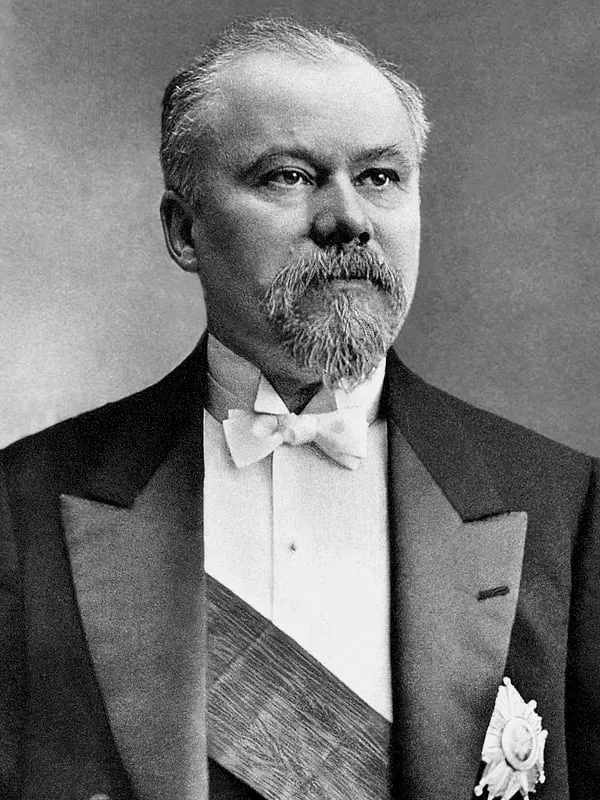
- Born:
- 20 August 1860, Bar-le-Duc (France)
- Died:
- 15 October 1934, Paris
- Author:
- Natalia
- Photo:
- Braun, domena publiczna, Wikimedia Commons

Raymond Poincaré was one of the most important politicians of the French Third Republic. He was President of France throughout the First World War, and in 1917, although he could not stand the man, he entrusted the government to Georges Clemenceau. After the war, as prime minister, he became the symbol of the policy of strict enforcement of the Treaty of Versailles: in January 1923 he ordered French and Belgian troops to occupy the Ruhr in order to force Germany to pay reparations. The operation brought Germany to the brink of disintegration, but it isolated France, and its failure set French policy on the road of concessions. As prime minister in 1926–1929, Poincaré saved the franc and balanced the budget. To the Germans and to Soviet propaganda he was “Poincaré-la-guerre”, a revanchist guilty of the war. To the French he was an honest, cool-headed lawyer who defended the state and its currency.
Lorrainer and lawyer
Raymond Nicolas Landry Poincaré was born on 20 August 1860 in Bar-le-Duc, in the Meuse department of Lorraine, into a well-to-do bourgeois family. His father was an engineer in the roads and bridges service, one brother, Lucien, was a physicist, and his cousin Henri Poincaré was one of the most eminent mathematicians of his day. As a ten-year-old boy he lived through the Franco-Prussian War: Prussian soldiers occupied his family’s house, and France lost Alsace and part of Lorraine. That defeat shaped his patriotism for the rest of his life.
He studied law in Paris and became a successful barrister. In 1887, as one of the youngest deputies, he entered the Chamber of Deputies for the Meuse, and in the 1890s he was successively Minister of Education and Minister of Finance. He belonged to the moderate, secular centre, then known as the Progressists, and in 1902 he was one of the founders of the centre-right Democratic Republican Alliance. In the Dreyfus affair he eventually came out in favour of a review of the verdict. From 1903 he was a senator, and in 1909 he was elected to the Académie française. He was regarded as an outstanding orator and an expert on finance, but also as cold, pedantic and reserved.
Prime minister and president
In January 1912, after the Moroccan crisis, Poincaré became head of the government and at the same time took over the Foreign Ministry. He pursued a policy of firmness towards Germany, strengthened the entente with Britain and the alliance with Russia, and in the summer of 1912 visited St Petersburg. His foreign policy was essentially defensive: he wanted France and Russia to be strong enough to deter Germany from war. In January 1913 the National Assembly elected him president, despite the opposition of part of the left led by Georges Clemenceau, who never forgave him for it. He took office on 18 February 1913. Unlike his predecessors, he wanted to be an active president, especially in foreign and military policy. He supported the law extending military service to three years.
In July 1914 Poincaré and the prime minister, René Viviani, were on a visit to Russia and held talks with Tsar Nicholas II. Vienna deliberately delivered its ultimatum to Serbia only after they had left, while they were sailing back to France. When war broke out, Poincaré, in his message to parliament on 4 August, called on the French to form a “sacred union” (union sacrée) of all parties in the face of the enemy. In the first years of the war military decisions lay in the hands of the Commander-in-Chief, Joseph Joffre, and the president complained in his diary that he was a ruler without power. He nevertheless often travelled to the front, presided over the Council of Ministers and mediated between governments, generals and allies. On 4 June 1917 he signed the decree creating an autonomous Polish army in France.
In November 1917, at the moment of France’s deepest crisis, Poincaré made the most important choice of his presidency: he entrusted the government to his enemy Clemenceau, judging that only he could lead the war to victory. Clemenceau governed energetically and seldom took the president into account. Poincaré considered the Armistice of Compiègne premature, because he wanted the armies to advance deeper into Germany. On 18 January 1919 he opened the Paris Peace Conference. Together with Marshal Ferdinand Foch he demanded that the left bank of the Rhine be detached from Germany, or at least that the Rhineland be occupied for a long period. Foch urged him to take matters into his own hands, but Poincaré, although he considered resigning, accepted the compromise negotiated by Clemenceau and written into the Treaty of Versailles. His term ended on 18 February 1920.
“Germany will pay”
While still president, Poincaré secured a seat as senator for the Meuse. He wrote newspaper articles criticising successive governments for treating Germany too leniently over reparations. In January 1922, when the prime minister, Aristide Briand, resigned after being criticised for his conciliatory stance at the Cannes conference, President Alexandre Millerand entrusted the government to Poincaré. On 15 January 1922 he became prime minister and foreign minister.
He believed that the Treaty of Versailles was France’s only guarantee of security, and that if Germany could ignore its obligation to pay reparations with impunity, it would soon ignore disarmament and the borders too. France needed money to rebuild its devastated northern departments and to repay its war debts to the United States and Britain. The British under David Lloyd George wanted to reduce reparations and revive trade with Germany. When Germany and Soviet Russia signed the Treaty of Rapallo in April 1922, Poincaré saw it as proof that Berlin wanted to blow apart the Versailles order and that London refused to see it. In a speech at Bar-le-Duc on 24 April 1922 he announced publicly for the first time that France might act alone. To German requests for a moratorium he replied that he would agree only in exchange for “productive pledges”, meaning control over German mines and forests.
When the Reparation Commission declared Germany in default on deliveries of timber and coal, Poincaré made his decision. On 11 January 1923 French and Belgian troops marched into the Ruhr. Germany responded with passive resistance, which it financed by printing money, leading to hyperinflation. Poincaré did not give way: he rejected German offers of talks for as long as the resistance continued. On 26 September 1923 the government of Gustav Stresemann capitulated and declared an end to the resistance. It was a triumph for Poincaré, but a short-lived one. The French occupation authorities supported the Rhineland separatists, and historians still debate how far the prime minister himself wanted to detach the Rhineland permanently from the Reich. Some scholars believe that his aims were moderate and that he was concerned above all with the enforcement of the treaty; others point to plans for a special status for the Rhineland and the Ruhr, similar to that of the Saar.
Victory came at a high price. The occupation isolated France, made it look like a militaristic power in British and American eyes, and the franc, weakened by the budget deficit, began to lose value rapidly. At the turn of 1923 and 1924 Poincaré had to agree to the reparations question being examined by an international committee of experts chaired by the American Charles Dawes. At the beginning of 1924, to save the currency, he raised taxes by 20 per cent and obtained a loan from the American bank J.P. Morgan. The tax rises sealed the defeat of his camp in the elections of 11 May 1924, which were won by Édouard Herriot’s left-wing Cartel des Gauches. On 1 June Poincaré resigned. A few weeks later Herriot’s government agreed in London to the Dawes Plan and to the withdrawal of troops from the Ruhr within a year.
Saving the franc
The Cartel des Gauches could not cope with the public finances. In July 1926 the franc was falling day by day and governments were collapsing every few weeks. On 23 July 1926 the 65-year-old Poincaré formed a government of national unity that included six former prime ministers. He took the Finance Ministry himself and left foreign affairs to Briand, who continued the policy of reconciliation with Germany begun at Locarno. The mere news of his return strengthened the franc. The government raised taxes, cut spending and balanced the budget, and capital began to flow back into the country. A law of 25 June 1928 fixed the currency’s new value: the so-called Poincaré franc was worth roughly a fifth of the pre-war franc in gold. This meant a devaluation, but one that recognised the real exchange rate and, above all, put an end to inflation. Poincaré’s camp won the elections of April 1928. In these years France enjoyed a brief period of prosperity, and its strong, gold-backed currency and large gold reserves meant that the Great Depression reached it later than other countries.
The author of the Ruhr occupation now accepted a policy he did not share: in 1928 Briand signed the Kellogg–Briand Pact, and the talks on the Young Plan opened the way to an early evacuation of the Rhineland. Poincaré no longer cherished the illusion that France could compel Germany’s obedience on its own. In July 1929, ill and exhausted and facing an operation, he resigned. He never returned to government.
Last years
He remained a senator for the rest of his life. He wrote his ten-volume memoirs, Au service de la France (In the Service of France), one of the most important sources for the history of French policy in 1912–1918, in which he defended himself against the charge of having dragged Europe into war. He watched the rise in Germany of Adolf Hitler’s movement, which invoked the Ruhr occupation and the Versailles “diktat” in every speech. On 9 October 1934 in Marseille, in an assassination organised by Croatian Ustaše and Macedonian terrorists, King Alexander I of Yugoslavia and the French Foreign Minister, Louis Barthou, a friend of Poincaré’s who had been trying to build a system of alliances against Germany, were killed. Six days later, on 15 October 1934, Poincaré died in Paris of a pulmonary embolism. After a state funeral in Paris he was buried in the family grave at Nubécourt in the Meuse.
Assessment
Throughout the interwar years Poincaré was a contested figure. German, Soviet and French communist propaganda portrayed him as a Lorraine revanchist who in St Petersburg in 1914 had encouraged Russia to go to war. Most historians reject this claim. His biographer John Keiger regards his pre-war policy as essentially defensive, although others, such as Christopher Clark, point out that his assurances of loyalty to Russia may have emboldened St Petersburg.
The occupation of the Ruhr was the last attempt to enforce the Treaty of Versailles by force. Poincaré won the confrontation with Germany, but lost the battle for international opinion and for the support of his allies. After 1924 France no longer dared to act alone. In 1936, when Hitler remilitarised the Rhineland, the memory of the lonely and costly operation of 1923 was one of the reasons for French passivity. His policy remains a subject of debate: some see it as short-sighted vindictiveness that drove the Germans into the arms of the nationalists, others as the last serious attempt to uphold an order that was then dismantled step by step, without resistance, until 1939.
Sources
Often appears with
People who appear in the same events.