United Kingdom
Alan Brooke
Commander of II Corps BEF (1939–1940), C-in-C Home Forces (1940–1941), Chief of the Imperial General Staff (1941–1946)
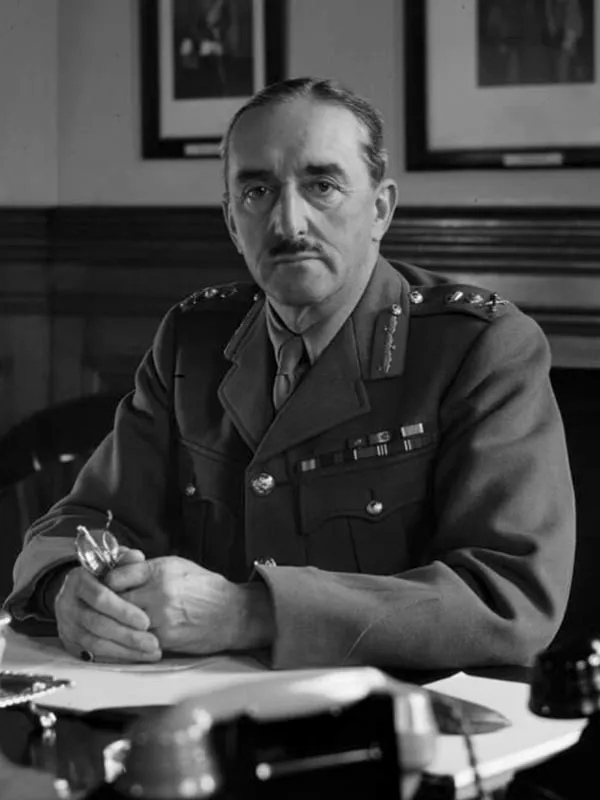
- Born:
- 23 July 1883, Bagnères-de-Bigorre (France)
- Died:
- 17 June 1963, Hartley Wintney (United Kingdom)
- Author:
- Łukasz
- Photo:
- War Office official photographer, domena publiczna, Wikimedia Commons

Alan Brooke was the most important British soldier of the Second World War, even though he did not command a single great victorious battle in it. From December 1941 until the end of the war, as Chief of the Imperial General Staff, he ran the British Army, and as chairman of the Chiefs of Staff Committee he shaped British strategy: North Africa and the Mediterranean first, a landing in France only afterwards. It was he who chose the theatre commanders, Montgomery and Alexander among them, and it was he who for more than three years argued with Churchill every day. His diaries, written in the evenings for his wife, are today one of the most important and most merciless accounts of how the Allies ran the war.
An Ulsterman from the Pyrenees
Alan Francis Brooke was born on 23 July 1883 at Bagnères-de-Bigorre (PL) in the French Pyrenees, the youngest child of Sir Victor Brooke, baronet, of Colebrooke in County Fermanagh (PL). The family belonged to the Protestant gentry of Ulster and had given the Crown soldiers for generations. His father died when Alan was eight, and his mother preferred the mild climate of southern France to that of Ireland, so the boy grew up in Pau (PL). He spoke French earlier and more easily than English, and he also knew German. All his life he spoke very fast, which later irritated some Americans.
He got into the artillery academy at Woolwich with one of the weakest results but passed out high. In December 1902 he was commissioned into the artillery, served in Ireland and India, and in 1906 transferred to the elite Royal Horse Artillery. In 1914 he married Jane Richardson, a neighbour from Fermanagh; a few days after the wedding war broke out.
On the Western Front Brooke made his name as an outstanding planner of fire. At the Battle of the Somme in 1916 he introduced in his division a barrage modelled on French practice that moved forward ahead of the advancing infantry, and in 1917, on the artillery staff of the Canadian Corps, he drew up the fire plan for the assault on Vimy Ridge. He ended the war as a lieutenant-colonel, twice decorated with the Distinguished Service Order.
Between the wars
In 1925 his wife died after a car accident; he had been driving and blamed himself for it for the rest of his life. In 1929 he married Benita Lees, a baronet’s widow, and it was to her that he later wrote his wartime diary. His career advanced quickly. He was a student and then an instructor at the Staff College at Camberley, attended and taught at the Imperial Defence College, where he got to know most of the future commanders of the war, was commandant of the School of Artillery at Larkhill, commanded an infantry brigade, and at the War Office was Inspector of Artillery and Director of Military Training. In 1937 he took over the Mobile Division, the nucleus of Britain’s armoured forces, and in 1938, by then a lieutenant-general, the Anti-Aircraft Corps. He built up good cooperation with the head of Fighter Command, Hugh Dowding, which proved its worth in 1940. In the summer of 1939 he took over Southern Command.
Flanders and France
After the outbreak of war Brooke led II Corps of the British Expeditionary Force to France, with Major-General Bernard Montgomery’s 3rd Division and the 4th Division. From December his chief of staff was Neil Ritchie. During the months of the Phoney War Brooke watched his allies with unease: French units struck him as slovenly and dispirited, and he regarded the commander-in-chief of the BEF, Lord Gort, as a good soldier for detail rather than for strategy. Gort, for his part, considered him a pessimist.
In May 1940 the pessimism proved justified. During the retreat to the sea II Corps beat off a German attack on the Ypres–Comines canal on 27 and 28 May, and when the capitulation of the Belgian army opened a gap on its left flank, Brooke moved Montgomery’s division there in a night march. Closing that gap saved the line of retreat to Dunkirk for a large part of the army (see the Battle of Dunkirk). On 29 May Gort sent him back to England; according to Montgomery, Brooke broke down and wept as he handed the corps over to him.
A few days later he learned that he was to return to France at the head of a re-formed expeditionary force. He landed at Cherbourg on 12 June and quickly concluded that the French army had ceased to exist as an organised force. On 14 June, over the telephone, he persuaded a reluctant Churchill that further divisions sent to France would simply be lost. In Operation Aerial most of the roughly 140,000 British troops still in France were brought out of the French ports, together with many Allied soldiers, Poles among them.
Defending the islands
In July 1940 Brooke replaced General Edmund Ironside as Commander-in-Chief, Home Forces. Against a German invasion he moved away from his predecessor’s concept, based on lines of fortifications inland: the coast was to be held only by a light screen to delay the enemy, and the battle was to be decided by mobile reserves counter-attacking the landing force before it could establish itself. After the war he admitted that he had also intended to use poison gas against the troops coming ashore. For more than a year he trained an army that was to fight on its own soil and tested its commanders in large-scale exercises.
Chief of the Imperial General Staff
At the end of December 1941 Brooke succeeded his friend John Dill as Chief of the Imperial General Staff, the professional head of the army. In March 1942 he also took over the chairmanship of the Chiefs of Staff Committee from Admiral Dudley Pound, and from then on he was the Prime Minister’s principal military adviser. Dill went to Washington and became an invaluable link with the Americans, which Brooke regarded as one of his own best ideas.
The main line of his strategy was first to clear North Africa, open the Mediterranean to shipping and knock Italy out of the war, and only then, once Germany had been weakened in the east and the south, to land across the Channel. This led to fierce disputes with the US Army Chief of Staff, General George Marshall, who wanted to strike at France as soon as possible. At successive conferences, at Casablanca, Washington and Quebec, Brooke largely got his way, although over time the increasingly powerful Americans imposed their own priorities. Critics, among them Max Hastings, believe that he was excessively afraid of the German army and overrated the importance of the Mediterranean theatre; his defenders reply that a landing in France in 1942 or 1943 could have ended in disaster.
Appointments mattered just as much. In August 1942 Brooke flew with Churchill to Cairo. He declined the Middle East command, believing that a new chief of staff would need six months to learn how to work with the Prime Minister. For the Eighth Army he wanted Montgomery, while Churchill wanted William Gott. When Gott was killed on 7 August in an aircraft that was shot down, the army went to Montgomery (see Montgomery takes command of the Eighth Army); Brooke noted that it seemed as if God himself had put a mistake right. He trusted few people, but he could also give a second chance: Ritchie, dismissed after the defeat at Gazala, was given a division by him and later a corps.
Brooke wanted to command the invasion of France himself and was convinced that Churchill had promised it to him three times. In August 1943 at Quebec, however, the Prime Minister told him that since American troops would predominate, the commander would also have to be an American. Brooke considered it one of the greatest disappointments of his life, and he was hurt even more by how lightly Churchill spoke of it. In the end Operation Overlord was commanded by Dwight Eisenhower, whom Brooke valued as a coordinator but not as a strategist. On 1 January 1944 Brooke became a field marshal.
Brooke and Churchill
Their partnership was stormy. Churchill worked late into the night, kept inventing new operations, such as a landing on the northern tip of Sumatra, and put pressure on his generals. Brooke was the only member of the Chiefs of Staff Committee who could consistently stand up to him and defend the plans he considered sound. In his diary he wrote of the Prime Minister now with admiration, now with despair: that he was a genius and at the same time the most difficult man to work with that he had ever met. After one row Churchill complained to General Ismay that Brooke hated him. Brooke replied that he loved him, but that on the day he agreed with him against his own judgement he would cease to be of any use to him. Historians agree that, for all the friction, the pair created the most efficient machinery for directing the war of any of the warring states.
In 1943 Brooke accompanied the Prime Minister to the conferences in Cairo and in Tehran, and in 1945 to Malta and Yalta. Of Stalin he wrote that he had a quick military mind, but also the face of a man who would send people to their deaths without batting an eyelid. After Operation Market Garden in the autumn of 1944 it was to Brooke that Montgomery wrote that the Polish parachute brigade had fought badly, which contributed to the removal of General Stanisław Sosabowski. In March 1945 Brooke crossed with Churchill and Montgomery to the east bank of the Rhine during Operation Plunder, and a few days later, together with the other British Chiefs of Staff, he protested that Eisenhower had, without consulting his allies, given up the drive on Berlin.
The diaries and his reputation
After the war Brooke was made a baron (1945) and then Viscount Alanbrooke (1946); in June 1946 he left the army. He was not well off: with his wife he moved into the gardener’s cottage of his former house at Hartley Wintney (PL), and he sat on the boards of banks and companies. He was Chancellor of the university in Belfast, and at the coronation of Elizabeth II in 1953 he served as Lord High Constable. His greatest passion remained birds: he photographed them and was president of the Zoological Society of London. He died of a heart attack on 17 June 1963 at Hartley Wintney, two years after his daughter had been killed in a riding accident.
In 1957 and 1959 the historian Arthur Bryant published two books based on his diaries, “The Turn of the Tide” and “Triumph in the West”. Despite the cuts they caused a storm: in them Brooke answered Churchill’s memoirs, in which the Prime Minister had claimed many of the staff’s ideas as his own, and judged Marshall, Eisenhower and Alexander harshly. The full edition, prepared by Alex Danchev and Daniel Todman, did not appear until 2001. Today Brooke is regarded as one of the greatest heads of the army in British history. Since 1993 his statue has stood in front of the Ministry of Defence in London, alongside those of Montgomery and William Slim.
Sources
Mentioned in battles
(06)Often appears with
People who appear in the same events.