China
Song Ziwen
Minister of Finance of the Republic of China (1928–1933), Chiang Kai-shek's representative in Washington (1940–1942), Minister of Foreign Affairs (1941–1945), President of the Executive Yuan (1944–1947)
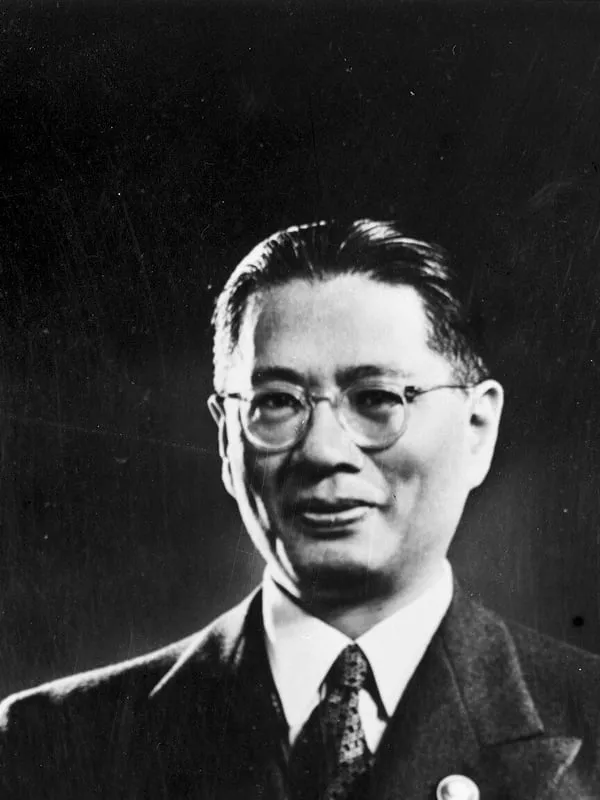
- Born:
- 4 December 1894, Shanghai (China)
- Died:
- 25 April 1971, San Francisco (United States)
- Author:
- Łukasz
- Photo:
- Anefo, CC0, Wikimedia Commons

Song Ziwen, known in the West as T. V. Soong, was the financier who built the modern treasury of the Republic of China and then, throughout the Pacific War, served as China’s most important go-between in Washington. Educated at Harvard, fluent in English and at ease among bankers, Treasury officials and President Roosevelt’s entourage, he turned Chiang Kai-shek’s requests into loans, aircraft and seats at the Allied table. It was he who signed the Declaration by United Nations on China’s behalf, agreed to General Stilwell’s posting and later tried to have him removed, conducted difficult talks with Stalin in Moscow and led the Chinese delegation to the founding conference of the United Nations. He was also the brother of the three most famous sisters in China and the brother-in-law of two of its leaders, and his career shows how far the Kuomintang government was a family affair.
A Methodist’s son
He was born on 4 December 1894 in Shanghai, the son of Charlie Soong, a wealthy Shanghai Methodist who had been educated in the United States and wanted his children to follow the same path. His sisters made great careers in China: the eldest, Ailing, married the banker H. H. Kung; the middle one, Qingling, married the founder of the Kuomintang, Sun Yat-sen; and the youngest, Soong Mei-ling, married Chiang Kai-shek in 1927. After a year at a missionary university in Shanghai, Ziwen went to America, graduated in economics from Harvard University in 1915 and then studied at Columbia University while working at a New York bank. After his return he was secretary of a large mining and iron-and-steel concern at Hanyang and moved in Shanghai’s financial circles.
Nanking’s treasurer
In 1923 Sun Yat-sen brought him to Canton, where Soong ran first the salt monopoly, then a new central bank and, from 1925, the finances of the Nationalist government. After the victory of the Northern Expedition and the move of the capital to Nanking, he became Minister of Finance and Governor of the Central Bank of China in 1928. In those years he unified the currency and taxes, abolished burdensome internal tolls, curbed the deficit and managed to balance the budget. Several times he stood in for the head of government. He quarrelled with Chiang, however, over the money spent on the war against the Communists, which in his view was ruining the budget.
Their sharpest disagreement was over Japan. After the invasion of Manchuria Soong was among the advocates of resistance. In February 1933 he came to Peking with ministers from Nanking and, together with Marshal Zhang Xueliang, gave assurances that China would defend the province of Jehol. A few weeks later the Japanese took Jehol and attacked the passes of the Wall (defence of the Great Wall), and on 31 May the government concluded the Tanggu Truce, which Soong regarded as humiliating. In the autumn of 1933, at odds with Chiang also over the money from an American loan, he resigned as minister. He did not drop out of the game, though: he founded a company which for years afterwards acted as an intermediary for foreign investment in China, and in 1935 he became chairman of the board of the Bank of China.
In December 1936, when Zhang Xueliang held Chiang captive at Xi’an, Soong flew there as one of the first members of the family. Together with his sister Mei-ling and the Communist envoy Zhou Enlai, he negotiated his brother-in-law’s release in exchange for verbal promises to end the civil war. The Xi’an Incident opened the way to a united front against Japan, which went to open war in July 1937.
Chiang’s man in Washington
In the summer of 1940, when China was already in its third year of fighting and France had just fallen, Chiang sent Soong to the United States as his personal representative to President Franklin Delano Roosevelt. America was still neutral, but Soong knew how to exploit its growing hostility towards Japan. He negotiated a series of American loans, and when Congress passed Lend-Lease in March 1941 he pressed for the aid to cover China as well. Together with Claire Chennault he persuaded Washington to let China buy a hundred P-40 fighters and recruit American volunteers to fly them. Thus was born the group that went down in history as the Flying Tigers; its airmen were formally employees of a private company. Soong also boasted that every dispatch American diplomats sent from China reached him within a few days.
In the autumn of 1941, when Secretary of State Cordell Hull was considering a temporary arrangement with Japan, Soong and Chiang’s American adviser warned that the Chinese would regard it as a betrayal. Shortly afterwards Hull handed the Japanese a note that ruled out any compromise (the Hull note).
Foreign minister
After the attack on Pearl Harbor Chiang appointed Soong Minister of Foreign Affairs, on 23 December 1941 according to Chinese sources. Soong did not go to Chungking, however, but stayed in Washington, because that was where decisions were made. On 1 January 1942, in Roosevelt’s study, together with the President, Winston Churchill and the Soviet ambassador Maxim Litvinov, he signed the Declaration by United Nations. China thus took its place among the four great powers of the coalition. On 21 January, on behalf of his government, he agreed that an American general should become chief of Chiang’s Allied staff and command troops in Burma, and his exchange of letters with the Secretary of War, Henry Stimson, defined the duties of Joseph Stilwell (Stilwell in China). From April 1942 he represented China on the Pacific War Council, which met in the White House.
It soon became clear that Stilwell and Chiang could not work together, and Soong sided with his brother-in-law and with Chennault. At the Trident Conference in May 1943 he backed Chennault’s plan to give most of the cargo flown over the Himalayas to the air force, and Roosevelt agreed. In August he took part in some of the talks on China at the Quebec Conference. On 15 September 1943 he handed Roosevelt a memorandum on the “complete reorganisation” of command in the China theatre, which in practice meant removing Stilwell. General George Marshall refused, and in October Chiang himself, persuaded by the Soong sisters and Admiral Mountbatten, made his peace with Stilwell (Chiang demands Stilwell’s recall). Historians also link this turn to the sisters’ rivalry with their brother for influence over the Generalissimo.
Premier in the year of victory
In December 1944 Soong took over from Chiang the duties of President of the Executive Yuan, that is head of government, and in 1945 he assumed the office formally. That spring he led the Chinese delegation to the San Francisco conference and was one of its four presiding chairmen, alongside Anthony Eden, Vyacheslav Molotov and the American Secretary of State Edward Stettinius. The conference adopted the United Nations Charter, and China received a permanent seat on the Security Council of the new organisation.
At the same time Soong had to deal with arrangements nobody had asked China about. At the Yalta Conference Roosevelt had promised Stalin ports and railways in Manchuria and the preservation of the status quo in Outer Mongolia in return for the Soviet Union’s entry into the war against Japan. In June 1945 President Harry Truman confirmed the content of these commitments to Soong, and on 30 June Soong began talks in Moscow with Joseph Stalin and Molotov. He bargained hard and invoked American backing, but Stalin demanded formal recognition of Mongolia’s independence, a wide military zone around Port Arthur and the upper hand in running the railways. Soong did not want to put his own name to such concessions: at the end of July he handed the foreign ministry over to Wang Shijie, although he went on leading the delegation. The negotiations were completed in August, when the Red Army was already advancing in Manchuria, and the Sino-Soviet treaty was signed by Wang on 14 August. China agreed to most of the Soviet demands in exchange for a promise that Moscow would support only Chiang’s government and not Mao Zedong’s Communists.
Fall and exile
After the war Soong’s government failed to master inflation. When in early 1947 the sale of gold reserves did not stop the currency’s slide, an avalanche of criticism fell on Soong: rivals in the Kuomintang and the press accused him of “bureaucratic capitalism”, meaning the enrichment of his family through state posts. On 1 March 1947 he resigned. From September 1947 to January 1949 he was governor of Guangdong province. After the defeats in the Chinese Civil War he left in 1949, travelling via Hong Kong and Europe to the United States, and settled in New York. He belonged to the circle of people who lobbied in America for support for the government on Taiwan. He died on 25 April 1971 in San Francisco, having choked during dinner at the home of a banker he knew. He was buried near New York.
Assessment
Soong was one of the ablest men around Chiang Kai-shek: as finance minister he gave China its first modern treasury and currency, and during the war he managed to obtain more for his country in Washington than its real strength warranted. His position depended, however, on the whims of his brother-in-law, with whom he quarrelled many times, and on the rivalry with the Kung family. Chinese Communist propaganda made him a symbol of the families that grew rich at the state’s expense, and in America stories circulated about his enormous fortune. Some historians regard these accusations as largely political and exaggerated. His archive, given after his death to the Hoover Institution at Stanford University, is one of the most important sources for the history of the Chinese–American alliance.
Sources
Mentioned in battles
(01)Often appears with
People who appear in the same events.