United States
George Marshall
Chief of Staff of the United States Army (1939–1945), member of the Combined Chiefs of Staff (1942–1945), US Secretary of State (1947–1949) and Secretary of Defense (1950–1951)
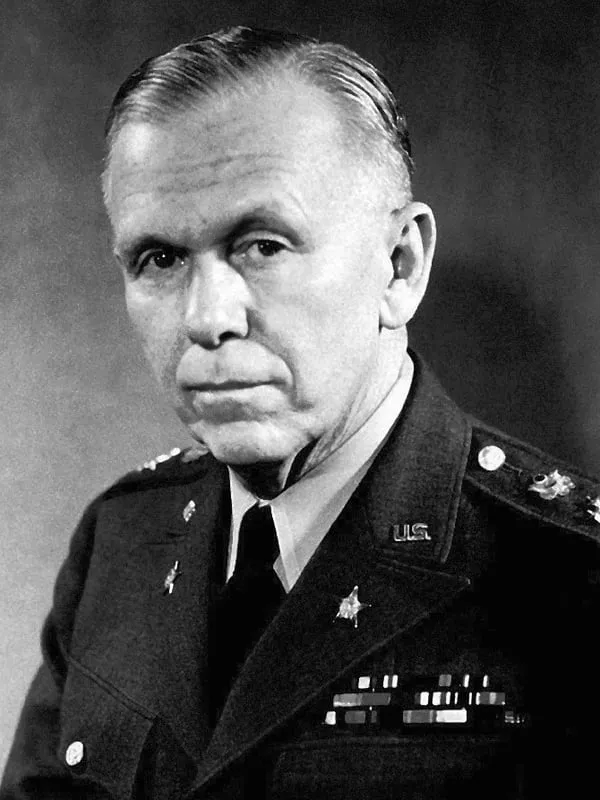
- Born:
- 31 December 1880, Uniontown (Pennsylvania, United States)
- Died:
- 16 October 1959, Washington (United States)
- Author:
- Łukasz
- Photo:
- autor nieznany, domena publiczna, Wikimedia Commons

George Catlett Marshall commanded no army in the field in the Second World War, yet many historians regard him as the most important American soldier of that war. He became Chief of Staff of the United States Army on the day Germany invaded Poland, and for six years he built, trained and equipped land and air forces which in 1939 were smaller than the armies of many middling European states and by 1945 numbered more than eight million men. In Washington and at the Allied conferences he was the most consistent advocate of the principle that Germany had to be beaten first, and by a blow across the Channel. It was he who chose the commanders, among them Eisenhower, Bradley and Patton. Winston Churchill called him the “organiser of victory”. After the war, as Secretary of State, he gave his name to the programme for rebuilding Europe, and he remains the only general of the American army to have received the Nobel Peace Prize.
Virginia cadet and Pershing’s staff officer
He was born on 31 December 1880 in Uniontown (PL) in western Pennsylvania, the son of the owner of a coal business. He did not go to West Point but to the Virginia Military Institute, from which he graduated in 1901 as first captain of the corps of cadets. In February 1902 he was commissioned a second lieutenant of infantry and sailed for the Philippines, where the war against the Filipino insurgents was still going on. In 1907 and 1908 he was the top graduate of the courses at Fort Leavenworth and stayed on there as an instructor. In the peacetime army, however, promotion came very slowly.
After the United States entered the First World War in 1917 he sailed to France as operations officer of the 1st Infantry Division. He planned the attack at Cantigny in May 1918, the first successful American assault of the war, and in the summer moved to the general staff of the American Expeditionary Forces and to the staff of the First Army. In the autumn he organised the transfer of several hundred thousand men from the dying battle of Saint-Mihiel to the front of the Meuse-Argonne offensive within a couple of weeks. Among his fellow officers he earned the nickname “the wizard”. From 1919 to 1924 he was aide-de-camp to the commander-in-chief John Pershing, who became his patron.
Between the wars
From 1924 to 1927 he served in China, with the 15th Infantry Regiment in Tianjin, and learned the basics of Chinese there. In 1927 his first wife, Elizabeth (Lily) Coles, died. In the same year he became assistant commandant of the Infantry School at Fort Benning, where for five years he changed the way officers were trained: he made them issue short, simple orders and act on incomplete information, as in real war. According to his biographers some two hundred future generals passed through Benning in those years as students or instructors, and Marshall noted down the names of the ablest. Omar Bradley was one of them. In 1930 he married a widow, Katherine Tupper Brown.
He spent the 1930s in posts regarded as career dead ends. He commanded a regiment in Georgia and camps of the Civilian Conservation Corps, which gave work to young unemployed men during the Great Depression; for three years he was instructor to the Illinois National Guard in Chicago; and in 1936, as a brigadier general, he took over the 5th Infantry Brigade at Vancouver in Washington State. In July 1938 he was brought to Washington, to the War Plans Division, and in the autumn he became Deputy Chief of Staff. His biographers describe a meeting at the White House in November 1938 at which he alone openly contradicted President Franklin Delano Roosevelt, who wanted to build aircraft without the men and the support needed to operate them. Those present thought he had finished his career. The opposite happened: Roosevelt chose him as Chief of Staff, passing over dozens of generals senior to him.
Chief of Staff: building the army
On 1 July 1939 Marshall became acting Chief of Staff, and he formally took office on 1 September 1939, the day of the German attack on Poland. The regular army then numbered about 190,000 men, had obsolete weapons and almost no large formations. For two years Marshall worked on Congress and public opinion, often ahead of a cautious President. Together with the Secretary of War, Henry Stimson, with whom he worked in exceptional harmony, he backed the first peacetime draft in September 1940, and in August 1941 he won the extension of the draftees’ service; the House of Representatives passed it by a single vote. He sent home older officers he considered unfit to command in war and promoted younger men in their place, men who had proved themselves in the great Louisiana manoeuvres of 1941.
The day of the attack on Pearl Harbor weighs on Marshall too. On the morning of 7 December 1941, after reading an intercepted Japanese note, he sent a warning to the commands in the Pacific, but the message to Hawaii went by ordinary commercial telegraph and arrived after the raid. Congressional committees criticised him for slowness and for a poor grasp of the state of readiness in Hawaii, though they laid the main blame on the commanders on the spot.
Coalition strategy
At the Arcadia Conference in December 1941 Marshall pushed through the principle of unity of command: in each theatre the land, sea and air forces of all the Allies were to come under a single commander. The conference gave rise to the Combined Chiefs of Staff and, in Washington, to the Joint Chiefs of Staff, in which Marshall was the leading figure alongside the head of the Navy, Ernest King. In March 1942 he carried out a reorganisation of the War Department: in place of dozens of offices reporting directly to him there were now three great commands – the Ground Forces, the Air Forces and the Services of Supply – while planning passed to the Operations Division, headed by Dwight Eisenhower. He brought the chief of the Army Air Forces, Henry Arnold, into the Joint Chiefs as a full member.
From the spring of 1942 Marshall wanted to concentrate troops in Britain and land in France, if necessary with limited forces as early as 1942. The British regarded this as suicide, and in July 1942 Roosevelt settled the dispute in their favour and chose a landing in North Africa. Marshall accepted the decision loyally but believed to the end that operations in the Mediterranean were putting off the decisive blow. At the conferences that followed, in Casablanca, Washington and Quebec, he argued with the Chief of the Imperial General Staff, Alan Brooke, over Sicily, Italy and the date of the invasion. In Washington his closest British partner was Field Marshal John Dill; the friendship between the two men softened many of these disputes.
Marshall also dealt with the Pacific and Asia. In March 1942 he secured the Medal of Honor for Douglas MacArthur, evacuated from the Philippines, although he himself had many reservations about him. He sent Joseph Stilwell to China and defended him for years against Chiang Kai-shek, until in October 1944 Roosevelt gave way and recalled the general. From 1941 Marshall belonged to the small group directing the American atomic programme.
Overlord and the last years of the war
When in 1943 the invasion of France became certain, it was widely expected that Marshall would command Operation Overlord. He wanted it badly but did not ask. In December 1943, after the Tehran Conference, Roosevelt decided that he needed Marshall in Washington and named Eisenhower to command the invasion. According to accounts, the President told Marshall that he could not sleep easily with him out of the country. Marshall accepted this without a word of complaint and went on directing the supply of all the theatres of war from Washington.
Not all his decisions have stood up. Faced with a choice between more divisions and more men for industry and the air forces, in 1943 he halted the expansion of the army at 90 divisions and made good losses with individual replacements rather than by rotating whole units. Historians point out that this system harmed the cohesion of units, and in the winter of 1944 the divisions began to run short. He was also criticised for backing Lloyd Fredendall, whose corps was defeated at the Kasserine Pass.
On 16 December 1944 Marshall became the first to receive the newly created five-star rank of General of the Army. He took part in the Yalta Conference and at Potsdam. In the summer of 1945 he approved the use of the atomic bomb against Japan, having earlier prepared plans for an invasion of the Japanese home islands. On 18 November 1945 he handed over his post to Eisenhower.
Diplomat
He did not rest for long. As early as December 1945 President Harry Truman sent him to China to bring about an agreement between Chiang Kai-shek’s Nationalists and the Communists of Mao Zedong. The mission lasted more than a year and ended in failure; the civil war flared up again. On 21 January 1947 Marshall became Secretary of State. On 5 June 1947, in a speech at Harvard University, he announced American aid for the rebuilding of Europe, which went down in history as the Marshall Plan. Moscow rejected it and forced the states of its sphere of influence, Poland and Czechoslovakia among them, to do the same. In 1950–1951, during the Korean War, he was Secretary of Defense and took part in the decision to recall MacArthur. Senator Joseph McCarthy accused him at the time of having “lost China” and of something close to treason.
Assessment
In 1953 Marshall received the Nobel Peace Prize (PL). He died on 16 October 1959 in an army hospital in Washington and was buried in Arlington National Cemetery, where fifteen years earlier, thanks to his efforts, John Dill had been laid to rest. Historians value him above all as an organiser: a man able to build a great army within a few years, choose its commanders and keep the confidence of the President, Congress and the Allies. His insistence on the invasion of France caused years of argument with the British, but in the end it was in Normandy, in the summer of 1944, that the war in the west was decided. The weak points of his legacy – the replacement system, the delayed warning of 7 December 1941, the failed China mission – did not overshadow the opinion expressed by Truman, who called him the greatest living American.
Sources
Mentioned in battles
(04)Often appears with
People who appear in the same events.
On the timeline
(70)1940
1941
February
March
June
July
August
October
November
December
- 22
- The landing at Lingayen GulfOn 22 December 1941 the main body of General Homma's 14th Army landed at Lingayen Gulf on Luzon. Next day MacArthur decided to fall back to Bataan.
- The Arcadia ConferenceOn 22 December 1941 Churchill arrived in Washington to confer with Roosevelt. They agreed on “Germany first” and set up a joint Allied command.
1942
February
March
May
- 06
- The fall of CorregidorOn 6 May 1942, after a Japanese landing, Wainwright surrendered Corregidor. Homma forced him to extend it to all US and Filipino forces in the islands.
- Stilwell's walk out of BurmaOn 6 May 1942 General Joseph Stilwell abandoned his vehicles and led 114 people on foot from Burma to India. Two weeks later all reached Imphal alive.
June
- 18
- The Manhattan Project beginsOn 18 June 1942 Colonel James C. Marshall was ordered to organise the military side of the American atomic programme. So the Manhattan Project was born.
- Churchill in WashingtonOn 18 June 1942 Churchill flew to Washington for talks with Roosevelt. Before leaving he named Anthony Eden to the King as his successor.