Czechoslovakia
Emil Hácha
President of the Supreme Administrative Court (1925–1938), President of Czecho-Slovakia (1938–1939), President of the Protectorate of Bohemia and Moravia (1939–1945)
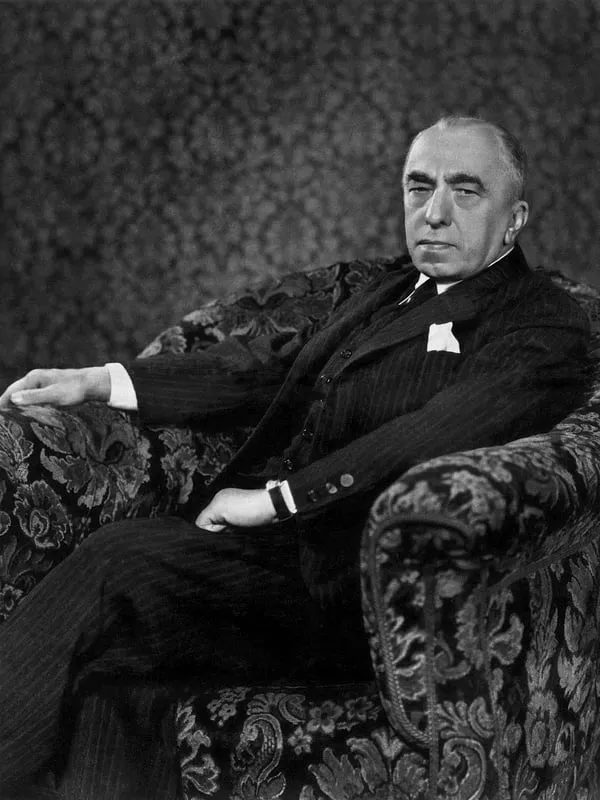
- Born:
- 12 July 1872, Trhové Sviny (Bohemia, Austria-Hungary)
- Died:
- 27 June 1945, Prague (Czechoslovakia)
- Author:
- Natalia
- Photo:
- ateliér Langhans / Viktor Meisner (1883–1950), domena publiczna, Wikimedia Commons

Emil Hácha was a distinguished jurist who never sought power, yet became one of the most tragic figures in Czech history. Elected president of a truncated Czecho-Slovakia two months after the Munich Agreement, he was meant to steer the state through a time of crisis. Instead, on the night of 14–15 March 1939, intimidated by Adolf Hitler and Hermann Göring, he signed a declaration in Berlin that gave the Germans a pretext for occupying Bohemia and Moravia. For six years of occupation he was President of the Protectorate of Bohemia and Moravia, at first trying to defend what remained of Czech self-government, then, increasingly ill, serving as a tool of German propaganda. He died in a Prague prison a few weeks after the liberation. To some he was a traitor; to others, a man who took disgrace upon himself to spare his nation bloodshed.
A lawyer from southern Bohemia
He was born on 12 July 1872 in Trhové Sviny in southern Bohemia, the son of a tax official. He attended the grammar school in České Budějovice and studied law at the Czech university in Prague, where he received his doctorate in 1896. He worked in the provincial administration of the Kingdom of Bohemia, and in 1902 he married Marie Klausová. A year later their only daughter, Milada, was born. He knew several languages. Together with his brother he translated Jerome K. Jerome’s “Three Men in a Boat (To Say Nothing of the Dog)” into Czech; he wrote poetry, collected paintings and walked in the Alps.
During the First World War, from 1916, he was a counsellor of the Administrative Court in Vienna, the supreme administrative court of the Austrian half of the monarchy. After Czechoslovakia came into being in 1918 he helped to establish its Supreme Administrative Court and became its vice-president. He lectured at Charles University, co-edited a major dictionary of Czechoslovak public law and was regarded as one of the country’s leading experts on English and international law. He was a member of the Permanent Court of Arbitration in The Hague. In 1925 President Tomáš Masaryk appointed him president of the Supreme Administrative Court. As a judge he kept his distance from politics. He was a devout Catholic and a conservative, loyal to any lawful government in the manner of the British civil service.
President after Munich
In February 1938 his wife died, a loss he felt deeply. He was 66, had a heart condition and was thinking of retirement when, in the autumn of 1938, an offer he had not expected fell upon him. After Munich, President Edvard Beneš resigned on 5 October and left the country. Politicians were looking for a candidate who bore no responsibility for the disaster, who would be acceptable to Czechs and Slovaks, to right and left, and – no less important – who would not irritate Berlin. The chairman of the Party of National Unity, Rudolf Beran, proposed Hácha. He refused for a long time, pointing to his age and health. He is said to have told a colleague that they wanted to make him the receiver of a bankrupt estate. In the end he gave way, on condition of a two-year term. On 30 November 1938 the National Assembly elected him, by 272 votes out of the 312 members present, president of a state that had just adopted the name of the Czecho-Slovak Republic.
On 1 December he appointed the government of Rudolf Beran, which received powers from parliament to rule by decree. The Second Republic became a state of “authoritarian democracy”: it banned the communists, restricted the press and, under German pressure, introduced the first measures directed against Jews. In foreign policy it tried at all costs not to give Hitler a pretext. Hácha personally did not believe in the idea of a single Czechoslovak nation, but he defended the unity of the state. When the autonomous Slovak government of Jozef Tiso held talks with the Germans about independence, on the night of 9–10 March 1939 Hácha dismissed it and sent the army into Slovakia. For Hitler this was the pretext he had dreamed of. On 14 March, after Tiso had been summoned to Berlin, the diet in Bratislava proclaimed the Slovak State.
A night in Berlin
That same day Hácha, on the advice of the British minister, asked for a meeting with Hitler and travelled to Berlin by train together with the Foreign Minister, František Chvalkovský, and his daughter. He believed he would save at least the Czech part of the state. He did not know that German troops had already entered Moravia near Ostrava that evening, and that the final deadline for the invasion had been set for six in the morning. Hitler received him only at around 1 a.m. on 15 March, after several hours’ wait, and announced that the German army would enter Bohemia at dawn. If the Czechs did not resist, they would receive autonomy; if they did, they would be crushed.
Over the following hours Göring and Joachim von Ribbentrop threatened that the Luftwaffe would bomb Prague. Hácha fainted, and Hitler’s doctor gave him an injection. At around 4 a.m., after a telephone call to Prague in which he ordered the army not to resist, he signed a declaration that he “confidently placed the fate of the Czech people and country in the hands of the Führer”. According to his own note of 20 March, he deluded himself that the occupation would prove temporary and that the Czech lands would keep their autonomy. He returned to Prague on a train that was deliberately held up, so that Hitler was already waiting for him at Prague Castle (Hradčany). The next day the creation of the Protectorate was proclaimed from the castle.
President of the Protectorate
Hácha remained in office as “State President” of the Protectorate, subordinate to the Reich Protector, Konstantin von Neurath. He believed that his presence would preserve something of Czech statehood and keep both the Czech fascists and German governors from power. On 21 March 1939 he dissolved parliament and set up the only permitted political organisation, National Partnership (Národní souručenství), which almost the entire adult Czech male population joined. On 27 April he appointed as prime minister General Alois Eliáš, who secretly cooperated with the resistance and with Beneš’s government-in-exile. In the first years of the occupation Hácha protested to Neurath against Germanisation, and after the Czech universities were closed in November 1939 he pressed for the release of students deported to camps, in many cases successfully. According to Czech historians he refused to swear an oath of allegiance to Hitler. He also maintained secret contacts with London. At the same time he publicly condemned the policies of the First Republic, and after the fall of France in 1940 he spoke of the “mistaken orientation” of its foreign policy and of outdated liberalism.
The turning point came in September 1941. Hitler judged Neurath too lenient and sent Reinhard Heydrich to Prague. Heydrich had Prime Minister Eliáš arrested; he was sentenced to death and executed in June 1942. Hácha considered resigning but did not do so. In January 1942 he appointed the government of Jaroslav Krejčí, in which the collaborator Emanuel Moravec became Minister of Education – from then on the chief Czech executor of German policy. After the assassination attempt on Heydrich in May 1942, Hácha sharply condemned the assassins and Beneš’s government in a radio address, and on 3 July he headed a great rally of loyalty to the Reich in Wenceslas Square, while terror raged across the country and Lidice and Ležáky had already been razed to the ground. From then on the Germans used him as a symbol of Czech loyalty.
Illness and death
From 1940 Hácha was seriously ill. Progressive arteriosclerosis sapped his strength and his memory. From 1943 he rarely appeared in public and lived mostly at Lány Castle near Prague. Several times he asked to be allowed to step down, but the Germans refused. His speeches were written by Moravec, and by 1944 the President was no longer able to read them out. According to those around him, towards the end of the war he often failed to recognise people and did not know what was happening around him.
After the liberation of Prague, on 13 May 1945, on the orders of the communist Interior Minister Václav Nosek, he was arrested at Lány and taken to the prison hospital at Pankrác. According to accounts, he was humiliated there by the guards. He died on 27 June 1945, before he could be brought to trial. He was buried secretly in Vinohrady Cemetery, in a family grave without his name, which was added only in 1994. Beneš, who had returned to Prague on 16 May, is said to have remarked later that the arrest of a dying old man should never have happened, but he did nothing for him. Post-war proceedings assumed that from the beginning of 1943, because of his illness, he had not been fully responsible for his actions.
Significance
Hácha’s signature of 15 March 1939 did not change the course of events: German troops would have entered Bohemia without it, and their entry had been decided beforehand. It did, however, give Hitler a semblance of legality, which German propaganda exploited by presenting the occupation as “taking under protection” at the request of the Czech president. For the Western powers it meant nothing. It was precisely the seizure of Prague, sanctified by an extorted signature, that convinced London that concessions to Hitler were pointless, and that led to the British guarantee to Poland.
Hácha still divides Czechs today. Communist historiography portrayed him as a traitor and collaborator, part of the emigration as a victim. Modern historians see him as a man who, in a hopeless position, chose what he considered the lesser evil, saved many people’s lives and during the first years of the occupation genuinely shielded Czech self-government, but who by his presence legitimised the occupier’s rule and after 1942, broken by illness and fear, became its instrument. In Czech memory he remains a symbol of the tragic choice between resistance and survival that faced the small nations of Central Europe after Munich.
Sources
Often appears with
People who appear in the same events.
On the timeline
(14)1938
1939
March
- 15
- Key eventGermany occupies Bohemia and MoraviaOn 15 March 1939 the Wehrmacht marched into Bohemia and Moravia, and that night Hitler slept at Prague Castle. Breaking the Munich Agreement ended appeasement.
- Hungary occupies Carpatho-UkraineOn 15 March 1939, as Carpatho-Ukraine proclaimed independence, Hungarian troops advanced on Khust. In three days they took it and reached the Polish border.