Germany
Konstantin von Neurath
Reich Foreign Minister (1932–1938), Reich Protector of Bohemia and Moravia (1939–1943, in practice until 1941)
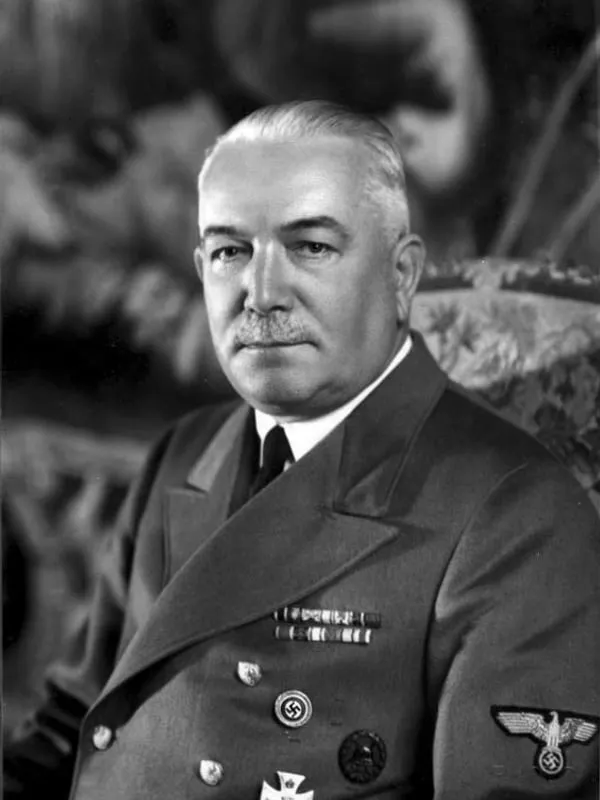
- Born:
- 2 February 1873, Kleinglattbach (Württemberg, German Empire)
- Died:
- 14 August 1956, Enzweihingen (West Germany)
- Author:
- Łukasz
- Photo:
- autor nieznany, CC BY-SA 3.0 DE, Wikimedia Commons

Baron Konstantin von Neurath was a Württemberg aristocrat and a career diplomat of the old school who directed German foreign policy for the first five years of Adolf Hitler’s rule. To foreign governments he was a guarantee that the Reich remained a predictable state, and his presence in the cabinet made it easier for Hitler to leave the League of Nations, remilitarise the Rhineland and dismantle the Versailles order without war. Pushed aside in 1938, when Hitler decided to move faster than Neurath considered safe, he returned a year later as the first Reich Protector in occupied Bohemia and Moravia. The closure of the Czech universities in November 1939 was announced over his signature. To Hitler, however, he proved insufficiently ruthless, and in September 1941 he was in practice replaced by Reinhard Heydrich. At Nuremberg he was sentenced to fifteen years’ imprisonment.
A Württemberg aristocrat
He was born on 2 February 1873 on the family estate of Kleinglattbach near Vaihingen an der Enz in the Kingdom of Württemberg, into a family that had served the kings of Württemberg for generations. His grandfather had been Württemberg’s foreign minister, and his father, a Conservative member of the Reichstag, was a chamberlain at the court in Stuttgart. Neurath studied law in Tübingen and Berlin, did his military service in a Württemberg infantry regiment and in 1898 entered the Württemberg judicial service. In 1901 he married Marie Auguste Moser von Filseck, a banker’s daughter. They had a son, Konstantin, and a daughter, Winifred, who married the diplomat Hans Georg von Mackensen, later the Reich’s ambassador in Rome.
In 1901 Neurath moved to the Reich consular service. From 1903 to 1908 he was vice-consul in London, where he got to know the British elite and learned the language, which later became his greatest asset. Around the turn of 1912 and 1913 he transferred to the diplomatic service. When war broke out he fought as a reserve officer in a Württemberg grenadier regiment and was awarded the Iron Cross, and in the spring of 1915 he became counsellor at the embassy in Constantinople. There he witnessed at first hand the Armenian genocide, to which German diplomacy, shielding its ally, responded with no more than formal reservations. At the end of 1916, at his own request, he left the Reich service and became head of the civil cabinet of King Wilhelm II of Württemberg, serving as his closest adviser until the November Revolution swept away the monarchy.
Envoy of a republic he disliked
In December 1919, with the consent of President Friedrich Ebert, he returned to diplomacy as minister in Copenhagen. From 1921 to 1930 he was ambassador in Rome, where he watched at close quarters the rise to power of Benito Mussolini and the building of the Fascist dictatorship. It did not greatly impress him, but he maintained correct relations with Mussolini. A conservative and a monarchist, he disliked the Weimar Republic and wanted the Treaty of Versailles revised, though by diplomacy rather than force. After the death of Gustav Stresemann in 1929, Paul von Hindenburg wanted him at the head of the Auswärtiges Amt (the Foreign Office), but the appointment fell through in the face of opposition from the coalition parties. In 1930 Neurath became ambassador in London.
Hitler’s minister
When, after Brüning’s dismissal, Hindenburg appointed the presidential cabinet of Franz von Papen in June 1932 – the so-called “cabinet of barons” – Neurath became Foreign Minister as a non-party expert and the President’s man of confidence. He kept the post in the government of Kurt von Schleicher and, from 30 January 1933, in Hitler’s government. The conservatives hoped that together with Papen and Hindenburg they would keep the Nazis in check. Neurath, however, proved an obedient executor. An American diplomat wrote in May 1933 that the baron showed an “extraordinary capacity” for swallowing humiliations from the Nazis.
His ministry carried out the most important moves of the early years. On 19 October 1933, after the Reich had walked out of the Disarmament Conference, Neurath gave notice of Germany’s withdrawal from the League of Nations. On 26 January 1934, with the Polish envoy Józef Lipski, he signed the declaration of non-aggression with Poland. On the morning of 7 March 1936 he handed the ambassadors of France, Britain, Italy and Belgium a memorandum justifying the entry of troops into the Rhineland, and in the following days he assured Hitler that Paris would not risk war. He also signed the German guarantee to Belgium of October 1937. Increasingly, however, he was bypassed by Joachim von Ribbentrop, who with his party bureau concluded the naval agreement with the British, although Neurath had counted on his failure, and who in 1936 prepared the Anti-Comintern Pact, which Neurath viewed with reluctance because he favoured cooperation with China rather than Japan.
Neurath was not opposed to expansion, only to its pace. On 30 January 1937 he accepted the Golden Party Badge from Hitler, which meant joining the NSDAP, and in September of that year he received the honorary rank of SS-Gruppenführer. On 5 November 1937 he was the only participant from outside the armed forces at the secret conference in the Reich Chancellery, at which the Führer set out his plan to win “living space” by force, starting with Austria and Czechoslovakia. Together with Werner von Blomberg and Werner von Fritsch he warned that a war in Central Europe would draw in France and Britain. These were not moral objections but a calculation of risk, yet Hitler drew his conclusions from them. On 4 February 1938, in the course of the Blomberg–Fritsch affair, Neurath lost the ministry to Ribbentrop. Formally he was promoted: he became chairman of the Secret Cabinet Council, which was to advise Hitler on foreign policy but, according to Hermann Göring, never met. He remained a minister without portfolio until the end of the war.
He did not retire into the shadows. During the Anschluss in March 1938, while Ribbentrop was in London, he answered the powers’ protests on behalf of the Reich. In September 1938, in the last days before the Munich conference, he was among those who urged Hitler to accept Mussolini’s mediation, and the draft agreement that the Italian dictator presented at Munich as his own had been prepared in Berlin by Göring, Neurath and the State Secretary Ernst von Weizsäcker. This was how the Munich Agreement came about.
Protector of Bohemia and Moravia
After the occupation of Bohemia and Moravia Hitler appointed Neurath Reich Protector on 18 March 1939. The choice was meant to reassure London and Paris: Prague Castle was now occupied by an aristocrat known for his moderation rather than by a Nazi activist. In April he took over power from the military administration. He was the Führer’s personal representative and stood above the autonomous government of the Protectorate, headed by President Emil Hácha and Prime Minister Alois Eliáš. He introduced press censorship, dissolved political parties and trade unions, and on 21 June 1939 issued a decree on Jewish property that introduced a racial definition of a Jew on the Nuremberg model and opened the way to plunder. Real power in police matters, however, lay with his State Secretary, the Sudeten German Karl Hermann Frank, and the Gestapo answered directly to Berlin.
The first test came in the autumn of 1939. The demonstrations in Prague on 28 October, the anniversary of Czechoslovakia’s founding, ended with the death of a baker’s journeyman, Václav Sedláček, and the shooting of a medical student, Jan Opletal, whose funeral on 15 November turned into another demonstration. On 16 November Hitler summoned Neurath and Frank to Berlin and demanded that resistance be crushed immediately. During the night of 16–17 November the police and the SS raided the Prague student halls of residence (Sonderaktion Prag): nine student leaders were shot without trial, and some 1,200 students were sent to Sachsenhausen concentration camp. A proclamation bearing Neurath’s signature announced the closure of Czech institutions of higher education for three years. In reality they remained closed until the end of the war. Neurath later claimed that the proclamation had been issued without his consent and that Frank had directed the operation. He also sought the release of some of the imprisoned students, sometimes successfully.
In the following months the Protectorate became an industrial base for the Reich, and Czech self-government shrank month by month. In the summer of 1940 Neurath and Frank submitted memoranda to Hitler on the future of the Czech lands, which envisaged the Germanisation of the “racially valuable” part of the Czech population and the removal of the rest. Hitler, however, judged Neurath’s rule too soft in the face of the growing resistance movement. On 27 September 1941 he sent him on leave “for health reasons” and dispatched to Prague as Deputy Protector the head of the Reich Security Main Office, Reinhard Heydrich. Heydrich declared a state of emergency, had Eliáš arrested and within a few weeks brought about hundreds of executions. After Heydrich’s death following the assassination attempt of June 1942, Kurt Daluege became acting Protector. Neurath, still the titular Protector, asked several times to be relieved. In June 1943 he was even promoted to SS-Obergruppenführer, and in August 1943 Hitler accepted his resignation and Wilhelm Frick became Protector.
Nuremberg and the final years
On 6 May 1945 Neurath was detained by the French. He appeared before the International Military Tribunal at Nuremberg (PL) as one of the major defendants. His defence argued that he had acted as a brake on Hitler and Ribbentrop and that in Prague he had moderated Frank’s policies. The tribunal found that as minister he had taken part in preparing aggression and that as Protector he bore responsibility for the crimes committed in the Czech lands, including the execution of students and the deportation of their fellows to camps. It took into account mitigating circumstances: his interventions on behalf of those arrested and his attempt to resign. On 1 October 1946 Neurath was found guilty on all four counts of the indictment and sentenced to fifteen years’ imprisonment.
He served his sentence in Spandau Prison. After a heart attack, and at the request of the Vatican, he was released on 6 November 1954 with the consent of the Soviet Union, which had previously rejected every plea for a reduction of sentences. He spent his final years on the Leinfelder Hof estate near Enzweihingen in Württemberg. He died on 14 August 1956 at the age of 83.
Significance
Neurath was the prime example of the conservative elites who in 1933 believed they would tame Hitler and in practice lent him a trustworthy face. His reputation in London and Rome helped the Reich through its most dangerous years, while it was still weak, and his diplomats handled the formalities of each successive break with Versailles. His objection of November 1937 concerned not the aims but the risk, and it cost him his post. In Prague, despite his reputation for moderation, he lent his name to the persecution of the Jews, the dissolution of Czech political life and the closure of the universities. The Czechs remembered him as the first occupier, under whom their situation seemed bad until Heydrich arrived. The Nuremberg verdict, one of the more lenient, reflects this ambiguity: the tribunal regarded him as a conscious accomplice in crimes, but not as their author.
Sources
Often appears with
People who appear in the same events.