Japan
Harukichi Hyakutake
Commander of the 18th Division (1940–1941) and the 17th Army in the Solomon Islands and New Guinea (1942–1945), lieutenant general
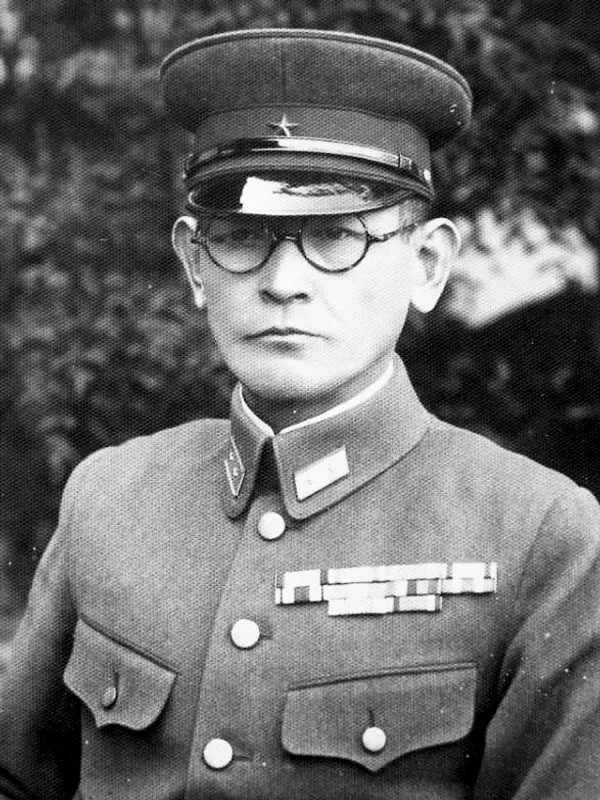
- Born:
- 25 May 1888, Saga Prefecture (Japan)
- Died:
- 10 March 1947
- Author:
- Natalia
- Photo:
- autor nieznany, domena publiczna, Wikimedia Commons

Harukichi Hyakutake commanded the Japanese 17th Army in one of the most important campaigns of the Pacific War: the struggle for the airfield on Guadalcanal, where in 1942–1943 Japan lost the initiative on land. He was a staff officer and signals man who as a young man had learned codebreaking from a Polish cryptologist and lived in Poland for almost two years, rather than a line commander. On Guadalcanal he sent units into battle that were too weak to win, and then an army he could not feed. Later his forces on Bougainville lost the last major Japanese offensive in the Solomon Islands. A stroke ended his service before the war was over.
A cipher man from Saga
He was born on 25 May 1888 in Saga Prefecture (PL) on the island of Kyushu, the sixth son of Niwazō Hyakutake, once a foot soldier in the service of the local lord. Two of his elder brothers, Saburō and Gengo, became admirals in the imperial navy. His given name is sometimes also read as Haruyoshi or Seikichi. In 1909 he graduated from the Military Academy in the 21st class, the same as Kanji Ishiwara, and in 1921 from the Army Staff College.
At the General Staff Hyakutake joined the Russian section and took up ciphers. The Japanese army was then learning cryptology from the Poles, who in the war against the Bolsheviks in 1920 had shown how much could be gained by breaking an enemy’s codes. According to Japanese sources Hyakutake was a pupil of Captain Jan Kowalewski, who in the early 1920s ran a course in Tokyo for Japanese officers. From December 1925 to July 1927 he lived in Poland himself to learn the craft on the spot. On his return he headed the General Staff’s cipher unit.
Between the wars
In August 1931, shortly before the seizure of Manchuria, Hyakutake took over the intelligence post at Harbin, one of the most important facing the Soviet Union. He then worked at the signals school and in the communications section of the General Staff, commanded the 78th Infantry Regiment in 1935 and from 1936 the preparatory school in Hiroshima. In March 1937 he became a major general and commandant of the Army Signals School. In 1939 he commanded the 4th Independent Mixed Brigade in China, in August that year he was promoted to lieutenant general, and from February 1940 to April 1941 he commanded the 18th Division. When the Pacific War broke out he was the army’s inspector of signals.
Guadalcanal
On 18 May 1942 Hyakutake took command of the 17th Army, formed for operations in the South Pacific. His headquarters were first at Davao in the Philippines and from July at Rabaul. The main objective at the time was Port Moresby in New Guinea. The South Seas Detachment of Major General Tomitarō Horii set out in July across the mountains along the Kokoda Track, even though pre-war reports of a road to Port Moresby proved false.
On 7 August 1942 the Americans landed on Guadalcanal and seized the airfield under construction there. Tokyo took it for a raid and put the enemy’s strength at about two thousand men. Hyakutake was ordered to retake the island with whatever he had to hand. The first echelon of Colonel Kiyonao Ichiki’s regiment was almost wiped out at the Tenaru River on 21 August. In September Major General Kiyotake Kawaguchi’s 35th Brigade lost the Battle of Bloody Ridge. Only then did Tokyo grasp that a large army was fighting on the island. Hyakutake, with his superiors’ approval, halted Horii’s advance, which had come within a few dozen kilometres of Port Moresby, and ordered him to withdraw. Guadalcanal took priority over New Guinea.
For October Hyakutake prepared an attack with much larger forces. Convoys and destroyers carried to the island the 2nd “Sendai” Division, part of the 38th Division, heavy artillery and tanks, and on 9 October the general himself arrived on Guadalcanal. He had about 20,000 men, but believed the Americans numbered about 10,000, when there were more than twice as many. The main blow by the 2nd Division was to come out of the jungle from the south. The march through the mountains took longer than planned, the soldiers abandoned their heavy weapons, and the attack broke up into uncoordinated assaults. On the night of 24–25 October Hyakutake reported to Rabaul that his troops had taken the airfield, and a few hours later he had to retract it. The Battle for Henderson Field ended in defeat, and on 26 October the general ordered a retreat.
In November the Japanese tried to bring the rest of the 38th Division to the island, but in the Naval Battle of Guadalcanal most of the transports were sunk. On 9 November the 8th Area Army of General Hitoshi Imamura was set up above the 17th Army, and from then on Hyakutake was responsible only for the Solomons. His soldiers, cut off from supplies, were dying of hunger and malaria; in December he was losing about 50 men a day. At the end of December the decision to evacuate was taken. On 4 February 1943 Hyakutake and the 17th Army staff left the island aboard destroyers; in all about 10,600 soldiers were evacuated, out of almost 30,000 shipped there since August.
Bougainville
After Guadalcanal the 17th Army staff settled on Bougainville, with headquarters at Erventa. When on 1 November 1943 the Americans landed in Empress Augusta Bay near Cape Torokina, Hyakutake at first took it for a diversion before a landing in the south, where his main forces stood. Only at the end of December did his staff become convinced that the Americans were building airfields on the beachhead and meant to stay.
In January 1944 Imamura ordered him to attack. The Japanese hauled through the jungle the largest concentration of artillery they had yet assembled in the Pacific. According to the American official historian John Miller, between 15,000 and 19,000 soldiers were assigned to the attack, mostly from General Masatane Kanda’s 6th Division. Hyakutake put the American strength at about 30,000, too low by half, and was so sure of victory that he set a date for accepting the enemy’s surrender. He called on his soldiers to wipe out the disgrace of Guadalcanal.
The counteroffensive opened with an artillery bombardment on 8 March 1944. For two weeks three assault groups attacked Hill 700, Hill 260 and the positions of the 129th Infantry Regiment. The Americans knew the plan from captured documents, had superiority in artillery and tanks, and quickly sealed every breach in their lines. On 25 March Hyakutake halted the attack, and on 27 March his troops began to withdraw. According to Miller the Japanese lost more than 5,000 killed and more than 3,000 wounded, the Americans 263 killed; other estimates are somewhat lower. Imamura told him to switch to guerrilla warfare and grow his own food.
Stroke and last years
Until the end of the war the 17th Army lived on Bougainville on what it could grow itself, plagued by hunger and disease. Hyakutake suffered a stroke; according to Japanese sources this happened in December 1944, while American ones say that in February 1945 he was replaced by Kanda. There was no way to take him back to Japan. He was formally attached to the 8th Area Army headquarters, and he returned home only in February 1946. He died on 10 March 1947, aged 58, leaving his memoir of Guadalcanal unfinished.
Hyakutake has not gone down in history as an outstanding commander. American historians credit him with helping to create the myth of the Japanese soldier as an invincible jungle fighter, a myth to which he himself finally succumbed, demanding more of his men than any human could bear. On Guadalcanal he threw his forces into battle piecemeal, because he lacked better intelligence and depended on a navy that could not keep him supplied. At Torokina he repeated the same mistakes in worse conditions. In both campaigns his soldiers suffered more from hunger and disease than from enemy fire.
Sources
Commanded in battles
(02)Mentioned in battles
(03)Often appears with
People who appear in the same events.